

NVIDIA Jetson for Edge AI
 Suyash Raizada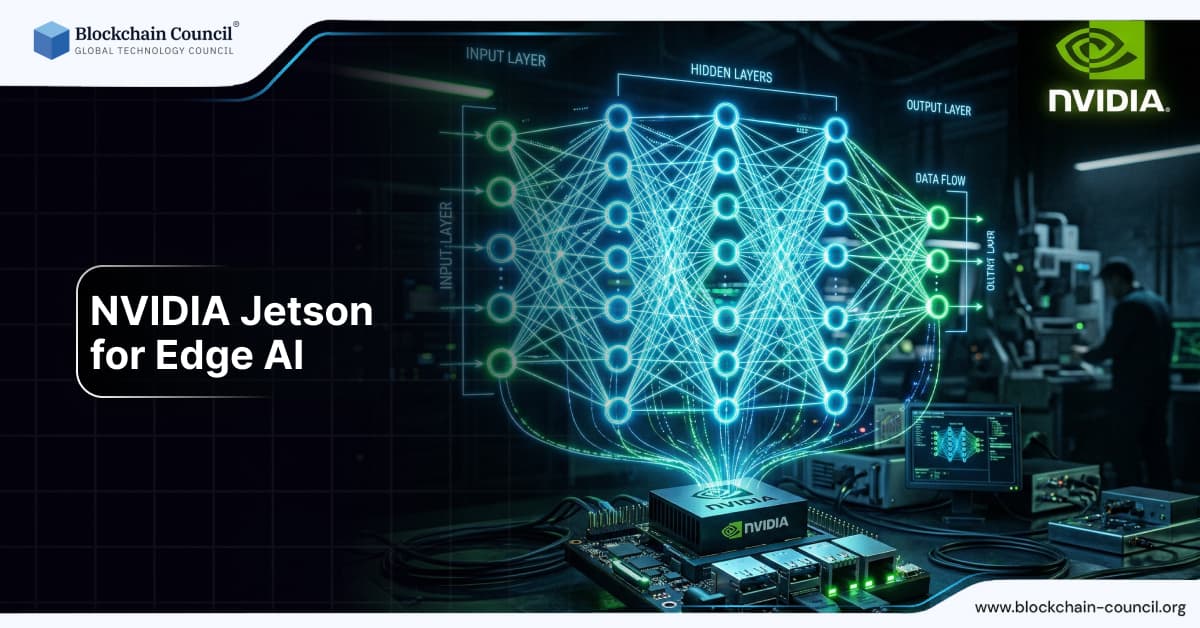
NVIDIA Jetson for edge AI has become a practical path to running modern computer vision and large language models (LLMs) directly on embedded devices. Instead of sending video, audio, and sensor data to the cloud, Jetson modules such as Jetson Orin Nano, Jetson Orin, and the newer Jetson Thor are designed to deliver low-latency inference in compact, power-efficient form factors. This matters for robotics, autonomous machines, industrial inspection, and multimodal assistants where milliseconds, privacy, and reliability directly affect outcomes.
Edge AI requires optimizing models for low-latency inference, limited compute, and real-time processing-build expertise with an AI certification, implement edge pipelines using a Python Course, and explore deployment scenarios via an AI powered marketing course.

Why NVIDIA Jetson for Edge AI Is Gaining Momentum
Edge inference is accelerating for three main reasons: latency, cost, and operational constraints. Many real-world systems cannot tolerate round trips to a data center for perception, planning, or voice interaction. At the same time, cloud GPU capacity and memory constraints can make always-on AI expensive and difficult to scale.
With NVIDIA Jetson for edge AI, teams can deploy AI close to sensors and actuators, enabling:
Lower latency for real-time perception and control loops
Improved privacy by keeping sensitive data on-device
Reduced bandwidth costs by processing video and audio locally
Higher resilience in environments with limited or unreliable connectivity
There is also a broader shift toward open model ecosystems, where developers fine-tune and deploy domain-specific agents locally rather than depending on a single hosted API. Jetson platforms are well-positioned for running open models at the edge, particularly in physical AI scenarios that interact with the real world through cameras, microphones, and robotic arms.
Jetson Platform Overview: Orin Nano, Orin, and Thor
NVIDIA's Jetson lineup spans entry-level generative AI through industrial real-time inference. The specific module choice depends on model size, sensor throughput, and thermal limits, but the ecosystem is unified by a common software stack and deployment tooling.
Jetson Orin Nano 8GB: Accessible Entry Point
Jetson Orin Nano 8GB targets smaller generative AI and edge vision workloads. For developers building speech interfaces, lightweight vision models, or compact multimodal assistants, it offers a cost-effective way to prototype and deploy without requiring data center GPU resources.
Jetson Thor: Real-Time Inference for Industrial and Robotics
Jetson Thor targets industrial robotics and safety-aware, low-latency inference. It supports tools such as vLLM for serving LLMs, including model families like Qwen, Gemma, and Mistral AI. Jetson Thor is capable of supporting models up to 30B parameters, enabling more capable on-device assistants and multimodal reasoning than previous embedded generations could deliver.
Ecosystem Systems: Vision Boxes and Safety-Focused Edge Platforms
Beyond individual modules, partners are shipping production-ready systems that bundle compute, I/O, and sensor synchronization. One example is Darsi Pro, a Jetson-based vision box designed for autonomous mobile robots (AMRs) and intelligent transportation systems (ITS). Reported capabilities include up to 100 TOPS and support for 8 synchronized GMSL cameras with PTP-based time alignment for sensor fusion.
On the safety and industrial side, Jetson Thor variants and related edge inference platforms are increasingly relevant for healthcare, robotics, and digital twin workflows, particularly when paired with simulation and orchestration tools.
Running Computer Vision on Jetson: From Cameras to Sensor Fusion
Computer vision remains the most common edge AI workload because cameras generate high-volume data and often require near-instant decisions. Typical Jetson vision pipelines include:
Video ingest from CSI, USB, or GMSL cameras
Pre-processing for resizing, normalization, and frame batching
Inference for detection, segmentation, pose estimation, or tracking
Post-processing and eventing such as alerts, control commands, and logs
For robotics and ITS applications, the value extends beyond single-camera inference to synchronized multi-sensor fusion. Systems that support time-aligned camera streams can more reliably combine vision with lidar and radar, improving stability in motion planning, obstacle avoidance, and scene understanding.
Real-World Computer Vision Use Cases
AMRs and warehouse robotics: multi-camera perception, aisle navigation, pallet detection, and safety zone enforcement
Industrial inspection: defect detection, counting, OCR, and quality control near production lines
ITS: lane analytics, vehicle classification, traffic monitoring, and incident detection
Healthcare imaging and surgical support: low-latency processing for imaging workflows where delay and downtime carry direct costs
Running LLMs on Embedded Devices: What Changed
Until recently, LLM inference was primarily a data center workload due to compute and memory requirements. Two shifts have made on-device LLMs more practical:
Smaller, more efficient open models that deliver useful reasoning and instruction-following at lower parameter counts
Edge platforms designed for generative AI, enabling higher throughput within embedded thermal and power envelopes
In demonstrations across the Jetson ecosystem, models such as Gemma (including multimodal variants with long context windows) and gpt-oss-20B have been shown running locally on Thor and Orin-class systems. A local voice and text assistant using Qwen3 4B for conversational interaction, paired with on-device speech capabilities, is another documented example of what current hardware can support.
Practical LLM Patterns on Jetson
Production embedded LLM deployments typically differ from cloud chatbot architectures. Common patterns include:
On-device copilots for operators and technicians, combining a small domain-tuned model with retrieval from local documentation
Robotics reasoning components that translate user intent into actions, while safety and control logic remain in deterministic modules
Multimodal assistants that combine camera understanding with speech for in-cab guidance or on-site operator support
These architectures reduce dependency on network connectivity and avoid sending sensitive audio or video streams off-device.
Jetson for Robotics and Physical AI: From Perception to Motion
Robotics is where NVIDIA Jetson for edge AI demonstrates clear advantages, because robots require tight control loops. The ecosystem supports perception-to-motion pipelines that operate entirely onboard, enabling robots to interpret the environment and act in real time.
Examples from recent robotics showcases include:
Franka FR3 running an end-to-end perception-to-motion stack onboard, demonstrating script-free workflows for task execution
Embodied AI prototypes using Thor-class hardware to generalize pick-and-place skills across varied objects and layouts
Humanoid control research where controllers trained on large motion datasets are deployed on Orin platforms
One reported robotics performance figure is a kinematic planner running at roughly 12 ms per pass with a policy loop operating at 50 Hz on Jetson Orin. Metrics like these translate directly into system stability, responsiveness, and safety margins.
Developer Stack: JetPack SDK, Deployment, and Acceleration
A significant factor in Jetson adoption is the software stack. JetPack SDK provides accelerated components and pre-built services for vision, robotics, and geospatial AI workloads. In practice, teams combine JetPack with optimized inference runtimes and model serving tools to build repeatable pipelines from training through to deployment.
Organizations building production edge AI systems benefit from structuring skills across teams:
Computer vision engineering for dataset design, model selection, and evaluation
MLOps and edge deployment for packaging, monitoring, OTA updates, and rollback strategies
Security and safety for device hardening and model governance
Structured certification can help teams standardize these practices. Blockchain Council's Certified AI Engineer and Certified Machine Learning Professional programs address model development skills, while cybersecurity certification tracks support secure edge deployment planning.
Selection Guide: Choosing the Right Jetson Approach
The following considerations help determine an appropriate module or integrated system:
Model size and modality: vision-only models are typically lighter than multimodal LLM assistants; Thor-class hardware targets larger models in the 2B to 30B parameter range
Sensor throughput: multi-camera setups often benefit from integrated vision systems designed for synchronization and sensor fusion
Latency requirements: robotics and industrial control applications favor deterministic, low-jitter inference
Thermal and power budgets: smaller enclosures and fanless designs can limit sustained performance ceilings
Compliance and safety requirements: healthcare and safety-critical environments may require additional platform assurances and formal validation
Future Outlook: Server-Class Inference in Compact Modules
Looking toward 2026 and 2027, the edge AI trajectory is toward more capable models, more sensors, and greater autonomy in smaller devices. Jetson Thor and its successors are expected to bring server-class inference performance into embedded form factors for industrial robotics, AMRs, and extreme-edge deployments including space-grade modules for orbital AI research.
Two practical trends matter for builders planning ahead:
Multimodal edge systems will become standard, combining vision, audio, and structured sensor data with on-device reasoning
Sensor-compute integration will increase as thermal constraints drive tighter coupling between sensors and processing, reducing external system complexity
Deploying AI on Jetson requires model optimization, hardware acceleration, and pipeline integration-develop these capabilities with an Agentic AI Course, deepen ML optimization via a machine learning course, and align solutions with real-world use cases through a Digital marketing course.
Conclusion
NVIDIA Jetson for edge AI now extends well beyond classical computer vision. With Jetson Orin Nano, Orin, and Jetson Thor, embedded development teams can run real-time perception, sensor fusion, and increasingly capable LLM-driven assistants directly on-device. For robotics, industrial automation, ITS, and healthcare-adjacent imaging workflows, the practical benefits are measurable: lower latency, reduced cloud dependency, and more reliable operation in physical environments.
Moving from demonstrations to production deployments requires attention to the full lifecycle: model selection, optimization, secure packaging, monitoring, and iterative improvement. Building that capability in-house is also a skills challenge. Structured learning through programs such as Blockchain Council's AI, machine learning, and cybersecurity certifications can help teams establish consistent best practices for production edge AI.
FAQs
1. What is NVIDIA Jetson for Edge AI?
NVIDIA Jetson is a series of compact computing modules designed for running AI applications at the edge. It enables real-time processing on devices without relying on cloud infrastructure. This is useful for robotics, vision, and IoT.
2. What does edge AI mean in simple terms?
Edge AI refers to running AI models directly on local devices instead of sending data to the cloud. This reduces latency and improves privacy. It is ideal for real-time applications.
3. What are the main Jetson devices available?
Popular models include Jetson Nano, Xavier NX, and Jetson Orin series. Each offers different levels of performance and power efficiency. Selection depends on the application requirements.
4. What are common use cases for NVIDIA Jetson?
Use cases include robotics, autonomous vehicles, smart cameras, and industrial automation. It is also used in healthcare and retail analytics. Jetson supports real-time AI inference.
5. How does Jetson support AI model deployment?
Jetson runs AI models using NVIDIA software like CUDA, TensorRT, and JetPack. These tools optimize performance for edge devices. Deployment is efficient and scalable.
6. What is JetPack SDK?
JetPack is NVIDIA’s software development kit for Jetson devices. It includes libraries, drivers, and tools for AI development. It simplifies setup and development workflows.
7. How does Jetson compare to cloud-based AI?
Jetson processes data locally, reducing latency and bandwidth usage. Cloud AI offers more computing power but depends on connectivity. Edge and cloud often work together.
8. What programming languages are supported on Jetson?
Jetson supports Python and C++ for AI development. These are commonly used with frameworks like TensorFlow and PyTorch. Developers can also use OpenCV for vision tasks.
9. What is TensorRT and why is it important?
TensorRT is a high-performance inference optimizer from NVIDIA. It speeds up AI model execution on Jetson devices. This improves efficiency and reduces latency.
10. Can Jetson run deep learning models?
Yes, Jetson devices are designed for deep learning inference. They support popular frameworks and pretrained models. Performance depends on the specific device.
11. How energy-efficient are Jetson devices?
Jetson devices are optimized for low power consumption. They deliver high performance per watt. This makes them suitable for embedded and mobile applications.
12. What is the role of GPUs in Jetson modules?
Jetson modules include integrated NVIDIA GPUs for parallel processing. GPUs accelerate AI computations significantly. This enables real-time performance.
13. How does Jetson handle computer vision tasks?
Jetson uses libraries like OpenCV and CUDA for image processing. It can perform object detection, tracking, and recognition. These tasks run efficiently on-device.
14. What are the storage and memory options in Jetson?
Jetson devices offer varying RAM and storage configurations depending on the model. External storage can be added if needed. Memory size impacts model performance.
15. How can developers get started with Jetson?
Developers can use developer kits provided by NVIDIA. These kits include hardware and pre-installed software. Tutorials and documentation support quick onboarding.
16. What industries benefit most from Jetson-based solutions?
Industries like manufacturing, agriculture, transportation, and healthcare benefit. Jetson enables automation and real-time insights. It supports edge intelligence across sectors.
17. How does Jetson support robotics applications?
Jetson integrates with robotics frameworks like ROS. It processes sensor data and controls actions in real time. This improves autonomy and responsiveness.
18. What are the limitations of Jetson devices?
Jetson devices have limited compute compared to cloud GPUs. Large models may require optimization. Thermal and power constraints must also be managed.
19. How secure are Jetson-based AI systems?
Jetson supports secure boot, encryption, and access controls. Security depends on system design and implementation. Regular updates and monitoring are important.
20. What is the future of NVIDIA Jetson in edge AI?
Jetson will continue to evolve with more powerful and efficient hardware. Integration with AI frameworks and robotics will expand. Edge AI adoption is expected to grow significantly.
Related Articles
View All
AI & ML
How NVIDIA Cosmos 3 Enables Physical AI and Multi-Agent Workflows
Explore how NVIDIA Cosmos 3 enables Physical AI and agent-based workflows through multimodal reasoning, world simulation, action prediction, synthetic data, and autonomous system development.

AI & ML
NVIDIA Nemotron 3.5 Lightning vs NVIDIA Cosmos 3: Key Differences and Use Cases
Compare NVIDIA Nemotron 3.5 Lightning and NVIDIA Cosmos 3, including their architectures, reasoning capabilities, modalities, performance goals, and use cases across agentic and physical AI.
AI & ML
NVIDIA Cosmos 3 Explained: The Next Generation of Physical AI
Explore NVIDIA Cosmos 3, an open foundation model for Physical AI that combines vision reasoning, world simulation, multimodal generation, and action prediction for robotics and autonomous systems.
Trending Articles
The Role of Blockchain in Ethical AI Development
How blockchain technology is being used to promote transparency and accountability in artificial intelligence systems.

Top 5 DeFi Platforms
Explore the leading decentralized finance platforms and what makes each one unique in the evolving DeFi landscape.
How to Install Claude Code
Learn how to install Claude Code on macOS, Linux, and Windows using the native installer, plus verification, authentication, and troubleshooting tips.