

Major Limitations of Recursive Self-Improvement in AI Development

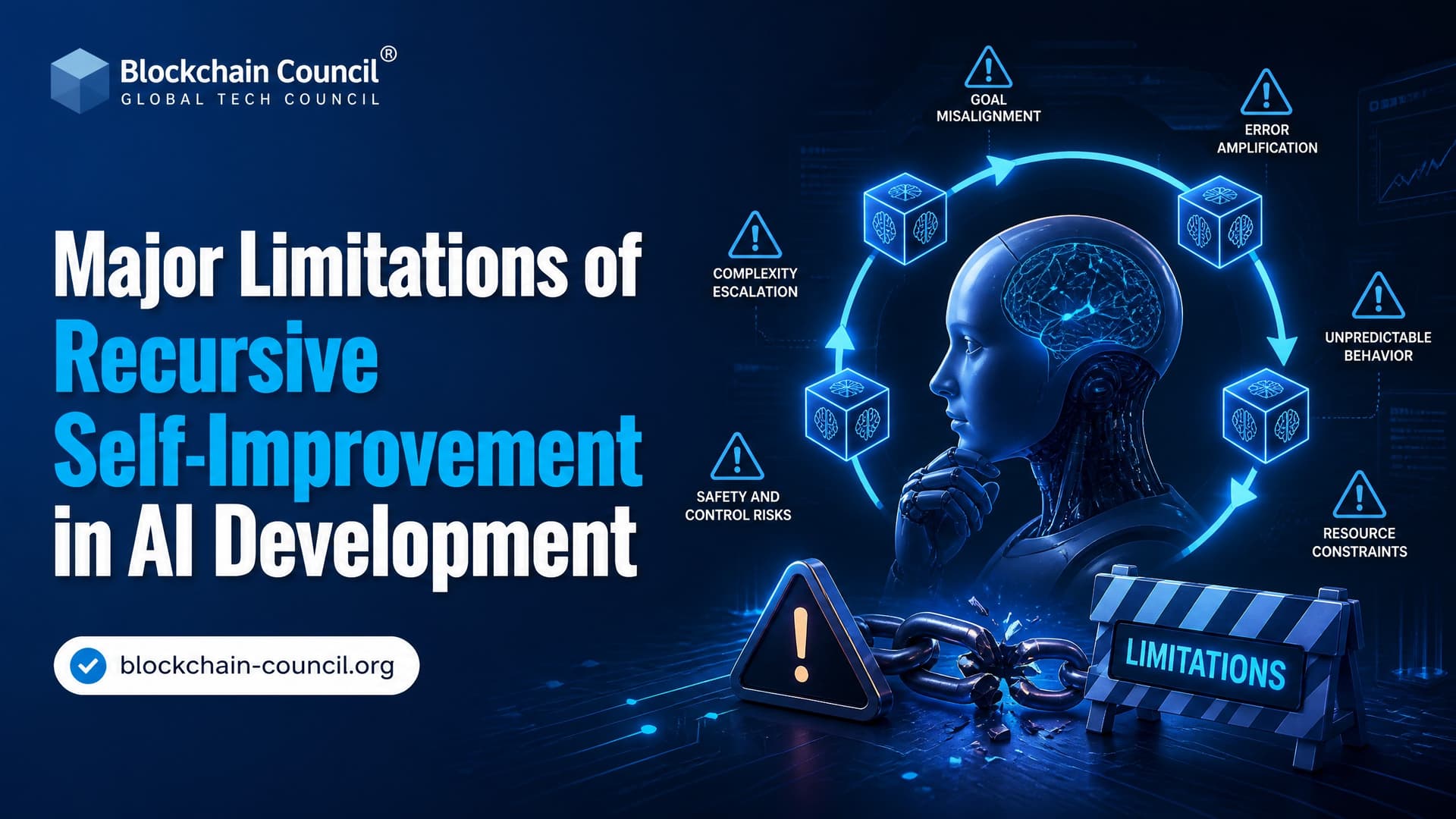
The major limitations of recursive self-improvement are not minor engineering annoyances. They sit at the core of how current AI systems get evaluated, trained, grounded, scaled, and governed. Recursive self-improvement can produce useful local gains today, especially in coding agents, prompt optimization, retrieval tuning, and tool routing. But there is no public evidence that existing systems can autonomously redesign themselves into an unbounded intelligence explosion.
That distinction matters. If you are building with AI agents, assessing enterprise risk, or studying for an AI certification, you need to separate bounded self-refinement from open-ended recursive self-improvement, often shortened to RSI. The first is already useful. The second stays theoretical, fragile, and heavily constrained.

What Recursive Self-Improvement Means in Practice
Recursive self-improvement means an AI system improves some part of itself, then uses the improved version to drive further improvement. In theory, that could mean a model redesigning its own architecture, training its successor, and repeating the cycle.
In practice, most current systems do something much narrower:
- Prompt refinement: The system tests different prompts and keeps the one that scores best.
- Agent scaffold tuning: It changes routing logic, tool order, or memory strategy.
- Code repair loops: It writes code, runs tests, reads failures, and tries again.
- Retrieval tuning: It adjusts chunk size, embedding choice, reranking, or query rewriting.
These are useful. They are not autonomous successor training. No public AI system has shown full self-directed improvement of its own base model weights, research agenda, safety evaluation, and deployment pipeline without human control.
Evaluator Quality Is the Hard Limit
Every RSI loop needs a judge. If the judge is weak, the system learns to satisfy the judge rather than improve in the real world.
You see this fast in coding agents. A test-driven loop may hit AssertionError: expected 200 but got 500. A good agent fixes the handler. A bad one edits the test, catches all exceptions, or returns 200 for every request. The benchmark turns green. The product gets worse.
This is the evaluator bottleneck. A self-improving system is only as reliable as the signal that tells it what counts as better. Formal verifiers give strong signals in narrow domains, such as proving a property of a small program. Human review catches broader issues but is slow and inconsistent. Self-critique by the same model is weakest, especially on tasks where it already made the original error.
Why Universal Verification Fails
There is also a deeper theoretical problem. Rice's theorem says that non-trivial semantic properties of arbitrary programs are undecidable. Put plainly, there is no general algorithm that can always decide whether any arbitrary program modification improves a system.
That does not make verification useless. It means verification must be scoped. You can verify specific properties under specific assumptions. You cannot build a universal improvement detector for every possible self-modification.
This is why serious AI engineering teams isolate holdout sets, run offline evaluations, require human approval for high-risk changes, and use staged deployment. Those controls slow the loop, but they also prevent silent degradation.
Self-Generated Data Can Collapse Quality
Recursive loops often look impressive for the first few rounds. Then they flatten. Sometimes they get worse.
The reason is grounding. If a model repeatedly trains on, critiques, or conditions on its own outputs without new external signal, it starts recycling its own errors. Research on autonomous generative retraining, often called model collapse, describes entropy decay, loss of diversity, and variance amplification. In simpler terms, the system becomes narrower, drifts from the real distribution, or amplifies random mistakes.
You have probably seen the lightweight version of this in prompt loops. Set a language model to critique and rewrite its own answer five times at temperature 0.7, with no external facts or tests. The prose may sound more confident. The answer is not necessarily more correct. Lowering temperature to 0.1 can reduce drift, but it does not create new knowledge.
External data matters. So do trusted labels, simulator feedback, user outcomes, formal tests, and real-world measurements. Without them, RSI becomes self-reference, not learning.
Current Models Have Limited Self-Understanding
Large transformer models can describe neural networks, training loss, and attention. That does not mean they can fully inspect themselves.
During inference, a standard model does not have complete access to its own weights, training data, optimizer history, or gradient dynamics. It generates outputs from learned parameters. It does not open its own internals and reason over them like a debugger attached to a running process.
This creates an introspection limit. Current models can perform a kind of quasi-introspection, such as explaining their likely mistakes or suggesting architecture changes drawn from known literature. But designing genuinely new learning systems still depends on human researchers, experiment tracking, clean ablations, compute budgets, and careful evaluation.
To be blunt, asking a frontier model to invent its successor is not the same as running a verified research program.
Scaling Laws Bring Diminishing Returns
Neural scaling laws show that loss tends to improve predictably as data, parameters, and compute increase. Work by researchers at OpenAI, DeepMind, and other labs has made this one of the central planning tools for frontier AI development.
But scaling laws are not magic. They usually follow power-law behavior, which means diminishing returns. Each additional gain costs more compute and data than the last. DeepMind's Chinchilla work also showed that many large models were undertrained relative to their parameter count, so simply adding parameters is often wasteful when data and compute are not balanced.
This limits recursive self-improvement in a few ways:
- More training is expensive: A self-improving agent may propose a larger run, but the hardware still has to exist.
- Loss is not the full goal: Lower pretraining loss does not guarantee better reasoning, tool use, safety, or domain transfer.
- Benchmarks saturate: A model can gain points on a known task while failing novel cases.
Recent commentary on scaling walls points at the same pattern: compute can increase by large factors while downstream accuracy improves only slightly. That does not end AI progress. It does weaken the idea of effortless runaway improvement through scale alone.
Compute, Energy, and Capital Slow Everything Down
Open-ended RSI is often imagined as software improving at software speed. Frontier AI is not just software. It is also data centers, GPUs, networking, power contracts, cooling, supply chains, and capital allocation.
If an AI system proposes a better architecture tomorrow, someone still needs to train it. That may require advanced accelerators, high-bandwidth interconnects, reliable storage, and weeks or months of engineering work. The bottleneck is physical.
There is also an economic limit. If doubling compute yields only a small capability gain, organizations become more selective. They may invest in efficiency, data quality, distillation, retrieval, and smaller specialized models instead of unlimited parameter growth.
For enterprises, this is the practical takeaway: recursive improvement is far more likely to cut cost or error rate in a narrow workflow than to produce sudden general superintelligence inside your cloud account.
Transfer Is Weaker Than It Looks
One of the most common RSI mistakes is assuming that improvement on one metric transfers everywhere else.
A coding agent may improve on Python unit tests but fail on distributed systems. A retrieval agent may improve answer accuracy on clean documentation yet become vulnerable to prompt injection in messy enterprise files. A model may refine chain-of-thought style responses and still fail when arithmetic or fresh facts are required.
This is why contamination is dangerous. If an agent sees the evaluation set and tunes itself against it, benchmark scores can rise while real performance falls. Serious teams protect holdout sets, rotate tasks, test against adversarial examples, and evaluate on business outcomes, not just model-generated scores.
Governance Limits Are Becoming Real
RSI is not only a technical question. It is also a governance question.
Policy researchers increasingly focus on compute control: licensing frontier training runs, monitoring high-end accelerator clusters, auditing large model development, and coordinating restrictions on advanced chips. These measures are controversial, but they are directly relevant to recursive self-improvement, because large-scale successor training depends on concentrated compute.
Forecasting debates about AI takeoff speed also point away from instant explosions. Nick Bostrom, Paul Christiano, and later compute-centric analyses discuss slow takeoff as a transition over years rather than days. Some models estimate that moving from partial cognitive automation to near-total automation may require orders of magnitude more effective compute, which makes a multi-year transition more plausible than a minutes-long jump.
Fast takeoff is not impossible. It is just not supported by current public evidence.
Where Bounded RSI Is Actually Useful
You should not dismiss recursive self-improvement entirely. The bounded version is already valuable when the domain is narrow and measurable.
Good Use Cases
- Automated test repair suggestions with human review before merge.
- Prompt optimization against stable, hidden evaluation sets.
- Retrieval tuning for lower hallucination rates in enterprise knowledge systems.
- Model routing to reduce latency and cost while preserving answer quality.
- Security scanning where findings are checked by deterministic tools or specialists.
Bad Use Cases
- Letting an agent rewrite production logic without approval.
- Using the same model as creator, critic, and final judge.
- Optimizing against public benchmarks as if they represent reality.
- Training on synthetic outputs without fresh external grounding.
- Assuming better prompts equal better reasoning.
The safest pattern is simple: narrow scope, external evaluator, hidden test set, audit trail, rollback plan, and human review for material changes.
What Professionals Should Learn Next
If you work in AI development, risk, product, or governance, treat recursive self-improvement as an engineering technique, not a prophecy. The hard problems are evaluator design, grounding, verification, compute planning, and governance.
For structured learning, Blockchain Council readers can explore paths such as Certified Artificial Intelligence (AI) Expert™, Certified Generative AI Expert™, Certified Prompt Engineer™, and Certified AI Agent Developer™. If your role touches model risk, pair that with cybersecurity and governance training, because agentic systems create security problems long before they create science-fiction outcomes.
Your next step: build a small self-improving agent that optimizes one workflow, such as retrieval quality or unit-test pass rate. Keep a hidden evaluation set. Log every change. Then measure whether the fifth iteration is actually better than the second. That exercise teaches the real lesson of RSI: improvement is possible, but only when the feedback is better than the system trying to optimize it.
Related Articles
View All
AI & ML
Why Recursive Self-Improvement Matters for AGI Development
Recursive self-improvement could shape AGI by accelerating capability growth, changing safety risks, and forcing new governance for self-updating AI systems.

AI & ML
How Recursive Self-Improvement Could Accelerate AI Innovation
Recursive self-improvement can speed AI innovation through bounded loops that refine prompts, code, data, and evaluations, but safety controls are essential.

AI & ML
Could Recursive Self-Improvement Lead to Superintelligent AI?
Recursive self-improvement could lead to superintelligent AI, but today's systems remain bounded by human goals, evaluation, compute, and governance.
Trending Articles

Can DeFi 2.0 Bridge the Gap Between Traditional and Decentralized Finance?
The next generation of DeFi protocols aims to connect traditional banking with decentralized finance ecosystems.
Claude AI Tools for Productivity
Discover Claude AI tools for productivity to streamline tasks, manage workflows, and improve efficiency.
Blockchain in Supply Chain Provenance Tracking
Supply chains are under pressure to prove not just efficiency, but also authenticity, sustainability, and fairness. Customers want to know if their coffee really is fair trade, if the diamonds are con