

LangChain in 2026: Building Reliable Agents and RAG Pipelines
 Suyash Raizada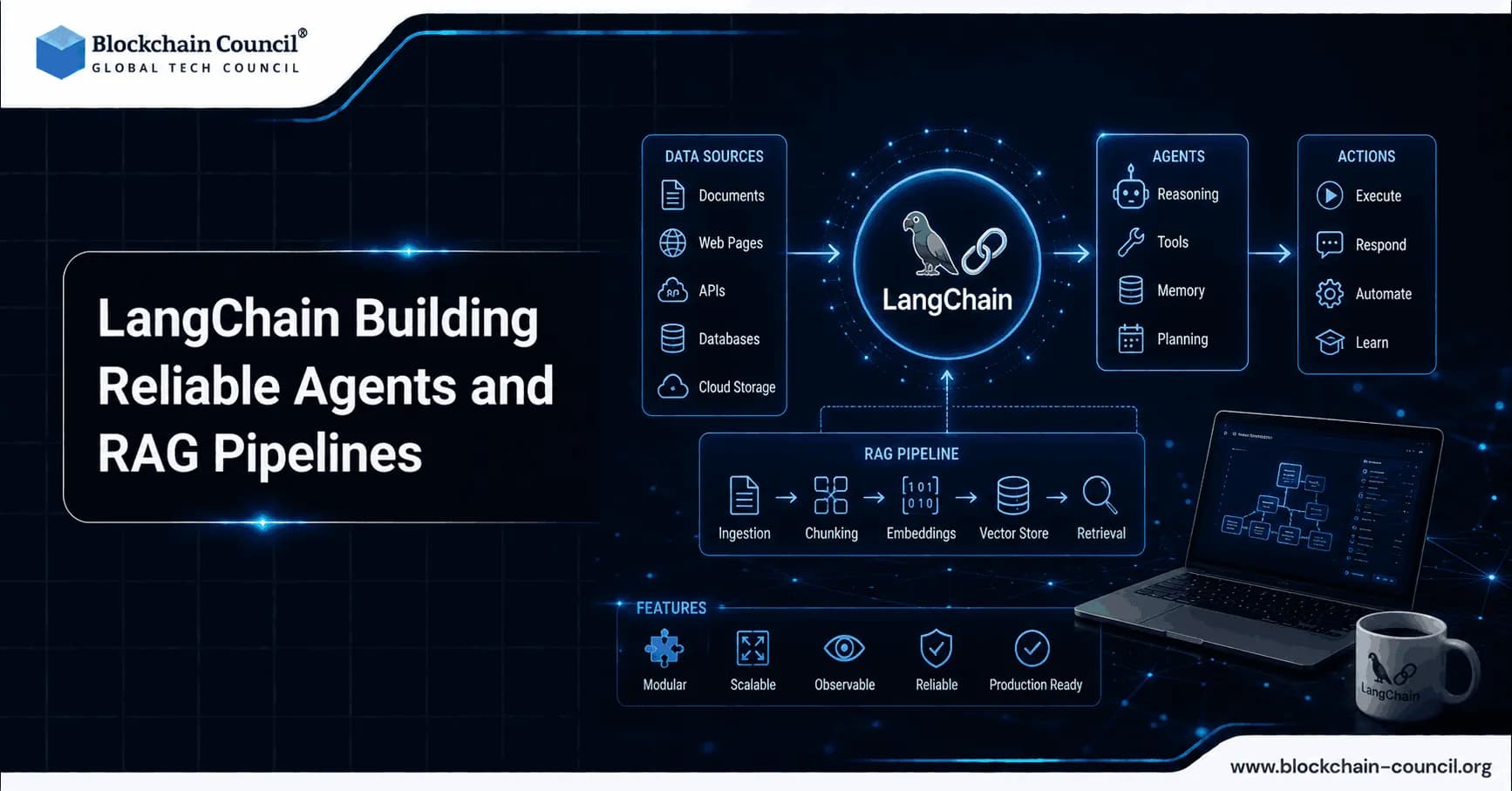
LangChain has become one of the most widely used open-source frameworks for building LLM-powered applications, from conversational interfaces to agentic automation and retrieval-augmented generation (RAG) systems. Since its launch in October 2022, LangChain has evolved alongside the broader shift from prompt-centric prototypes to production-grade AI systems that require reliability, observability, and governance.
By 2026, the conversation has shifted. Most teams are no longer asking whether to build agents, but how to deploy them safely and at scale. This article explains what LangChain is, how modern RAG and agent systems are structured, and what the latest ecosystem updates mean for AI practitioners and builders.

As agent-based AI systems become more common in production environments, many professionals are pursuing an Agentic AI Certification to develop expertise in autonomous workflows, tool orchestration, and multi-step reasoning, while an LLM Developer Certification helps build practical skills in RAG architectures, prompt engineering, model evaluation, and production-scale LLM application development.
What is LangChain?
LangChain is an open-source framework for developing applications powered by large language models (LLMs). It provides composable building blocks for orchestrating LLM calls with external data, tools, and multi-step workflows. While early usage often focused on document-based chat, LangChain's scope now covers:
RAG pipelines that ground responses in private or domain-specific knowledge
Agents that decide which tools to use and in what sequence
Multi-agent systems where specialized agents collaborate on complex tasks
Observability and evaluation workflows through an expanding ecosystem of complementary tools
A major factor in its adoption is broad compatibility with model providers such as OpenAI, Anthropic, and Google, paired with flexible orchestration patterns that adapt to a wide range of enterprise environments.
Why LangChain Matters in 2026: Reliability and Observability
In 2026, the practical requirements for LLM applications resemble standard software engineering: regression testing, monitoring, guardrails, and predictable failure behavior. A 2026 LangChain survey of more than 1,300 professionals confirmed a clear shift toward reliable, scalable agent deployment rather than exploratory prototyping.
This reflects what many teams have encountered directly:
Agent workflows can fail in subtle ways, including wrong tool selection, partial tool output, and hallucinated intermediate steps.
RAG quality can degrade over time as data volumes grow and retrieval patterns change.
Enterprises require auditability and precise control over data access and tool permissions.
In response, the LangChain ecosystem has invested heavily in observability and agent engineering tooling, including improvements to LangSmith and the low-level orchestration capabilities of LangGraph.
Key Components of the LangChain Ecosystem
LangChain (Core Framework)
LangChain provides abstractions and integrations for building chains, agents, tool calling, and retrieval pipelines. It helps developers structure complex LLM workflows beyond basic prompt engineering, particularly when multiple steps, tools, or data sources are involved.
LangGraph (Orchestration Layer)
LangGraph underpins many advanced LangChain workflows through a graph-based orchestration model designed for controlled execution. Key capabilities include:
Streaming and intermediate outputs for real-time visibility into workflow progress
Safety controls such as tool scoping to limit what an agent can access
Middleware for guardrails including PII detection and policy enforcement
Many production agent failures originate from orchestration and control gaps rather than model limitations. Graph-based execution makes it easier to reason about state transitions, retries, and fallback behavior.
LangSmith (Observability, Evaluation, and Agent Building)
LangSmith has become central to teams that need to debug, evaluate, and monitor LLM applications in production. In January 2026, LangChain confirmed that the LangSmith Agent Builder was generally available, supporting natural language-based agent creation with automatic prompt generation, tool selection, subagents, and reusable skills.
Other notable capabilities highlighted in 2026 include:
Side-by-side experiment comparisons to detect regressions when changing prompts, models, or retrievers
Trace analysis via an Insights Agent, with a self-hosted option available for organizations with strict compliance requirements
LangChain RAG: How Modern Pipelines Are Structured
RAG with LangChain involves grounding model responses in retrieved context from a knowledge base rather than relying solely on model weights. In 2026, effective RAG is less about a single vector search step and more about a structured pipeline with measurable, maintainable quality.
Core RAG Building Blocks
Document loaders: ingest PDFs, web pages, internal documentation, tickets, or wikis
Text splitters: chunk content into retrieval-friendly segments
Embeddings: represent chunks as dense vectors for similarity search
Retrievers: fetch the most relevant chunks for a given query
Vector databases: store and search embeddings at scale
Answer synthesis: assemble a response using retrieved context, often with citations or quoted passages
What Effective RAG Looks Like in Practice
A production-ready RAG system should deliver:
Grounded answers that align with the source documents
Lower hallucination rates through context-first prompting and retrieval constraints
Freshness via continuous indexing or scheduled data updates
Access control so users only retrieve content they are authorized to view
These requirements explain why production teams treat retrieval quality, chunking strategy, and evaluation as first-class engineering concerns rather than implementation details.
Agents in LangChain: From Q&A to Automation
LangChain agents represent the progression from conversational Q&A toward systems capable of planning and executing multi-step tasks. A typical agent:
Interprets the user goal
Selects tools (APIs, search, databases, code execution) based on the task
Executes steps iteratively
Returns a final result and, in mature setups, a full auditable trace
Improvements in LangChain JS v1.2.13 highlighted stronger agent robustness through dynamic tool usage and hallucination recovery patterns. In real deployments, controlled retries and safe fallbacks are essential - blind persistence on a failing path creates significant operational risk.
Safety and Governance: Tool Scoping and Data Leak Prevention
As agent capabilities expand, so does the associated risk surface. A standard safety practice is restricting tool access so an agent can only invoke tools relevant to its assigned role. LangGraph supports tool scoping natively, and middleware-based guardrails can be layered in to detect PII or block sensitive content from being exposed inadvertently.
Real-World LangChain Use Cases in 2026
LangChain's adoption is closely tied to practical outcomes in complex, regulated environments:
Regulated workflow automation: Coinbase reported using a LangSmith-powered agent stack to automate regulated workflows, reducing development timelines from quarters to days.
Structured data transformation: Remote deployed a Code Execution Agent that separates LLM reasoning from Python execution, converting multi-format payroll inputs into validated JSON in significantly less time.
Document ingestion and semantic search: End-to-end RAG systems combining chunking, embeddings, vector databases, and a lightweight UI layer have become a common deployment pattern.
Content automation: Agent pipelines that fetch source material, extract key points, and format a structured brief represent a repeatable pattern across publishing and research workflows.
Across these examples, the consistent finding is that value comes from orchestration, evaluation, and operational control, not from model selection alone.
Getting Started with LangChain: A Practical Checklist
For teams evaluating LangChain for a RAG or agent project, a minimal and testable starting path is recommended:
Define the task clearly: document Q&A (RAG) or workflow automation (agent).
Start with a small dataset: validate chunking and retrieval quality before scaling ingestion.
Add evaluation early: compare prompt or retriever changes side-by-side to catch regressions before they reach production.
Implement safety controls: establish tool scoping, logging, and PII handling from the start.
Plan for observability: capture traces and failure modes so production issues can be debugged systematically.
For those seeking a structured learning path, Blockchain Council offers certifications in generative AI, prompt engineering, AI security, and advanced AI engineering that complement hands-on LangChain development work.
Many professionals also pursue a Tech Certification to strengthen their understanding of emerging technologies, AI infrastructure, and scalable system design, while a Marketing Certification can help bridge technical innovation with customer needs, stakeholder communication, and the successful adoption of AI-powered solutions across the organization.
Future Outlook: Where LangChain Is Heading
Agent engineering in 2026 is increasingly shaped by production realities: multi-server deployments, human-in-the-loop verification for high-stakes actions, and advanced observability to detect and manage failure modes. LangSmith and LangGraph are positioned directly around these requirements.
As multi-agent adoption grows, expect continued emphasis on:
Standardized evaluation frameworks for agent behavior and RAG quality
More reliable tool execution and structured output handling
Enterprise deployment patterns including self-hosting options and stricter data governance controls
Conclusion
LangChain has matured from a widely adopted prompt-chaining framework into a full ecosystem for building production LLM applications. The clearest 2026 lesson for AI practitioners is that success depends on reliability, safety, and observability as much as model capability. Whether the goal is implementing RAG for grounded knowledge access or building agents for workflow automation, structured pipelines, controlled tool use, and measurable evaluation are what determine whether an application remains trustworthy at scale.
For those looking to build formal expertise, Blockchain Council's certifications in generative AI, AI security, and advanced AI engineering provide structured learning pathways that align directly with the skills required for production LangChain development.
FAQs
1. What is LangChain in 2026?
LangChain is a framework for building AI applications using language models. It helps developers create agents, workflows, and RAG pipelines. It focuses on modular and scalable design.
2. How is LangChain used to build AI agents?
LangChain provides tools to connect models with tools, APIs, and memory. Agents can perform tasks autonomously based on user input. This enables dynamic and interactive systems.
3. What is a RAG pipeline in LangChain?
A RAG pipeline retrieves relevant data and feeds it into a language model. LangChain helps manage retrieval, embeddings, and generation. This improves response accuracy.
4. Why is LangChain popular for building RAG systems?
It simplifies integration between models, vector databases, and tools. Developers can build pipelines quickly. It supports flexibility and customization.
5. What are the key components of LangChain?
Key components include chains, agents, tools, memory, and retrievers. These modules work together to build applications. Each component serves a specific function.
6. How does LangChain improve agent reliability?
It provides structured workflows and tool integration. Developers can control agent behavior more effectively. This reduces errors and improves consistency.
7. What are common use cases for LangChain in 2026?
Use cases include chatbots, document search, automation, and AI assistants. It is widely used in enterprise AI systems. These applications require reliable workflows.
8. How does LangChain integrate with vector databases?
LangChain connects with databases like Pinecone and Weaviate. It manages embeddings and retrieval processes. This enables efficient similarity search.
9. What is memory in LangChain agents?
Memory allows agents to retain context across interactions. It improves continuity and personalization. This enhances user experience.
10. How can developers reduce hallucinations using LangChain?
They can use RAG pipelines and validation layers. Grounding responses in retrieved data improves accuracy. Monitoring also helps detect issues.
11. What are the challenges of using LangChain in production?
Challenges include complexity, debugging, and performance tuning. Poor design can lead to unreliable agents. Proper architecture is important.
12. How does LangChain support tool integration?
It allows agents to call APIs and external tools. This extends functionality beyond the model. Integration enables real-world applications.
13. What is the role of chains in LangChain?
Chains define sequences of operations in a workflow. They connect different components and processes. This helps structure complex tasks.
14. How can developers test LangChain applications?
Testing involves evaluating accuracy, latency, and reliability. Simulating real-world scenarios helps identify issues. Continuous testing improves performance.
15. What are best practices for building reliable agents with LangChain?
Use clear workflows, validation layers, and monitoring. Limit agent autonomy where necessary. Regular testing ensures stability.
16. How does LangChain handle scalability?
It supports integration with cloud infrastructure and distributed systems. Efficient design improves scalability. Performance tuning is essential.
17. What tools complement LangChain in AI development?
Tools include vector databases, LLM APIs, and frameworks like LlamaIndex. Monitoring and evaluation tools are also important. These enhance functionality.
18. How can developers optimize RAG pipelines in LangChain?
Optimize chunking, embeddings, and retrieval parameters. Use reranking for better results. Continuous tuning improves performance.
19. What is the future of LangChain in AI development?
LangChain will continue evolving with better tools and integrations. It will support more advanced agent workflows. Adoption will grow in enterprise systems.
20. How can beginners get started with LangChain?
Start with basic tutorials and simple projects. Learn core components like chains and agents. Practice building small applications to gain experience.
Related Articles
View All
AI & ML
How Prompt, Loop, and Context Engineering Shape Reliable AI Agents
Learn how prompt, loop, and context engineering improve AI agent reliability, enterprise GenAI workflows, orchestration, guardrails, and governance.

AI & ML
How LLMs Work in Openclaw: Models, Agents, Tools, and Local Setups
Learn how OpenClaw uses LLMs as pluggable reasoning engines for agents, tools, local models, cloud providers, and JSON-based workflows.

AI & ML
Building AI Applications with GLM 5.2: A Practical Guide for Developers
A practical developer guide to GLM 5.2, covering long context design, reasoning modes, deployment choices, coding agents, Web3 use cases, and governance.
Trending Articles
AWS Career Roadmap
A step-by-step guide to building a successful career in Amazon Web Services cloud computing.
How Blockchain Secures AI Data
Understand how blockchain technology is being applied to protect the integrity and security of AI training data.

Can DeFi 2.0 Bridge the Gap Between Traditional and Decentralized Finance?
The next generation of DeFi protocols aims to connect traditional banking with decentralized finance ecosystems.