

IBM Layoffs Replace HR Staff with AI Agents
 Michael Willson
IBM recently confirmed it has replaced over 200 human resource professionals with AI agents. This shift isn’t a future possibility—it’s already happening. The move signals a wider industry trend: repetitive office roles are being automated. If you’re working in HR or any operational support role, now is the time to adapt. This article explores what IBM has done, why it matters, and how to protect your career.
What IBM Did
IBM rolled out AI tools like AskHR and Watsonx Orchestrate to handle internal HR tasks. These include answering employee queries, processing vacation requests, managing performance data, and supporting policy-related operations.

IBM CEO Arvind Krishna stated that nearly 94% of routine HR work can now be handled by these AI systems. As a result, over 200 HR roles have been phased out. However, the company is hiring aggressively in areas like AI engineering, business strategy, and sales.
This change is part of IBM’s larger goal to optimize operations and integrate AI into as many business functions as possible. The firm’s actions show that AI is no longer a futuristic experiment but a core part of enterprise strategy.
Why Companies Are Automating HR
IBM’s automation strategy has saved over $3.5 billion in the past two years. By using AI for repeatable processes, companies gain speed, accuracy, and 24/7 service availability. HR departments can then focus more on people strategy, compliance, and culture development.
AI also helps ensure consistent handling of tasks across large organizations. This standardization is particularly valuable in global operations, where regional variation can lead to inefficiencies.
Automation is not just about cost-cutting. It also reduces human error, accelerates decision-making, and ensures faster employee services. For companies that manage tens of thousands of employees, this is a major advantage.
What This Means for You
If your job involves repetitive tasks—especially in HR or administrative roles—AI could be a threat. But this doesn’t mean your role is irrelevant. The modern workplace still needs humans who understand people, context, and leadership. The new challenge is to combine human skills with AI fluency.
That’s why upskilling is critical right now. You need to learn how to work alongside AI, supervise it, and use it effectively. The sooner you build these skills, the more future-ready you’ll be.
Think of AI as a co-worker that doesn’t sleep. Your advantage lies in doing what machines can’t—connecting emotionally, solving complex problems, and leading innovation.
The Future of Work: Human + AI Collaboration
Organizations like IBM are building hybrid workforces where AI and people work together. AI handles scale and speed. Humans manage nuance, creativity, and ethics. As AI evolves, roles will not disappear—they’ll transform.
You don’t need to become a machine-learning engineer overnight. But understanding how AI tools function, where they can help, and how to direct them is vital.
Learning Agentic AI, for example, teaches you how to design, supervise, and optimize AI systems. These are high-value skills that put you in control rather than at risk.
Skills That Can Future-Proof Your Career
How to Start Your Upskilling Journey
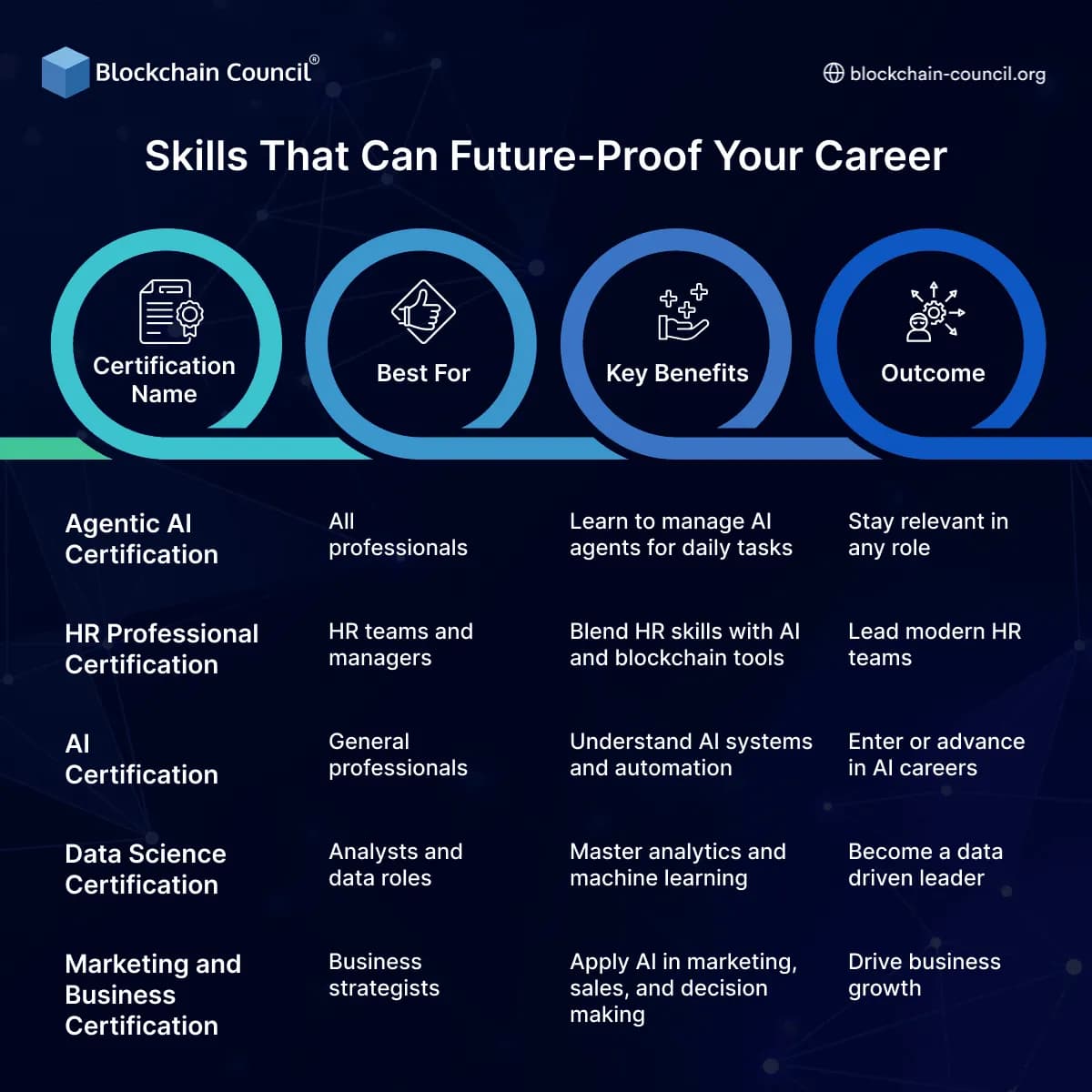
Start by identifying which certification aligns with your current role or future goals. If you’re in HR, the HR Professional Certification is an ideal entry point. If you want broader control over AI tools, the Agentic AI Certification helps you understand how to supervise autonomous agents.
Those aiming for cross-functional expertise should explore the AI and Data Science certifications to stay competitive in any department. For leadership or sales-driven roles, the Marketing and Business Certification adds strategic value.
The most important step is to begin. Waiting for change to settle will only push you further behind. Companies are already rewriting job descriptions to favor those with AI and automation awareness.
Conclusion
IBM’s decision to replace over 200 HR roles with AI is not just a headline—it’s a signal. AI is not coming for jobs. It’s already here. The only way to stay ahead is to learn how to work with it.
If you don’t evolve, you risk being replaced. But if you upskill now, you could become one of the professionals leading this new AI-powered future. Don’t wait for change to catch up with you. Take control by investing in skills that make you indispensable.
Related Articles
View All
AI & ML
AI Agents & Agentic AI: When AI Starts Thinking, Planning & Acting
Discover AI Agents & Agentic AI in simple terms. Learn how agents perceive, reason, plan, use tools, and remember, how they differ from chatbots, and where they are used today.
AI & ML
System One Models for AI Agents
Explore how System One Models can support AI agents with fast, structured decisions, calibrated confidence, routing, verification, and reliable workflow automation.
AI & ML
Jev vs AI Agents
Compare Jev with AI agents and learn how Jev’s structured decision-making differs from autonomous systems that plan, use tools, and complete multi-step tasks.
Trending Articles
The Role of Blockchain in Ethical AI Development
How blockchain technology is being used to promote transparency and accountability in artificial intelligence systems.

Can DeFi 2.0 Bridge the Gap Between Traditional and Decentralized Finance?
The next generation of DeFi protocols aims to connect traditional banking with decentralized finance ecosystems.
Claude AI Tools for Productivity
Discover Claude AI tools for productivity to streamline tasks, manage workflows, and improve efficiency.