

How to Get a Job in AI in 2026: Skills, Portfolio, and Hiring Strategy
 Suyash Raizada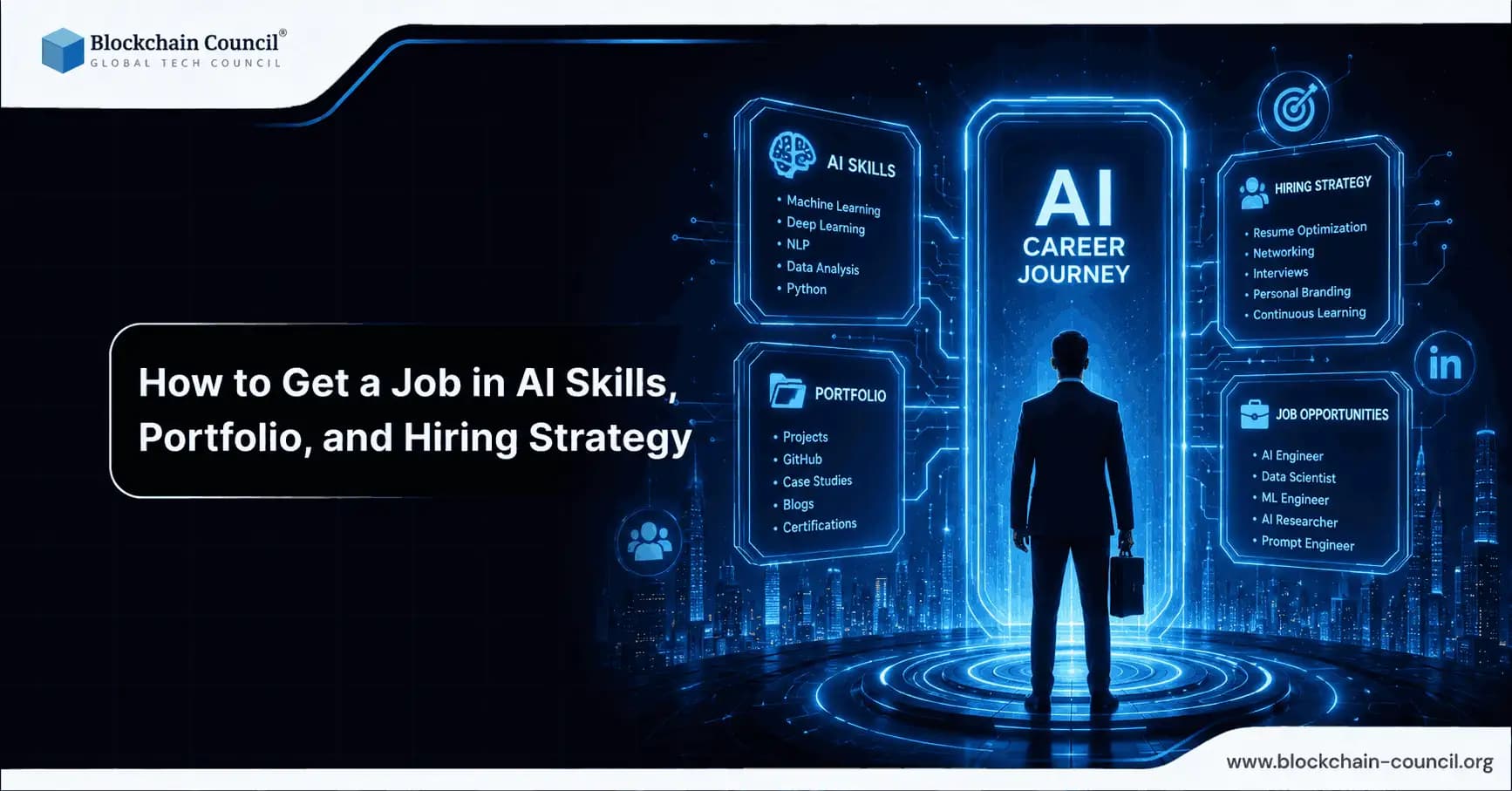
Getting a job in AI in 2026 is less about collecting credentials and more about proving you can solve real problems. The AI job market now includes both deeply technical roles (building models) and AI-native roles (using AI tools to transform work in marketing, law, healthcare, and operations). Across both tracks, hiring teams increasingly prioritize evidence: a portfolio, public problem-solving, and clear communication.
This guide lays out a practical path to an AI job, based on current industry guidance from Syracuse University, NVIDIA, and other widely referenced career resources.

What an AI Job Means in 2026
AI has moved far beyond research labs into everyday production systems and workflows. That shift creates multiple entry points depending on your background and goals. Many candidates assume the only path is becoming a machine learning engineer, but research on AI career pathways commonly groups roles into two major directions:
Technical AI roles: you build, train, evaluate, and deploy models.
AI-native roles: you use AI tools and AI-enabled processes to improve business outcomes, sometimes without training models from scratch.
There is also a large middle category: hybrid roles where domain knowledge plus AI skills is the differentiator. A supply chain analyst who can prototype forecasting models and communicate trade-offs is one example of this growing category.
Choose Your Target AI Job Path
Before building skills, pick a role direction. Your target job determines what tools to learn, what projects to build, and what keywords belong on your resume. Trying to learn everything at once is one of the most common reasons candidates stall.
Common Entry and Early-Career Roles
Junior ML Specialist: builds end-to-end ML pipelines, monitors model performance, handles preprocessing and evaluation.
Data Analyst (AI-adjacent): analyzes structured data, generates insights that support AI initiatives, often a strong entry point.
AI Developer: builds AI-powered applications, integrates model APIs, develops chatbots and agentic workflows, focuses on product and user experience.
AI Software Engineer: integrates AI features into software systems, including recommendation, personalization, speech, and automation functionality.
Learn how to get a job in AI in 2026 by building in-demand skills, creating strong portfolios, and understanding modern hiring trends across machine learning, automation, and generative AI by gaining expertise through an AI certification, building AI projects and automation systems using a Python certification, and positioning your professional brand with a Digital marketing course.
Skills You Need to Qualify for an AI Job
Most AI job descriptions look intimidating because they bundle core skills, preferred tools, and optional extras together. Focus on the fundamentals that appear consistently across roles.
1) Programming Foundations
Python is the single most common requirement across AI roles. Supporting skills frequently requested include SQL for data work, and Java or C++ in some software engineering tracks.
Python: data structures, functions, modules, testing basics, reading and writing files, APIs.
SQL: filtering, joins, aggregation, window functions (useful for analytics and ML data preparation).
Git: essential for portfolio credibility and team collaboration.
2) Math and ML Fundamentals
To qualify for a technical AI role, you need workable foundations in:
Statistics and probability: distributions, sampling, bias-variance intuition, metrics.
Linear algebra: vectors, matrices, dot products, transformations.
Basic calculus concepts: gradients and optimization intuition.
University career programs consistently note that weak math fundamentals create compounding difficulty as you progress. You do not need to become a mathematician, but you should be able to justify model selection and evaluation decisions clearly.
3) Tools Commonly Listed in AI Job Postings
Many job postings list specific libraries. Commonly referenced frameworks include:
Scikit-learn for classical ML and baselines
PyTorch or TensorFlow for deep learning
XGBoost for strong tabular baselines
Hugging Face Transformers for modern NLP and LLM-based workflows
Match your tool selection to the role you want. An AI Developer integrating LLM APIs may need strong software engineering and prompt skills, while an ML Specialist may need deeper evaluation and pipeline experience.
A Step-by-Step Plan to Get a Job in AI (6 to 12 Months)
A realistic timeline for a bootcamp or self-directed route often ranges from 6 to 12 months to land an entry-level role, with networking and portfolio building running throughout the process.
Step 1: Build Python Foundations (4 to 6 Weeks)
Start with core Python skills and simple projects. Common free resources include Harvard CS50 and the official Python documentation. Speed is not the priority here. Rushing fundamentals makes every subsequent step harder.
Write small scripts daily
Practice debugging and reading error messages
Use Git from the start, even for small exercises
Step 2: Learn Machine Learning Fundamentals (4 to 8 Weeks)
Cover core ML concepts and build at least one end-to-end project:
Supervised learning: classification and regression
Unsupervised learning: clustering, dimensionality reduction
Evaluation: train-test splits, cross-validation, precision/recall, ROC-AUC (as appropriate)
Model iteration: start with baselines, then improve systematically
Step 3: Adopt AI-Native Work Habits
Many candidates use AI tools, but few demonstrate they can use them professionally. Two habits can differentiate you in interviews and on the job:
Breadcrumbing: save key AI chat links in code comments, record why decisions were made, and preserve reasoning chains. This makes your work reviewable and maintainable by others.
Swipe files: keep a private library of prompts, patterns, and explanations that worked. Refine them over time into reusable templates.
These habits help you scale output while reducing dependency on any single tool. They also improve collaboration quality, which hiring teams consistently value.
Step 4: Build a GitHub Portfolio That Proves You Can Deliver
Across multiple hiring guides, portfolio quality is repeatedly cited as a stronger signal than a long list of certificates. Your GitHub should demonstrate that you can define a problem, build a solution, and communicate results clearly.
Every portfolio project should include:
Problem statement: what you are solving and why it matters
Data sourcing: where the data came from and what it represents
Cleaning and preprocessing: what you changed and why
Modeling approach: baselines, alternatives considered, trade-offs made
Results and limitations: what worked, what failed, what you would do differently
Plain-language write-up: written for a reader who is not an AI specialist
Strong portfolio project ideas include:
Churn prediction with a clear business narrative and cost-aware metrics
Document classification or summarization with evaluation examples
Customer support chatbot prototype with guardrails and failure analysis
Demand or inventory forecasting with error analysis and seasonality discussion
Step 5: Network While You Learn
Networking is not asking strangers for a job. It is building visible proof of work and forming relationships with people who can validate it. NVIDIA career guidance highlights the value of connecting with professionals who are several years ahead of you on your target path.
Kaggle: even mid-leaderboard participation demonstrates real engagement with messy, real-world datasets.
Hackathons: fast project cycles, team collaboration, and strong portfolio material in a short timeframe.
LinkedIn: share what you learned, what broke, how you fixed it, and what you would improve next time.
Open source: small contributions build credibility and show you can work within existing codebases.
How to Get Past Automated Resume Screening
Applicant tracking systems can filter out candidates without formal experience. To reduce that risk, make your application evidence-driven and keyword-aligned.
Practical actions:
Mirror job description keywords honestly - include only tools, methods, and responsibilities you have actually used.
Link your portfolio prominently - include your GitHub profile and one to two best project case studies.
Quantify outcomes - accuracy alone is rarely enough; include latency, cost reduction, error rates, time saved, or user impact where relevant.
Show end-to-end thinking - demonstrate familiarity with data handling, modeling, evaluation, deployment basics, and monitoring considerations.
Education Choices: Degree, Bootcamp, or Hybrid
There is no single correct route. A degree is commonly preferred for research-oriented roles and provides strong theoretical grounding. Bootcamps and self-directed paths can be faster for applied roles, but they require disciplined project output to compensate for the absence of formal credentials. Many candidates succeed through a hybrid approach: structured learning combined with public portfolio work and open-source contributions.
Understand what recruiters look for in AI professionals including hands-on projects, prompt engineering, AI deployment, and real-world problem-solving by mastering AI technologies through an AI certification, developing AI applications using a Node JS Course, and growing your visibility in the AI industry using an AI powered marketing course.
Conclusion: The Simplest Formula for Getting an AI Job
To get a job in AI in 2026, focus on proof over promises. Build solid Python and ML foundations, then create a small number of well-documented projects that solve real problems end-to-end. Share your work early, network consistently, and develop AI-native habits like breadcrumbing and swipe files so your work is reproducible and reviewable by others.
The AI job market rewards demonstrated ability through portfolios, public learning, and collaboration signals. Starting today with a clear role target and a weekly project routine gives you a realistic path to credible AI job candidacy within 6 to 12 months.
FAQs
1. What is the best way to get a job in AI in 2026?
The best way is to choose a clear AI career path and build proof of real skills. Employers want portfolios, projects, and problem-solving ability. Certificates help, but evidence matters more.
2. What does an AI job mean in 2026?
An AI job can mean building models, using AI tools, or applying AI to business workflows. Not every role requires deep research skills. Many jobs combine domain knowledge with practical AI ability.
3. What are technical AI roles?
Technical AI roles involve building, training, testing, and deploying AI or machine learning systems. These jobs often require Python, math, ML frameworks, and evaluation skills. Examples include ML specialist and AI software engineer.
4. What are AI-native roles?
AI-native roles use AI tools to improve productivity, decisions, and business outcomes. These roles may appear in marketing, healthcare, operations, law, or finance. They focus more on applying AI effectively than building models from scratch.
5. Why should candidates choose a target AI role first?
Choosing a target role helps candidates learn the right tools and build relevant projects. Trying to learn everything at once usually leads to confusion. A focused path makes resumes and portfolios stronger.
6. What entry-level AI roles are common?
Common entry-level roles include junior ML specialist, data analyst, AI developer, and AI software engineer. Each role requires a slightly different skill set. Candidates should match their learning plan to the job they want.
7. Why is Python important for AI jobs?
Python is the most common programming language used in AI roles. It supports data analysis, machine learning, automation, and model development. Strong Python basics make advanced AI learning much easier.
8. Is SQL useful for AI careers?
Yes, SQL is highly useful for working with structured data. Many AI projects require filtering, joining, and preparing data before modeling. Ignoring SQL is a charming way to make data work harder than necessary.
9. What math skills are needed for AI jobs?
AI candidates should understand statistics, probability, linear algebra, and basic optimization concepts. These skills help explain model behavior and evaluate results. You do not need to be a mathematician, but you need practical understanding.
10. Which AI tools should beginners learn?
Beginners can start with Scikit-learn, PyTorch or TensorFlow, XGBoost, and Hugging Face Transformers. The best tools depend on the target role. AI developers may also need API integration and prompt engineering skills.
11. How long does it take to get an entry-level AI job?
A realistic self-study or bootcamp path can take six to twelve months. The timeline depends on prior experience, consistency, and portfolio quality. Learning randomly will stretch the process, because chaos remains undefeated.
12. What should beginners learn first?
Beginners should start with Python foundations, basic coding projects, and Git. After that, they can move into machine learning concepts and applied projects. Strong fundamentals prevent problems later.
13. Why is a GitHub portfolio important?
A GitHub portfolio shows employers that a candidate can build and explain real projects. It provides stronger proof than simply listing skills on a resume. Well-documented projects make hiring decisions easier.
14. What should an AI portfolio project include?
A strong project should include a problem statement, data source, preprocessing steps, modeling approach, results, and limitations. It should also explain business value in plain language. This shows both technical and communication ability.
15. What are good AI portfolio project ideas?
Good projects include churn prediction, document classification, chatbot prototypes, and demand forecasting. These projects demonstrate practical AI skills and real-world thinking. The best projects include evaluation and honest limitations.
16. What are AI-native work habits?
AI-native work habits include documenting AI-assisted decisions and saving reusable prompt patterns. Breadcrumbing and swipe files help make work reviewable and repeatable. These habits show professional maturity, a rare species in the wild.
17. How can networking help with AI jobs?
Networking helps candidates share proof of work and connect with professionals in their target field. Kaggle, hackathons, LinkedIn, and open-source projects are useful channels. Good networking is about visible learning, not begging for referrals.
18. How can candidates pass automated resume screening?
Candidates should use relevant job keywords honestly and link directly to their best projects. They should quantify outcomes such as accuracy, cost savings, latency, or time saved. Clear evidence helps resumes survive automated filters.
19. Do AI jobs require a degree?
A degree can help, especially for research-heavy or advanced technical roles. Bootcamps, certifications, and self-study can work for applied roles when paired with strong projects. The best route depends on the target job.
20. What is the main takeaway for getting an AI job in 2026?
Getting an AI job in 2026 requires proof of skill, not just claims. Candidates should build foundations, create strong projects, share their work, and network consistently. A focused portfolio is the strongest signal to employers.
Related Articles
View All
AI & ML
AI-Era Hiring Needs AI-Proof Tests: How HireValid Is Redefining Talent Assessment
Explore how HireValid is rethinking talent assessment for the AI era with job-relevant tests, anti-cheating design, integrity signals, and human-reviewed evidence of candidate ability.

AI & ML
Prompt Engineering to Context Engineering: How to Get Better Results From AI
Learn the journey from Prompt Engineering to Context Engineering. Understand prompts, few-shot and chain-of-thought techniques, context windows, memory, and RAG to get better results from AI.

AI & ML
Built to Catch AI Cheating: Rethinking Pre-Employment Assessments with HireValid
Explore how HireValid is rethinking pre-employment assessments with AI-resistant test design, integrity signals, candidate evidence, and human review to address AI-assisted cheating.
Trending Articles
The Role of Blockchain in Ethical AI Development
How blockchain technology is being used to promote transparency and accountability in artificial intelligence systems.
What is AWS? A Beginner's Guide to Cloud Computing
Everything you need to know about Amazon Web Services, cloud computing fundamentals, and career opportunities.
How to Install Claude Code
Learn how to install Claude Code on macOS, Linux, and Windows using the native installer, plus verification, authentication, and troubleshooting tips.