

OpenAI and Anthropic Enter Enterprise Services: Should Indian IT Giants Worry?
 Suyash Raizada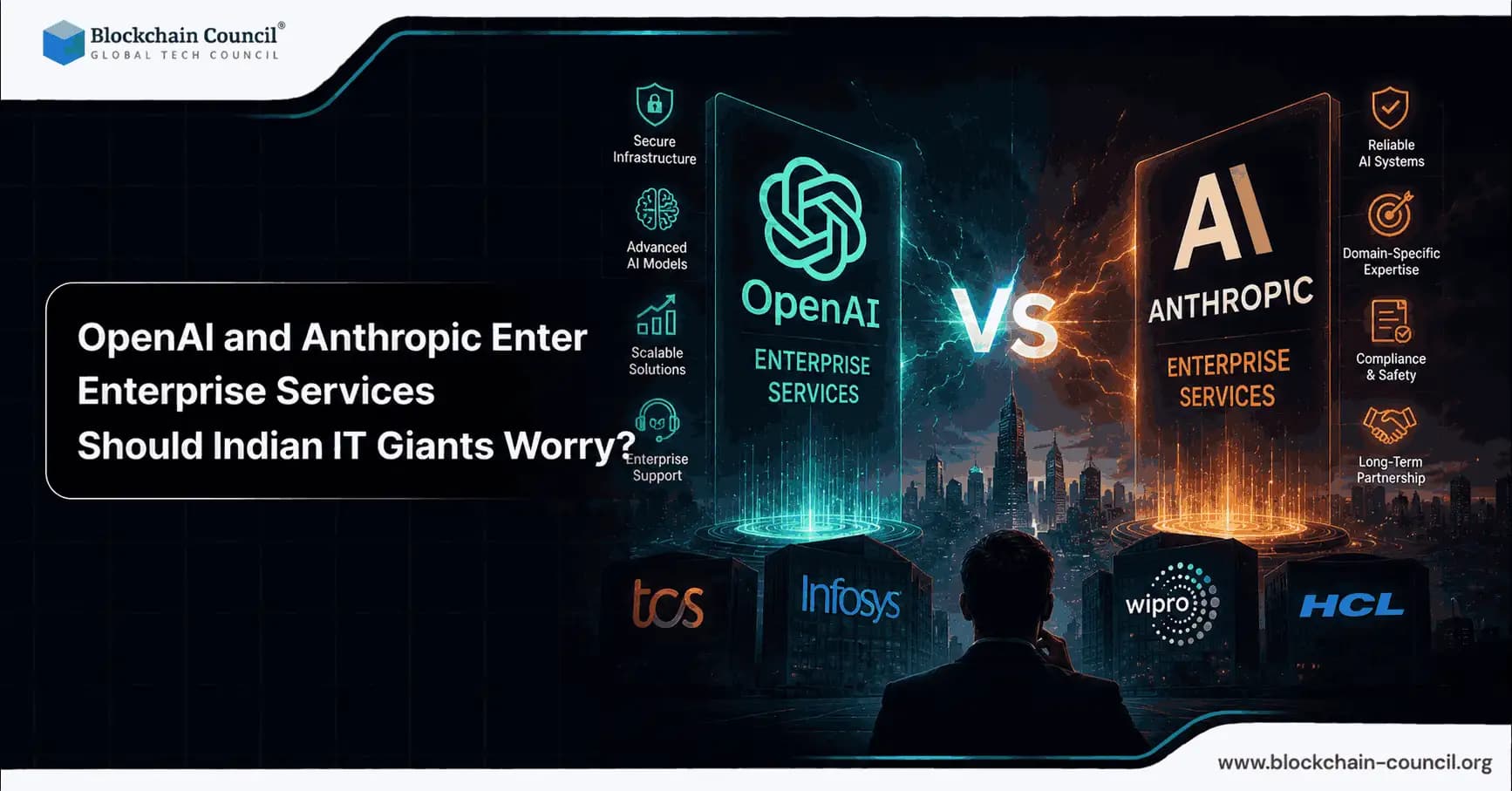
OpenAI and Anthropic are no longer just model providers. In May 2026, both companies moved decisively into enterprise services by creating dedicated deployment-focused entities that embed engineers with clients, integrate AI into workflows, and take responsibility for measurable outcomes. For developers and engineering leaders, this shift changes vendor selection, delivery models, and how AI transformation work gets staffed and priced.
The central question is whether Indian IT giants like TCS, Infosys, HCLTech, and Wipro should be concerned. The realistic answer: they should take the move seriously, but it is not automatically a zero-sum threat. It is a structural change that compresses timelines, pushes outcome-based delivery, and intensifies competition for high-value consulting, while also expanding the overall market for AI implementation at scale. Understand how OpenAI and Anthropic entering enterprise AI services could reshape outsourcing, automation, SaaS, and consulting models for Indian IT companies by building expertise through an AI certification, analyzing enterprise AI adoption trends using a Python certification, and adapting business strategies with a Digital marketing course.

What Changed in 2026: From LLM APIs to Full-Stack Deployment
Until recently, OpenAI and Anthropic primarily monetized by offering access to foundation models such as ChatGPT and Claude via APIs and enterprise licenses. That model still exists, but May 2026 introduced a new layer: services arms designed to operationalize AI directly inside enterprises.
Anthropic announced a $1.5 billion joint venture with major investors including Blackstone, Hellman and Friedman, Goldman Sachs, and Sequoia Capital. The focus is on mid-sized, private equity-backed companies that want rapid AI adoption without building large in-house teams.
OpenAI is reported to be raising approximately $4 billion from a group of 19 investors to launch The Deployment Company, with a reported valuation around $10 billion. The stated goal is to turn model capability into measurable business outcomes at scale.
In parallel, cloud and private equity partnerships are forming around agentic AI solutions, reinforcing the signal that AI labs and their partners intend to own more of the enterprise transformation stack, not just the model layer.
Why This Is a Serious Challenge to Traditional Systems Integration
For decades, large IT services organizations won projects through scale, process maturity, long-term enterprise relationships, and the ability to run multi-year programs across application modernization, data platforms, and operations. The new services arms from OpenAI and Anthropic introduce a different operating model:
Smaller teams, faster cycles: AI-native delivery often uses compact teams shipping in weeks, not quarters.
Outcome-led pricing pressure: Instead of billing by effort and headcount, clients increasingly ask for measurable outcomes - reduced handling time, higher conversion, or fewer support tickets.
Direct ownership of AI value: When the model provider also handles deployment, it can claim a larger share of the relationship and value, especially for early, high-visibility use cases.
Analysts have described this as one of the most significant structural threats to Indian IT since the offshore outsourcing wave, largely because it changes how work is packaged and priced. The core risk is margin compression in commoditized service lines and reduced differentiation for generic AI integration work.
Where Indian IT Giants Are Vulnerable
Indian IT firms have built world-class delivery at scale, but the new competitive landscape exposes pressure points that developers and delivery leaders should understand.
1) Commoditized AI Enablement Work Becomes a Quick-Win Target
Common tasks like building internal chat interfaces, integrating an LLM into a knowledge base, automating basic ticket triage, or producing a first version of document summarization can now be delivered rapidly by AI-lab deployment teams using opinionated architectures and pretrained capabilities.
2) High-Value Advisory and Program Control Can Shift
If OpenAI or Anthropic deploys the first successful pilot, they can influence architecture decisions, governance choices, and platform selection. That positioning affects who becomes the long-term prime contractor for modernization and process transformation programs.
3) Delivery Economics Change
AI can compress timelines and reduce staffing requirements for specific workflows. That creates tension for traditional pyramidal staffing models and pushes service providers toward smaller teams working on higher-leverage tasks such as evaluation, reliability engineering, and domain-specific system design.
Why Indian IT Giants Should Not Panic
The enterprise reality is that deploying AI in production is rarely just an API call. It involves security, governance, data readiness, integration with legacy systems, and organizational change. Many industry observers argue this is where established IT services firms remain difficult to replace.
1) The Last Mile Is Still the Hardest Mile
Enterprise-grade deployments require:
Identity and access integration (SSO, RBAC, audit trails)
Data pipelines and retrieval systems that respect permissions and handle stale or conflicting sources
Evaluation and monitoring for hallucinations, drift, and policy violations
Regulatory and security alignment for sectors like BFSI, healthcare, and telecom
Change management to drive adoption and prevent shadow AI
These requirements align directly with the core strengths of large Indian IT organizations: integration depth, process discipline, and experience operating in regulated, global enterprises.
2) Enterprises Want Choice, Not Lock-In
Many buyers prefer a multi-model strategy spanning ChatGPT, Claude, and other models for cost, resilience, and governance reasons. Indian IT firms can act as neutral integrators, building a unified AI platform layer that abstracts model differences while enforcing consistent controls.
3) Partnerships Are Already Forming
Rather than competing head-on, Indian IT leaders are partnering with AI labs and incorporating their models into existing service offerings. Public reporting indicates collaborations involving both OpenAI and Anthropic, reflecting a hybrid go-to-market approach: AI labs provide frontier models and tooling, while IT services firms deliver integration, modernization, and long-term operations.
What This Means for Developers: Skills That Will Matter Most
For developers, architects, and engineering managers, the entry of OpenAI and Anthropic into services raises the bar for production quality. Teams will be evaluated less on demos and more on reliability, safety, and business impact.
Core Technical Competencies to Prioritize
LLM application architecture: RAG patterns, tool use, agent orchestration, state management, and latency design
Evaluation engineering: test sets, automated judges, human-in-the-loop review, regression testing, and red teaming
Security for AI: prompt injection defenses, data exfiltration controls, secrets handling, and safe tool execution
Data governance: lineage, access controls, retention, and PII handling
Observability: tracing, cost monitoring, quality metrics, and incident response for AI features
For teams seeking structured upskilling, certifications in AI, Generative AI, Prompt Engineering, AI Governance, and related tracks build the deployment-ready skills that enterprise environments now demand.
Use Cases That Make Enterprise Services Arms Attractive
The early enterprise service push focuses on use cases where value is clear and implementation can be standardized.
Healthcare Documentation and Admin Automation
One cited direction is deploying Claude-integrated systems that reduce documentation burden and automate administrative tasks, freeing clinicians to focus on patient care. This kind of workflow automation is attractive because ROI can be measured in time saved and throughput improvements.
Private Equity-Backed Mid-Market Acceleration
Anthropic's joint venture targets mid-sized firms that need rapid AI adoption but lack internal AI platforms and dedicated teams. Embedded engineers can deliver repeatable playbooks for customer support, finance operations, contract analysis, and internal knowledge workflows.
Modernization Combined With AI Assistants in Large Enterprises
Indian IT firms are positioning model integrations inside broader modernization programs - for example, using ChatGPT-style assistants for developer productivity, L1 support automation, and enterprise search on top of modernized data estates.
Should Indian IT Giants Worry? A Pragmatic View
They should treat this the same way they treated cloud migration, SaaS, and automation: as a catalyst that forces delivery evolution. The market for AI services is projected to be substantial over the next four to five years, with estimates placing the opportunity around $300 billion tied to AI engineering and legacy modernization. The competitive shift is about who captures which layers of that value.
Primary risks include margin pressure in commoditized projects, reduced billing leverage from smaller AI-native teams, and competition for transformation leadership. Primary advantages for Indian IT remain deep enterprise relationships, regulated delivery maturity, and the ability to operationalize AI at scale across geographies and business units.
Conclusion: Expect a Hybrid Ecosystem and Prepare for Outcome-Led Delivery
OpenAI and Anthropic entering enterprise services is a milestone that blurs the line between AI model vendors and systems integrators. It will intensify competition for fast, high-impact deployments and accelerate the industry shift from effort-based delivery to outcome-based execution.
Indian IT giants should not dismiss the threat, but displacement is not inevitable. The likely future is a hybrid ecosystem: AI labs drive model innovation and packaged deployment playbooks, while large IT services firms own the execution layer across integration, governance, change management, and long-term operations. For developers, the professionals who will stand out are those who can ship production-grade AI systems with strong evaluation, security, and measurable business impact - regardless of whether the underlying model is ChatGPT, Claude, or a multi-model stack. Explore how enterprise AI platforms from OpenAI and Anthropic could impact software development, automation services, and global IT competition by mastering AI transformation through an AI certification, building enterprise-grade AI systems using a Node JS Course, and positioning AI-focused businesses using an AI powered marketing course.
FAQs
1. Why are OpenAI and Anthropic entering enterprise services?
OpenAI and Anthropic are expanding beyond APIs to help enterprises deploy AI directly into business workflows. Their new services arms focus on implementation, integration, and measurable outcomes rather than only providing models. This reflects growing demand for production-ready AI transformation.
2. What changed in the AI industry in 2026?
In 2026, AI companies moved from being only model providers to becoming enterprise deployment partners. OpenAI and Anthropic started building dedicated teams to integrate AI into enterprise systems and operations. This changes how organizations buy, deploy, and manage AI solutions.
3. Why are Indian IT giants paying attention to this shift?
Indian IT companies such as TCS, Infosys, Wipro, and HCLTech rely heavily on enterprise transformation and integration services. OpenAI and Anthropic entering the same space increases competition for high-value consulting and AI deployment projects. The shift may also pressure traditional pricing and staffing models.
4. How do OpenAI and Anthropic’s services differ from traditional IT services?
Their approach focuses on smaller teams, faster execution, and outcome-based delivery instead of large staffing-heavy programs. AI-native delivery models can complete certain implementations in weeks rather than months. Clients increasingly want measurable business impact instead of paying mainly for manpower.
5. Why is this considered a structural challenge for Indian IT firms?
The challenge comes from changing delivery economics and customer expectations. AI can reduce the amount of manual effort required for some software and support tasks. This creates pressure on traditional large-scale staffing models that have powered IT outsourcing for decades.
6. Which areas are most vulnerable for Indian IT companies?
Commoditized AI integration work such as chatbots, knowledge assistants, document summarization, and basic ticket automation faces the highest pressure. AI-native deployment teams can deliver these solutions quickly using standardized architectures. Faster implementation reduces differentiation in simpler projects.
7. Why are enterprise AI deployments still difficult?
Enterprise AI deployment involves security, governance, compliance, integration, monitoring, and organizational change management. Companies must also handle access controls, retrieval systems, hallucination risks, and regulatory requirements. Deploying AI safely in production is far more complicated than pasting prompts into a demo window, despite what marketing departments imply.
8. What strengths do Indian IT companies still have?
Indian IT firms remain strong in enterprise integration, regulated delivery, large-scale operations, and long-term support. They have deep relationships with global clients and extensive experience with legacy systems. These strengths are difficult to replace in highly regulated industries.
9. Why do enterprises prefer multi-model AI strategies?
Many organizations do not want to depend on a single AI vendor for cost, resilience, or governance reasons. A multi-model strategy allows companies to combine ChatGPT, Claude, and other models depending on the task. IT service providers can help manage this complexity through unified AI platforms.
10. Are Indian IT companies partnering with AI labs?
Yes, many Indian IT firms are already partnering with OpenAI, Anthropic, and other AI providers. These partnerships combine frontier AI models with enterprise integration and operational expertise. The likely future is collaboration rather than total replacement.
11. What skills will become more important for developers?
Developers will increasingly need skills in RAG systems, agent orchestration, evaluation engineering, observability, AI security, and governance. Production AI systems require more than prompt writing because reliability and safety matter in enterprise environments. The industry finally discovered that deploying AI at scale requires engineering discipline. Tragic news for shortcut enthusiasts.
12. What is evaluation engineering in AI systems?
Evaluation engineering focuses on testing AI quality, consistency, reliability, and safety. It includes automated testing, human review, regression testing, and red teaming. This helps organizations prevent hallucinations, poor outputs, and unstable behavior in production systems.
13. Why is AI security becoming important?
AI systems can introduce risks such as prompt injection, data leaks, unsafe tool execution, and unauthorized access. Enterprises need strong controls around secrets handling, permissions, and monitoring. AI security is becoming a core part of production software engineering.
14. What role does data governance play in enterprise AI?
Data governance ensures AI systems use data securely, legally, and responsibly. Organizations must manage access controls, retention policies, lineage tracking, and personal information handling. Poor governance can create compliance and security problems across enterprise workflows.
15. How are AI services changing delivery models?
AI services are shifting delivery from effort-based billing toward outcome-based execution. Clients increasingly care about measurable results such as reduced support costs, improved efficiency, or faster workflows. This changes how projects are staffed, priced, and evaluated.
16. What use cases are driving enterprise AI adoption?
Popular use cases include customer support automation, healthcare documentation, contract analysis, enterprise search, developer productivity, and workflow automation. These areas offer measurable ROI and can often be standardized across organizations. Businesses enjoy automation most when it directly reduces repetitive human suffering.
17. Why are healthcare workflows attractive for AI deployment?
Healthcare organizations spend significant time on documentation and administrative tasks. AI systems can help automate records, summaries, and operational workflows to improve efficiency. This allows clinicians to focus more on patient care rather than paperwork.
18. How are private equity-backed companies using AI services?
Private equity-backed firms often want rapid AI adoption without building large internal AI teams. AI deployment services can provide repeatable solutions for support operations, finance workflows, and contract management. Faster implementation can improve operational efficiency across portfolio companies.
19. Should Indian IT giants worry about losing relevance?
Indian IT giants should take the shift seriously, but they are unlikely to become irrelevant overnight. Their strengths in integration, governance, compliance, and global delivery remain valuable. The competition mainly pressures commoditized work and forces faster delivery evolution.
20. What is the likely future of enterprise AI services?
The likely future is a hybrid ecosystem where AI labs provide advanced models while IT firms manage enterprise execution and operations. Organizations will increasingly expect secure, reliable, and outcome-focused AI systems. Developers who can build production-grade AI workflows with measurable business impact will remain in strong demand.
Related Articles
View All
AI & ML
How to Crack AI Roles in Companies Like OpenAI & Emergent
Learn how to prepare for AI roles at companies like OpenAI and Emergent by building the right technical skills, projects, research experience, portfolio, and interview strategy.

AI & ML
Has OpenAI Achieved Recursive Self-Improvement in Its AI Models?
OpenAI has not achieved fully autonomous recursive self-improvement, but it is using AI to improve training, evaluation, red teaming, and safety workflows.

AI & ML
NVIDIA’s New AI Models: Nemotron 3.5 Lightning, Cosmos 3 and the Future of Agentic AI
Explore NVIDIA Nemotron 3.5 Lightning and Cosmos 3, how they support agentic and Physical AI, and what these models reveal about NVIDIA’s broader vision for autonomous intelligent systems.
Trending Articles
AWS Career Roadmap
A step-by-step guide to building a successful career in Amazon Web Services cloud computing.

Top 5 DeFi Platforms
Explore the leading decentralized finance platforms and what makes each one unique in the evolving DeFi landscape.
Claude AI Tools for Productivity
Discover Claude AI tools for productivity to streamline tasks, manage workflows, and improve efficiency.