

How to Become an OpenAI Consultant: Skills, Certifications, and Career Roadmap
 Suyash Raizada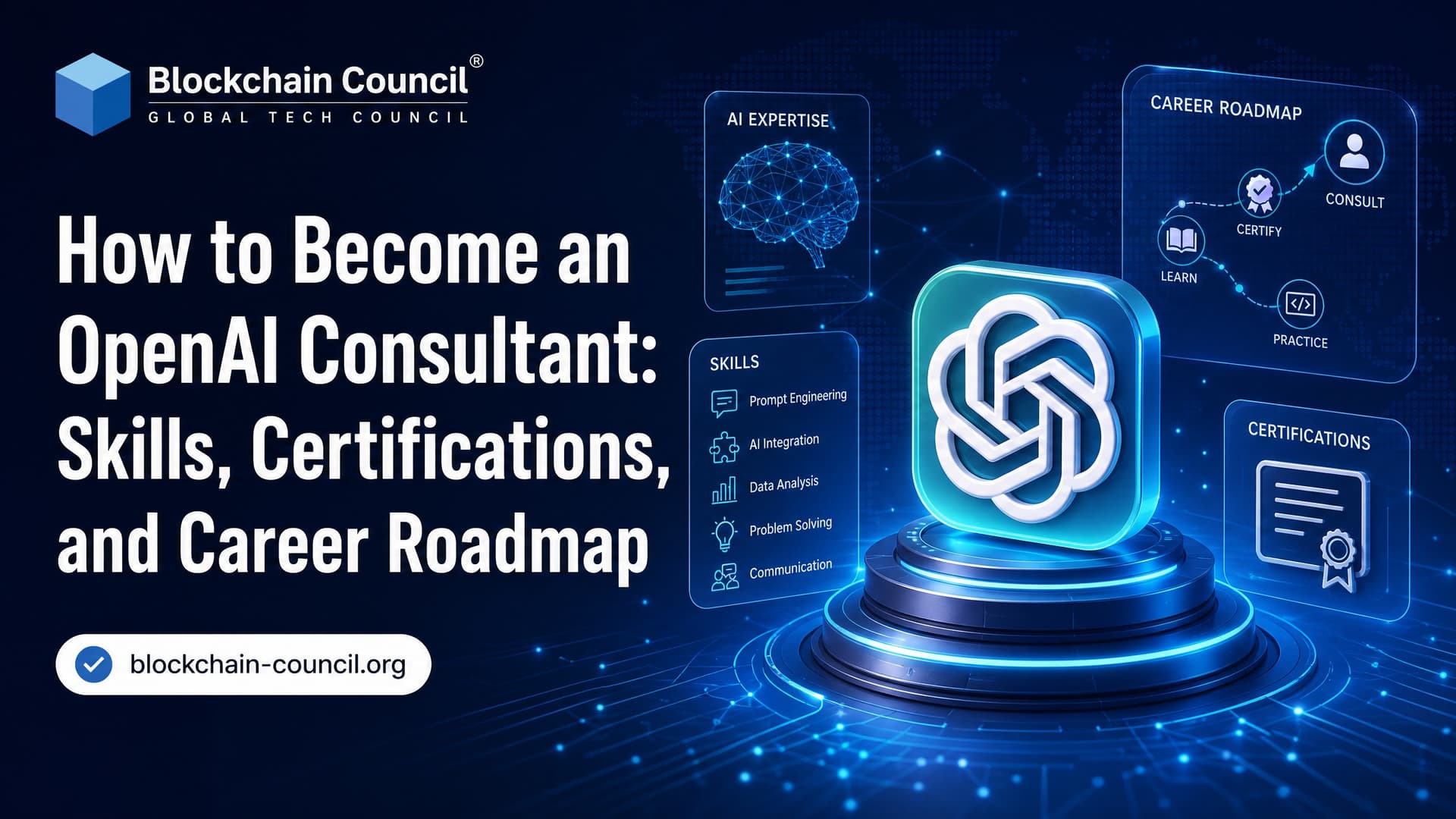
An OpenAI consultant helps organizations design, build, integrate, and govern AI solutions using OpenAI models and tools. The work is not just prompt writing. You need software judgment, data literacy, security awareness, and the ability to turn vague business problems into working AI systems.
By 2026, this role sits somewhere between AI engineer, solutions architect, product consultant, and governance advisor. Some employers call it an AI consultant, generative AI consultant, AI solutions architect, or OpenAI specialist. The title varies. The skill set is getting clearer.

As organizations move from experimentation to enterprise-scale AI adoption, interest in the Certified OpenAI Consultant credential is growing among professionals who help businesses evaluate AI opportunities, design implementation roadmaps, manage governance requirements, and deliver measurable outcomes from AI initiatives.
What Does an OpenAI Consultant Do?
An OpenAI consultant works with clients or internal teams to find where OpenAI models can improve workflows, products, or services. Typical projects include knowledge assistants, customer support copilots, document automation, code assistants, structured extraction tools, and AI training programs for staff.
On a real engagement, your work may include:
Running discovery workshops to find high-value AI use cases.
Designing prototypes with GPT models, embeddings, speech, vision, or tool-calling features.
Connecting OpenAI APIs to CRMs, ERPs, internal web apps, data warehouses, and knowledge bases.
Building retrieval-augmented generation, often called RAG, for proprietary documents.
Setting evaluation criteria for accuracy, latency, cost, tone, and safety.
Creating governance rules for access, logging, human review, and data handling.
Training business users so the tool is actually adopted after launch.
To be blunt, the best consultants are not the people who write the cleverest prompt. They are the people who know when a prompt is not enough.
Why OpenAI Consulting Is Growing
Demand is rising because companies have moved past curiosity. They now want measurable results from generative AI. OpenAI's certification work, its enterprise rollout of ChatGPT, and the wider hiring push around applied AI all point the same way: organizations need people who can make AI useful at work, not just impressive in a demo.
Compensation data shows why the skill set is attractive. Public salary bands for research engineer and research scientist roles at OpenAI have commonly appeared in the high six figures, with some ranges around USD 295,000 to 555,000 depending on role and level. Senior AI engineers who work with foundation models at top technology firms can also reach total compensation in the USD 350,000 to 550,000 range. Those figures are not consultant-specific, but they show the market value of advanced applied AI skills.
The consulting market has its own logic. Clients pay for reduced risk. If you can scope a project, estimate ROI, build a safe prototype, guide procurement, and train users, you are far more valuable than someone who only knows the API syntax.
Core Skills You Need to Become an OpenAI Consultant
1. Software and Integration Skills
You should be comfortable building production-grade services in Python or JavaScript/TypeScript. Python is often the better first choice for AI consulting because the data and ML ecosystem is stronger. TypeScript earns its place when you are closer to product engineering and frontend-heavy applications.
You need to know how to:
Build REST APIs and backend services.
Work with authentication, secrets, and environment variables.
Deploy applications on cloud platforms.
Log requests, failures, latency, and token usage.
Handle retries, rate limits, and partial failures.
One practical detail: many older tutorials still use openai.ChatCompletion.create. With the OpenAI Python SDK 1.x, that pattern raises APIRemovedInV1. If you cannot debug that quickly, a client demo can go sideways in five minutes. Keep your SDK knowledge current.
2. OpenAI API and Model Skills
You need hands-on experience with OpenAI tools, not just ChatGPT as an end user. Learn how model choice, context length, temperature, structured outputs, embeddings, and tool calling change system behavior.
Build small systems that use:
Chat and reasoning models for workflow assistance.
Embeddings for semantic search.
RAG pipelines for internal documents.
Vision models for document or image understanding.
Speech models for transcription or voice applications.
Evaluation scripts that compare prompts and model outputs.
Do not skip evaluation. A chatbot that sounds confident but gives wrong policy answers is worse than no chatbot. In consulting work, define test sets, expected answers, escalation rules, and unacceptable outputs before deployment.
3. Data, RAG, and Knowledge Architecture
Most enterprise OpenAI projects involve private data. So you need to understand chunking, metadata, vector search, access control, and document freshness.
A common beginner mistake is dumping 400-page PDFs into a RAG pipeline and expecting clean answers. The better approach is to split documents by meaningful sections, preserve headings as metadata, store source references, and test retrieval before you test generation. If retrieval fails, the model will improvise. And improvised legal advice is not what your client paid for.
4. Consulting and Business Analysis
An OpenAI consultant must ask better questions than the client does. Start with workflow pain, not model features.
Ask questions like:
Which task is slow, expensive, repetitive, or error-prone?
Who approves the final output?
What would a 20 percent improvement be worth?
What data is available, and who is allowed to see it?
What happens if the AI is wrong?
This is where many technical professionals struggle. They present architecture diagrams too early. First map the process. Then define the smallest useful AI solution.
5. Governance, Risk, and Ethics
Governance is now part of the job. You should understand data protection, auditability, human-in-the-loop review, bias risk, and sector-specific rules. The EU AI Act, privacy laws such as GDPR, and internal risk controls all matter when AI touches hiring, lending, healthcare, legal review, or financial advice.
Good governance includes:
Clear acceptable-use policies.
Role-based access to AI tools and data sources.
Human review for high-risk outputs.
Documentation of prompts, models, datasets, and evaluations.
Monitoring after launch, not just before launch.
Best Certifications for an OpenAI Consultant
Certifications are useful signals. They are not a substitute for project work. The right mix depends on your background.
OpenAI Certifications
OpenAI has introduced certification paths meant to validate practical AI skills, with early areas covering AI fundamentals and ChatGPT use at work. For aspiring OpenAI consultants, these credentials can help prove baseline fluency with OpenAI tools, especially when paired with hands-on projects.
Blockchain Council Certifications to Consider
Blockchain Council offers several certification paths that fit professionals building AI consulting careers:
Certified Artificial Intelligence (AI) Expert - a strong fit if you need broader AI concepts, use cases, and implementation knowledge.
Certified Generative AI Expert - useful if your work focuses on generative AI applications, content systems, copilots, and automation.
Certified Prompt Engineer - suitable for professionals who need stronger prompt design, testing, and output control skills.
Certified ChatGPT Expert - relevant for teams building business workflows around ChatGPT and related OpenAI tools.
If you are technical, pair these with cloud or data credentials. If you come from a business background, start with AI and prompt engineering foundations, then build a portfolio that proves implementation ability.
Career Roadmap: How to Become an OpenAI Consultant
Stage 1: Foundations, 0-6 Months
Learn Python or TypeScript. Study basic machine learning, APIs, databases, and cloud deployment. Complete an introductory AI or OpenAI-oriented course. Build three small projects: a document summarizer, a customer FAQ assistant, and a simple RAG app over your own notes.
Keep the projects small. Finished beats ambitious and broken.
Stage 2: Applied Practitioner, 6-18 Months
Move from demos to usable tools. Add authentication, logging, error handling, feedback buttons, and cost tracking. Learn embeddings and vector databases such as Pinecone, Weaviate, Chroma, or pgvector.
At this stage, take on internal pilots or freelance projects. A practical example: build a policy assistant for HR that retrieves answers only from approved documents and shows source links. That kind of case study is far stronger than a generic chatbot screenshot.
Stage 3: Specialist Consultant, 2-5 Years
Pick a domain. Finance, healthcare, legal, manufacturing, education, and customer service all carry different risk profiles. Specialization helps you price your work, speak the client's language, and avoid shallow advice.
You should be able to lead discovery, architecture, implementation, testing, training, and post-launch review. You should also know when not to use OpenAI. For deterministic calculations, regulatory recordkeeping, or simple rule-based routing, traditional software is often safer and cheaper.
Stage 4: Strategic Advisor or Practice Lead, 5+ Years
At senior levels, you advise executives on AI strategy, operating models, governance, vendor selection, and portfolio planning. You may manage teams, define reusable delivery playbooks, and create enterprise-wide AI enablement programs.
Your value shifts from building one assistant to helping an organization decide which 20 AI ideas deserve funding, which 5 should be piloted, and which 2 should be stopped immediately.
Portfolio Projects That Prove You Can Consult
Your portfolio should show business impact, not just code. Include short case studies with the problem, users, architecture, evaluation method, risks, and result.
Strong portfolio ideas include:
Internal knowledge assistant: RAG over policies, handbooks, or technical docs with source citations.
Support triage tool: classifies tickets, drafts replies, and escalates sensitive cases.
Contract review assistant: extracts clauses, flags missing terms, and routes to human review.
Sales enablement copilot: summarizes account notes and drafts follow-up emails from approved context.
Developer documentation assistant: answers questions from code docs and links to source files.
What to Learn Next
If you want to become an OpenAI consultant, follow one clear path: learn Python, build a RAG application, add evaluation, document the trade-offs, and earn a recognized AI certification. Then repeat in a real domain.
For a structured route, begin with Blockchain Council's Certified Artificial Intelligence (AI) Expert or Certified Generative AI Expert, then add Certified Prompt Engineer if your work involves prompt-heavy solution design. Your next milestone is simple: build one AI assistant that a real user can test, criticize, and improve.
As AI solutions become more closely tied to customer experience and business outcomes, a Marketing Certification can also help professionals better understand user needs, product positioning, customer engagement, and the adoption strategies that drive successful AI implementations.
FAQs
1. What Is an OpenAI Consultant?
An OpenAI Consultant helps organizations understand, implement, optimize, and govern AI solutions built with OpenAI technologies, including chatbots, workflow automation, content generation, customer support systems, and AI-powered business applications.
2. What Does an OpenAI Consultant Do?
An OpenAI Consultant advises businesses on AI strategy, use case development, prompt engineering, workflow automation, AI integration, employee training, and implementation best practices.
3. Why Is Demand Growing for OpenAI Consultants?
Organizations across industries are adopting generative AI to improve productivity, reduce costs, automate processes, and enhance customer experiences, creating demand for AI expertise.
4. What Skills Are Required to Become an OpenAI Consultant?
Key skills include AI fundamentals, prompt engineering, business analysis, workflow design, communication, project management, automation tools, and basic technical integration knowledge.
5. Do You Need a Technical Background to Become an OpenAI Consultant?
Not necessarily. While technical knowledge is helpful, many successful consultants come from business, marketing, operations, product management, and consulting backgrounds.
6. What Is Prompt Engineering and Why Is It Important?
Prompt engineering involves designing effective instructions for AI systems to generate accurate, useful, and reliable outputs for specific business objectives.
7. How Important Is Understanding Large Language Models (LLMs)?
A strong understanding of LLMs is essential because they form the foundation of many AI applications and business use cases.
8. What Business Skills Should an OpenAI Consultant Develop?
Important skills include stakeholder communication, problem-solving, business process analysis, change management, strategy development, and ROI evaluation.
9. Which Industries Hire OpenAI Consultants?
Industries such as healthcare, finance, education, marketing, legal services, retail, manufacturing, technology, and professional services increasingly seek AI consulting expertise.
10. What Certifications Can Help Aspiring OpenAI Consultants?
Certifications in AI, machine learning, prompt engineering, cloud computing, data analytics, digital transformation, and AI governance can strengthen credibility.
11. How Important Is AI Governance Knowledge?
AI governance knowledge is increasingly important because organizations need guidance on privacy, compliance, security, risk management, and responsible AI practices.
12. Should OpenAI Consultants Learn Automation Platforms?
Yes, familiarity with workflow automation tools and business process automation platforms can significantly increase consulting value.
13. What Technical Skills Are Useful for OpenAI Consultants?
Useful skills include API fundamentals, data analysis, no-code and low-code tools, basic programming, integrations, and AI workflow development.
14. How Can Beginners Gain Practical Experience?
Beginners can build AI projects, create automation workflows, develop chatbots, conduct AI audits, and solve real business problems using generative AI tools.
15. Why Is Building a Portfolio Important?
A portfolio demonstrates practical skills, showcases successful implementations, and helps potential clients understand the consultant's expertise.
16. What Types of Projects Should Be Included in an AI Consulting Portfolio?
Projects may include AI chatbots, marketing automation systems, content workflows, customer support solutions, productivity tools, and AI strategy case studies.
17. How Can Someone Find Their First OpenAI Consulting Clients?
Consultants often start through networking, LinkedIn outreach, referrals, freelancing platforms, content marketing, workshops, and industry communities.
18. What Career Paths Can Lead to OpenAI Consulting?
Common backgrounds include digital marketing, business consulting, software development, project management, product management, operations, and data analytics.
19. What Common Mistakes Should New OpenAI Consultants Avoid?
Common mistakes include focusing only on technology, ignoring business outcomes, lacking governance knowledge, overpromising AI capabilities, and failing to demonstrate measurable value. Clients generally care less about model specifications and more about whether the solution saves time, increases revenue, or solves a real problem.
20. What Is a Practical Career Roadmap to Become an OpenAI Consultant?
A practical roadmap includes learning AI fundamentals, mastering prompt engineering, understanding business workflows, earning relevant certifications, building a portfolio, gaining hands-on experience, developing consulting skills, learning AI governance, and continuously staying updated on emerging AI technologies. By combining technical understanding with business expertise, aspiring professionals can position themselves as valuable OpenAI consultants in a rapidly growing market.
Related Articles
View All
AI & ML
OpenAI Consulting as a Freelance Career: How to Land Clients and Build a Practice
Freelance OpenAI consulting is becoming a high-demand career as businesses seek experts to implement AI solutions. Learn how to find clients, build a strong portfolio, price your services, and grow a successful consulting practice.

AI & ML
OpenAI Consultant vs ChatGPT Specialist: What's the Difference and Which Pays More?
OpenAI Consultants and ChatGPT Specialists both work with AI technologies, but their roles, responsibilities, technical expertise, and earning potential differ. Learn which career path best fits your skills and goals in the evolving AI industry.

AI & ML
Is the Certified OpenAI Consultant Certification Worth It? An Honest Review for 2026
The Certified OpenAI Consultant certification aims to validate expertise in implementing OpenAI technologies for business solutions. Explore its curriculum, career value, potential benefits, and whether it is worth pursuing in 2026.
Trending Articles
The Role of Blockchain in Ethical AI Development
How blockchain technology is being used to promote transparency and accountability in artificial intelligence systems.
AWS Career Roadmap
A step-by-step guide to building a successful career in Amazon Web Services cloud computing.
What is AWS? A Beginner's Guide to Cloud Computing
Everything you need to know about Amazon Web Services, cloud computing fundamentals, and career opportunities.