

OpenAI Consultant vs ChatGPT Specialist: What's the Difference and Which Pays More?

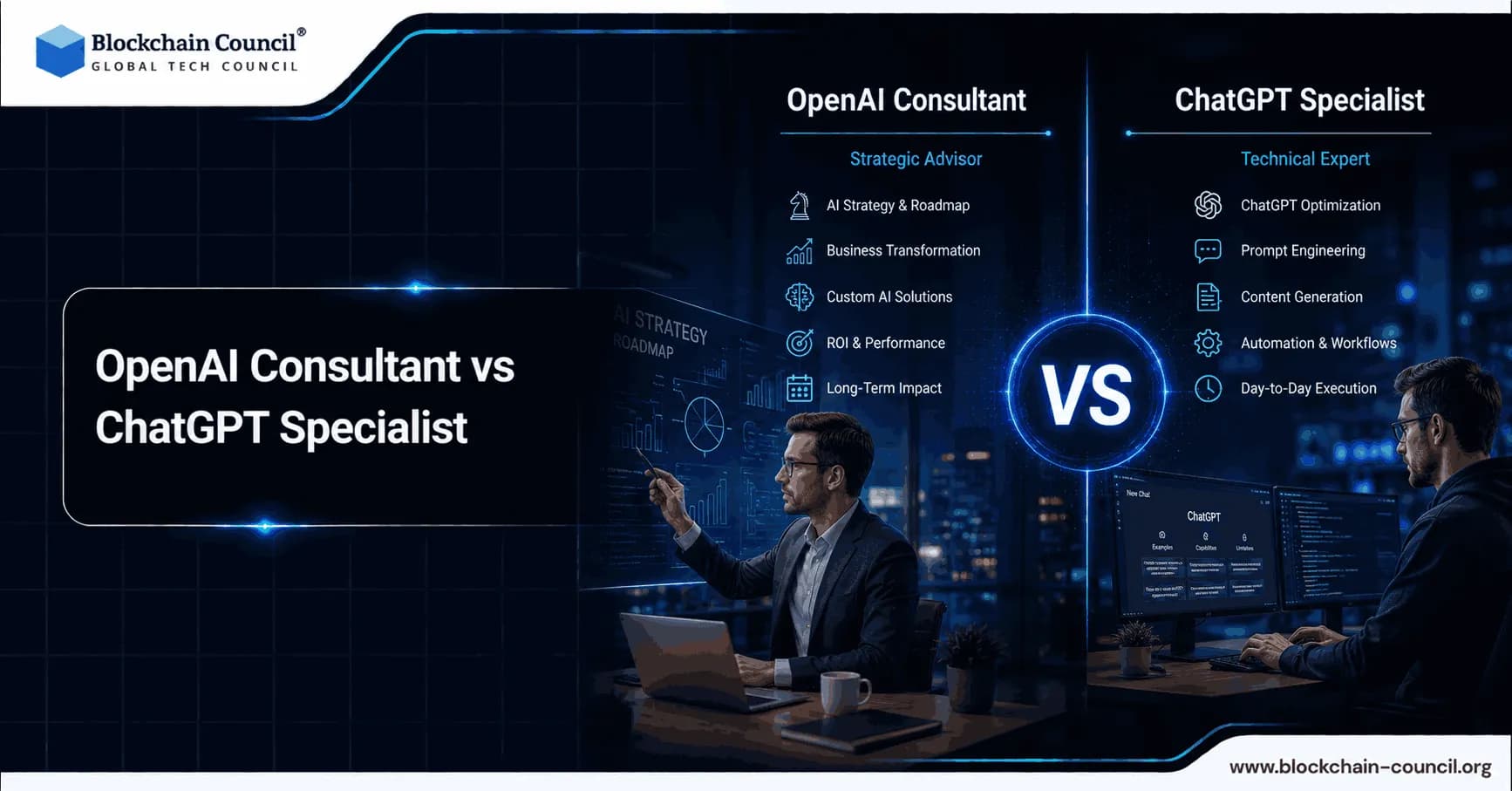
Two job titles are dominating AI hiring conversations in 2026: OpenAI Consultant and ChatGPT Specialist. Consequently, professionals at every career stage are asking the same question what exactly separates these roles, and which one offers greater earning potential? Furthermore, the answer is not as straightforward as most job descriptions suggest.
When comparing OpenAI Consultant vs ChatGPT Specialist, the distinction matters enormously for career planning, compensation negotiation, and credential selection. Specifically, these roles differ in scope, seniority, technical depth, and the type of value they deliver to organizations. Therefore, understanding these differences before investing in training and certification is essential.

Moreover, professionals who wish to enter the OpenAI Consultant track should explore the structured OpenAI Consultant Certification program, which directly prepares practitioners for the strategic and deployment dimensions of enterprise AI consulting. Consequently, it provides a recognized credential that hiring managers and clients actively look for in 2026.
This article breaks down both roles in depth, compares their salary data from verified 2026 sources, and helps you determine which path best aligns with your professional goals.
Defining the Two Roles: OpenAI Consultant vs ChatGPT Specialist
Before comparing salaries, it is essential to understand what each role actually involves. Specifically, the two titles reflect fundamentally different orientations toward AI work, even though they share a common technological foundation.
What Is an OpenAI Consultant?
An OpenAI Consultant is a strategic and technical professional who helps organizations design, deploy, and scale AI solutions built on OpenAI's platform. Specifically, the role involves identifying high-value business use cases, structuring implementation roadmaps, integrating AI into existing enterprise systems, and ensuring responsible governance of AI outputs.
Furthermore, OpenAI Consultants work across the full engagement lifecycle. They conduct discovery sessions with client stakeholders, assess workflow readiness, configure and test AI deployments, and manage ongoing optimization after go-live. Therefore, the role demands a combination of technical fluency and business acumen that goes significantly beyond tool proficiency alone.
Additionally, consulting firms, systems integrators, and independent practitioners fill this role. As the OpenAI Consultant vs ChatGPT Specialist comparison reveals, consultants tend to operate at the organizational level, advising on strategy and implementation rather than focusing exclusively on model interaction design.
What Is a ChatGPT Specialist?
A ChatGPT Specialist often also referred to as a prompt engineer or ChatGPT prompt professional focuses primarily on designing, testing, and refining prompts and conversational workflows within ChatGPT-based systems. Specifically, this role centers on optimizing how the model interprets inputs and generates outputs that serve specific business or user needs.
Moreover, ChatGPT Specialists work closely with product managers, content teams, developers, and data scientists to align prompt systems with organizational goals. Consequently, they are responsible for iterating on prompt frameworks, documenting model behavior patterns, running A/B evaluations, and maintaining quality across deployed conversational systems.
Furthermore, the role has evolved significantly since 2023. In 2026, the highest-paying ChatGPT Specialist positions increasingly require adjacent technical skills such as Python scripting, API integration, retrieval-augmented generation (RAG) implementation, and version control. Therefore, the days of the role being solely about writing clever text prompts are firmly behind us.
Core Differences Between OpenAI Consultants and ChatGPT Specialists
Understanding the key distinctions between these two roles is critical for making an informed career decision. Specifically, five dimensions separate them most clearly.
Scope of Work
OpenAI Consultants operate at the organizational level. Consequently, they assess entire business functions, recommend AI adoption strategies, and oversee multi-system integrations. In contrast, ChatGPT Specialists operate at the product or workflow level, focusing on the performance of specific AI-powered interfaces and conversational pipelines.
Therefore, a consultant might determine that an enterprise should deploy AI-powered customer service, procurement automation, and internal knowledge management simultaneously. Conversely, a ChatGPT Specialist on that same project would be responsible for building and refining the specific prompt systems that power each of those tools.
Technical Depth Required
Both roles require technical capability, but the nature of that capability differs substantially. Specifically, OpenAI Consultants need enterprise API integration knowledge, governance framework expertise, change management competency, and business case development skills. Furthermore, they must be able to communicate technical realities to non-technical executives and translate organizational objectives into AI deployment specifications.
ChatGPT Specialists, on the other hand, require deeper hands-on familiarity with model behavior, prompt engineering methodologies including zero-shot, few-shot, and chain-of-thought techniques and evaluation frameworks. Moreover, senior Specialist roles increasingly demand Python proficiency, API management skills, and experience with agentic frameworks such as LangChain or the OpenAI Agent SDK.
Client and Stakeholder Relationships
OpenAI Consultants are typically client-facing in a strategic advisory capacity. Therefore, they engage with C-suite executives, department heads, and procurement teams throughout an engagement. Consequently, communication, persuasion, and structured problem-framing skills carry as much weight as technical knowledge.
ChatGPT Specialists more commonly work within product, engineering, or content teams in an internal or cross-functional capacity. Moreover, while they also communicate with stakeholders, their primary outputs are tested, documented, and scalable prompt systems rather than strategic recommendations. Therefore, the primary success metric for a Specialist is measurable AI output quality, not stakeholder alignment alone.
Key Deliverables
The deliverables for each role reflect their different orientations clearly. Specifically:
OpenAI Consultant Deliverables: AI strategy roadmaps, use case assessments, integration architecture plans, governance frameworks, ROI models, and implementation project management.
ChatGPT Specialist Deliverables: Prompt libraries, evaluation datasets, model performance reports, workflow documentation, custom GPT configurations, and A/B test results.
Therefore, while both roles contribute to the same AI transformation outcome, they do so from distinct vantage points. Consequently, organizations with mature AI adoption strategies typically need both profiles working in coordination rather than treating them as interchangeable.
Skills Comparison: What Each Role Demands
A direct skills comparison between OpenAI Consultant vs ChatGPT Specialist helps professionals identify where their current background fits and what gaps they need to close.
Skills Required for an OpenAI Consultant
Enterprise AI Strategy: Ability to assess business processes, identify automation opportunities, and prioritize AI investment areas based on impact and feasibility.
OpenAI Platform Expertise: Deep knowledge of the full OpenAI product suite including GPT-4o, GPT-4 Turbo, Assistants API, Batch API, and enterprise deployment options.
API Integration and Systems Architecture: Understanding how to connect OpenAI services to enterprise systems including CRMs, ERPs, and data pipelines.
AI Governance and Compliance: Knowledge of responsible AI principles, data privacy regulations, bias mitigation, and audit trail design.
Client Management and Communication: Ability to run structured discovery sessions, present findings to executives, and manage multi-stakeholder projects.
Change Management: Competency in guiding organizations through workflow redesign and cultural adoption of AI tools.
Additionally, consultants who expand their expertise into MLOps practices through a recognized MLOps Certification gain a significantly stronger command of production AI lifecycle management. Therefore, understanding model deployment pipelines, monitoring, and retraining cycles makes a consultant substantially more valuable to enterprise clients building long-term AI infrastructure.
Skills Required for a ChatGPT Specialist
Advanced Prompt Engineering: Mastery of zero-shot, few-shot, chain-of-thought, tree-of-thought, and constitutional AI prompting methodologies.
Model Behavior Analysis: Deep understanding of how ChatGPT and GPT models interpret context, handle ambiguity, and generate outputs across different configurations.
Python and API Integration: Ability to automate prompt testing, build evaluation scripts, and work with the OpenAI API programmatically.
RAG Implementation: Knowledge of retrieval-augmented generation systems that connect language models to external knowledge bases.
Quality Evaluation Frameworks: Ability to design and run systematic A/B tests, build evaluation datasets, and track prompt performance metrics over time.
Version Control and Documentation: Proficiency with Git-based version control for managing prompt libraries and tracking iterative improvements.
Salary Comparison: Which Role Pays More in 2026?
The central question in any OpenAI Consultant vs ChatGPT Specialist analysis is compensation. Specifically, 2026 salary data from verified sources reveals a meaningful and structured difference between the two roles.
OpenAI Consultant Salary Data for 2026
According to Glassdoor's June 2026 data, the average salary for an AI consultant in the United States stands at $208,223 per year, with a typical range of $156,167 at the 25th percentile to $286,597 at the 75th percentile. Furthermore, top earners at the 90th percentile report total compensation reaching $377,319 annually.
Moreover, independent AI consultants command even stronger rates. Specifically, hourly rates for independent practitioners range from $150 to $300 per hour, with high-specialization consultants particularly those working in healthcare compliance, financial risk modeling, or legal technology frequently generating over $200,000 annually. Additionally, retainer arrangements typically run between $2,000 and $10,000 per month, while full project engagements range from $15,000 to $50,000 depending on scope.
Furthermore, the AI consulting market itself is growing at 28.8% CAGR and is projected to reach $257.6 billion by 2033. Consequently, consultant earning potential is expected to continue rising in tandem with market expansion.
ChatGPT Specialist Salary Data for 2026
ChatGPT Specialist compensation varies significantly based on the technical depth and seniority of the specific role. Specifically, ZipRecruiter's June 2026 data places the average hourly rate for a ChatGPT Consultant at $49.72, translating to approximately $103,000 annually for salaried roles. Furthermore, the majority of workers in this category earn between $60,500 and $148,000 per year.
For prompt engineers, specifically the most common ChatGPT Specialist job title, Glassdoor reports an average annual salary of $128,000 in 2026, with top earners reaching $165,000. Moreover, Bloomberg has documented that some elite prompt engineering roles at major technology companies can command salaries as high as $335,000. Therefore, significant upside exists for specialists who develop highly technical, full-stack prompt engineering capabilities.
Additionally, hourly rates for ChatGPT Prompt Engineers on ZipRecruiter average $55.99 per hour in May 2026, with experienced practitioners earning between $40.14 and $74.52 per hour depending on specialization and employer. Consequently, the ceiling for specialized technical prompt engineering is substantially higher than entry-level ChatGPT roles.
Direct Salary Comparison: The Verdict
The numbers tell a clear story. Specifically, the OpenAI Consultant role commands a higher overall compensation ceiling, with average salaries exceeding $208,000 and top earners approaching $380,000 annually. In contrast, the ChatGPT Specialist role has a lower average approximately $103,000 to $128,000 but elite technical specialists can push significantly beyond that range.
Therefore, the OpenAI Consultant path pays more on average. However, a highly technical senior ChatGPT Specialist with RAG expertise, Python fluency, and API integration skills can approach or even match mid-tier consultant compensation. Consequently, the gap narrows considerably as technical specialization increases.
Furthermore, professionals who hold both strategic consulting capabilities and deep technical prompt engineering skills are in the strongest position of all. As a result, the most effective career strategy is often not choosing between these roles but developing genuine depth in both directions.
Career Paths and Progression for Each Role
Career Progression for OpenAI Consultants
OpenAI Consultants typically progress from project-level implementation roles toward senior advisory positions, practice leadership, and eventually partner-level engagements. Specifically, early-career consultants focus on single-project deployments and technical configuration, while mid-career practitioners take on multi-stakeholder strategy engagements and team leadership.
Moreover, senior consultants who develop deep industry specialization in finance, healthcare, or legal technology, for example command the strongest market premiums. Furthermore, professionals who have invested in formal credentials demonstrate a structured knowledge baseline that accelerates both client trust and internal advancement. Consequently, certification acts as a compressor of the typical credibility-building timeline.
Career Progression for ChatGPT Specialists
ChatGPT Specialists typically progress from prompt design roles into senior prompt engineering positions, then into AI product management, LLM engineering, or AI solutions architecture. Specifically, early-career specialists focus on individual prompt systems, while senior practitioners design entire evaluation frameworks and multi-model AI pipelines.
Furthermore, specialists who add Python development, agentic workflow design, and RAG system implementation to their profile increasingly find that their compensation trajectory converges with that of AI engineers and consultants. Consequently, the pure prompt engineering specialization is evolving rapidly into a hybrid technical-product role in 2026.
Additionally, professionals in marketing, content strategy, and communications are finding the ChatGPT Specialist path particularly accessible. Moreover, those who combine this technical foundation with a structured Marketing Certification can deliver a distinctive hybrid profile capable of managing AI-powered marketing systems with both technical precision and commercial intelligence. Therefore, this combination is becoming increasingly valuable as organizations seek professionals who bridge the gap between AI operations and business outcomes.
Which Role Is Right for You?
The right choice between OpenAI Consultant vs ChatGPT Specialist depends on your existing strengths, career objectives, and the type of professional environment you thrive in. Specifically, the following profiles tend to gravitate naturally toward each path.
Choose the OpenAI Consultant Path If You:
Have prior experience in consulting, project management, or enterprise technology strategy.
Prefer working directly with clients at a strategic level rather than building technical systems.
Are comfortable managing multi-stakeholder projects and navigating organizational complexity.
Want the highest average compensation ceiling in the AI professional services market.
Are building an independent practice or joining a consulting firm's AI capability.
Have or want to earn a recognized credential in OpenAI deployment and enterprise consulting.
Choose the ChatGPT Specialist Path If You:
Have a background in content creation, linguistics, NLP, or software development.
Prefer deep technical work on AI systems over client-facing advisory engagements.
Are interested in building and optimizing the AI tools that organizations actually use day-to-day.
Want a faster entry point into AI roles without requiring full consulting experience.
Are willing to invest in Python, API integration, and RAG system skills to maximize earning potential.
Work within a product team, marketing department, or internal technology function.
Stacking Credentials to Maximize Your Market Value
The strongest AI professionals in 2026 are not limited to a single credential or specialization. Specifically, professionals who strategically layer certifications and practical skills across both strategic and technical domains command the highest market rates and the widest range of opportunities.
A Recommended Credential Stack for Maximum Earning Potential
First, establishing formal competency in enterprise AI deployment through the OpenAI Consultant Certification provides a recognized foundation for strategic advisory work. Consequently, this credential signals verified readiness to enterprise clients and employers evaluating AI implementation talent.
Second, adding a recognized MLOps Certification provides critical depth in the production and operations side of AI deployment. Specifically, understanding model monitoring, pipeline management, retraining cycles, and infrastructure considerations makes a consultant or specialist dramatically more valuable to organizations building production-grade AI systems. Therefore, this credential bridges the gap between strategic planning and technical execution.
Third, professionals who serve client-facing, marketing, or business strategy functions benefit substantially from a structured Marketing Certification that builds commercial and customer strategy expertise. Consequently, this credential enables practitioners to frame AI recommendations in terms of revenue impact, customer acquisition, and competitive positioning. Moreover, it is especially powerful for professionals who serve as the bridge between AI capabilities and business outcomes.
Together, these three credentials create a multi-dimensional professional profile that addresses enterprise AI adoption from strategic, technical, and commercial angles simultaneously. Therefore, practitioners who invest in this credential stack position themselves at the highest tier of the AI consulting and specialist market.
Conclusion
The comparison of OpenAI Consultant vs ChatGPT Specialist reveals two distinct but complementary professional roles in the 2026 AI landscape. Specifically, OpenAI Consultants command higher average compensation with salaries averaging over $208,000 and independent practitioners earning $150 to $300 per hour while senior ChatGPT Specialists with strong technical skills can approach or match mid-tier consultant compensation.
Furthermore, the roles differ fundamentally in scope, deliverables, and required skills. Specifically, OpenAI Consultants operate at the organizational strategy level, while ChatGPT Specialists focus on optimizing AI model performance within specific workflows and product systems. Therefore, career decisions should be based on a clear assessment of personal strengths, preferred work style, and long-term earnings goals rather than on title prestige alone.
Moreover, professionals who invest in the OpenAI Consultant Certification gain the structured knowledge and recognized credential that enterprise clients actively seek in 2026. Consequently, certification accelerates the trust-building timeline that every new consultant or specialist must navigate. Additionally, stacking complementary credentials in MLOps and marketing creates a multi-dimensional professional profile that commands the strongest market positioning.
Therefore, whether you choose the Consultant or Specialist path or wisely develop depth in both the OpenAI Consultant vs ChatGPT Specialist decision ultimately comes down to where you want to create value within the rapidly growing enterprise AI ecosystem. As a result, act decisively, credential strategically, and build a portfolio of real-world outcomes that your title alone can never fully convey.
Frequently Asked Questions (FAQs)
1. What is the main difference between an OpenAI Consultant and a ChatGPT Specialist?
An OpenAI Consultant operates at the organizational strategy level advising on AI adoption, overseeing enterprise deployments, and managing stakeholder relationships. In contrast, a ChatGPT Specialist focuses on optimizing how AI models perform within specific workflows and product systems.
2. Which role pays more OpenAI Consultant or ChatGPT Specialist?
OpenAI Consultants earn more on average. Glassdoor's 2026 data puts the average AI consultant salary at $208,223 annually, while ChatGPT Specialists average between $103,000 and $128,000. However, elite technical specialists with Python, RAG, and API skills can approach mid-tier consultant compensation.
3. Do ChatGPT Specialists need coding skills in 2026?
Yes, increasingly. The highest-paying ChatGPT Specialist roles in 2026 require Python proficiency, API integration experience, and familiarity with agentic frameworks. Consequently, the role has evolved well beyond writing text prompts into a technical systems design function.
4. Can I transition from a ChatGPT Specialist to an OpenAI Consultant?
Yes. Specialists who develop enterprise strategy skills, client communication competency, and formal consulting credentials can transition effectively. Furthermore, deep prompt engineering experience provides a strong technical foundation for consulting work. Therefore, the transition is well-supported by the existing skill overlap.
5. What industries hire OpenAI Consultants most actively?
Financial services, healthcare, legal technology, customer experience, supply chain, and professional services are the most active hiring industries. Moreover, any sector undertaking large-scale AI transformation creates demand for strategic consulting expertise.
6. What industries hire ChatGPT Specialists most actively?
Technology companies, marketing agencies, media organizations, healthcare technology providers, and e-commerce businesses are leading employers. Furthermore, any company deploying conversational AI or AI-powered content systems needs specialist expertise.
7. How do independent consulting rates compare for each role?
Independent OpenAI Consultants typically charge $150 to $300 per hour with retainers of $2,000 to $10,000 per month. Independent ChatGPT Specialists charge $40 to $100 per hour for contract work, with senior practitioners reaching $150 per hour for specialized engagements.
8. Is a formal certification necessary for either role?
Certification is not legally required, but it significantly accelerates market entry and trust-building for both roles. Moreover, 63% of hiring managers in 2026 now require verified AI credentials before shortlisting candidates, making certification increasingly non-negotiable.
9. What is RAG and why does it matter for ChatGPT Specialists?
Retrieval-augmented generation (RAG) connects language models to external knowledge bases, enabling AI systems to answer questions using current, organization-specific data. Consequently, ChatGPT Specialists who understand RAG implementation can build far more accurate and useful enterprise AI systems.
10. What does an OpenAI Consultant do on a typical client engagement?
They begin with a discovery phase to identify high-value use cases, then design an implementation roadmap, oversee technical deployment, manage stakeholder communication, and provide governance frameworks for ongoing AI operations. Therefore, the role spans strategy, execution, and change management.
11. Can marketing professionals become ChatGPT Specialists?
Yes. Marketing professionals are among the most natural candidates for the ChatGPT Specialist role because they already understand audience context, communication objectives, and content quality standards. Furthermore, pairing these skills with prompt engineering and AI tools creates strong market differentiation.
12. What is the fastest-growing segment of the AI consulting market?
The AI consulting market is projected to grow at a 28.8% CAGR through 2033, reaching $257.6 billion. Specifically, enterprise AI implementation services particularly governance, workflow redesign, and agentic system deployment are the highest-growth segments.
13. How do OpenAI Consultants and ChatGPT Specialists work together?
Consultants identify strategic opportunities and design the overall AI architecture, while Specialists build and optimize the specific prompt systems and AI workflows within that architecture. Consequently, the two roles are most effective when working in coordination rather than isolation.
14. What certifications are most valuable for OpenAI Consultants?
Certifications in OpenAI consulting, MLOps, AI governance, and enterprise technology management are all highly relevant. Furthermore, formal credentials in business strategy and marketing provide additional commercial context that strengthens client advisory capabilities.
15. What is the salary growth rate for AI consulting roles?
AI consultant salary growth averages 15-25% annually during the first five to seven years of a professional's career, according to 2026 market data. Moreover, the overall AI skills wage premium reached 56% above comparable non-AI roles in 2025, according to PwC.
16. Are ChatGPT Specialist roles at risk of being automated?
The basic elements of prompt writing are increasingly automated by AI tools themselves. However, the judgment, evaluation, and systems-design aspects of the ChatGPT Specialist role remain firmly in human hands. Therefore, specialists who develop these higher-order skills are well-protected from displacement.
17. Do OpenAI Consultants need to understand model architecture?
Deep model architecture expertise is not required, but a working understanding of how large language models process inputs, generate outputs, and exhibit failure modes is essential. Consequently, consultants who understand these fundamentals advise clients with much greater precision.
18. How does location affect salaries for both roles?
Location significantly impacts compensation. Specifically, San Francisco Bay Area AI consultants and specialists earn 40-60% above the national average. However, remote work is compressing this gap, and second-tier markets such as Austin and Dallas are emerging as strong alternatives.
19. What is the long-term career ceiling for each role?
OpenAI Consultants can progress to partner-level advisory roles, practice leadership, or Chief AI Officer positions at major organizations. ChatGPT Specialists can advance into senior LLM engineering, AI product management, or solutions architecture roles. Therefore, both paths offer strong long-term career ceilings.
20. Which role should beginners in AI pursue first?
Beginners with a business or communications background typically find the ChatGPT Specialist path more accessible as an entry point, while those with prior consulting or technology strategy experience may enter directly as junior OpenAI Consultants. However, earning a recognized certification in either direction significantly reduces the time needed to reach market-ready competency.
Related Articles
View All
AI & ML
Recursive Self-Improvement vs Recursive Self-Training: What's the Difference?
Recursive self-improvement changes the AI improvement loop itself, while recursive self-training retrains models on self-generated data.
AI & ML
OpenAI Dots vs Grok Bot vs Muse
Compare OpenAI Dots, Grok Bot, and Meta Muse to understand how these always-on AI agents differ in persistent work, computer use, connected apps, automation, and personal or business workflows.
AI & ML
What Is OpenAI Dots?
Learn what OpenAI Dots are, how these always-on AI agents work, and how they use GPT-6 Astra, cloud computers, connected apps, and persistent context to handle ongoing tasks.
Trending Articles
The Role of Blockchain in Ethical AI Development
How blockchain technology is being used to promote transparency and accountability in artificial intelligence systems.

Top 5 DeFi Platforms
Explore the leading decentralized finance platforms and what makes each one unique in the evolving DeFi landscape.
How Blockchain Secures AI Data
Understand how blockchain technology is being applied to protect the integrity and security of AI training data.