

How Forward Deployed Engineers Bridge Product Teams and Enterprise Clients
 Suyash Raizada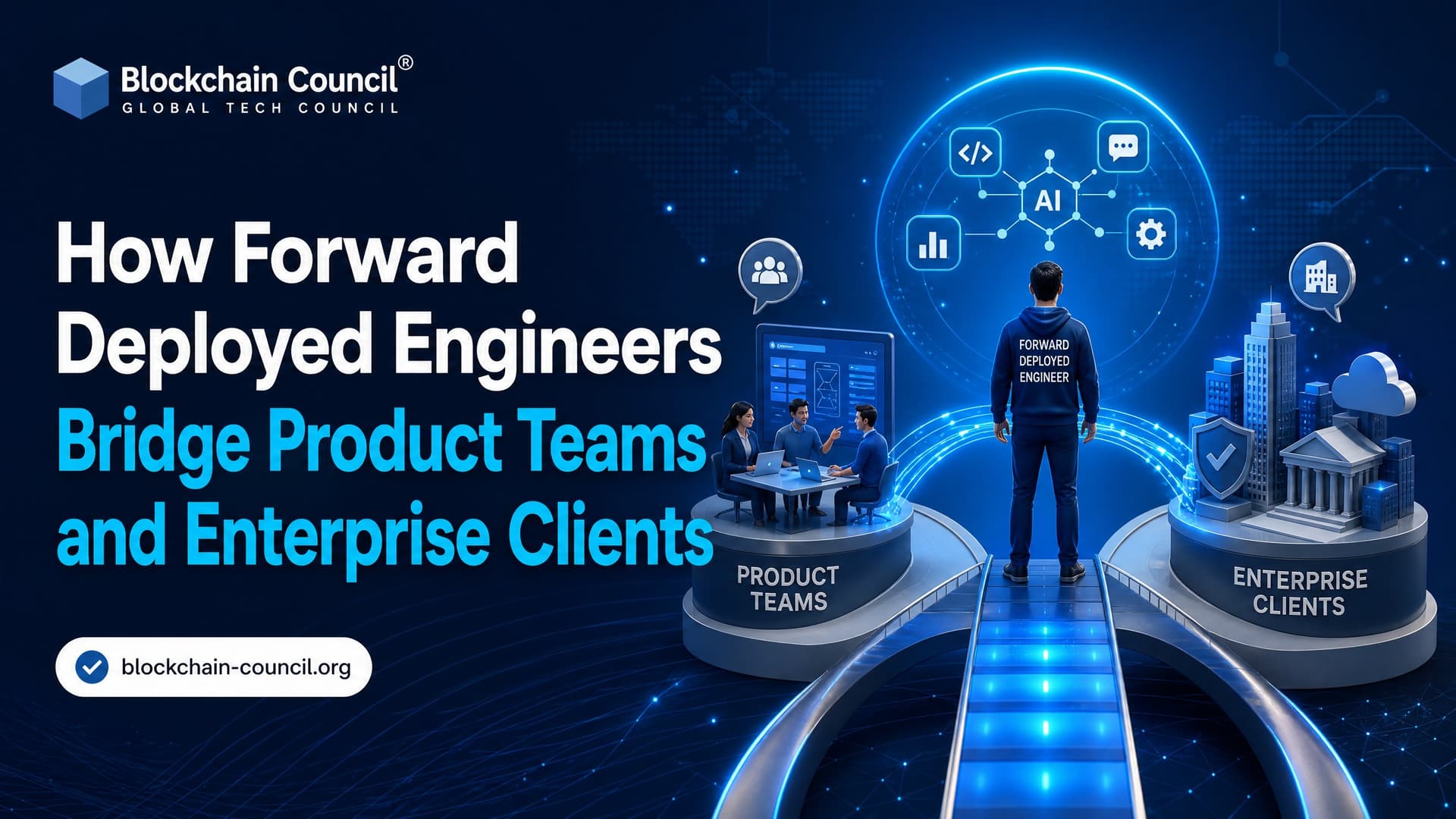
Forward deployed engineers sit where enterprise software usually breaks: between a polished product roadmap and a messy production environment. They write code, map workflows, debug integrations, and carry field evidence back to product teams so the product improves for more than one account.
The role is getting noticed in enterprise AI, data platforms, automation tools, and infrastructure-heavy SaaS. A generic demo may impress a buyer. A live deployment has identity rules, old databases, procurement limits, data residency questions, audit logs, and users who already have five tools open. That is where forward deployed engineers, often called FDEs, earn their place. Understand how Forward Deployed Engineers connect product teams with enterprise customers by translating business needs into scalable technical solutions through a Forward Deployed Engineer Certification, learning deployment and monitoring best practices with an MLOps Certification, and enhancing stakeholder management through a Digital Marketing Course.

What Is a Forward Deployed Engineer?
A forward deployed engineer is a senior technical practitioner embedded in or near a customer environment to design, build, customize, and operate a solution in production. The title sounds military because the operating model is direct and field-based. You are not waiting for tickets to arrive. You are close to the workflow, the users, and the failure modes.
In practice, FDEs combine parts of several jobs:
Software engineer: builds integrations, services, scripts, APIs, data pipelines, and product extensions.
Solution architect: designs how the product fits into cloud, identity, data, and security architecture.
Product partner: identifies repeatable customer pain that should become a core feature.
Customer-facing operator: handles ambiguity, stakeholder meetings, launch pressure, and production incidents.
That mix is hard to hire for. A good FDE can explain OAuth scopes to a security architect in the morning, tune an LLM retrieval pipeline after lunch, and brief a product manager on a missing admin control before the day ends.
Why Enterprises Need FDEs Now
Enterprise adoption of AI and data products has raised the cost of the product-client gap. With normal SaaS, the gap may be a configuration issue. With AI systems, the gap can affect regulatory exposure, data leakage, model reliability, and user trust.
Take a retrieval-augmented generation deployment for a legal or healthcare customer. The model is only one part of the system. You also need document ingestion, a chunking strategy, access control filtering, vector search, prompt design, logging, review workflows, and a fallback path when the answer is uncertain. If the embedding pipeline ignores document permissions, you have a security problem. If the model temperature is left high for policy answers, you may get creative wording when the user needs strict consistency. Small defaults matter.
This is why FDEs have moved from a niche model into a defined function at many enterprise AI and SaaS companies. They help customers get real value without forcing every requirement through a slow product roadmap cycle. Just as important, they keep product teams from building on sales notes or isolated support tickets alone.
How Forward Deployed Engineers Bridge the Gap
They capture the real workflow, not the idealized one
Requirements documents describe how a process is supposed to work. FDEs see how it actually works. That includes spreadsheet handoffs, unofficial approval steps, legacy systems with no clean API, and team-specific exceptions that never make it into the request for proposal.
For example, an enterprise may say it needs CRM integration. The real need is usually more specific: sync only approved account records, preserve field-level permissions, write back AI-generated summaries after manager review, and never send customer notes outside a particular region. A product team cannot design well from the phrase "CRM integration" alone.
They turn product capabilities into production systems
FDEs are builders. They connect the product to the customer's stack and fill the last-mile gaps that block adoption. Work can include:
API integrations with Salesforce, ServiceNow, SAP, Snowflake, or internal systems.
Data pipeline design, including validation, transformation, lineage, and retry behavior.
Identity integration with SSO, SCIM provisioning, and role-based access control.
Custom workflow logic for approvals, exception handling, and notifications.
Monitoring, dashboards, alerting, and incident runbooks.
One practitioner detail: SCIM integrations often fail for dull reasons, not exotic ones. A customer may send a userName field that looks like an email address in test but changes format in production. If your provisioning logic assumes email uniqueness, the launch can stall. An FDE catches that early because they are testing against the customer's real directory behavior, not a clean sample file.
They create one technical owner for complex accounts
Without an FDE, large customers bounce between sales engineering, support, product management, professional services, and customer success. Each team sees a slice. Nobody owns the whole technical outcome.
An FDE is the thread running through discovery, architecture, build, launch, and iteration. That single-owner model cuts translation loss. It also makes accountability clearer. When the customer asks whether a latency spike comes from the model endpoint, the network path, or a slow database query, the FDE can coordinate the answer instead of forwarding the question across five queues.
They feed product teams with tested evidence
The best FDEs do not build custom features forever. That is the trap. Their job is to separate one-off customer needs from repeatable product patterns.
Strong FDE feedback sounds like this: "Three regulated customers asked for approval workflows before AI-generated responses are sent externally. We built the same pattern twice. The common requirements are reviewer assignment, audit trail, policy labels, and override reason codes. This should become a first-class feature."
That kind of evidence is gold for product managers. It comes from live deployments, not guesswork. It exposes real user problems earlier and with far more context than a survey or a support ticket ever could.
FDEs in Enterprise AI Deployments
AI has made the FDE role more valuable because deployment depends on more than model access. Enterprises need systems that are secure, auditable, and tied to business workflows. The NIST AI Risk Management Framework 1.0, released in January 2023, gives organizations a practical vocabulary around mapping, measuring, managing, and governing AI risk. FDEs often turn those ideas into working controls.
In AI projects, an FDE may:
Connect LLM applications to approved data sources and permission models.
Design prompt templates and evaluation sets for domain-specific tasks.
Set guardrails for sensitive data, hallucination risk, escalation, and human review.
Build retrieval pipelines with vector databases and metadata filtering.
Track quality metrics such as groundedness, refusal rate, latency, and task completion.
To be blunt, "add a chatbot" is usually the wrong brief. A useful enterprise AI system needs a defined job, a known user group, measurable failure modes, and a path into the tools people already use. FDEs force that discipline because they are close to both the model behavior and the business process.
Skills That Make a Strong Forward Deployed Engineer
The role rewards breadth, but it is not a beginner generalist job. Most strong FDEs have deep experience in at least one technical area, then add customer-facing range.
Technical skills
Back-end engineering with APIs, queues, databases, and cloud services.
Data engineering, including ETL, ELT, schema design, and pipeline observability.
Security basics such as SSO, RBAC, secrets management, audit logging, and data residency.
AI engineering for LLM orchestration, evaluation, retrieval, and model operations.
Production debugging across application logs, network paths, permissions, and user behavior.
Business and communication skills
Translate vague stakeholder goals into technical scope.
Say no to custom work when it will damage maintainability.
Document trade-offs clearly for both customer and internal teams.
Handle urgent issues without creating panic.
Spot patterns that belong in the product roadmap.
Common Risks in the FDE Model
The model works only when leadership protects it from misuse. Three risks show up often.
Custom work can swallow the product
If every strategic account gets bespoke code, the company becomes a services shop with a product logo. Maintenance gets ugly. Upgrades slow down. Engineering loses focus. FDEs need a clear rule: customize only when it teaches something repeatable or unlocks a high-value deployment without fragmenting the platform.
Role ambiguity burns people out
FDEs can get pulled into sales calls, incident response, roadmap debates, support tickets, and executive briefings. That workload is not sustainable without boundaries. Define what the FDE owns, what support owns, and when core engineering must step in.
Field feedback can overpower product strategy
Enterprise customers are loud, especially the large ones. Their needs matter, but not every request should steer the roadmap. Product leaders should weigh FDE insights against broader market patterns, technical feasibility, and long-term platform direction.
How Companies Should Use FDEs Well
Use FDEs where technical complexity and account value justify deep embedding. Do not assign them to every onboarding. A practical operating model looks like this:
Select accounts carefully: prioritize strategic customers with complex integration, AI governance, or production-critical workflows.
Set success metrics: define time-to-value, adoption, reliability, model quality, or operational KPIs before build work starts.
Create feedback rituals: require FDEs to log patterns, not just tasks. Product and engineering should review them on a fixed cadence.
Build reusable assets: turn repeated integrations, templates, evaluation harnesses, and deployment playbooks into shared product capability.
Protect engineering quality: use code review, documentation, test coverage, and ownership rules for any customer-specific code.
The Future of Forward Deployed Engineering
Forward deployed engineers will become more central as AI systems move from pilots into regulated production workflows. Basic integration work will get easier with better tooling, but the harder questions stay: Which process should AI touch? What data can it access? How do you prove it is working? Who is accountable when it fails?
Expect the role to specialize. More forward deployed AI engineers, data engineers, and security-focused FDEs. The strongest teams will codify what they learn into reference architectures and product features, not private heroics.
Learn how FDEs improve product adoption, customer satisfaction, and implementation success across AI and enterprise software deployments through a Forward Deployed Engineer Certification, mastering operational AI systems with an MLOps Certification, and driving customer engagement through a Digital Marketing Course.
FAQs
1. What role do Forward Deployed Engineers play between product teams and enterprise clients?
Forward Deployed Engineers act as a bridge between technical product teams and enterprise customers. They help translate business requirements into technical solutions while ensuring products are implemented effectively in real-world environments.
2. Why is communication between product teams and clients important?
Effective communication ensures that customer needs are clearly understood and that product teams can develop solutions that address real business challenges. Forward Deployed Engineers facilitate this communication throughout the deployment lifecycle.
3. How do Forward Deployed Engineers gather client requirements?
They work directly with stakeholders through meetings, workshops, discovery sessions, and technical assessments to understand business goals, operational challenges, and implementation requirements.
4. How do FDEs translate business requirements into technical solutions?
Forward Deployed Engineers analyze customer objectives and convert them into actionable technical specifications, workflows, integrations, and deployment strategies that engineering teams can implement.
5. Why are Forward Deployed Engineers important during enterprise software deployments?
Enterprise deployments often involve complex systems, multiple stakeholders, and unique business requirements. FDEs ensure solutions are properly configured, integrated, and optimized to meet customer expectations.
6. How do FDEs support product teams during implementation projects?
They provide valuable customer insights, identify deployment challenges, communicate feature requests, and help product teams understand how customers use solutions in real-world scenarios.
7. What challenges arise between product teams and enterprise clients?
Common challenges include differing priorities, communication gaps, technical limitations, changing requirements, integration complexity, and unrealistic expectations. FDEs help resolve these issues through collaboration and problem-solving.
8. How do Forward Deployed Engineers improve customer adoption?
They provide implementation guidance, user training, workflow optimization, troubleshooting support, and best practices that help customers successfully adopt new technologies.
9. What role do FDEs play in customer feedback collection?
Because they work closely with clients, FDEs gather feedback on product performance, usability, feature requirements, and deployment experiences, which helps drive future product improvements.
10. How do FDEs contribute to product innovation?
They identify recurring customer challenges, emerging industry needs, and new use cases that can influence product roadmaps and inspire innovative solutions.
11. Why are FDEs valuable for AI and SaaS companies?
AI and SaaS solutions often require customization and integration. FDEs ensure these technologies align with customer workflows and deliver measurable business value after deployment.
12. How do Forward Deployed Engineers help enterprise clients achieve business goals?
They focus on aligning technology implementations with business objectives, ensuring solutions improve efficiency, productivity, decision-making, and operational performance.
13. What technical skills help FDEs bridge product teams and clients?
Skills such as software development, cloud computing, APIs, system integration, data engineering, AI deployment, and solution architecture help FDEs communicate effectively with technical teams and customers.
14. What soft skills are essential for this bridging role?
Communication, stakeholder management, consulting, negotiation, active listening, problem-solving, and relationship-building are critical for managing interactions between clients and internal teams.
15. How do FDEs handle changing customer requirements?
They assess new requirements, evaluate technical feasibility, communicate changes to product teams, and help adjust implementation plans while minimizing project disruption.
16. How do Forward Deployed Engineers support enterprise AI implementations?
They help configure AI systems, integrate data sources, optimize workflows, monitor performance, and ensure AI solutions meet business objectives and compliance requirements.
17. What role do FDEs play in enterprise digital transformation projects?
They help organizations adopt new technologies, modernize processes, integrate systems, and manage technology deployments that support long-term transformation goals.
18. How do FDEs reduce deployment risks?
By identifying technical challenges early, validating requirements, conducting testing, and maintaining close communication with all stakeholders, FDEs help prevent costly implementation failures.
19. Why do enterprise clients value Forward Deployed Engineers?
Clients appreciate having a dedicated technical expert who understands both the product and their business needs. This support improves deployment success, accelerates time-to-value, and increases confidence in the solution.
20. How will the role of Forward Deployed Engineers evolve in the future?
As AI, automation, cloud computing, and enterprise software become more complex, FDEs will play an even greater role in connecting product innovation with customer success, ensuring technologies deliver real-world business impact.
Related Articles
View All
AI & ML
Built to Catch AI Cheating: Rethinking Pre-Employment Assessments with HireValid
Explore how HireValid is rethinking pre-employment assessments with AI-resistant test design, integrity signals, candidate evidence, and human review to address AI-assisted cheating.

AI & ML
AI-Era Hiring Needs AI-Proof Tests: How HireValid Is Redefining Talent Assessment
Explore how HireValid is rethinking talent assessment for the AI era with job-relevant tests, anti-cheating design, integrity signals, and human-reviewed evidence of candidate ability.

AI & ML
Google Launches Gemini 4 Argon: Features and Capabilities
Google has launched Gemini 4 Argon, its flagship AI model for coding, finance, law, cybersecurity and science. Learn its key features, availability, pricing and safety details.
Trending Articles
The Role of Blockchain in Ethical AI Development
How blockchain technology is being used to promote transparency and accountability in artificial intelligence systems.
What is AWS? A Beginner's Guide to Cloud Computing
Everything you need to know about Amazon Web Services, cloud computing fundamentals, and career opportunities.
How to Install Claude Code
Learn how to install Claude Code on macOS, Linux, and Windows using the native installer, plus verification, authentication, and troubleshooting tips.