

Top Skills Every Forward Deployed Engineer Must Have to Succeed in 2026

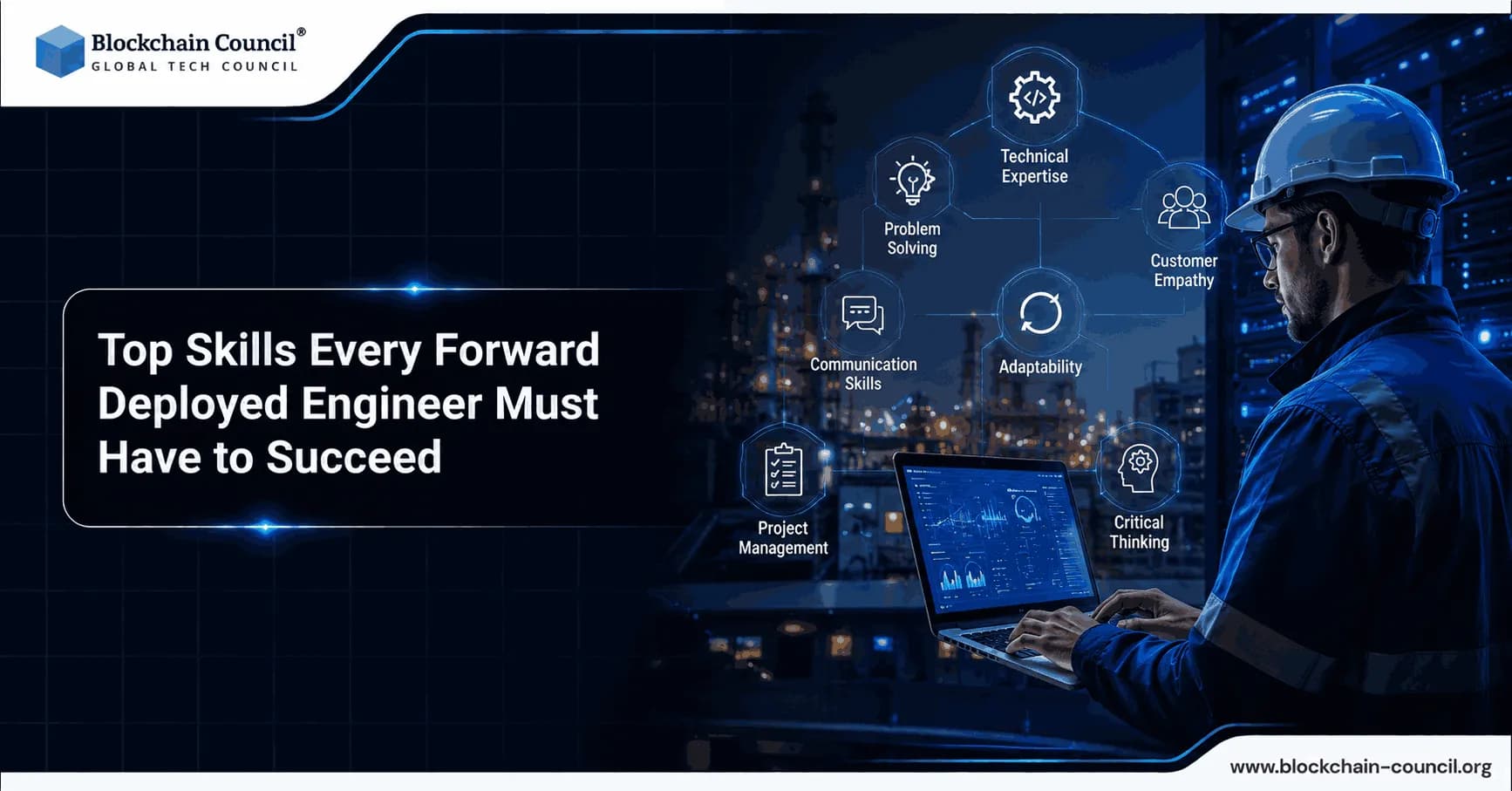
Introduction: The Role That Enterprise AI Cannot Live Without
Between April 2025 and April 2026, job postings for Forward Deployed Engineers grew by 729 percent from 643 listings to more than 5,330 making it one of the fastest-growing roles in all of technology. Box CEO Aaron Levie has called it one of the most important roles in enterprise AI adoption. OpenAI, Anthropic, Google Cloud, Palantir, Adobe, Salesforce, Stripe, Rippling, and McKinsey are all actively hiring for variations of the role in 2026.
The reason for this explosion is straightforward. Enterprise AI adoption has hit a wall not a model capability wall, but a deployment wall. Demos work. Production deployments inside messy enterprise environments, with legacy databases, OIDC authentication, data residency requirements, compliance constraints, and teams that need hands-on training, frequently stall or fail. The companies winning enterprise AI contracts in 2026 are not the ones with the best models. They are the ones that can actually deploy them.

The Forward Deployed Engineer is the professional who bridges that gap. This article outlines the complete set of Forward Deployed Engineer skills needed to succeed in this role in 2026 covering the T-shaped technical profile, the AI-specific stack, the enterprise integration capabilities, the soft skills that differentiate candidates, the salary landscape, and the career pathways available.
Professionals who want to formalise their credentials in this space should begin with a Forward Deployed Engineer Certification structured, verifiable expertise that directly maps to what hiring teams at frontier AI labs and enterprise software companies are screening for.
What a Forward Deployed Engineer Actually Does in 2026
The FDE at the Intersection of Three Domains
A Forward Deployed Engineer is a customer-embedded engineer who works directly inside a client's environment to make a complex software product actually work for them in the real world. The role combines three traditionally separate disciplines: software engineering depth, product thinking, and customer consulting. This overlap sometimes called the FDE trifecta is precisely what makes the role rare and high-value.
In practice, a Forward Deployed Engineer's week might look like this: Monday involves a technical discovery session with a client's CTO and security team. Tuesday is spent writing a RAG pipeline against the client's proprietary data. Wednesday is live debugging of an SSO integration that broke overnight. Thursday is an incident response with the client team waiting on a fix. Friday is explaining a technical trade-off to a non-technical VP without watering down the truth.
Getting a demo working in a sandbox is maybe 20% of the job. The other 80% is navigating enterprise SSO, legacy ETL pipelines, regulatory constraints, data residency, and the politics of getting production credentials from a customer's security team.
The "Integration Wall" and Why FDEs Exist
Most AI projects fail not because the model is bad, but because it cannot talk to the customer's legacy SQL databases, handle their OIDC/SAML authentication, or meet their data residency requirements. This is the integration wall, and it is where FDEs earn their compensation. The 2026 Forward Deployed Engineer is the professional who breaks through that wall navigating enterprise authentication, legacy ETL pipelines, regulatory constraints, and internal stakeholder politics simultaneously.
The OpenAI Deployment Company and Scale of Demand
In May 2026, OpenAI formalised its FDE approach at scale by announcing The Deployment Company a joint venture backed by more than four billion dollars from nineteen investors, anchored by TPG, with Advent International, Bain Capital, Brookfield Asset Management, Goldman Sachs, SoftBank, McKinsey, and Capgemini among the founding partners. Separately, Anthropic launched a 1.5 billion dollar joint venture with Blackstone and Goldman Sachs for the same purpose. Both announcements arrived within days of each other in May 2026 signalling that the deployment bottleneck is now the single most important problem in commercial AI.
The T-Shaped Skills Profile: The Foundation of Every Successful FDE
What T-Shaped Means in Practice
FDEs need a T-shaped profile. Deep technical skills in coding, data, and systems. Plus broad execution skills: customer empathy, radical ownership, problem decomposition, and product sense.
The vertical bar of the T is deep technical proficiency, the ability to write production-quality code, architect data pipelines, and deploy AI systems that run reliably in client environments. The horizontal bar is broad execution capability, the ability to navigate ambiguity, communicate across organisational levels, manage stakeholder relationships, and translate technical problems into business language without losing precision.
Both halves are required. A technically exceptional engineer who cannot communicate across organisational levels fails as an FDE. A skilled communicator who cannot write production code in customer environments is equally unsuitable.
Skill 1 Production-Quality Software Engineering
Why Coding Depth Is Non-Negotiable
FDEs must be able to write clean code, build integrations, fix edge cases, and navigate APIs or data pipelines. The role is not a consultant who recommends solutions. It is an engineer who ships them in the client's environment, on the client's infrastructure, with the client's team watching.
The Core Engineering Stack
FDEs need production-quality code in Python and at least one of TypeScript, Go, or Java, SQL fluency including window functions, CTEs, and query optimisation on large datasets, modern data stack experience with Snowflake, BigQuery, Databricks, dbt, and Airflow, and API integration across REST, GraphQL, streaming, auth including OAuth, SAML, and SCIM, rate limiting, and retries.
Python is the primary language of the AI engineering stack and a baseline expectation for every FDE role in 2026. TypeScript has become increasingly important as many enterprise AI products have frontend components. SQL fluency at the production level not just basic queries but complex multi-table operations on large datasets is essential for data pipeline work.
Infrastructure and Cloud Proficiency
Deep technical skills in systems include AWS and GCP, Docker, and Kubernetes. Cloud proficiency means more than using cloud services; it means understanding IAM roles, VPC configurations, secrets management, data residency constraints, and the security architecture of enterprise cloud environments. Docker and Kubernetes are baseline expectations for any production deployment work in 2026.
Skill 2 AI and LLM Deployment Expertise
The Shift to Agentic AI in 2026
For AI FDEs in 2026, the bar has shifted to agentic orchestration using frameworks such as LangGraph and CrewAI, evaluation frameworks, and AI observability and guardrails, on top of RAG and fine-tuning fundamentals. The AI skill set required for FDEs has evolved significantly in the past twelve months. The baseline skills of prompt engineering and basic model integration are now table stakes. The differentiating skills are in agentic systems, evaluation engineering, and production observability.
RAG Pipeline Architecture
Most enterprise use cases require the model to reason over internal company data absent from the model's training data. RAG involves embedding documents into a vector database such as Pinecone, Weaviate, or pgvector, retrieving relevant chunks at inference time, and injecting them into the prompt context. The pipeline design, including chunking strategy, embedding model, similarity metric, and reranking logic, significantly affects output quality. FDEs configure this for the client's specific data.
Every FDE working in enterprise AI in 2026 must be capable of designing, building, and debugging a complete RAG pipeline from scratch adapting it to the client's data format, access controls, and performance requirements.
Evaluation Frameworks: The 2026 Non-Negotiable
Anthropic's FDE job specification requires production experience with LLMs including advanced prompt engineering, agent development, evaluation frameworks, and deployment at scale. Building evaluation suites that catch hallucinations, regressions, bias, and grounding gaps before production is a non-negotiable FDE skill in 2026.
Evaluation engineering involves building systematic test suites that measure model performance against defined quality metrics accuracy, groundedness, relevance, latency, and safety across the range of inputs the production system will encounter. An FDE who cannot build evaluations cannot guarantee that the AI system they deploy will perform consistently for the client.
AI Observability and Monitoring
AI observability means building the infrastructure to monitor model outputs, detect performance degradation, track latency, and alert on anomalies in production. This is an emerging discipline that combines traditional software monitoring with AI-specific concerns such as hallucination rates, retrieval quality, and prompt injection detection.
Skill 3 Enterprise Systems Integration
The Core Technical Challenge of Enterprise Deployment
Integrations and migrations are the silent killers of onboarding. A single broken mapping or brittle legacy script can freeze a multi-million-dollar rollout. FDEs step in with engineering-level skills to repair data, build connectors, rewrite scripts, and optimise workflows, all within the onboarding motion, not through long engineering escalations.
Enterprise integration requires understanding how legacy systems work their data models, authentication mechanisms, rate limits, and failure modes and building connections that are robust enough to run in production without constant maintenance.
Authentication and Security Architecture
Every enterprise deployment involves navigating the client's security architecture. This means understanding OAuth 2.0, SAML, OIDC, SCIM, and the specific implementation patterns used by enterprise identity providers. It means working within the constraints of the client's security team obtaining production credentials, configuring network policies, managing secrets, and ensuring that AI systems do not create new attack surfaces in the client's environment.
SOC 2, HIPAA, and FedRAMP compliance requirements are standard in regulated industries and must be understood at an implementation level, not just conceptually. An FDE working in healthcare, finance, or government environments needs to understand exactly which compliance constraints affect system architecture and data handling.
Skill 4 Problem Decomposition and Ambiguity Management
The Decomposition Interview as a Skills Signal
This is the famous Palantir forward deployed engineer interview, now used by almost every company hiring FDEs. You get a massive, ambiguous, real-world problem on a whiteboard. Classic example: A major city wants to use our platform to reduce 911 emergency response times. They have 911 call data, traffic data, and ambulance GPS data. You have 60 minutes. Go.
The decomposition interview tests a skill that is central to the FDE role in practice: the ability to impose structure on an ambiguous problem without oversimplifying it. In client environments, problems are almost never well-defined. A client who says "our AI system isn't working" may mean any number of things model outputs are wrong, latency is too high, the integration with their CRM is broken, or their team has stopped using the system because it is confusing.
What Effective Decomposition Looks Like
For the decomposition case study, do not jump to solutions. Ask clarifying questions, break the problem into solvable chunks, propose a simple MVP, then iterate. Think out loud and show structured, first-principles reasoning.
In practice, effective decomposition means asking questions before proposing solutions, separating the stated problem from the underlying root cause, identifying which parts of the problem are technical and which are organisational, and proposing the smallest possible intervention that delivers measurable value.
Skill 5 Customer-Facing Communication and Stakeholder Management
Why Communication Is a Technical Skill in the FDE Role
The role demands a T-shaped profile: deep technical ability paired with the interpersonal skills most engineers never develop. You need someone who can write production code in Python or TypeScript, then walk into a boardroom and explain inference latency to a non-technical executive without losing them.
The ability to translate between engineering precision and business language is not a soft skill in the FDE context; it is a core competency that directly determines whether a deployment succeeds. An FDE who cannot explain a technical trade-off to a VP in plain language will lose stakeholder confidence. An FDE who simplifies too much will make commitments the system cannot deliver.
Radical Ownership and Outcome Accountability
FDEs do not just help with setup. They own the customer outcome end-to-end, making decisions that speed up delivery and improve adoption. This ownership orientation distinguishes FDEs from support engineers or implementation consultants. An FDE is accountable for whether the deployment works, not for whether their specific tasks were completed.
Skill 6 Data Engineering and Modern Data Stack Proficiency
Why Data Comes First in Enterprise AI
Every AI deployment begins with data. Before a model can generate useful outputs for a client, it needs access to the right data in the right format which in enterprise environments almost always means building pipelines, resolving schema conflicts, handling data quality issues, and ensuring that sensitive data is handled compliantly.
FDEs in 2026 are expected to be proficient with modern data stack tools: Snowflake and BigQuery for cloud data warehousing, dbt for data transformation, Airflow for pipeline orchestration, and Databricks for large-scale data processing. This proficiency is not optional; data engineering work is a standard part of almost every enterprise AI deployment.
Vector Databases and Embedding Infrastructure
With RAG pipelines now central to enterprise AI, FDEs must be proficient with vector databases Pinecone, Weaviate, pgvector, and Qdrant and understand the trade-offs between different embedding models, chunking strategies, and similarity metrics. This knowledge directly affects the quality of AI outputs in retrieval-dependent use cases.
Skill 7 Product Sense and Use Case Identification
The FDE as Product Intelligence Source
Top FDEs quickly identify whether a customer request deserves a one-off customisation or signals a true product gap. This product sense the ability to distinguish between a one-off client need and a pattern that reveals a missing platform capability is one of the most valuable skills an FDE can develop. FDE field work feeds the product roadmap: every deployment pattern discovered shapes future platform features.
Identifying High-Value AI Use Cases
According to OpenAI, advances in model capabilities are no longer the primary barrier to enterprise AI adoption. Instead, organisations increasingly face challenges in identifying high-value use cases, redesigning workflows, integrating AI into existing systems, and managing organisational change.
An FDE who can walk into a client's environment and quickly identify which workflows have the highest AI leverage where automation or intelligence would deliver measurable business impact provides value that goes far beyond technical deployment support.
Skill 8 MLOps, Observability, and Production AI Operations
Why MLOps Is Now Core to the FDE Skill Set
As AI deployments move from pilots to production, the operational discipline of managing AI systems in production has become a foundational FDE skill. MLOps encompasses model version management, deployment pipelines, performance monitoring, drift detection, rollback procedures, and the infrastructure needed to operate AI systems reliably at scale.
Professionals who want to build specific expertise in production AI operations and MLOps frameworks benefit from a structured learning path. An MLOps Certification provides the technical grounding in model deployment pipelines, monitoring infrastructure, and production AI operations that FDEs increasingly need to manage complex, multi-model enterprise deployments at scale.
AI Guardrails and Safety in Production
AI observability in 2026 goes beyond performance monitoring. It includes implementing guardrails that prevent harmful or incorrect model outputs from reaching end users prompt injection detection, content filtering, output validation, and confidence thresholding. These capabilities are expected by enterprise clients in regulated industries and are increasingly required by enterprise security teams before any AI system reaches production.
The Salary Landscape for Forward Deployed Engineers in 2026
Compensation That Reflects Skill Scarcity
The forward deployed engineer salary is massive for one reason: skill scarcity. You need to be a strong engineer and a high-empathy communicator who can manage a multi-million dollar relationship.
OpenAI FDE base salaries in San Francisco fall between $160,000 and $280,000 for mid-level positions. Total compensation at mid-to-senior levels reaches $350,000 to $550,000, with equity that can double cash at staff tiers.
New York City has overtaken San Francisco as the largest US hub for FDE roles, largely because regulated industries hire more of them. NYC now holds 35 percent of all FDE postings compared to San Francisco's 11 percent, driven by fintech, healthcare, and compliance-heavy industries.
The Remote Work Reality
Remote FDE roles are structurally rare because the core job requires embedding on-site with customers up to 50 percent of the time, with hybrid models adding travel on top of three in-office days. This on-site requirement is not a policy preference; it reflects the fundamental nature of the role. The most critical work in enterprise deployment happens on-site: establishing trust, navigating organisational politics, and solving problems in real time with the client team present.
Career Pathways for Forward Deployed Engineers
The FDE Career Progression
Career progression for Forward Deployed Engineers typically follows the path of Forward Deployed Engineer to Senior FDE to Principal FDE to Technical Solutions Architect to VP of Solutions Engineering or Engineering.
Each progression step increases the scope of client relationships managed, the complexity of deployments owned, and the degree to which the FDE influences product direction through field intelligence. Principal FDEs often manage multiple simultaneous client relationships and play a direct role in shaping the deployment methodology used by the broader team.
Adjacent Specialisations
Specialisations available for FDEs include Enterprise Integration with deep focus on connecting platforms with legacy systems, AI and ML Implementation deploying and customising AI platforms within client environments, Financial Services working with fintech platforms and regulatory compliance, and Security and Compliance focusing on secure deployments in regulated industries.
Building the Right Credentials for the FDE Role
The Forward Deployed Engineer role in 2026 demands credentials that reflect both technical depth and deployment experience. For professionals entering the field or transitioning from adjacent roles, structured certification provides a structured pathway to building and demonstrating the competency profile that hiring teams at OpenAI, Anthropic, Google Cloud, and enterprise software companies are screening for.
Beginning with a Forward Deployed Engineer Certification provides the foundational framework covering deployment methodology, enterprise integration, AI system management, and client engagement that maps directly to what FDE roles require. This credential demonstrates commitment to the specialised skill set and provides a verified baseline for interview performance.
Complementing FDE credentials with an MLOps Certification adds production AI operations expertise covering model deployment pipelines, monitoring, drift detection, and scalable AI infrastructure management that is increasingly required in senior FDE positions, particularly at frontier AI labs and enterprise platforms managing complex multi-model deployments.
For professionals in business development, account management, or strategy roles who work alongside FDE teams or for FDEs who want to develop the business strategy and go-to-market context that makes their technical work more commercially impactful a Marketing Certification that incorporates AI-driven strategy and technology communication provides the commercial language and strategic frameworks that distinguish FDEs who can influence product direction from those who execute deployments without connecting them to broader business outcomes.
FAQs
What Is a Forward Deployed Engineer?
A Forward Deployed Engineer is a customer-embedded engineer who works directly inside enterprise client environments to deploy, integrate, and optimise complex AI or software platforms in production. The role combines deep software engineering with customer-facing communication and product thinking, making it one of the most hybrid and highest-compensated positions in technology.
Why Have Forward Deployed Engineer Job Postings Grown So Rapidly in 2026?
FDE job postings grew 729 percent between April 2025 and April 2026. This growth reflects the deployment bottleneck in enterprise AI: most AI pilots fail not because models are weak but because they cannot be integrated into enterprise environments with legacy systems, compliance requirements, and organisational change management challenges. FDEs solve this problem directly.
How Is a Forward Deployed Engineer Different From a Solutions Engineer?
A Solutions Engineer typically focuses on pre-sales technical demonstrations and proof-of-concept work. A Forward Deployed Engineer goes further: they embed inside the client environment, write production code, own the deployment outcome end-to-end, and are accountable for whether the system works in production not just in a demo.
Which Companies Are Hiring Forward Deployed Engineers in 2026?
OpenAI, Anthropic, Google Cloud, Palantir, Adobe, Salesforce, Stripe, Rippling, EY, PwC, McKinsey, Bain & Company, and BCG are all actively hiring FDEs in 2026. The role has spread from AI-first companies into established technology giants and major consulting firms.
Is the Forward Deployed Engineer Role a Long-Term Career or a Transitional Role?
It is a long-term career with a clear progression path. FDEs move from junior to senior to principal levels, then into Technical Solutions Architect or VP of Solutions Engineering roles. The field intelligence gathered from client deployments also provides a natural pathway into product management and engineering leadership.
What Programming Languages Do Forward Deployed Engineers Need?
Python is the primary language for AI-focused FDE work. TypeScript is important for products with frontend components. Go and Java are valuable for backend systems work. SQL fluency at the production level including window functions, CTEs, and query optimisation is required for data pipeline work. Proficiency in at least two of these languages is the baseline expectation.
Do Forward Deployed Engineers Need to Know Cloud Platforms?
Yes. AWS and GCP are the most commonly required platforms, with Azure also relevant in Microsoft-heavy enterprise environments. FDEs need to understand IAM roles, VPC configurations, secrets management, data residency, and the security architecture of enterprise cloud environments not just how to use cloud services but how they work at the infrastructure level.
What AI-Specific Skills Are Required for FDE Roles in 2026?
The core AI skill set includes RAG pipeline design and implementation, agentic orchestration using frameworks such as LangGraph and CrewAI, evaluation framework development, AI observability and monitoring, prompt engineering, and fine-tuning fundamentals. In 2026, the bar has shifted significantly toward agentic systems and evaluation engineering as differentiating skills.
What Are RAG Pipelines and Why Do FDEs Need to Build Them?
RAG stands for Retrieval-Augmented Generation. It is the primary technique for giving AI models access to enterprise-specific data at inference time, without retraining the model. FDEs build RAG pipelines by embedding client documents into vector databases, configuring retrieval logic, and injecting relevant context into model prompts. The design choices, chunking strategy, embedding model, similarity metric significantly affect output quality.
What Is Evaluation Engineering and Why Is It Non-Negotiable?
Evaluation engineering involves building test suites that measure AI system performance against defined quality metrics accuracy, groundedness, relevance, latency, hallucination rate across the range of inputs a production system will encounter. Without evaluations, there is no systematic way to know whether an AI system performs reliably before deployment. Every major AI company's FDE specifications require this skill in 2026.
What Enterprise Authentication Systems Do FDEs Need to Understand?
FDEs need working knowledge of OAuth 2.0, SAML, OIDC, and SCIM, the authentication and identity federation protocols used by enterprise environments. They must be able to configure integrations that work within the client's existing identity provider, obtain production credentials through the client's security team, and ensure that AI systems do not create new vulnerabilities in the client's authentication architecture.
What Compliance Frameworks Are Relevant for FDE Work?
SOC 2, HIPAA, FedRAMP, and GDPR are the most commonly encountered compliance frameworks in enterprise AI deployments. FDEs in regulated industries healthcare, finance, and government need to understand which compliance constraints affect system architecture, data handling, and audit logging, and be able to build systems that satisfy these requirements without requiring special exceptions.
How Do FDEs Handle Legacy System Integration?
Legacy system integration requires understanding the data models, APIs, and failure modes of systems that were not designed for AI integration. FDEs build custom connectors, transform data formats, handle schema inconsistencies, and navigate the constraints of legacy ETL pipelines often without documentation and with limited access to the original system developers.
What Communication Skills Do Forward Deployed Engineers Need?
FDEs need the ability to translate between engineering precision and business language explaining technical trade-offs to non-technical executives without oversimplifying, and communicating business constraints to engineering teams without losing technical accuracy. They also need stakeholder management skills to navigate organisational politics within client organisations, build trust with multiple levels of the client hierarchy simultaneously, and maintain momentum under pressure.
What Is Radical Ownership in the FDE Context?
Radical ownership means being accountable for the deployment outcome, not just for the completion of assigned tasks. An FDE with radical ownership does not wait to be told what to do next when a blocker appears; they identify the blocker, determine what needs to happen to resolve it, and take action, escalating only when genuinely necessary. This orientation distinguishes high-performing FDEs from those who execute tasks without driving outcomes.
How Important Is Product Sense for a Forward Deployed Engineer?
Product sense is critically important. FDEs who can identify whether a client request signals a true product gap rather than a one-off customisation need provide valuable intelligence that directly influences the product roadmap. The best FDEs are simultaneously deploying the current product and informing what the next version should include.
What Is the Salary Range for a Forward Deployed Engineer in 2026?
Mid-level FDE roles at frontier AI labs such as OpenAI pay base salaries between $160,000 and $280,000 in San Francisco, with total compensation reaching $350,000 to $550,000 including equity. Entry-level roles at smaller AI companies typically start in the $120,000 to $160,000 base salary range. Senior and principal FDE roles at major AI labs can exceed $600,000 in total compensation.
Is Certification Important for Getting a Forward Deployed Engineer Role?
Yes. Certification provides two benefits: it demonstrates commitment to the specialised FDE skill set, and it provides verifiable evidence of competency in areas deployment methodology, enterprise integration, AI system management that are difficult to assess from a standard engineering resume. FDE hiring at frontier AI labs is competitive, and structured credentials help candidates differentiate their profiles.
What Background Do Most Forward Deployed Engineers Come From?
FDEs typically come from backend engineering, solutions engineering, data engineering, or consulting backgrounds. The common thread is experience working with complex systems in production environments, often combined with customer-facing exposure. Engineers who have both shipped production systems and communicated directly with enterprise clients are the strongest natural candidates.
Related Articles
View All
AI & ML
Built to Catch AI Cheating: Rethinking Pre-Employment Assessments with HireValid
Explore how HireValid is rethinking pre-employment assessments with AI-resistant test design, integrity signals, candidate evidence, and human review to address AI-assisted cheating.

AI & ML
AI-Era Hiring Needs AI-Proof Tests: How HireValid Is Redefining Talent Assessment
Explore how HireValid is rethinking talent assessment for the AI era with job-relevant tests, anti-cheating design, integrity signals, and human-reviewed evidence of candidate ability.

AI & ML
Google Launches Gemini 4 Argon: Features and Capabilities
Google has launched Gemini 4 Argon, its flagship AI model for coding, finance, law, cybersecurity and science. Learn its key features, availability, pricing and safety details.
Trending Articles
The Role of Blockchain in Ethical AI Development
How blockchain technology is being used to promote transparency and accountability in artificial intelligence systems.
AWS Career Roadmap
A step-by-step guide to building a successful career in Amazon Web Services cloud computing.

Top 5 DeFi Platforms
Explore the leading decentralized finance platforms and what makes each one unique in the evolving DeFi landscape.