

Why Forward Deployed Engineers Are Critical for AI, SaaS, and Enterprise Technology Deployments
 Suyash Raizada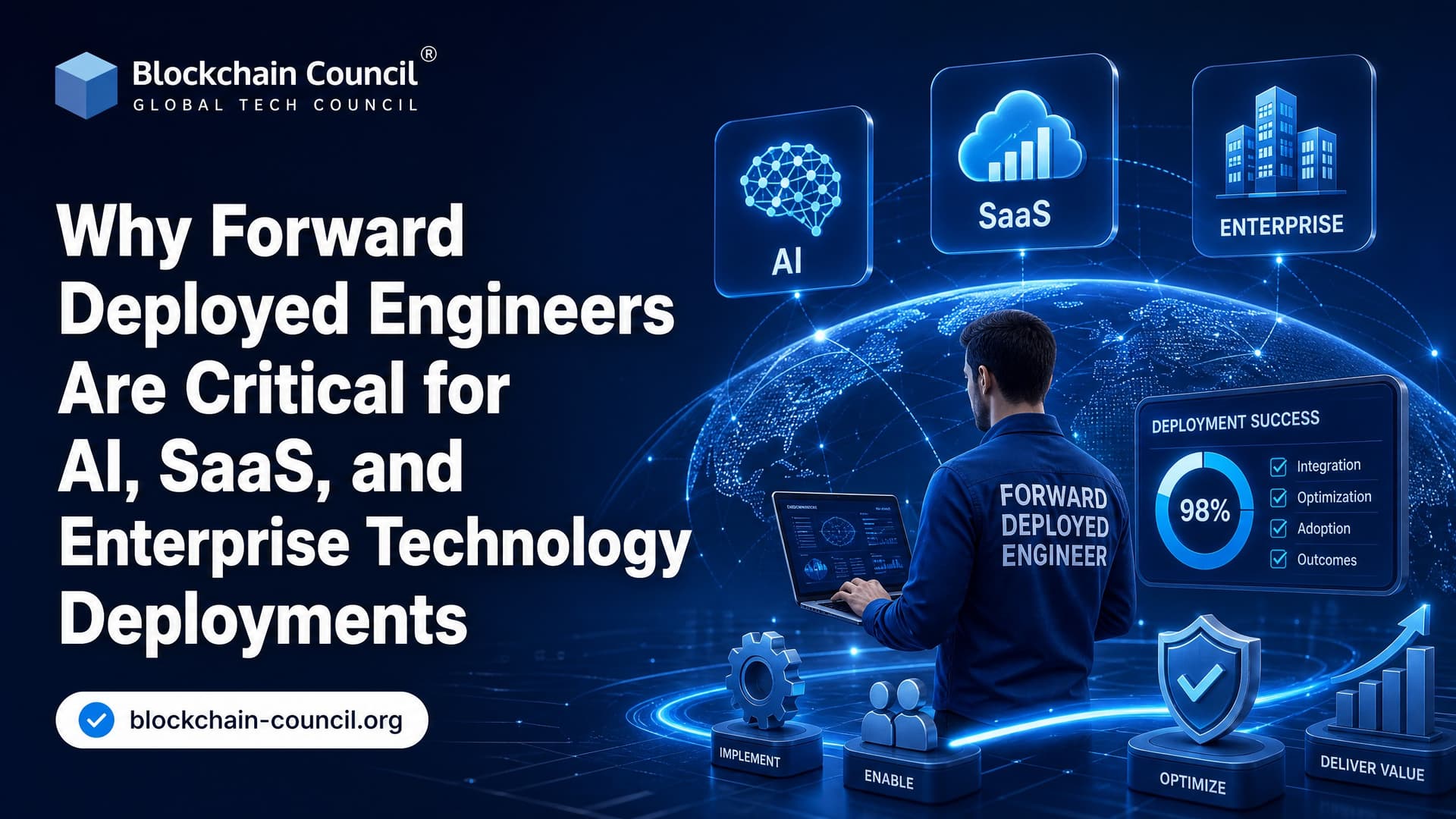
Forward Deployed Engineers are becoming essential because AI, SaaS, and enterprise technology rarely create value by simply being purchased. The hard part is fitting the platform into messy workflows, fragmented data, security controls, approval chains, and user habits. That is where a Forward Deployed Engineer, or FDE, earns the role.
Think of the FDE as an engineer who ships inside the customer's environment. Not a traditional sales engineer. Not a support agent. A real builder who writes code, connects systems, tunes workflows, and stays close enough to the business problem to know whether the deployment is actually working. Understand why Forward Deployed Engineers play a critical role in implementing AI, SaaS, and enterprise technology solutions by bridging customer requirements with technical execution through a Forward Deployed Engineer Certification, mastering deployment automation and operational AI workflows with an MLOps Certification, and improving customer-focused growth strategies through a Digital Marketing Course.

What Is a Forward Deployed Engineer?
A Forward Deployed Engineer is a software engineer who works directly with customers to implement, customize, and integrate a vendor's platform. The role sits between product engineering, solutions architecture, data engineering, and customer operations.
In practice, FDEs usually handle work such as:
Building custom integrations with enterprise systems such as Salesforce, ServiceNow, SAP, Snowflake, Jira, Workday, or internal APIs
Designing workflows that match how teams actually make decisions
Writing production code, scripts, data pipelines, connectors, dashboards, and automation logic
Helping security and compliance teams review access controls, logs, data flows, and audit requirements
Feeding lessons from the field back into product and engineering teams
Palantir helped popularize the model, but the pattern is now visible across AI-native software companies, data platforms, cybersecurity vendors, and enterprise SaaS firms. Forward deployed engineering has come to describe a distinct delivery model for complex products where self-service onboarding is not enough.
Why AI Deployments Need Forward Deployed Engineers
AI has a deployment problem. The models are impressive. The demos are polished. Then the system meets real enterprise data and things get awkward.
Industry analyses of AI programs often report that a large share, frequently cited around 70 to 85 percent, fail to deliver expected business value or never reach scaled production. The exact figure varies by study and methodology, so treat any single number with caution. The pattern, though, is consistent: failure usually comes from integration, ownership, workflow design, change management, and governance. Not from model math alone.
They Bridge Model Capability and Operational Reality
A general-purpose AI model can summarize, classify, generate, and reason across many tasks. That does not mean it knows your claims workflow, your exception handling rules, your internal product codes, or why a finance approval requires two human sign-offs above a certain threshold.
Forward Deployed Engineers translate between the model and the business process. They ask questions like:
Which task should the AI system perform, and which task should stay human-owned?
Where does the source data live?
What happens when confidence is low?
Who approves an AI-generated action before it affects a customer?
Which logs are needed for audit and incident review?
This is not glamorous work. It is where projects succeed or die.
They Turn AI Agents Into Production Systems
AI agents are a good example. A vendor can show an agent resolving tickets in a demo. But inside a real enterprise, the agent must connect to identity systems, ticketing queues, knowledge bases, role-based permissions, escalation rules, and sometimes legacy tools nobody wants to touch.
An FDE might connect an agent to ServiceNow, map ticket categories to internal routing logic, add retrieval from a Confluence knowledge base, and require manager approval before the agent closes certain high-risk tickets. They may also tune prompts, set guardrails, and build evaluation sets based on actual historical cases.
Here is a practitioner detail that matters: many early AI prototypes break when teams move from notebooks to production because the code was written against an older SDK. With openai-python 1.x, for example, openai.ChatCompletion.create is no longer the current pattern. You use client.chat.completions.create instead. Small? Yes. But when that error surfaces during a customer deployment window, someone has to fix it fast. FDEs live in that gap.
Why SaaS Vendors Are Adopting the FDE Model
Traditional SaaS assumes the customer can configure the product, read the documentation, and get value with help from customer success or professional services. That works for simple tools. It is weaker for platforms that touch core operations.
Modern SaaS products often require deep integration with data warehouses, event streams, access policies, internal workflows, and reporting systems. A dashboard is not useful if it pulls stale data. A security tool is not useful if it misses half the cloud accounts. A revenue operations platform is not useful if sales teams ignore it.
From Feature Delivery to Outcome Delivery
FDEs change the operating model. Instead of saying the feature exists, they help prove that the feature produces a business outcome.
That may mean:
Writing a connector that pulls customer data from a private API
Building a workflow that routes exceptions to the right team
Measuring cycle time before and after automation
Creating a reference architecture for a regulated customer segment
Identifying product gaps that should move into the core roadmap
To be blunt, if your SaaS product needs deep customization and you only offer a help center, you are asking the customer to finish your deployment work. That is risky for both sides.
FDEs Complement Customer Success
Customer success teams remain important. They manage adoption, relationships, renewals, business reviews, and expansion planning. Professional services teams also have a clear place, especially for packaged implementations and scoped delivery.
Forward Deployed Engineers are different. They are measured by whether the system works in the field. They write code. They debug data. They sit with users, watch the workflow fail, and then rebuild the missing piece.
The best enterprise deployments use all three functions clearly. Customer success owns adoption health, professional services handles defined delivery, and FDEs solve the technical uncertainty that cannot be fully specified at the start.
Where Forward Deployed Engineers Create the Most Value
Not every product needs FDEs. A small team adopting a lightweight project management tool should not need embedded engineering. If it does, the product may be too complicated.
FDEs are most valuable when the deployment has high complexity, high stakes, or both.
Common Use Cases
Enterprise AI agents: FDEs integrate agents with ticketing systems, identity providers, knowledge bases, and approval workflows.
Data platforms and analytics: They build pipelines, normalize data models, and help decision systems operate on trusted data.
Cybersecurity platforms: They connect telemetry sources, tune detections, and align alerts with incident response procedures.
Regulated workflows: They design logging, access controls, retention policies, and human review points for industries such as finance and healthcare.
Strategic account builds: They build custom solutions for major customers, then help product teams turn repeated patterns into standard features.
The Skills That Make a Strong FDE
The FDE role is demanding because it combines engineering depth with judgment under ambiguity. You need to be credible with developers, patient with business users, and calm when production systems behave badly.
Strong FDEs usually bring:
Software engineering: APIs, backend services, scripting, testing, version control, and deployment practices
Data skills: SQL, ETL patterns, data quality checks, data modeling, and warehouse basics
AI literacy: model behavior, prompt design, retrieval-augmented generation, evaluation, and monitoring
Security awareness: authentication, authorization, secrets management, audit logs, and least-privilege design
Communication: requirements discovery, stakeholder management, technical writing, and executive-level explanation
Learn how Forward Deployed Engineers help organizations accelerate AI adoption, improve customer outcomes, and drive enterprise transformation initiatives through a Forward Deployed Engineer Certification, gaining expertise in scalable AI deployment with an MLOps Certification, and strengthening business impact through a Digital Marketing Course.
What Enterprises Should Ask Before Accepting an FDE Model
Forward deployed engineering is powerful, but it should not be vague. Define the engagement carefully before you sign.
Ask the vendor:
Who owns production code after the engagement?
Will custom work be supported long term?
How are security reviews, access controls, and change approvals handled?
What metrics define success?
Which field learnings go into the core product roadmap?
How will your internal team be trained to operate the system after handoff?
Good FDE teams welcome these questions. Weak ones hide behind broad promises and unclear scopes.
The Future of Forward Deployed Engineering
The FDE model is likely to become standard for AI, deeptech, and complex enterprise SaaS. As AI moves deeper into high-impact workflows, companies will need engineers who understand both software systems and the operating environment around them.
Expect more specialization. Finance-focused FDEs will need to understand audit trails and risk controls. Healthcare FDEs will need privacy and clinical workflow awareness. Manufacturing FDEs will need to work with operational technology, downtime constraints, and sensor data. AI-agent FDEs will need strong evaluation practices because a clever demo is not the same as safe automation.
The role will also become more connected to governance. AI systems that recommend actions, draft decisions, or automate business processes need traceability. FDEs will increasingly work with legal, compliance, cybersecurity, and risk teams, not only engineering and operations.
Final Takeaway
Forward Deployed Engineers matter because enterprise technology value is created at the point of deployment. AI models, SaaS platforms, and data tools only earn their keep when they fit real workflows and survive production constraints.
FAQs
1. What is a Forward Deployed Engineer (FDE)?
A Forward Deployed Engineer is a technical professional who works directly with customers to implement, customize, integrate, and optimize technology solutions. Unlike traditional software engineers who primarily build products internally, FDEs bridge the gap between engineering teams and end users by ensuring technology delivers real-world business value.
2. Why are Forward Deployed Engineers becoming increasingly important?
As organizations adopt complex AI, SaaS, cloud, and enterprise solutions, they need professionals who can understand customer requirements and translate them into effective technical implementations. FDEs play a critical role in ensuring successful deployments and customer adoption.
3. How do Forward Deployed Engineers contribute to AI deployments?
Forward Deployed Engineers help organizations integrate AI models, automate workflows, connect data sources, and customize AI solutions according to business needs. They ensure AI technologies are implemented effectively and aligned with operational goals.
4. What role do FDEs play in SaaS implementations?
In SaaS environments, FDEs help customers configure platforms, integrate third-party tools, troubleshoot deployment challenges, and maximize platform performance. Their involvement often leads to faster adoption and higher customer satisfaction.
5. How are Forward Deployed Engineers different from software engineers?
Software engineers primarily focus on building and maintaining products, while Forward Deployed Engineers work closely with customers to implement and adapt those products for specific use cases. FDEs combine technical expertise with strong communication and problem-solving skills.
6. Why are enterprises investing in Forward Deployed Engineering teams?
Enterprises invest in FDEs because successful implementation is often as important as the technology itself. FDEs help reduce deployment risks, improve customer outcomes, and accelerate time-to-value for technology investments.
7. What industries benefit most from Forward Deployed Engineers?
Industries such as technology, healthcare, finance, cybersecurity, manufacturing, logistics, telecommunications, and government services benefit significantly from FDE expertise due to their complex technology requirements.
8. What technical skills are required for a Forward Deployed Engineer?
Common skills include software development, cloud computing, APIs, system integration, databases, DevOps practices, AI technologies, data engineering, and troubleshooting complex technical environments.
9. What soft skills are important for Forward Deployed Engineers?
Successful FDEs need strong communication, stakeholder management, problem-solving, project management, adaptability, customer engagement, and consulting skills to work effectively with clients and internal teams.
10. How do FDEs improve customer success?
By working directly with customers, FDEs ensure solutions are deployed correctly, issues are resolved quickly, and business objectives are achieved. This hands-on approach improves customer satisfaction and long-term retention.
11. Why are Forward Deployed Engineers valuable in AI-driven organizations?
AI implementations often require customization, integration, and workflow optimization. FDEs help organizations deploy AI solutions effectively while ensuring they deliver measurable business outcomes.
12. What challenges do Forward Deployed Engineers solve during deployments?
They address integration issues, infrastructure limitations, workflow mismatches, performance bottlenecks, data connectivity problems, and user adoption challenges that may arise during implementation.
13. How do FDEs support digital transformation initiatives?
FDEs help organizations adopt new technologies, streamline operations, automate processes, and integrate digital solutions into existing systems, making digital transformation more successful and sustainable.
14. Can Forward Deployed Engineers work with enterprise AI agents?
Yes. As AI agents become more common, FDEs often help organizations deploy, configure, monitor, and optimize agentic AI systems to support business operations and automation initiatives.
15. How do FDEs contribute to product improvement?
Because they work directly with customers, FDEs collect valuable feedback on product performance, feature requirements, and deployment challenges. This information helps product and engineering teams improve future releases.
16. Why is demand for Forward Deployed Engineers increasing in SaaS companies?
SaaS companies rely on customer adoption and successful implementation. FDEs help ensure customers achieve value from the platform quickly, which directly impacts retention, growth, and customer satisfaction.
17. What career opportunities are available for Forward Deployed Engineers?
Professionals can advance into roles such as Solutions Architect, Technical Consultant, Customer Engineering Manager, Product Manager, AI Solutions Specialist, Technical Program Manager, or Enterprise Architect.
18. How do Forward Deployed Engineers support cybersecurity and compliance initiatives?
FDEs help implement secure configurations, integrate compliance controls, support security monitoring, and ensure enterprise deployments meet regulatory and organizational requirements.
19. What is the future of Forward Deployed Engineering?
As AI, cloud computing, SaaS, and enterprise automation continue to expand, Forward Deployed Engineers will play an increasingly important role in helping organizations deploy and maximize the value of advanced technologies.
20. How can professionals prepare for a career as a Forward Deployed Engineer?
Professionals should build expertise in software engineering, cloud platforms, AI technologies, system integration, enterprise architecture, and customer-facing problem-solving. Certifications and hands-on project experience can further strengthen career prospects in this growing field.
Related Articles
View All
AI & ML
Built to Catch AI Cheating: Rethinking Pre-Employment Assessments with HireValid
Explore how HireValid is rethinking pre-employment assessments with AI-resistant test design, integrity signals, candidate evidence, and human review to address AI-assisted cheating.

AI & ML
AI-Era Hiring Needs AI-Proof Tests: How HireValid Is Redefining Talent Assessment
Explore how HireValid is rethinking talent assessment for the AI era with job-relevant tests, anti-cheating design, integrity signals, and human-reviewed evidence of candidate ability.

AI & ML
Google Launches Gemini 4 Argon: Features and Capabilities
Google has launched Gemini 4 Argon, its flagship AI model for coding, finance, law, cybersecurity and science. Learn its key features, availability, pricing and safety details.
Trending Articles

Top 5 DeFi Platforms
Explore the leading decentralized finance platforms and what makes each one unique in the evolving DeFi landscape.
How Blockchain Secures AI Data
Understand how blockchain technology is being applied to protect the integrity and security of AI training data.
What is AWS? A Beginner's Guide to Cloud Computing
Everything you need to know about Amazon Web Services, cloud computing fundamentals, and career opportunities.