

Evaluating RAG Systems: Metrics, Groundedness Tests, and Hallucination Reduction
 Suyash Raizada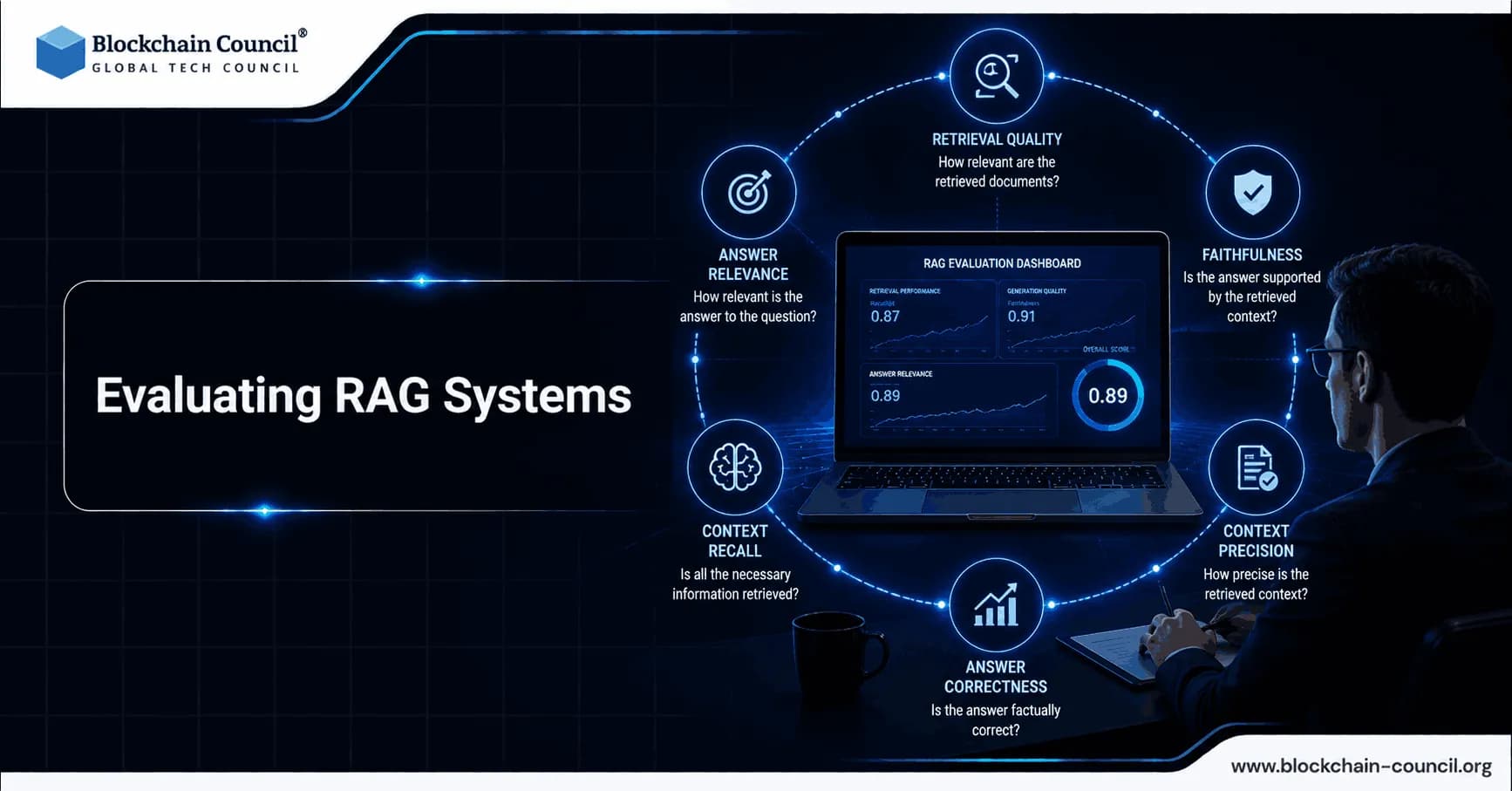
Evaluating RAG systems is now a core requirement for deploying trustworthy generative AI in production. Retrieval-Augmented Generation (RAG) improves large language model (LLM) reliability by retrieving external knowledge and using it to ground responses, which reduces hallucinations - plausible but factually incorrect outputs. With hallucinations recognized as a major public concern (Cambridge Dictionary named "hallucinate" its 2023 Word of the Year), teams need practical evaluation methods that measure both retrieval quality and answer faithfulness to sources.
As RAG architectures become a standard component of enterprise AI systems, many professionals are pursuing an LLM Developer Certification to build expertise in retrieval pipelines, model evaluation, prompt engineering, and the techniques required to develop reliable, production-ready LLM applications.

This guide explains how to evaluate RAG systems using key metrics, groundedness tests, and proven hallucination reduction strategies, with examples from recent research and industry implementations.
What Makes RAG Evaluation Different from Standard LLM Evaluation?
Traditional LLM evaluation focuses on answer quality, style, and correctness. RAG systems add a retrieval layer, so evaluation must cover two linked components:
Retrieval performance: Did the system fetch the right evidence?
Generation faithfulness: Did the model use the evidence accurately without inventing facts?
A response can look correct while being unsupported by retrieved documents. Conversely, retrieval can be excellent, but the generator may misread or distort the evidence. Effective RAG evaluation explicitly measures both.
Key Metrics for Evaluating RAG Systems
The most reliable RAG evaluation programs combine classic information retrieval metrics with generation metrics, plus RAG-specific hallucination and groundedness measures.
1) Accuracy
Accuracy measures how often the generated answer matches the ground truth. It is commonly used in question answering and structured output tasks.
In recent public health research, MEGA-RAG reported accuracy around 0.7913 on its benchmark, demonstrating how retrieval and reranking improvements can lift end-to-end correctness.
2) Precision
Precision measures how much of what the system returned was relevant. In RAG, precision applies at two levels:
Retrieval precision: retrieved chunks are actually related to the question
Answer precision: the response does not include unnecessary or incorrect statements
High precision reduces the risk of the model drawing on irrelevant context to produce confident but incorrect completions.
3) Recall
Recall measures whether the system retrieved all relevant information needed to answer correctly. In complex domains such as healthcare, legal, and finance, recall can be critical because missing one key document can force the model to guess or fabricate details.
MEGA-RAG reported recall around 0.8304 in its evaluation, indicating strong evidence coverage.
4) F1 Score
F1 is the harmonic mean of precision and recall, useful when you need a single number that balances both error types. MEGA-RAG achieved an F1 of approximately 0.7904 versus a standard RAG baseline of around 0.6739, illustrating how hybrid retrieval and reranking can meaningfully improve RAG quality.
5) Hallucination Score (Custom, RAG-Aware)
Many teams use a hallucination score tailored to RAG, typically built from multiple signals:
Answer correctness: whether the answer matches known truth labels or authoritative sources
Answer relevancy: whether the answer addresses the user query without drift
Context relevancy: whether retrieved context is aligned with the question
Faithfulness: whether claims are supported by the retrieved text
In agentic production workflows - for example, implementations on Amazon Bedrock - teams use threshold-based scoring. When the score indicates low alignment or high hallucination risk, the system can trigger remediation steps such as re-retrieval, reranking, or escalation to a human queue.
As these AI workflows become more sophisticated, a Tech Certification can help professionals strengthen their understanding of AI infrastructure, automation systems, cloud platforms, and the technical frameworks required to build, monitor, and govern reliable production-scale AI applications.
6) Groundedness
Groundedness measures whether the generated answer is supported by retrieved documents. This goes beyond citing sources - it involves verifying that each meaningful claim is entailed by the available evidence.
Groundedness is central to high-trust use cases because it directly targets the failure mode users care most about: confident, fluent answers that lack factual backing.
Groundedness Tests: How to Verify Alignment with Retrieved Documents
Groundedness tests should be designed as repeatable checks that run in both offline evaluation and production monitoring.
A Practical Groundedness Testing Workflow
Claim extraction: Break the model response into atomic claims (sentences or propositions).
Evidence mapping: For each claim, identify the top supporting spans in the retrieved documents.
Entailment check: Determine whether the evidence supports, contradicts, or does not mention the claim.
Scoring: Compute a groundedness rate, such as supported claims divided by total claims.
Actioning: If groundedness falls below a threshold, apply remediation - re-retrieve, expand sources, rerank, or route to human review.
Common Failure Patterns Groundedness Tests Catch
Unsupported specificity: The context supports a general statement, but the model fabricates specific numbers, dates, or names.
Context drift: The retrieved documents are relevant, but the model answers a slightly different question.
Source mixing: Evidence comes from multiple documents, but the model combines them into a claim not supported by any single source.
Outdated context: The system retrieves old policy or guidance, and the model presents it as current.
Hallucination Reduction Strategies for Production RAG Systems
Reducing hallucinations in RAG requires coordinated effort across retrieval, prompt design, decoding policies, evaluation, and oversight - not a single fix.
1) Multi-Source and Hybrid Retrieval
Hybrid retrieval combines dense methods (for semantic similarity) with keyword methods like BM25 (for exact matches), often followed by reranking. MEGA-RAG is a strong example, combining dense retrieval (FAISS), BM25, biomedical knowledge graphs, and cross-encoder reranking, then applying discrepancy-aware refinement. This multi-evidence approach has demonstrated substantial hallucination reductions in demanding domains.
2) Reranking with Cross-Encoders
Dense retrievers can return plausible but suboptimal passages. Cross-encoder rerankers more accurately assess question-context fit. Improving top-k quality typically improves both groundedness and answer correctness downstream.
3) Feedback Loops and Iterative Refinement
Feedback loops treat RAG as a system that learns from failures:
Log low-groundedness answers alongside their retrieved contexts
Improve chunking, metadata filters, embeddings, and reranker training data
Refine prompts to enforce quoting or require evidence-backed statements
This approach is often more cost-effective than full model retraining because retrieval and grounding improvements can significantly reduce hallucination rates without modifying model weights.
4) Agentic Remediation and Human-in-the-Loop Controls
In high-stakes settings, automated thresholds should route uncertain cases to human reviewers. Industry implementations demonstrate agentic workflows that compute hallucination-related scores - such as correctness and relevancy - and trigger interventions like notifications and human review when quality drops below defined thresholds.
This pattern is especially valuable in healthcare, finance, security, and compliance, where an ungrounded answer can cause real harm.
5) Use Structured Sources Where Possible
RAG performs better when retrieval includes structured data such as databases and knowledge graphs. Structured sources constrain ambiguity, support precise lookups, and reduce the likelihood of the model improvising details not present in the evidence.
6) Data Quality and Freshness
RAG cannot outperform its corpus. Clean, deduplicated, well-chunked, and regularly updated data reduces garbage-in-garbage-out effects and prevents grounded-sounding answers from being confidently wrong due to stale sources.
Real-World Examples of RAG Evaluation in Action
Public Health Question Answering
MEGA-RAG demonstrates how hybrid retrieval, knowledge graphs, and reranking can improve F1 and reduce hallucinations significantly compared to standard RAG baselines - particularly when users require evidence-backed biomedical guidance.
Customer Support and Enterprise Assistants
Agentic workflows apply automated hallucination detection and remediation by scoring answers for correctness and relevancy, applying thresholds, and escalating to a human agent when quality falls short. This approach reduces risk while maintaining responsiveness at scale.
Workflow Generation and Structured Outputs
Recent research shows that RAG can enable smaller LLMs paired with efficient retrievers to generate structured outputs such as workflows, preserving performance while reducing compute requirements. Evaluation in these cases should measure both format validity and groundedness to retrieved procedures and policies.
How to Build an Evaluation Plan for RAG Systems
A practical evaluation plan aligns metrics to business risk across four stages:
Offline benchmarking: accuracy, precision, recall, F1, and groundedness on a labeled dataset
Pre-production gates: minimum thresholds for groundedness and hallucination score before deployment
Production monitoring: drift detection, corpus freshness checks, and sampling-based human review
Incident response: fallback responses, re-retrieval strategies, and escalation playbooks
For teams building skills across the full RAG stack, Blockchain Council offers certifications in Generative AI, Prompt Engineering, AI Governance, and Data Science - covering the design, evaluation, and operational control competencies relevant to RAG deployments.
A Marketing Certification can complement these technical capabilities by helping professionals communicate AI initiatives more effectively, align deployment outcomes with business goals, and translate complex RAG performance metrics into insights that stakeholders and decision-makers can act upon.
Conclusion: RAG Evaluation Is the Foundation of Trustworthy GenAI
Evaluating RAG systems requires more than checking whether answers sound plausible. You must measure retrieval quality, generation correctness, and - most critically - groundedness to retrieved evidence. Combining accuracy, precision, recall, F1, and RAG-aware hallucination and groundedness tests helps teams detect failure modes early. Applying hybrid retrieval, reranking, feedback loops, and human oversight then provides a durable path to lower hallucination rates in real deployments.
As RAG continues to evolve toward multi-evidence pipelines, smaller efficient models, and agentic monitoring loops, evaluation rigor will be the deciding factor between systems that impress in demos and systems that organizations can deploy with confidence.
FAQs
1. What does evaluating a RAG system mean?
Evaluating a RAG system involves measuring how well it retrieves relevant data and generates accurate responses. It focuses on quality, reliability, and performance. Proper evaluation ensures production readiness.
2. Why is evaluation important for RAG pipelines?
Without evaluation, errors and hallucinations go unnoticed. It helps identify weaknesses in retrieval and generation. This improves system accuracy and user trust.
3. What are the key metrics for evaluating RAG systems?
Key metrics include retrieval accuracy, precision, recall, and response relevance. Latency and cost are also important. These metrics provide a complete performance view.
4. What is groundedness in RAG systems?
Groundedness measures how well responses are supported by retrieved data. A grounded response is based on factual context. This reduces hallucinations.
5. How do you test groundedness in RAG outputs?
Compare generated responses with retrieved documents. Check if claims are supported by evidence. Automated scoring and human review can be used.
6. What is retrieval accuracy in RAG evaluation?
Retrieval accuracy measures how relevant the retrieved documents are to the query. High accuracy improves response quality. Poor retrieval leads to incorrect outputs.
7. How does precision and recall apply to RAG systems?
Precision measures how many retrieved results are relevant. Recall measures how many relevant results are retrieved. Balancing both is important for performance.
8. What is hallucination rate in RAG evaluation?
Hallucination rate measures how often the model generates unsupported or incorrect information. Lower rates indicate better system reliability. It is a critical metric.
9. How can developers reduce hallucinations in RAG systems?
Improve data quality, optimize retrieval, and use validation layers. Grounding responses in reliable data helps. Continuous testing is essential.
10. What role does human evaluation play in RAG systems?
Human reviewers assess accuracy, relevance, and clarity. They provide insights that automated metrics may miss. This improves overall system quality.
11. What is latency in RAG evaluation?
Latency measures the time taken to retrieve data and generate a response. Lower latency improves user experience. It is important for real-time systems.
12. How do you evaluate response relevance in RAG systems?
Compare responses with user queries and expected answers. Check if the response addresses the query correctly. Relevance scoring helps quantify performance.
13. What are common evaluation challenges in RAG systems?
Challenges include defining clear metrics, handling subjective responses, and measuring groundedness. Data quality can also affect evaluation. Proper frameworks are needed.
14. How can automated testing improve RAG evaluation?
Automated tests run predefined queries and measure performance metrics. They provide consistent and repeatable results. This helps identify issues जल्दी.
15. What is the role of benchmark datasets in RAG evaluation?
Benchmark datasets provide standardized queries and expected outputs. They help compare system performance. This ensures consistent evaluation.
16. How does reranking affect RAG evaluation results?
Reranking improves the relevance of retrieved documents. It can increase precision and groundedness. This leads to better overall performance.
17. How can developers monitor RAG systems in production?
Use logging, analytics, and feedback loops to track performance. Monitor metrics like accuracy and latency. Continuous monitoring helps maintain quality.
18. What tools are used for evaluating RAG systems?
Tools include evaluation frameworks, analytics platforms, and custom scripts. Libraries like LangChain and LlamaIndex offer evaluation features. These tools simplify testing.
19. How can businesses improve RAG system performance over time?
They should refine data, tune retrieval, and update models regularly. Feedback from users helps identify gaps. Continuous improvement ensures better results.
20. What are best practices for evaluating RAG systems?
Use multiple metrics, combine automated and human evaluation, and monitor continuously. Focus on groundedness and hallucination reduction. Regular testing ensures reliability.
Related Articles
View All
AI & ML
AI-Era Hiring Needs AI-Proof Tests: How HireValid Is Redefining Talent Assessment
Explore how HireValid is rethinking talent assessment for the AI era with job-relevant tests, anti-cheating design, integrity signals, and human-reviewed evidence of candidate ability.

AI & ML
AI Loops, Harnesses & Autonomous Systems: The Architecture Behind Agentic AI
Learn how AI Loops, Harnesses & Autonomous Systems work. Understand the observe-reason-act-evaluate cycle, why agents need a harness, guardrails, evaluation, and long-running tasks.

AI & ML
OpenAI Launches GPT-6.1 Terra: What’s New?
OpenAI has launched GPT-6.1 Terra, a faster and cheaper mid-tier model with stronger computer use, better image understanding and fewer errors. See what is new, what it costs, and who can use it.
Trending Articles
AWS Career Roadmap
A step-by-step guide to building a successful career in Amazon Web Services cloud computing.

Top 5 DeFi Platforms
Explore the leading decentralized finance platforms and what makes each one unique in the evolving DeFi landscape.
How Blockchain Secures AI Data
Understand how blockchain technology is being applied to protect the integrity and security of AI training data.