

Chandrayaan 3 – How AI Helped India to Become the First Nation on Moon’s South Pole
 Blockchain Council

A Brief Overview of Chandrayaan-3
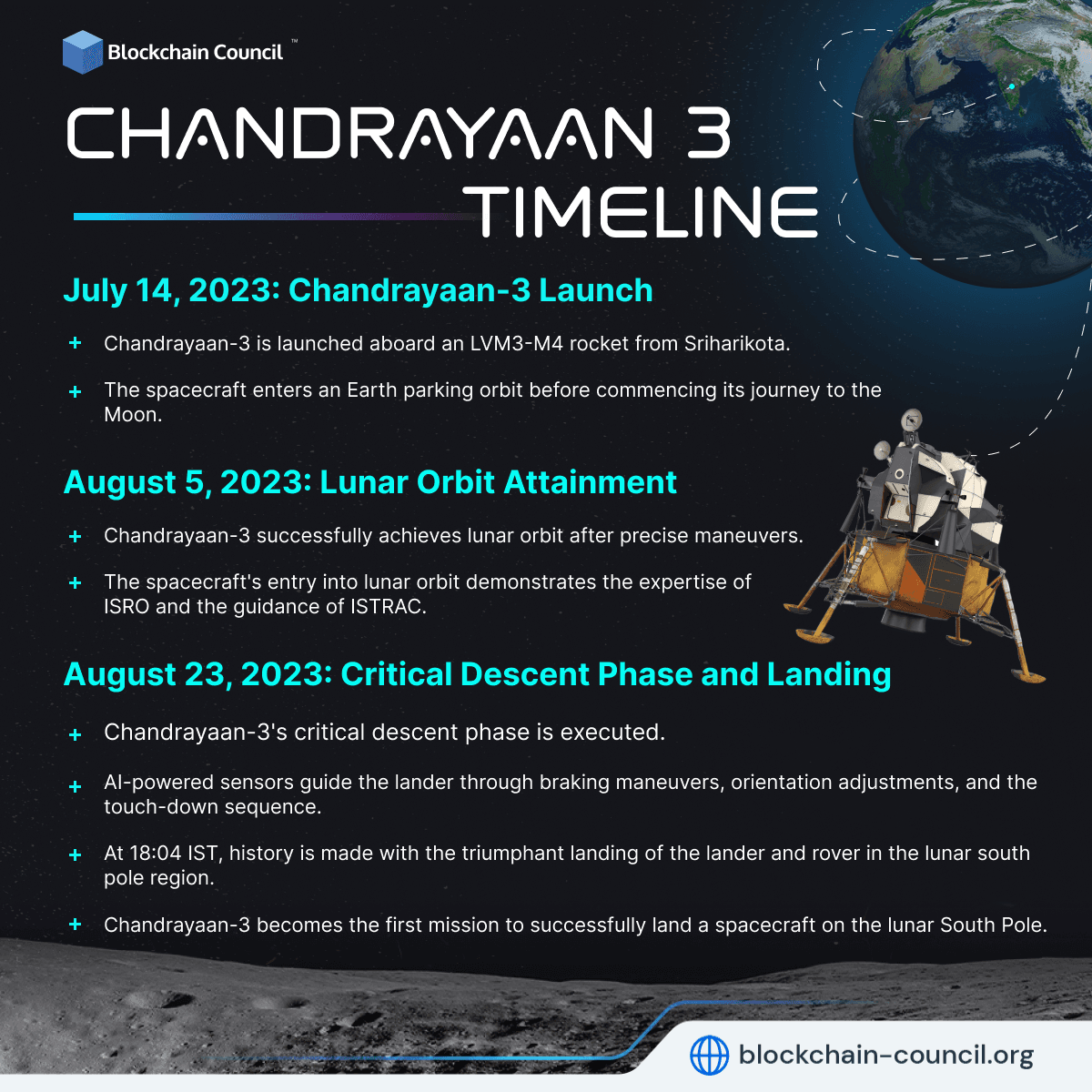
The saga commenced on July 14, 2023, when Chandrayaan-3 embarked on its cosmic journey. Anticipation rippled as it soared, with eyes set on the Moon’s mysterious south pole. On August 23, 2023, at 18:04 IST, history was etched – the triumphant touchdown of the lander and rover in the lunar south pole region.
Yet, this triumph was hard-won, with Chandrayaan-2 as a poignant precursor. Launched in July 2019, it carried an orbiter, lander, and rover. However, its lander encountered a heartbreaking deviation during descent. Undeterred, Chandrayaan-3 emerged, a symbol of resilience and determination, focused on conquering the lunar south pole.
Underneath this triumph lies AI’s unsung role. Guiding the spacecraft with precision, AI navigated complexities and ensured a secure landing. This silent force epitomized data-driven decision-making at its finest.
Collaboration also fueled Chandrayaan-3. The European Space Tracking Network (ESTRACK), operated by the European Space Agency (ESA), stood in solidarity. This partnership signifies a new age of shared expertise, amplifying space exploration’s reach.
The Synergy of AI and Spacecraft Design
At the heart of Chandrayaan-3’s triumphant lunar landing lies a sophisticated array of AI-powered sensors, a testament to modern technological marvels. These sensors encompass velocimeters, altimeters, and accelerometers that orchestrate the precision-driven landing with unparalleled accuracy. Unlike earlier lunar missions that grappled with landing deviations, Chandrayaan-3’s sensors harnessed AI’s capabilities. Armed with data from these sensors, AI models meticulously mapped the lunar topography, identified potential hazards, and recalibrated the descent trajectory to ensure a meticulously controlled landing.
Chandrayaan-3, a product of meticulous engineering, consisted of three main components, each meticulously designed to contribute to its mission:
- Propulsion Module: This module carried the lander and rover configuration into a lunar orbit of 100 kilometers. Equipped with a sizeable solar panel and a cylindrical mounting structure for the lander, this module served as the precursor to the crucial landing phase.
- Lander (Vikram): Responsible for the soft landing on the Moon’s surface, Vikram was a box-shaped marvel with four landing legs and four landing thrusters. These thrusters boasted an impressive thrust of 800 newtons each, aiding the precision landing. Unlike its predecessor, Chandrayaan-2, Vikram’s design featured four variable-thrust engines with improved attitude control and rate, maximizing its ability to navigate the descent phase.
- Rover (Pragyan): Pragyan, the six-wheeled rover with a weight of 26 kilograms, was equipped with a variety of instruments to analyze the lunar surface. With dimensions of 917 mm x 750 mm x 397 mm, this compact rover was geared to conduct in-depth research on the lunar composition, history of impacts, and more.
The Flight Path and Landing
A pivotal juncture during the descent is the transition from horizontal to vertical orientation. Drawing lessons from the challenges of the Chandrayaan-2 mission, ISRO leveraged AI as a safety net. The AI system honed through exhaustive simulations, supervised this orientation shift. The Lander Horizontal Velocity Camera (LHVC), under AI’s guidance, adeptly tilted the lander to a precise 90-degree angle. This episode underscores the intricate dance of human intellect and AI-enabled automation.
Chandrayaan-3’s mission profile was a meticulously choreographed sequence of events:
Conclusion
At the core of this success is artificial intelligence. It’s not a passive element but a guiding force. AI’s calculations and decisions orchestrated Vikram’s descent, adapting to real-time lunar variables. This mission’s achievement isn’t just in its landing; it’s in the seamless interaction between human ingenuity and machine intelligence.
Chandrayaan-3 marks not an end but a new beginning. Data collected, images sent – these are fragments of a larger mosaic. The lunar surface beneath Vikram and Pragyan holds secrets waiting to be unraveled, insights that could reshape our understanding of the Moon and beyond.
Chandrayaan-3’s success echoes through time and space. It’s a testament to India’s technological strides and unyielding determination. As we look to the future, we’re reminded that in the vast expanse of the cosmos, human innovation knows no bounds. With each mission, each landing, humanity takes another step toward the stars.
Frequently Asked Questions
Related Articles
View All
AI & ML
OpenAI Dots vs Grok Bot vs Muse
Compare OpenAI Dots, Grok Bot, and Meta Muse to understand how these always-on AI agents differ in persistent work, computer use, connected apps, automation, and personal or business workflows.

AI & ML
What Is OpenAI Dots?
Learn what OpenAI Dots are, how these always-on AI agents work, and how they use GPT-6 Astra, cloud computers, connected apps, and persistent context to handle ongoing tasks.

AI & ML
OpenAI Launches GPT 6.1-Sol
OpenAI launches GPT-6.1 Sol, a new reasoning model offering near-Astra performance at lower cost for complex coding, computer use, agentic workflows, and professional tasks.
Trending Articles
The Role of Blockchain in Ethical AI Development
How blockchain technology is being used to promote transparency and accountability in artificial intelligence systems.
What is AWS? A Beginner's Guide to Cloud Computing
Everything you need to know about Amazon Web Services, cloud computing fundamentals, and career opportunities.

Can DeFi 2.0 Bridge the Gap Between Traditional and Decentralized Finance?
The next generation of DeFi protocols aims to connect traditional banking with decentralized finance ecosystems.