

Careers in an AI Bubble: AI Skills, Certifications, and Roles That Stay Valuable After the Hype Cycle


Careers in an AI bubble can feel contradictory: headlines signal explosive growth, while hiring teams raise standards and some entry-level tasks get automated. The durable opportunity sits in roles that connect AI to infrastructure, data, security, and measurable business outcomes. Enterprise adoption remains high, with Salesforce reporting that 84% of CIOs believe AI will be as important as the internet, yet 95% say integration is a major hurdle and skills shortages remain a top barrier. That combination shapes what stays valuable after the hype cycle: professionals who can ship reliable AI into real systems.
What the Current AI Hype Cycle Means for Careers
AI spending and infrastructure investment suggest more than a short-lived trend. Global AI technology spending reached approximately $427 billion in 2025, and the cloud computing market was valued at roughly $912 billion with projections to exceed $1.1 trillion in 2026. This matters because AI capability is increasingly a cloud and platform capability, not a standalone product.

At the same time, hiring has become more selective. Layoffs since 2023 are widely attributed to pandemic-era over-hiring rather than AI replacing workers at scale. The shift is real, though: AWS research finds 50-55% of early-career workloads in selected tech roles are already AI-augmented. Juniors are expected to use AI tools, and the differentiator becomes fundamentals, judgment, and system-level understanding.
Roles That Stay Valuable After the Hype Cycle
Resilient roles share three traits: they are hard to automate end-to-end, they plug into core systems, and they map to ROI or risk reduction. Below are the AI roles with the strongest staying power.
1. AI Infrastructure, Cloud, and Platform Roles
Large AI projects depend on compute, networking, storage, observability, and cost control. Multi-year infrastructure commitments, including major big tech capital programs, reinforce that these roles are anchored to long-term investment plans.
- Cloud engineers, DevOps engineers, and solutions architects who design scalable environments and automate deployments for AI workloads.
- MLOps and AI platform engineers who operationalize models with CI/CD pipelines, monitoring, rollback procedures, access controls, and cost optimization.
- Site reliability engineers (SRE) with AI exposure who keep AI services reliable under changing traffic and model behavior.
Why they endure: the work is integration-heavy, reliability-focused, and requires cross-team coordination that is difficult to replace with tool automation.
2. Data Engineering and Data Architecture
Enterprise AI fails more often from data issues than from model selection. Data engineers and architects who build trusted pipelines, enforce governance, and make data usable at scale are consistently identified as durable demand roles.
- Data engineers building ETL/ELT pipelines, batch and streaming workflows, and quality checks.
- Data architects defining data models, lineage, access patterns, and platform standards.
- Analytics engineers bridging business metrics and reliable datasets for reporting and AI evaluation.
Why they endure: model performance, compliance, and auditability all depend on data quality, provenance, and governance.
3. Applied AI Engineering (Beyond Prompts)
Coursera-reported median pay levels underscore the continued value of deep technical AI roles, including AI engineer (approximately $151,000), computer vision engineer (approximately $164,000), and AI research scientist (approximately $196,000). These roles survive hype cycles because they are accountable for outcomes, not tool usage.
- AI engineers shipping end-to-end AI applications integrated with existing systems and workflows.
- Machine learning engineers building training and inference pipelines, optimizing performance, and managing evaluation.
- Computer vision engineers and NLP specialists delivering domain-specific solutions in healthcare, manufacturing, finance, and document processing.
Why they endure: these roles require strong programming, statistics, evaluation discipline, and production readiness.
4. AI Security, Cybersecurity, and AI Governance
AI expands the attack surface across data pipelines, model endpoints, and integrations. Cybersecurity is repeatedly cited as a resilient growth category, and AI-savvy security practitioners gain leverage as more organizations move models into production.
- AI security engineers addressing model and pipeline risks such as prompt injection, data leakage, and model exfiltration.
- Cybersecurity professionals securing cloud environments, identities, APIs, and monitoring infrastructure.
- AI governance, risk, and compliance specialists building controls for transparency, privacy, safety, and audit readiness.
Why they endure: regulation and risk management requirements typically increase after periods of rapid experimentation, especially in regulated sectors.
5. AI Product, Program, and Domain Expert Roles
AI systems only matter when they change decisions, workflows, or customer outcomes. That requires leadership in ambiguous environments, strong metric design, stakeholder management, and relevant domain knowledge.
- AI product managers translating capabilities into features, requirements, and measurable impact.
- Technical program managers coordinating data, engineering, security, and compliance delivery.
- Domain experts using AI tools in healthcare, finance, supply chain, law, and manufacturing who can validate outputs and manage liability.
AI Skills That Remain Valuable After the Hype
To build a future-proof AI career, focus on fundamentals that transfer across tools and model families rather than narrowly tool-specific knowledge.
Core Foundations (Durable Across Cycles)
- Programming and software engineering: Python is central, along with Java or C++ in many production stacks. Maintain strong fundamentals in testing, code review, and architecture even when using AI coding assistants.
- Math and statistics: probability, linear algebra, optimization, and experimental design enable you to evaluate, debug, and explain model behavior.
- Cloud and systems: Linux, networking, containers, and infrastructure automation are foundational because AI is increasingly deployed as a platform service.
AI Engineering Skills That Compound Over Time
- Model development and evaluation: training, validation, error analysis, bias checks, and robustness testing.
- MLOps and LLMOps: CI/CD for models, monitoring drift, observability, rollback strategies, and cost-performance tuning.
- Data engineering for AI: lineage, governance, feature pipelines, and reliable datasets for training and evaluation.
- Prompt engineering as a workflow competency: treat prompting as part of a broader workflow that includes retrieval, tools, evaluation, and guardrails rather than a standalone job identity.
Hybrid Skills That Differentiate Senior Talent
- Critical thinking and problem framing: define the real decision being improved, the relevant metric, and the likely failure modes.
- Communication: explain tradeoffs to non-technical stakeholders and align teams on risk, timelines, and ROI.
- Ethics and risk awareness: understand what can go wrong and how to mitigate issues in regulated environments.
Which AI Certifications Stay Valuable After the Hype Cycle
Certifications retain value when they validate hands-on capability in durable layers: cloud, data, security, and production AI. Certifications focused narrowly on a single UI or prompt templates are more exposed to commoditization as tools evolve.
High-Retention Certification Areas
- Cloud architecture and engineering: demonstrates the ability to run AI workloads securely and reliably at scale.
- DevOps and infrastructure-as-code: portable skills that support both AI and non-AI systems.
- Data engineering and analytics: validates pipeline construction, warehousing, governance, and metrics foundations.
- Machine learning and AI engineering: most valuable when coverage includes deployment, evaluation, monitoring, and real-world projects.
- Cybersecurity and AI security: security is a durable demand category, and AI adoption increases urgency for specialized controls.
- AI governance and responsible AI: aligns with emerging regulation and enterprise audit requirements.
How to Evaluate an AI Certification
- Is it hands-on? Look for labs, projects, and scenario-based assessments.
- Does it cover production? Monitoring, evaluation, security, and integration matter more than demonstrations.
- Does it teach fundamentals? Statistics, data pipelines, and architecture outlast specific tools.
- Is it role-aligned? Match it to a target role such as MLOps engineer, data engineer, or AI product manager.
Practical Learning Paths for Professionals and Enterprises
For individuals, the most reliable strategy for building a sustainable career during an AI hype cycle is to anchor your profile in a durable base role, then layer AI capabilities on top.
- Software engineer to AI engineer: strengthen Python, APIs, testing, and system design, then add ML fundamentals and deployment skills.
- IT or DevOps to MLOps: deepen Linux, containers, CI/CD, observability, and cloud security, then learn model lifecycle management.
- Analyst to data engineer or decision scientist: build SQL, data modeling, pipelines, and experiment design skills, then expand into ML evaluation and causal thinking.
- Security to AI security and governance: add model risk concepts, data protection for AI pipelines, and secure AI deployment patterns.
For enterprises, prioritize organization-wide AI literacy while investing deeply in a smaller set of core functions: cloud and platform engineering, data engineering, AI engineering, cybersecurity, and AI governance. Salesforce CIO research highlights that integration hurdles and skill shortages are primary barriers to AI adoption, so capability-building must target integration and operations, not just prototype development.
Conclusion: What Stays Valuable After the AI Hype Cycle
Careers in an AI bubble become resilient when your skills address hard problems directly: production infrastructure, reliable data, security, governance, and outcomes that leadership can measure. Spending trends show AI is being built into cloud and enterprise platforms at scale, and job projections for computer and information research roles point to sustained growth over the next decade. The professionals who thrive after the hype are not those who chase the newest tool. They are the ones who can design systems, validate results, secure deployments, and translate AI capability into business value.
Related Articles
View All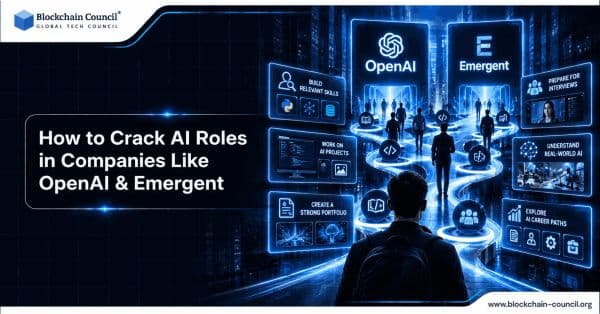
AI & ML
How to Crack AI Roles in Companies Like OpenAI & Emergent
Learn how to prepare for AI roles at companies like OpenAI and Emergent by building the right technical skills, projects, research experience, portfolio, and interview strategy.

AI & ML
Built to Catch AI Cheating: Rethinking Pre-Employment Assessments with HireValid
Explore how HireValid is rethinking pre-employment assessments with AI-resistant test design, integrity signals, candidate evidence, and human review to address AI-assisted cheating.

AI & ML
AI-Era Hiring Needs AI-Proof Tests: How HireValid Is Redefining Talent Assessment
Explore how HireValid is rethinking talent assessment for the AI era with job-relevant tests, anti-cheating design, integrity signals, and human-reviewed evidence of candidate ability.
Trending Articles
AWS Career Roadmap
A step-by-step guide to building a successful career in Amazon Web Services cloud computing.
How Blockchain Secures AI Data
Understand how blockchain technology is being applied to protect the integrity and security of AI training data.
How to Install Claude Code
Learn how to install Claude Code on macOS, Linux, and Windows using the native installer, plus verification, authentication, and troubleshooting tips.