

AWS Load Balancer Guide for AI Workloads: ALB vs NLB vs GWLB
 Suyash Raizada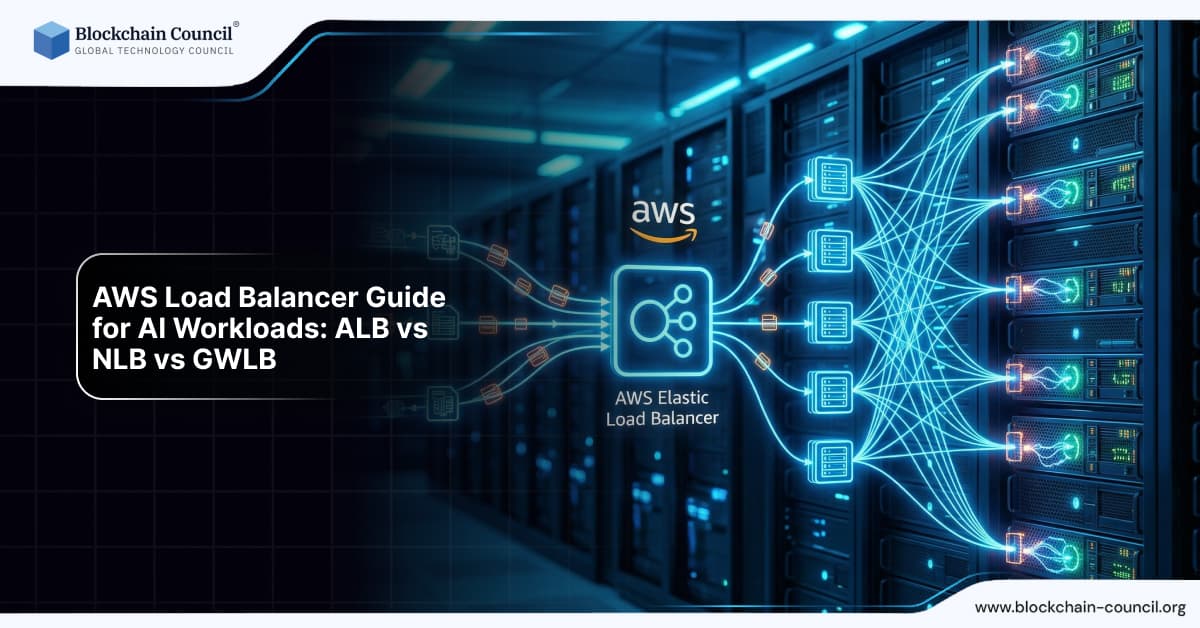
AWS Load Balancer services are a core building block for reliable, scalable AI applications on AWS. Whether you are serving real-time inference, streaming features into an online model, or routing traffic across microservices, AWS Elastic Load Balancing (ELB) distributes incoming requests across multiple targets - Amazon EC2 instances, containers, or Lambda functions - across one or more Availability Zones. This improves availability, fault tolerance, and scalability while reducing operational overhead in DevOps workflows.
This guide explains how AWS load balancing works, how to choose the right load balancer type, and how to apply capabilities that matter for AI systems, including mutual TLS, automatic target weights, and ultra-low latency networking..

Optimize AI workloads using AWS load balancers with secure and scalable configurations by mastering frameworks through an AI Security Certification, automating deployments via a Python certification, and scaling solutions using a Digital marketing course.
What is AWS Elastic Load Balancing (ELB)?
AWS Elastic Load Balancing automatically distributes traffic across multiple targets. Supported target types include:
Amazon EC2 instances
Containers (ECS and EKS)
IP addresses (for on-premises or hybrid patterns)
AWS Lambda functions (with Application Load Balancer)
ELB is designed to span multiple Availability Zones, which is critical for AI services that must remain available even when a zone experiences degradation. It integrates with AWS security and observability tooling, including IAM, CloudTrail, CloudWatch metrics, and access logs.
AWS Load Balancer Types: ALB vs NLB vs GWLB vs CLB
AWS provides four ELB options. Most modern architectures use ALB or NLB, while GWLB serves specialized networking needs and CLB is primarily a legacy option.
1) Application Load Balancer (ALB) for Layer 7 Routing
ALB operates at Layer 7 and is well suited for HTTP/HTTPS and gRPC workloads. For AI applications, ALB is commonly used as the entry point for model APIs, multi-tenant endpoints, and microservice routing.
Key ALB capabilities for AI workloads:
Content-based routing using paths, hosts, headers, and query strings - useful for versioned model endpoints such as /v1/infer vs /v2/infer.
TLS termination and certificate management (commonly paired with AWS Certificate Manager) to reduce encryption overhead on backend servers.
WebSocket support for streaming responses, relevant for interactive AI applications.
Container-friendly traffic handling, including multi-port patterns and deep integration with ECS and EKS.
Mutual TLS (mTLS) for two-way x509 authentication with revocation checks, important for regulated AI environments and partner integrations.
Automatic Target Weights (ATW) that reduce traffic to impaired targets based on observed HTTP or TCP error signals, improving resilience during partial failures.
Target Optimizer for strict concurrency scenarios, helpful when a model server must process a limited number of concurrent requests per target.
ALB also supports hybrid patterns, including AWS Outposts and Local Zones, which can be relevant when AI inference must run closer to data sources or end users.
2) Network Load Balancer (NLB) for Layer 4 Performance and Low Latency
NLB operates at Layer 4 and is a strong choice for high-throughput and low-latency workloads. This makes it a natural fit for AI inference serving and real-time search where response time is critical.
Why NLB is common in AI serving paths:
Ultra-low latency networking characteristics suited to real-time inference pipelines.
Static or elastic IP support, which simplifies allowlisting for enterprise consumers.
Source IP preservation for accurate rate limiting, auditing, and user-level analytics.
Long-lived TCP connection handling, useful for streaming or persistent client patterns.
PrivateLink support (TCP/TLS) for private, service-to-service connectivity across accounts or VPCs.
When raw throughput or minimal data-path overhead is the priority, NLB is generally the preferred option.
3) Gateway Load Balancer (GWLB) for Network Appliance Insertion
GWLB operates at Layers 3 and 4 and is designed to deploy, scale, and manage third-party or custom network appliances. In AI contexts, GWLB is typically used for security and compliance purposes - for example, routing traffic through inspection, data loss prevention (DLP), or IDS/IPS systems before it reaches inference services.
Common GWLB scenarios:
Inline traffic inspection for regulated data
Centralized security tooling shared across multiple VPCs
Scalable appliance fleets without complex routing configuration
4) Classic Load Balancer (CLB) for Legacy Architectures
CLB supports basic Layer 4 and some Layer 7 features but is considered a legacy option with limited modern capabilities compared to ALB and NLB. For new AI projects, ALB or NLB is recommended unless a specific legacy constraint applies.
Core AWS Load Balancer Features for Production AI Services
Regardless of load balancer type, several foundational capabilities help keep AI services stable and observable.
Observability with CloudWatch Metrics and Logs
ELB publishes metrics to CloudWatch. Common signals include request counts, latency, and error rates for ALB, while NLB and GWLB emphasize flow-level metrics such as active flows, new flows, and processed bytes. Combining these signals with application metrics - model latency, queue depth, and GPU utilization - provides a complete operational picture.
Access logs support traffic analysis, security investigations, and model endpoint usage analytics.
CloudTrail integration provides auditability for configuration changes, which is important for enterprise AI governance programs.
Connection Management and Graceful Behavior Under Change
Connection draining prevents dropped requests during deployments and auto scaling events.
Cross-zone load balancing improves utilization and availability across Availability Zones.
Deletion protection prevents accidental removal of critical load balancer resources.
Security Patterns for AI Endpoints
AI endpoints are often high-value targets because they expose sensitive data and expensive compute capacity. ELB supports a range of security controls:
SSL/TLS offloading to reduce per-instance encryption overhead and standardize cipher configuration.
SNI to host multiple secure applications behind a single endpoint.
Backend encryption for end-to-end TLS when required.
Security groups (where supported) and VPC controls to restrict access at the network level.
ALB authentication options for controlling user access at the service edge.
For regulated or partner-facing AI APIs, ALB mutual TLS provides strong client identity verification and certificate-based access controls.
How to Choose the Right AWS Load Balancer for AI Workloads
Use these decision points when selecting an AWS Load Balancer for an AI system:
Protocol and routing needs: If you need HTTP routing features - paths, headers, and redirects - choose ALB. For raw TCP/UDP/TLS performance, choose NLB.
Latency sensitivity: For ultra-low latency inference and real-time pipelines, NLB is generally preferred.
Target type: Invoking Lambda directly requires ALB. For IP or instance targets at Layer 4, both ALB and NLB can work, but protocol requirements typically determine the choice.
Security and compliance: For certificate-based client authentication, use ALB with mTLS. For private connectivity across accounts, consider NLB with PrivateLink.
Hybrid and edge requirements: For on-premises or edge deployments, ALB on Outposts and Local Zones can help reduce latency and maintain consistent operations.
AWS Load Balancer in Kubernetes and DevOps Pipelines
Many AI teams deploy inference and feature services on Kubernetes for portability and scaling flexibility. The AWS Load Balancer Controller enables ALB and NLB integration with Amazon EKS, supporting direct-to-pod load balancing, multi-namespace patterns with ALB, and fully private cluster designs.
For DevOps workflows, ELB reduces operational overhead in dynamic environments:
ECS integration supports dynamic port mapping so services can scale without manual configuration updates.
Health checks and automated target registration help CI/CD deployments remain safe as instance fleets roll over.
Combining load balancing with auto scaling and multi-AZ deployment produces more resilient service architectures.
Practical Architectures for AI Using AWS Load Balancer
Pattern 1: Multi-Model API Gateway with ALB Routing
Use ALB rules to route requests by host or path to different target groups - for example, /embed, /rerank, and /generate. This isolates scaling and deployment cycles by model type while presenting a single, consistent endpoint to clients.
Pattern 2: Low-Latency Inference Fronted by NLB
Place NLB in front of GPU-backed inference servers on Amazon EC2 or container targets. This approach maximizes throughput and reduces network overhead, aligning with real-time inference and search pipeline requirements.
Pattern 3: Secure Partner Access with ALB mTLS
For B2B integrations, enforce client certificate authentication at the ALB layer and pass certificate details to backend applications for authorization decisions. Combined with access logging, this approach supports compliance and audit requirements.
Building Skills in AWS Networking and DevOps for AI Systems
Load balancing sits at the intersection of AWS networking, security, and site reliability engineering. Professionals building AI services benefit from structured learning in cloud architecture, container orchestration, and security operations. Blockchain Council offers certifications in DevOps, cloud security, and AI engineering for practitioners looking to formalize expertise across these disciplines.
Design high-performance infrastructure for AI applications using AWS load balancing strategies by gaining expertise through an AI Security Certification, building backend services via a Node JS Course, and promoting cloud solutions using an AI powered marketing course.
Conclusion
An AWS Load Balancer is more than a traffic router. For AI systems, it functions as a reliability layer that protects model endpoints from failures, supports safer deployments, strengthens security controls, and improves performance through the appropriate Layer 7 or Layer 4 choice. Use ALB when you need HTTP-level intelligence, authentication, and features like mTLS or weighted resilience controls. Choose NLB when latency and throughput are the primary concerns for inference and real-time pipelines. Invest in strong metrics, logging, and connection management so your AI services remain stable as demand scales.
FAQs
1. What is an AWS Load Balancer?
An AWS Load Balancer distributes incoming traffic across multiple targets such as servers or containers. It improves availability, scalability, and performance of applications.
2. What are the main types of AWS Load Balancers?
The main types are Application Load Balancer (ALB), Network Load Balancer (NLB), and Gateway Load Balancer (GWLB). Each serves different use cases and traffic layers.
3. What is an Application Load Balancer (ALB)?
ALB operates at the application layer (Layer 7). It routes HTTP and HTTPS traffic based on content such as URLs and headers.
4. What is a Network Load Balancer (NLB)?
NLB operates at the transport layer (Layer 4). It handles TCP, UDP, and TLS traffic with high performance and low latency.
5. What is a Gateway Load Balancer (GWLB)?
GWLB is designed to deploy and manage third-party virtual appliances. It operates at Layer 3 and routes traffic through security or inspection services.
6. Which load balancer is best for AI workloads?
The choice depends on the workload type. ALB is ideal for HTTP-based AI services, while NLB suits high-performance and low-latency requirements.
7. When should I use ALB for AI applications?
Use ALB for AI APIs, web-based inference services, and microservices. It supports advanced routing and integrates well with containerized environments.
8. When should I use NLB for AI workloads?
NLB is suitable for real-time AI applications requiring low latency. It is commonly used for high-throughput data processing and streaming.
9. When is GWLB useful in AI infrastructure?
GWLB is useful when integrating security appliances like firewalls. It ensures traffic inspection and compliance in AI systems.
10. How does ALB handle traffic routing?
ALB uses rules based on URL paths, hostnames, and headers. This allows precise routing to different services or models.
11. What are the performance benefits of NLB?
NLB offers ultra-low latency and can handle millions of requests per second. It is designed for high-performance workloads.
12. How does GWLB improve security in AI systems?
GWLB routes traffic through security tools for inspection. This helps detect threats and enforce compliance policies.
13. Can I use multiple load balancers in one architecture?
Yes, combining ALB, NLB, and GWLB is common in complex systems. Each can handle specific layers or functions.
14. How do load balancers support scalability in AI workloads?
They distribute traffic across multiple instances. This ensures systems can scale horizontally as demand increases.
15. What is the difference between Layer 4 and Layer 7 load balancing?
Layer 4 focuses on network-level routing using IP and ports. Layer 7 handles application-level routing based on content.
16. How does AWS integrate load balancers with AI services?
Load balancers work with services like EC2, ECS, EKS, and Lambda. They ensure efficient traffic distribution across AI workloads.
17. What are common mistakes when choosing a load balancer?
Choosing based on familiarity rather than workload needs is common. Misunderstanding traffic types can lead to performance issues.
18. How does latency impact AI workloads?
Low latency is critical for real-time AI applications. Choosing the right load balancer helps maintain fast response times.
19. Are AWS load balancers cost-effective for AI systems?
Costs depend on usage, traffic, and configuration. Optimizing architecture helps manage expenses effectively.
20. What is the best practice for load balancing in AI architectures?
Use the right load balancer for each layer and workload. Combine performance, security, and scalability for optimal results.
Related Articles
View All
AI & ML
Jev AI: the complete guide to TypeSafe's System One Model
Explore Jev AI in this complete guide, including TypeSafe’s System One architecture, RLCD training, parallel sampling, typed decisions, calibrated confidence, performance, and automation use cases.

AI & ML
Jev AI: Complete Guide
Explore Jev AI in this complete guide, including how TypeSafe AI’s System One model works, its features, use cases, benefits, limitations, and role in software automation.

AI & ML
OpenAI Launches GPT-6.1 Terra: What’s New?
OpenAI has launched GPT-6.1 Terra, a faster and cheaper mid-tier model with stronger computer use, better image understanding and fewer errors. See what is new, what it costs, and who can use it.
Trending Articles
The Role of Blockchain in Ethical AI Development
How blockchain technology is being used to promote transparency and accountability in artificial intelligence systems.

Top 5 DeFi Platforms
Explore the leading decentralized finance platforms and what makes each one unique in the evolving DeFi landscape.
How Blockchain Secures AI Data
Understand how blockchain technology is being applied to protect the integrity and security of AI training data.