

Building an AI Video Pipeline for Marketing Teams: Script to Automated Editing and Localization

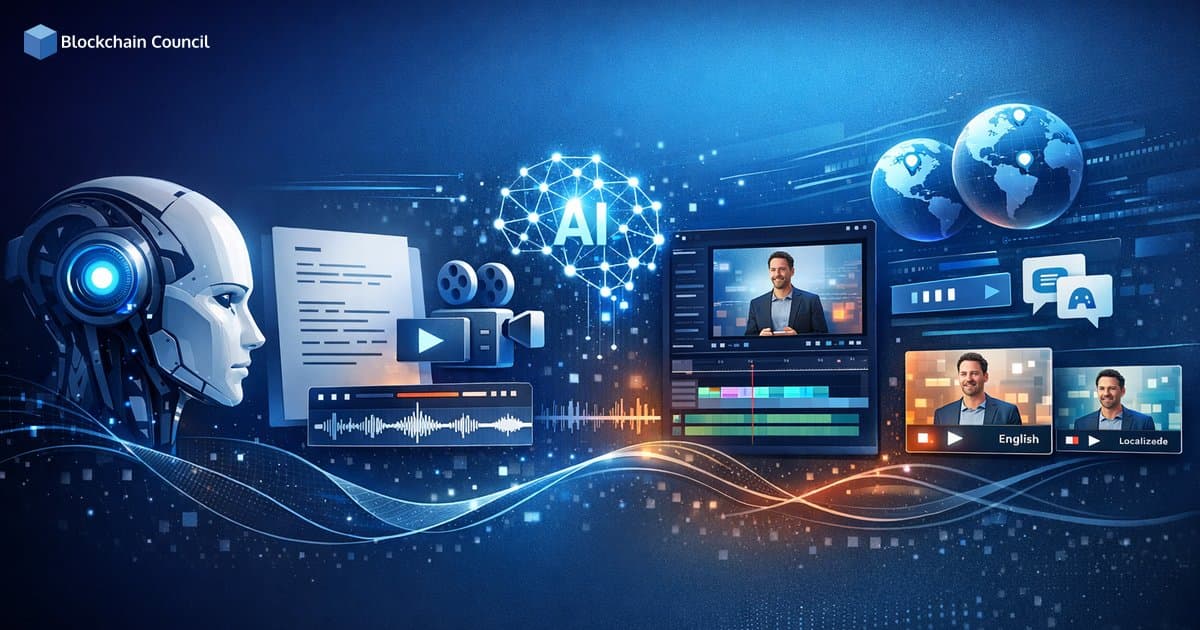
Building an AI video pipeline for marketing teams in 2025-2026 is less about picking a single best tool and more about orchestrating an end-to-end workflow: strategy, scripting, asset creation, automated editing, localization, distribution, and a feedback loop that improves every iteration. High-performing teams consistently follow the same pattern: humans define the strategy and guardrails, AI generates scalable variants, and humans perform final approvals at key checkpoints.
What an AI Video Pipeline Means for Marketing in 2025-2026
An AI video pipeline is a connected content workflow where multiple AI systems and automation steps move work from a brief to published, localized videos across platforms. Rather than treating AI as a script generator or an editing shortcut, modern teams treat it as a continuous production line that reliably outputs volume without sacrificing brand control.

A typical AI-first pipeline includes:
- Research and insight ingestion (competitive and audience signals)
- Script and concept generation (hooks, storyboards, variants)
- Asset creation (avatars, prompt-to-video, templates)
- Automated editing and repurposing (clipping, captions, reframing)
- Localization and personalization (dubbing, subtitles, transcreation)
- Distribution and iteration (publishing, analytics, learning loops)
Why Marketing Teams Are Adopting AI Video Pipelines Now
The primary drivers are economics and speed. In UGC-style performance marketing, traditional creator-based videos can cost around USD 200 per video after fees and coordination, while AI-driven UGC-style pipelines using avatars can reduce marginal costs toward USD 5 per video. That cost reduction changes how teams test creatives: instead of producing a handful of videos per month, teams can run continuous experimentation with dozens or hundreds of variants.
AI-based clipping and templating workflows are also being designed to scale to 1,000 or more clips per month from a relatively small set of long-form inputs such as webinars, podcasts, and product demos. This makes consistent publishing realistic even for lean teams.
End-to-End Blueprint: From Script Generation to Automated Editing and Localization
Below is a practical, implementation-oriented blueprint reflecting how advanced teams build an AI-first workflow today.
1) Strategy, Research, and Briefing (Human-Led, AI-Assisted)
Strong output begins with strong inputs. Many teams now use a strategy layer that pulls together:
- Competitive ad examples to identify repeated hooks, formats, and claims in the market.
- Audience insights from surveys, call notes, reviews, and engagement data to surface objections and desires.
- Brand voice and positioning as a living document that every agent in the pipeline must follow.
The goal is a clear message framework that the rest of the pipeline executes against, including prioritized angles such as pain, aspiration, proof, and urgency, plus brief templates for awareness, acquisition, and retention.
Human checkpoint: Marketing leadership should approve positioning, claims boundaries, and the list of statements the brand will not make before any scaled production begins.
2) Script Generation and Ideation (Variant-Driven)
Once the brief is finalized, LLM-based scripting can produce large sets of platform-specific scripts and hooks. Mature workflows generate:
- Script variants tuned to TikTok, YouTube Shorts, LinkedIn, and paid social.
- A/B hooks that test different angles while preserving the same offer and CTA.
- Storyboard markers that label where captions, B-roll, testimonials, or proof points should appear.
Consistency depends on enforcing brand constraints: tone, vocabulary, reading level, and compliance rules. Teams that succeed avoid ad-hoc prompting and instead run scripts through a structured workflow with reusable prompt templates and approved knowledge bases.
Human checkpoint: Select the scripts to produce, validate all claims, and confirm the narrative matches brand intent.
3) Asset Creation and Initial Renders (Choose the Right Branch)
Production does not follow a single path. High-performing pipelines branch based on the creative type required:
- UGC-style performance ads: AI avatar tools can create presenter-led videos that resemble creator content, enabling fast iteration across offers, hooks, and personas. Some UGC-focused workflows support multi-language output across 30 or more languages to support global testing.
- Narrative or cinematic concepts: Prompt-to-video models are often used for top-of-funnel visuals, combined with stock footage and motion graphics as needed.
- Product explainers and feature highlights: Template-driven systems generate structured scenes covering problem-solution, social proof, and feature demos to reduce manual production time.
Typical outputs include a master video (often in 9:16 for social), scene-level assets for editing, and voiceover tracks that can be swapped during localization.
4) Automated Editing, Formatting, and Repurposing (Scale Output Without Scaling Headcount)
AI-assisted editing has become the core scaling mechanism for video teams. Common automation steps include:
- Text-based editing: edit video by editing the transcript, remove filler words, cut silences, and tighten pacing.
- Auto-reformatting: generate 9:16, 1:1, and 16:9 versions with subject-aware reframing.
- Captions and overlays: auto-generated captions using brand fonts and colors, plus lower-thirds and CTAs triggered by script markers.
- Clip extraction: convert long-form assets into a high volume of short clips by identifying hook moments and formatting them with templates.
This is how teams move from one webinar to dozens of short-form clips, or from one ad concept to many tailored variants, without rebuilding every edit from scratch.
Human checkpoint: Review pacing, on-screen text accuracy, brand look and feel, and any sensitive claims before publication.
5) Automated Localization and Transcreation (Highest ROI for Global Teams)
Localization is one of the most impactful applications of AI video pipelines because it multiplies distribution without multiplying production cost. A strong localization layer includes:
- Multilingual dubbing and voice replacement that preserves timing and emotional tone.
- Lip-sync for avatar presenters to improve perceived authenticity in local markets.
- Subtitle generation and translation with consistent style rules and safe area constraints for each platform.
- On-screen text localization for CTAs, pricing, disclaimers, and UI labels in product demos.
- Transcreation to adapt hooks and idioms to local culture rather than simply translating words.
Localization should be designed as a repeatable, governed process, particularly for teams operating in regulated industries or markets with strict advertising standards.
Human checkpoint: Native-language review for nuance, compliance, cultural fit, and offer accuracy.
6) Distribution, Analytics, and Learning Loops (Close the Flywheel)
An AI-first pipeline should not stop at export. Leading teams connect publishing and analytics so that performance data directly informs the next production cycle. A practical loop includes:
- Automated scheduling and publishing aligned to a campaign calendar.
- Performance monitoring across watch time, view-through rate, CTR, and CPA.
- Iteration agents that detect winning hooks and angles, then generate improved variants for the next test cycle.
This creates a compounding system: the more you publish, the more data you gather, and the smarter the next round of scripts and edits becomes.
Design Principles for a Brand-Safe AI Video Pipeline
Most failures in AI video production come from poor workflow design rather than model quality. The following principles help teams build something reliable and repeatable.
Start Outcome-First, Not Tool-First
Define success metrics before selecting tools. Examples include qualified pipeline growth, customer acquisition cost, retention lift, or regional expansion goals. Then design the workflow backwards from those outcomes.
Separate Strategy from Execution
Maintain a stable strategy layer covering positioning, claims boundaries, message framework, and brand kit that feeds into execution. This prevents inconsistent outputs caused by ad-hoc prompting across the team.
Make Each Stage Modular with Clear Interfaces
Treat research, scripting, asset generation, editing, localization, and publishing as swap-friendly modules. Clear inputs and outputs reduce vendor lock-in and simplify future upgrades.
Instrument Feedback Loops
If performance data does not flow back into script generation and creative decisions, the result is faster content production, not a true pipeline. A genuine AI pipeline improves with each cycle based on real performance signals.
Keep Humans in the Loop for Approvals
Human approval checkpoints are non-negotiable for brand reputation, legal risk, and creative direction. The fastest teams automate production but centralize governance at defined review stages.
Team Skills and Training to Operationalize the Pipeline
As AI video pipelines mature, marketing teams increasingly need operational skills alongside creative skills. Key capabilities include workflow orchestration, prompt and template design, data governance, and structured QA processes.
For structured upskilling, consider internal training pathways aligned to specific roles, such as:
- Certified AI Marketing Professional for campaign and workflow design using AI systems.
- Certified Prompt Engineer for reusable prompt frameworks, evaluation methods, and brand-safe generation.
- Certified Generative AI Expert for deeper understanding of model capabilities, constraints, and governance requirements.
Conclusion: Strategy-Led, AI-Scaled, and Governance-Driven
Building an AI video pipeline for marketing teams is now a practical approach to delivering more creative iterations, faster turnaround, and global localization without proportionally scaling headcount. The most effective model is consistent across organizations: humans set strategy and guardrails, AI generates and repurposes at scale, and humans approve at defined checkpoints.
When built as a modular system with clear governance and a closed feedback loop, an AI video pipeline delivers more than faster production. Each campaign generates data that makes the next one more targeted, more consistent, and more effective.
Related Articles
View All
AI & ML
Jev Decision-Making Pipeline
Learn how Jev’s decision-making pipeline transforms structured program state and predefined questions into typed, probabilistic decisions for automated software workflows.

AI & ML
Jev Decision Pipeline
Learn how the Jev decision pipeline works, from structured program state and predefined questions to parallel processing, typed outputs, calibrated probabilities, and software actions.

AI & ML
AI Models for Automated Decisions
Explore how AI models support automated decisions through prediction, classification, scoring, optimization, and probabilistic reasoning across software and business systems.
Trending Articles
How Blockchain Secures AI Data
Understand how blockchain technology is being applied to protect the integrity and security of AI training data.
What is AWS? A Beginner's Guide to Cloud Computing
Everything you need to know about Amazon Web Services, cloud computing fundamentals, and career opportunities.
Claude AI Tools for Productivity
Discover Claude AI tools for productivity to streamline tasks, manage workflows, and improve efficiency.