

AI Security Fundamentals (2026): Core Concepts, Threat Models, and Key Controls
 Suyash Raizada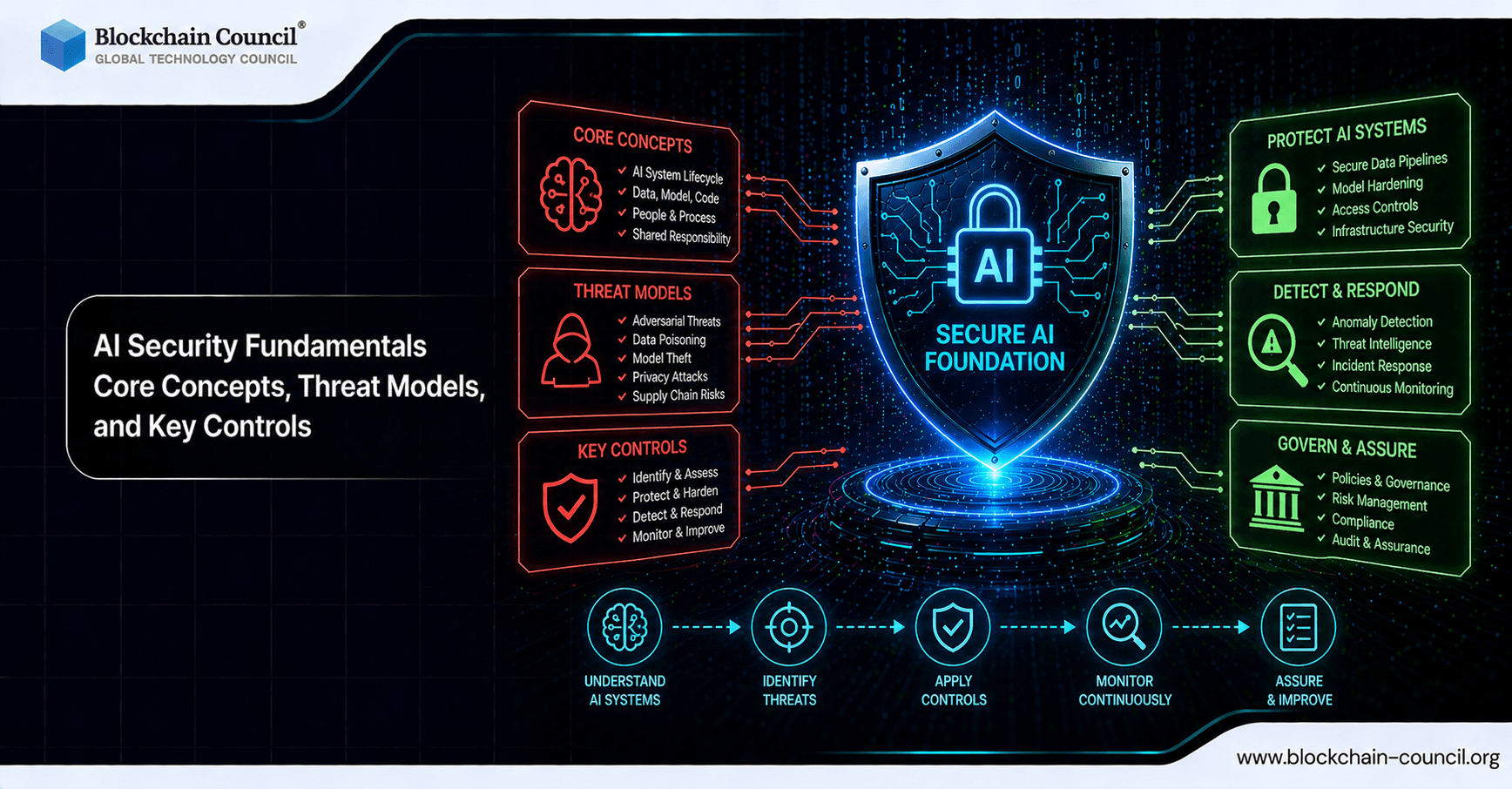
AI security fundamentals in 2026 are no longer optional. As AI shifts from experimentation to business-critical infrastructure, attackers increasingly target data, models, and AI-powered workflows. The 2025 Stanford AI Index Report noted that AI-related incidents in business increased by over 56% year over year, reinforcing why organizations need practical threat models and concrete controls that work across the AI lifecycle.
This guide covers the core concepts behind AI security, the most relevant threat models for modern AI systems including autonomous agents, and the key controls enterprises should implement now.

Mastering AI security fundamentals starts with the right foundation-learn with an AI Security Certification, build technical depth using a Python Course, and explore applications via an AI powered marketing course.
What Makes AI Security Different from Traditional Cybersecurity?
AI systems introduce an expanded attack surface that goes beyond typical application vulnerabilities. In addition to code and infrastructure, AI security must protect:
Training data (integrity and provenance) that can be poisoned
Model artifacts such as weights and embeddings that can be stolen or tampered with
Inference endpoints exposed to prompt injection and data exfiltration attempts
Human-AI interaction where overreliance can create unsafe automation loops
Because AI behavior is probabilistic and can shift with new data, models, tools, and prompts, AI security requires both classic controls (identity, logging, segmentation) and AI-specific controls (prompt defenses, dataset chain-of-custody, model governance).
Core AI Security Concepts to Align Teams
1) The AI Asset Inventory Is the Foundation
Security programs cannot protect what they cannot see. An AI asset inventory should map:
Models (internal, third-party, fine-tuned, foundation models)
Datasets (source, licensing, collection method, sensitivity, retention)
Tooling (vector databases, orchestration frameworks, agent tools, plugins)
Endpoints (APIs, chat interfaces, batch inference jobs)
Third-party services (model hosting, evaluation services, data labeling vendors)
NIST-style mapping activities are especially useful here because they require a living, continuously updated inventory that enables threat modeling, monitoring, and incident response.
2) AI Supply Chain Risk Is Now Business Risk
The AI supply chain extends beyond source code. It includes scraped datasets, open model repositories, dependencies, orchestration tools, and evaluation benchmarks. A single compromised dependency or contaminated dataset can cascade into downstream retraining and deployment, amplifying impact across products and teams.
3) Agents Change the Threat Model
AI agents are evolving from assistants into autonomous actors operating inside networks. When agents can call tools, access APIs, and take actions, they resemble a new class of insider threat. The security model must assume that agent inputs and tool calls can be manipulated, and that agent outputs can cause harm if left unconstrained.
AI Security Threat Models to Use in 2026
Threat modeling is where AI security fundamentals become actionable. Two widely used references for AI-specific threats are:
MITRE ATLAS, which maps adversary tactics and techniques for AI systems and supports red teaming and threat hunting
OWASP LLM Top-10, which identifies practical, high-impact vulnerabilities in LLM applications such as prompt injection and supply chain issues
Threat Model 1: Data Breaches and Access Control Failures
AI systems often concentrate sensitive data into training sets, logs, prompts, and retrieval sources. Attackers target weak points such as insecure APIs, misconfigured storage, excessive permissions, and leaky integrations.
Typical scenarios include:
Unauthorized access to training data or vector databases
Prompt-based data extraction (asking the model to reveal secrets from context)
Exposed keys in agent toolchains and orchestration scripts
Threat Model 2: Data Poisoning and Pipeline Compromise
Data poisoning attacks aim to corrupt training or fine-tuning data so the model behaves incorrectly, embeds backdoors, or becomes biased in ways that benefit the attacker. This risk is especially relevant when organizations ingest large-scale external data or rely on third-party labeled datasets.
Warning signs include:
Unexpected performance shifts after a data refresh
New edge-case failures clustered around specific triggers
Unexplained changes in dataset distributions
Threat Model 3: Prompt Injection and Tool Manipulation
Prompt injection is a leading risk for LLM applications, particularly when models can invoke tools. Attackers craft inputs that override instructions, manipulate retrieval, or direct an agent into taking unsafe actions.
Common impacts:
Exfiltration of sensitive data from retrieved context
Unauthorized API calls (payments, account changes, data deletion)
Policy bypasses that produce prohibited output or actions
Threat Model 4: Autonomous Agent Threats as an Insider-Like Risk
Agents operating with broad permissions can move quickly and at scale. If compromised or misdirected, an agent can access systems, modify data, or trigger workflows faster than a human attacker could.
Security focus areas: tool governance, least privilege, sandboxing, real-time output monitoring, and detailed logging.
Threat Model 5: Deepfakes and Authentication Bypass
Deepfake video and audio can bypass biometric or voice-based authentication and enable convincing social engineering. This threat is operational as well as technical, targeting help desks, finance approvals, and executive communications.
Threat Model 6: Shadow AI and Accidental Data Leakage
Unapproved AI tools used by employees can transmit confidential data to external services without security review, contractual controls, or audit visibility. Shadow AI typically grows when teams lack a sanctioned alternative that meets their productivity needs.
Key Controls for AI Security Fundamentals
1) Input Sanitization and Prompt Injection Defenses
Basic input validation is insufficient for LLMs. Implement layered defenses aligned with OWASP LLM Top-10 guidance:
Prompt sanitization to filter or transform malicious instructions
Context and retrieval controls to prevent unsafe data exposure
Dependency pinning and strict version control for AI application components
2) Zero-Trust Architecture for AI Workloads
Apply zero-trust principles across AI systems and their supporting infrastructure:
Strong identity verification and multi-factor authentication
Network segmentation to reduce lateral movement
Continuous authorization and policy enforcement for services and users
This approach reduces blast radius when an endpoint, key, or agent is compromised.
3) API Governance and Least-Privilege Access for Agents
If an agent only needs read access, it should not hold write permissions. Implement:
Scoped tokens with minimal permissions
Tool allowlists and approval workflows for new integrations
Rate limits and transaction thresholds for high-risk actions
4) Output Monitoring, Guardrails, and Human-in-the-Loop Controls
Real-time checks on model and agent outputs help stop harmful actions and data leaks before they propagate. Effective approaches include:
Policy-based output filtering for sensitive data patterns
Action validation before tool calls execute
Human approval for high-impact operations (payments, deletions, privilege changes)
5) Sandboxing and Containment
Run agents and untrusted model interactions in isolated environments so a compromise does not grant direct access to core systems. Sandboxing should include:
Restricted network egress
Ephemeral credentials
Separation between experimentation and production
6) Shadow AI Detection and Safe Alternatives
Use Cloud Access Security Brokers and network analysis to detect traffic to unapproved AI services. Pair detection with governance:
AI Acceptable Use Policies that define data handling rules
Sanctioned internal tools such as private, company-hosted LLMs for approved use cases
7) Continuous Monitoring and Logging for AI Systems
Log AI interactions, tool calls, model updates, and access events. Comprehensive logging enables threat detection, compliance audits, and faster incident response when issues arise.
Secure AI Development Lifecycle (SAIDL): A Workable Blueprint
To operationalize AI security fundamentals, implement a Secure AI Development Lifecycle that covers data, models, and deployments.
Phase 1: Secure Data Acquisition and Management
Verify training data integrity and origin to reduce poisoning risk
Use cryptographic signatures for original datasets and timestamped change approvals to establish chain of custody
Classify data sensitivity and enforce retention rules
Phase 2: Secure Model Development
Scan ML libraries and dependencies with vulnerability tooling
Perform model architecture reviews and evaluate attack resilience
Use adversarial training where appropriate to improve robustness
Phase 3: Secure Deployment and Monitoring
Implement real-time output checks and guardrails
Deploy agents in sandboxed environments
Monitor continuously for anomalies and unauthorized access
30-Day Implementation Plan for 2026
Adopt OWASP LLM Top-10 mitigations for prompt sanitization, output filtering, and supply chain controls.
Create a living AI asset inventory of models, datasets, endpoints, and third parties using NIST-style mapping.
Centralize logging and detection by collecting AI endpoint and agent telemetry into security platforms for real-time alerting.
Lock down agent permissions with least privilege, allowlists, and approval workflows for tools.
Frameworks and Standards to Align Security and Engineering
Most organizations benefit from combining a tactical framework with a lifecycle framework:
OWASP LLM Top-10 for immediate, developer-friendly fixes
MITRE ATLAS for AI threat modeling, red teaming, and threat hunting
Google Secure AI Framework (SAIF) for enterprise lifecycle coverage and supply chain focus
NIST-oriented mapping to keep AI asset inventories current and auditable
AI security is quickly becoming a core skill-not optional-so getting hands-on with an AI Security Certification, strengthening your foundation via a machine learning course, and understanding how these systems are actually used through a Digital marketing course can put you ahead of most professionals.
Conclusion: AI Security Fundamentals as a Lifecycle Discipline
AI security in 2026 requires protecting not only applications and infrastructure, but also data pipelines, model artifacts, prompts, agents, and the broader AI supply chain. Start with high-visibility wins such as OWASP LLM Top-10 mitigations, a living AI asset inventory, and robust monitoring. Then build toward a Secure AI Development Lifecycle supported by frameworks like MITRE ATLAS and Google SAIF. Organizations that treat AI security as a continuous discipline will be better positioned to reduce incidents, limit blast radius, and scale AI responsibly across the enterprise.
FAQs
1. What is AI security?
AI security focuses on protecting machine learning systems from attacks, misuse, and failures. It covers data, models, infrastructure, and outputs. The goal is to ensure safe and reliable AI operations.
2. Why are AI security fundamentals important in 2026?
AI systems are widely used in critical industries and handle sensitive data. Threats are becoming more advanced and frequent. Strong fundamentals help reduce risks and maintain trust.
3. What are the core components of AI security?
Core components include data security, model integrity, system infrastructure, and monitoring. Each layer requires specific protections. Together, they form a comprehensive defense strategy.
4. What is a threat model in AI security?
A threat model identifies potential attackers, vulnerabilities, and risks. It helps prioritize security measures. This structured approach improves risk management.
5. Why is threat modeling important for AI systems?
It helps organizations understand where attacks may occur. This allows targeted defenses. Without threat modeling, security efforts may be incomplete.
6. What are common threats to AI systems?
Common threats include data poisoning, adversarial attacks, model theft, and prompt injection. These attacks target different stages of the AI lifecycle. Each requires specific defenses.
7. What is data poisoning in AI security?
Data poisoning involves injecting malicious data into training datasets. It affects model behavior and accuracy. Preventing it requires strong data validation.
8. What are adversarial attacks in AI?
Adversarial attacks use crafted inputs to manipulate model predictions. These inputs appear normal but cause errors. They are a major concern in AI security.
9. What is model theft in AI systems?
Model theft occurs when attackers replicate or extract a model. This can lead to loss of intellectual property. It often happens through API abuse.
10. What are key security controls for AI systems?
Key controls include access management, encryption, monitoring, and validation. These controls protect data and models. Layered defenses improve security.
11. How does access control improve AI security?
Access control limits who can interact with data and models. It prevents unauthorized actions. Strong authentication reduces risks.
12. What role does encryption play in AI security?
Encryption protects data during storage and transmission. It ensures confidentiality and integrity. This is essential for compliance and protection.
13. How does monitoring help secure AI systems?
Monitoring tracks system behavior and detects anomalies. It enables early detection of threats. Continuous monitoring supports rapid response.
14. What is model robustness in AI security?
Model robustness refers to the ability to handle unexpected or malicious inputs. Robust models maintain performance under attack. This improves reliability.
15. How can organizations implement AI security fundamentals?
Organizations should integrate security into design, development, and deployment. Use best practices, tools, and governance frameworks. Continuous improvement is essential.
16. What is the role of governance in AI security?
Governance defines policies, responsibilities, and compliance requirements. It ensures accountability and structured management. Strong governance supports secure operations.
17. What are best practices for securing AI systems?
Use layered security, validate data, and monitor continuously. Apply least-privilege access and regular testing. Combine automation with human oversight.
18. How do regulations impact AI security?
Regulations require data protection, transparency, and accountability. Organizations must comply with laws like GDPR. Compliance reduces legal risks.
19. What challenges exist in AI security?
Challenges include evolving threats, complex systems, and lack of standardization. Balancing performance and security can be difficult. Continuous adaptation is required.
20. What is the future of AI security fundamentals?
AI security will become more standardized and integrated into development processes. Advanced tools will improve detection and prevention. Security will remain a critical priority.
Related Articles
View All
AI & ML
NVIDIA’s New AI Models: Nemotron 3.5 Lightning, Cosmos 3 and the Future of Agentic AI
Explore NVIDIA Nemotron 3.5 Lightning and Cosmos 3, how they support agentic and Physical AI, and what these models reveal about NVIDIA’s broader vision for autonomous intelligent systems.

AI & ML
NVIDIA Nemotron 3.5 Lightning vs NVIDIA Cosmos 3: Key Differences and Use Cases
Compare NVIDIA Nemotron 3.5 Lightning and NVIDIA Cosmos 3, including their architectures, reasoning capabilities, modalities, performance goals, and use cases across agentic and physical AI.
AI & ML
System One Models for Software
Explore how System One Models can be used in software to make fast, structured, probabilistic decisions for automation, routing, scoring, verification, and real-time applications.
Trending Articles
The Role of Blockchain in Ethical AI Development
How blockchain technology is being used to promote transparency and accountability in artificial intelligence systems.
AWS Career Roadmap
A step-by-step guide to building a successful career in Amazon Web Services cloud computing.
How to Install Claude Code
Learn how to install Claude Code on macOS, Linux, and Windows using the native installer, plus verification, authentication, and troubleshooting tips.