

GLM 5.2 Explained: Key Features, Architecture, and AI Use Cases
 Suyash Raizada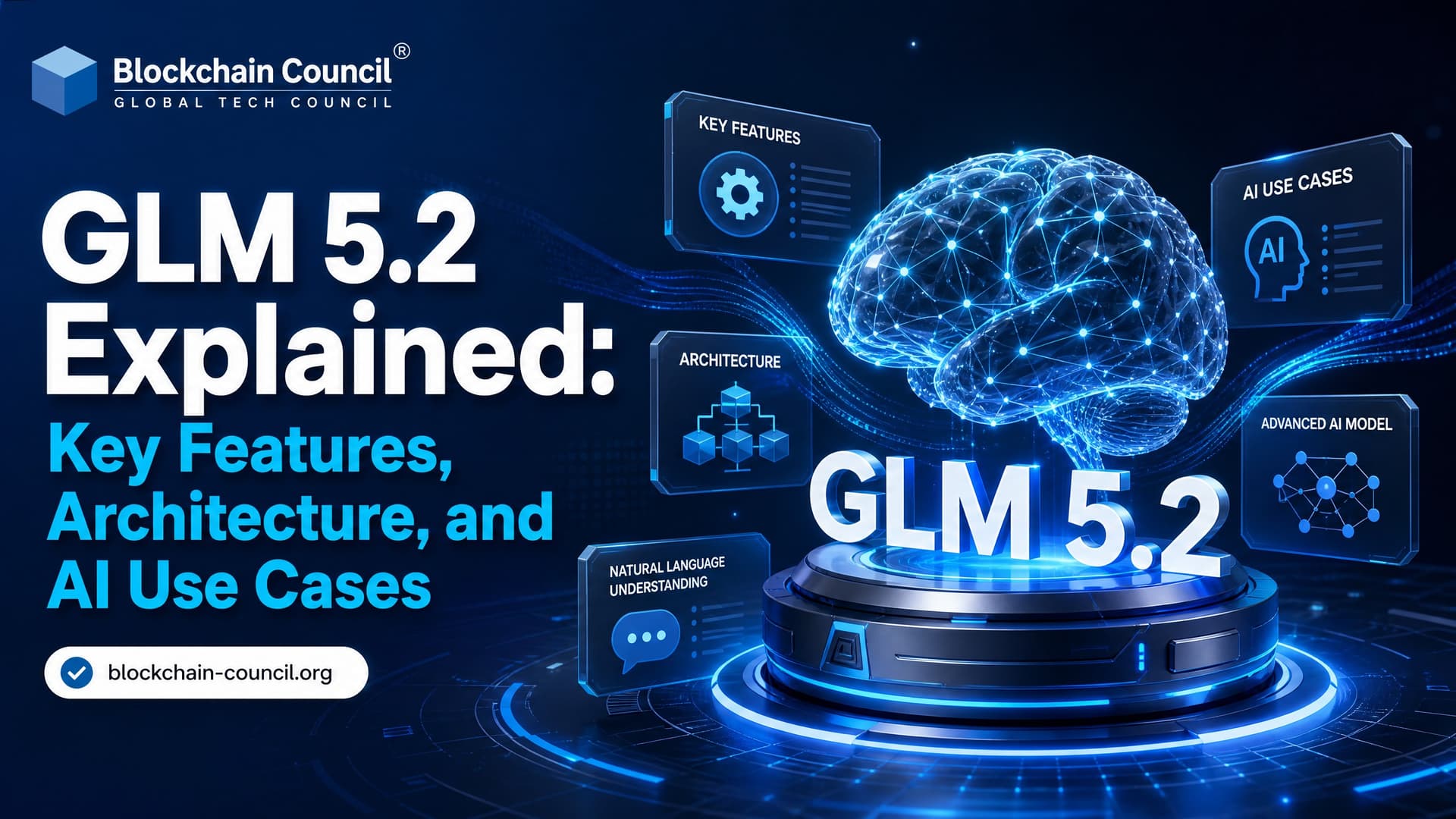
GLM 5.2 is Z.ai's fifth-generation open-weight large language model, built for long-context reasoning, coding agents, and enterprise AI workflows that need more control than a closed API can offer. It pairs a Mixture-of-Experts architecture with sparse attention and multi-token prediction to make frontier-scale AI more practical to deploy.
The short version: GLM 5.2 is not just another large model with a bigger context number. Its design choices target hard work. Reading full repositories. Tracking multi-step plans. Auditing long documents. Running tool-using agents without losing the thread halfway through.

As enterprise AI systems become more capable, developing as an AI Expert can help professionals build practical skills in long-context reasoning, AI governance, agent workflows, and deploying advanced models for real-world business and engineering applications.
What Is GLM 5.2?
GLM 5.2 is an open-weight frontier model from Z.ai, positioned as the successor to earlier GLM 5 models. It is built for organizations that want high-capacity AI while keeping deployment, data handling, and model governance under their own control.
That matters for developers and enterprises. A legal team may not want sensitive contracts sent to a third-party black-box service. A security team may need audit logs and data residency controls. A blockchain engineering team may want a model that can inspect Solidity 0.8.x contracts, Hardhat tests, Foundry traces, and deployment scripts in one workflow.
Z.ai describes GLM 5.2 as built for long-horizon tasks. In practice, that means it is tuned for work that takes many steps, many files, and many tool calls. Think repository migration, policy analysis, bug triage, or agentic devops.
GLM 5.2 Architecture: How It Works
Mixture-of-Experts Backbone
The headline is a very large total parameter count, but the model does not use all of it for every token. It uses a Mixture-of-Experts, or MoE, transformer design.
In an MoE model, a router selects the most relevant expert networks for each token rather than running the entire model every time. Only a fraction of the total parameters activate per token.
This is the main trade-off. You get the representational range of a very large model, while inference cost stays closer to a smaller active model. MoE systems are not magic, though. Routing quality matters. If the router sends tokens to poorly matched experts, output quality can drop, especially in niche technical domains.
Long Context With Sparse Attention
GLM 5.2's native configuration is reported to support a usable context window of around 1 million tokens. Some hosted providers expose smaller windows, such as 256K tokens, because latency, memory cost, and throughput still matter in production.
The key mechanism is dynamic sparse attention. Instead of forcing every token to attend to every other token across a massive prompt, the model uses an indexer to select the most relevant parts of the context before applying full attention.
Z.ai's technical material points to an optimization that shares a lightweight indexer across groups of sparse attention layers rather than computing a new one in every transformer layer. The goal is a meaningful per-token compute reduction at the full 1M context length.
That is a real engineering improvement. Still, do not treat 1M context as a substitute for retrieval design. If you paste a full repo, all logs, and a vague prompt such as fix the bug, you will waste tokens and get uneven results. Give the model a failing command, the stack trace, target files, and constraints.
Multi-Token Prediction and KV Cache Optimizations
GLM 5.2 also uses multi-token prediction, often called MTP, to improve generation speed. Instead of predicting one next token at a time, the model predicts multiple candidate tokens ahead and accepts the valid sequence during decoding.
The model also includes cache management work, including KV cache strategies that help long-context sessions stay usable. This matters more than it sounds. In long agent runs, the bottleneck is often not model intelligence but waiting for the model to read, reason, call tools, and continue without GPU stalls.
Key Features of GLM 5.2
1. Long-Horizon Coding
GLM 5.2 is clearly coding-first. It is built to inspect larger codebases, reason across modules, and propose changes that respect existing architecture.
A practical example: if you are debugging a smart contract test and Hardhat returns VM Exception while processing transaction: reverted with reason string, a useful model must trace the revert through contract state, test setup, signer roles, and gas assumptions. A snippet generator is not enough. GLM 5.2's long-context design makes that kind of multi-file diagnosis more realistic.
For Web3 teams, promising use cases include:
Reviewing ERC-20 and ERC-721 contract implementations for consistency and edge cases
Tracing Foundry test failures across contracts, mocks, and deployment scripts
Checking EIP-1559 gas handling in transaction workflows
Auditing frontend wallet flows involving MetaMask, chain ID 1 for Ethereum mainnet, and testnet switching
If your goal is smart contract development, pair model experimentation with Blockchain Council's Certified Smart Contract Developer™ or Certified Blockchain Developer™ as internal learning paths.
2. Configurable Reasoning Effort
GLM 5.2 supports reasoning effort modes often described as high and max. This lets you trade response time for deeper reasoning.
Use max effort for repository migrations, legal comparisons, financial analysis, or complex agent plans. Use lower effort for interactive code help, summarization, and quick explanations. To be blunt, max effort on every prompt is expensive and usually unnecessary.
3. Long Outputs and Structured Tool Use
Hosted API documentation has described large output limits in some configurations. That is useful for generating long technical reports, migration plans, or multi-file patches.
GLM 5.2 also supports structured outputs and function calling in agent workflows. This is critical when you need JSON that a downstream system can parse. One practical tip: set lower temperature for schema-sensitive tasks. High creativity settings can quietly break JSON with trailing commentary or optional fields you did not request.
GLM 5.2 Benchmarks and Performance Signals
Benchmark claims around GLM 5.2 place it among the strongest open-weight models for coding, reasoning, mathematics, and long-context work. The most defensible signals are architectural and efficiency-related:
A high total parameter count with only a fraction active per token, thanks to MoE routing
Native context reported around 1M tokens, with hosted variants often exposing smaller limits
Large output token limits in some API configurations
Per-token compute reductions at long context through shared-indexer sparse attention
Improved accepted token length from multi-token prediction versus earlier GLM versions
Public benchmark leaderboards are useful, but do not buy the ranking blindly. Test your own workload. A model that wins a coding benchmark may still fail your internal policy format, your Terraform modules, or your Solidity invariant tests.
AI Use Cases for GLM 5.2
Enterprise Document and Policy Analysis
GLM 5.2 suits long documents where context loss is costly. Examples include legal agreements, product specifications, compliance manuals, and technical standards.
You can ask it to compare a vendor agreement against a template, flag unusual indemnity language, extract data processing clauses, or map policy sections to controls. Human review is still required. The model should shorten review cycles, not replace accountability.
Software Engineering Agents
This is GLM 5.2's strongest fit. A coding agent can combine the model with tools such as Git, ripgrep, unit test runners, CI logs, Hardhat, Foundry, or Docker.
Good agent tasks include:
Analyze a failing test and identify likely files to inspect
Propose a patch with minimal scope
Run tests through a tool wrapper
Read the error output
Revise the patch until the issue is resolved
For professionals building this type of workflow, Blockchain Council's Certified Artificial Intelligence (AI) Expert™ and Certified Prompt Engineer™ are relevant internal learning paths.
A Tech Certification can further strengthen this foundation by expanding your understanding of cloud platforms, software engineering, automation frameworks, and emerging technologies that support secure, production-ready AI systems.
Cybersecurity and Log Analysis
Security teams can use GLM 5.2 to analyze large telemetry streams, incident timelines, firewall logs, IAM policy exports, or vulnerability reports. Long context helps when the signal is spread across many events.
The wrong use case is autonomous remediation without guardrails. Do not let an agent rotate keys, block accounts, or change production firewall rules without approval workflows and audit logging.
Blockchain and Web3 Development
For blockchain teams, GLM 5.2 can support contract review, protocol documentation, token standard comparisons, bridge integration analysis, and developer support bots trained on internal docs.
It can also help explain why a transaction failed, compare ABI changes, or draft migration notes after a contract upgrade. Pair this with human security review. Models still miss economic attacks and state-dependent exploits.
Governance Considerations
Open-weight models still need AI governance. You should define data retention rules, access controls, prompt logging, evaluation sets, red-team testing, and human approval points for high-impact decisions.
In regulated sectors, the model choice is only one part of the risk picture. You also need controls around data residency, output validation, user permissions, and incident response.
What Should You Learn Next?
If you are a developer, build a small repo-review agent before you attempt a full autonomous coding system. Start with read-only access, a test runner, structured JSON outputs, and clear stopping conditions. Then measure patch quality, false positives, token cost, and latency.
If your role is strategy, compliance, or architecture, focus on model evaluation and governance. GLM 5.2 is capable because it combines open deployment with long-context reasoning, but value comes from disciplined workflows. For structured learning, explore Blockchain Council's Certified Artificial Intelligence (AI) Expert™, Certified Blockchain Expert™, or Certified Smart Contract Developer™ based on the systems you plan to build.
As enterprise AI platforms continue to reach broader markets, a Marketing Certification can also help professionals understand product positioning, customer communication, user adoption, and go-to-market strategies for advanced AI technologies.
FAQs
1. What Is GLM 5.2?
GLM 5.2 is a large language model (LLM) developed by Zhipu AI. It is designed for reasoning, coding, content generation, multilingual communication, and AI agent applications across enterprise and developer use cases.
2. Who Developed GLM 5.2?
GLM 5.2 was developed by Zhipu AI, a Chinese artificial intelligence company focused on foundation models, enterprise AI solutions, and large language model research.
3. What Is GLM 5.2 Used For?
GLM 5.2 can assist with content creation, software development, document analysis, code generation, AI agents, research, summarization, translation, and business automation.
4. How Does GLM 5.2 Work?
GLM 5.2 uses transformer-based deep learning to understand prompts, analyze context, generate natural language, solve reasoning tasks, write code, and respond to user queries.
5. Is GLM 5.2 a Large Language Model (LLM)?
Yes. GLM 5.2 is a large language model trained on extensive text and code datasets to perform natural language understanding, reasoning, programming, and conversational AI tasks.
6. What Features Does GLM 5.2 Offer?
Common capabilities include natural language understanding, code generation, multilingual support, reasoning, document summarization, AI agents, content generation, and enterprise AI integration.
7. Can GLM 5.2 Generate Code?
Yes. GLM 5.2 supports code generation, debugging, code explanation, refactoring, documentation, and programming assistance across multiple programming languages.
8. Which Programming Languages Does GLM 5.2 Support?
It commonly supports Python, JavaScript, TypeScript, Java, C++, Go, Rust, SQL, HTML, CSS, and other widely used programming languages, depending on the deployment.
9. Can GLM 5.2 Help with AI Agents?
Yes. GLM 5.2 can serve as the reasoning engine for AI agents that perform planning, workflow automation, tool usage, coding assistance, and task execution within defined systems.
10. Does GLM 5.2 Support Multilingual Tasks?
Yes. GLM 5.2 is designed to support multiple languages for tasks such as translation, multilingual conversations, content generation, and cross-language document understanding.
11. Can GLM 5.2 Analyze Documents?
Yes. It can summarize documents, extract key information, answer questions about uploaded text, and assist with knowledge management depending on the implementation.
12. How Does GLM 5.2 Support Enterprise AI?
Organizations can use GLM 5.2 for customer support, knowledge management, software development, workflow automation, document processing, and AI-powered business applications.
13. Which Technologies Work with GLM 5.2?
Developers commonly integrate GLM 5.2 with APIs, AI agents, Retrieval-Augmented Generation (RAG), vector databases, cloud platforms, MLOps tools, workflow automation frameworks, and enterprise software.
14. Which Industries Can Benefit from GLM 5.2?
Finance, healthcare, education, software development, manufacturing, legal services, customer support, retail, cybersecurity, logistics, and enterprise IT can benefit from GLM 5.2-powered applications.
15. What Are the Benefits of GLM 5.2?
Benefits include improved productivity, multilingual support, AI-assisted coding, faster document analysis, intelligent automation, enterprise scalability, and support for AI-driven workflows.
16. What Are the Limitations of GLM 5.2?
Like other LLMs, GLM 5.2 may generate inaccurate information, produce incorrect code, misunderstand ambiguous prompts, or reflect outdated knowledge depending on the deployment and available data. Human review remains important.
17. How Can Businesses Adopt GLM 5.2?
Organizations should identify suitable AI use cases, integrate the model through supported APIs or platforms, establish governance policies, monitor performance, protect sensitive data, and train employees on responsible AI usage.
18. What Skills Are Needed to Work with GLM 5.2?
Useful skills include prompt engineering, Python, APIs, machine learning fundamentals, AI agents, Retrieval-Augmented Generation (RAG), workflow automation, MLOps, and AI governance.
19. What Common Mistakes Should Organizations Avoid When Using GLM 5.2?
Avoid deploying the model without testing, trusting every output without verification, exposing confidential data unnecessarily, skipping human review for high-impact decisions, and ignoring security or compliance requirements. AI is fast at producing answers; correctness still requires validation.
20. What Is the Future of GLM 5.2?
Models like GLM 5.2 are expected to become more capable in reasoning, coding, multimodal understanding, AI agents, and enterprise automation. As the technology evolves, they are likely to support more complex workflows, improve multilingual performance, and integrate more deeply into business software while continuing to require governance, monitoring, and responsible human oversight.
Related Articles
View All
AI & ML
NVIDIA Nemotron 3.5 Lightning vs NVIDIA Cosmos 3: Key Differences and Use Cases
Compare NVIDIA Nemotron 3.5 Lightning and NVIDIA Cosmos 3, including their architectures, reasoning capabilities, modalities, performance goals, and use cases across agentic and physical AI.
AI & ML
Jev Architecture Explained
Explore Jev’s architecture, including TypeSafe AI’s System One design, parallel sampling, RLCD training, typed outputs, calibrated probabilities, and machine-native decision making.
AI & ML
Google Launches Gemini 4 Argon: Features and Capabilities
Google has launched Gemini 4 Argon, its flagship AI model for coding, finance, law, cybersecurity and science. Learn its key features, availability, pricing and safety details.
Trending Articles
The Role of Blockchain in Ethical AI Development
How blockchain technology is being used to promote transparency and accountability in artificial intelligence systems.
How Blockchain Secures AI Data
Understand how blockchain technology is being applied to protect the integrity and security of AI training data.
What is AWS? A Beginner's Guide to Cloud Computing
Everything you need to know about Amazon Web Services, cloud computing fundamentals, and career opportunities.