

AI and the Future of Democracy
 Michael Willson
Artificial intelligence has moved from labs and niche industries into the heart of society, and one of the biggest questions it raises is how it will shape democracy. At its core, democracy relies on trust, accountability, and the free flow of information. AI can support these pillars—or weaken them. That’s why the future of democracy is increasingly tied to how AI develops and how it is governed. This is not a distant problem for the next generation. AI is already being used in political campaigns, election systems, and government decision-making. Whether it strengthens or undermines democracy depends on choices we make now. For citizens and professionals who want to play a role in shaping this future, earning an AI certification is one way to build the knowledge and credibility needed to influence the conversation.
How AI Challenges Democratic Systems
The most common worry about AI and democracy is the spread of misinformation. Generative AI can produce convincing fake images, videos, and articles within seconds. These deepfakes can be used to discredit political opponents, confuse voters, or push polarizing narratives. In the past, creating propaganda required significant resources. Today, a single individual with the right tools can flood social media with realistic but false content.

Another challenge is microtargeting. AI can analyze user data to craft political messages tailored to each voter’s fears or desires. While targeted ads have existed for years, AI makes the process far more precise. Campaigns can design thousands of variations of a message and deliver them quietly to different audiences, making it hard to know what promises or arguments are being made in public. This undermines transparency, one of the cornerstones of a healthy democracy.
AI can also tilt the playing field in favor of those who already have power. Large political parties or governments with access to advanced AI tools can drown out smaller voices. Automated bot networks can simulate grassroots support or create the illusion of consensus, leaving genuine civic movements struggling to be heard.
Studies are beginning to show measurable impacts. Some research suggests that countries with fast AI adoption sometimes see weaker democratic indicators. The concern is that while AI can be used to support governance, it can also become a tool for surveillance, manipulation, or control, especially in fragile democracies.
How AI Can Support Democracy
It would be a mistake, however, to see AI only as a threat. In many cases, it can be a powerful ally for democratic systems. AI can help election officials detect fraud by scanning voter rolls for anomalies or identifying suspicious voting patterns. It can reduce human error in ballot counting, speeding up results while maintaining accuracy.
AI also has potential to strengthen public participation. Language models can translate government documents into multiple languages, ensuring that minority groups can engage in debates. They can also summarize long reports so that citizens who do not have hours to spare can still understand complex policies. Generative systems can even help people articulate their own opinions more clearly, lowering the barrier to participation.
Another promising idea is the development of “public AI”—models built, owned, or managed by democratic institutions rather than private corporations. Instead of relying on the products of a few powerful companies, public AI would reflect collective values and operate with oversight. This could increase trust and ensure that technology aligns with the public interest rather than shareholder profit.
AI can also unlock what some scholars call “public wisdom.” By analyzing large-scale citizen input, AI can identify patterns, summarize opinions, and highlight consensus points. This makes it easier for governments to understand the priorities of their citizens and for citizens to see where common ground exists. Far from undermining democracy, AI could revitalize it by making participation more meaningful and accessible.
Trust and Transparency
The future of democracy with AI will depend heavily on trust. Citizens must feel confident that AI systems are being used fairly, that they are transparent, and that they are accountable when mistakes are made. This is not simple, because many AI models operate as “black boxes.” They produce outputs without clear explanations of how decisions are made.
For democracy to survive and thrive alongside AI, transparency must become a requirement. Systems used in elections, policymaking, or public engagement should be auditable. Citizens should be able to ask not only what decision was made but also why. Without this transparency, suspicion will grow, and trust in both AI and democracy could collapse.
Some countries are already experimenting with labeling AI-generated content in political campaigns. Others are considering laws that require parties to disclose when they use AI to create ads or speeches. These steps are small but important in ensuring that voters can tell truth from manipulation.
Early Lessons from Elections
Real-world events are offering lessons about AI’s role in democracy. During recent elections in several countries, deepfake videos surfaced showing candidates saying or doing things they never actually said or did. Even when debunked, the content spread quickly, sowing confusion.
At the same time, election authorities have begun to test AI tools of their own. In some regions, AI systems scan for duplicate voter registrations or suspicious spikes in turnout. These tools help ensure fairness and reduce the chance of fraud. This dual role—AI as both a threat and a safeguard—highlights the complexity of its relationship with democracy.
The takeaway is clear: AI is not neutral. It is a tool that can be used to support or subvert democratic processes. Its impact depends on who controls it, how it is regulated, and whether citizens can trust it.
Why This Debate Matters Now
Some might ask why this debate is urgent. After all, democracy has survived challenges before—from radio and television propaganda to the rise of the internet. But AI represents a step change in speed, scale, and realism. Unlike earlier tools, AI can generate content that is indistinguishable from reality. It can personalize messages at scale. It can operate around the clock without fatigue.
This means the risks and opportunities are magnified. If democracy adapts, AI could help create more informed citizens, more responsive governments, and stronger institutions. If democracy fails to adapt, AI could accelerate polarization, entrench authoritarianism, and weaken trust in governance.
The decisions being made now—in parliaments, in companies, and in civil society—will shape the trajectory for decades. This is not simply about technology. It is about the survival of the democratic model itself.
Why Democratic Governance of AI Matters
Democracy depends on consent and accountability. Citizens accept laws and policies because they believe they had a fair say in shaping them. AI complicates this because decisions may come from algorithms that few people understand. If those systems operate in secrecy, citizens lose trust. If only private corporations control them, accountability breaks down.
This is why democratic governance of AI is not just a nice idea but a necessity. It ensures that decisions about how AI is used in politics, elections, and public services are not made behind closed doors. Instead, they are debated openly, tested against public values, and subject to oversight. Without this, AI risks becoming a tool for elites rather than a resource for everyone.
The Role of Regulation
Strong regulation is the first step. Some countries are already developing laws that set rules for how AI can be used in elections and campaigns. For example, proposals are being drafted to require political ads created by AI to carry labels. Others are exploring mandatory disclosure whenever AI-generated content is used in campaigns. These rules help voters identify misinformation and hold campaigns accountable.
Beyond elections, regulations are also being shaped around broader principles. The Council of Europe has introduced a treaty linking AI development with human rights, democracy, and the rule of law. This treaty, known as the Framework Convention on Artificial intelligence, sets out baseline standards for how AI should be used across sectors. It is the first international legal instrument that explicitly ties AI to democratic principles.
The message is clear: democracy cannot be left to chance in the age of AI. Regulation must evolve as quickly as the technology itself.
Public Oversight and Participation
Laws are essential, but they are not enough. For governance to be democratic, citizens must be able to participate in shaping how AI is used. One approach is to create citizen assemblies on AI. These are groups of everyday people who are briefed by experts and then deliberate on policy recommendations. By involving the public directly, governments can ensure that AI governance reflects a wide range of values, not just the perspectives of technologists and lawmakers.
Citizen oversight can also take the form of watchdog organizations. These groups could monitor AI systems used in elections or public administration, reporting any misuse or bias. By making these reports public, they strengthen transparency and keep institutions accountable.
The principle here is simple but powerful: AI must be governed not just for the people but with the people.
Co-Governance Models
Another idea gaining traction is co-governance, where power over AI is shared between experts, institutions, and citizens. In this model, no single group has total control. Instead, decision-making is distributed across multiple stakeholders.
For example, a national AI council could include representatives from government, academia, civil society, and the general public. This council would oversee AI policies, set standards, and ensure compliance. The benefit of co-governance is that it avoids both extremes: technocracy, where experts dominate, and populism, where complex technical issues are oversimplified.
Co-governance respects expertise but keeps it accountable to the public. It reflects the democratic balance between knowledge and representation.
Public AI Options
A particularly innovative proposal is the idea of public AI—systems developed and controlled by democratic institutions rather than private companies. Just as public broadcasting provides an alternative to commercial media, public AI would ensure that citizens have access to trustworthy, transparent systems not driven solely by profit.
Public AI could be used in elections to verify content, in parliaments to summarize debates, or in municipalities to support participatory budgeting. Because these systems would be publicly owned, their algorithms could be open to audit, and their priorities would be set by democratic processes.
This does not mean banning private AI companies. It means creating an alternative so that citizens are not forced to rely only on tools designed to maximize shareholder value. Public AI ensures that democratic values have a technological anchor in the digital age.
Global Cooperation
Democracy does not stop at national borders, and neither does AI. Disinformation campaigns often cross countries, with actors in one region targeting voters in another. This makes global cooperation essential.
International agreements like the Council of Europe’s convention are just the start. Democracies must work together to set common standards for AI transparency, election integrity, and ethical use. Without alignment, bad actors will exploit gaps, moving operations to countries with weaker regulations.
Shared frameworks also help level the playing field. If all democracies require disclosure of AI-generated political ads, then no campaign can gain an unfair advantage by hiding its methods. Global cooperation ensures fairness across borders, protecting democratic systems in an interconnected world.
Building Trust Through Transparency
Transparency is the bridge between technology and trust. For AI to fit into democracy, it must be explainable and auditable. This means developing systems that can show how decisions are made and allowing independent bodies to verify those claims.
Imagine an AI tool used to detect fraudulent ballots. If the system flags thousands of votes as invalid, election officials and the public must be able to see why. Was it a pattern in voter IDs? A statistical anomaly? Without this explanation, trust collapses.
Transparency also applies to AI used in policymaking. If a government relies on AI to predict the economic impact of a law, citizens should know how the predictions were generated. This does not mean every voter must understand the code. But it does mean the system must be open to audits and checks.
When people understand how AI fits into their democracy, they are more likely to trust it. Without transparency, even well-intentioned systems will face suspicion.
Democratizing Data
Behind every AI system is data. The question of who controls that data is central to democracy. If data remains concentrated in the hands of a few corporations, then power will also remain concentrated. For AI to serve democracy, data governance must be democratized.
This means creating rules that give citizens more control over how their data is used, shared, and protected. It also means ensuring that datasets are diverse and representative, so AI does not reinforce bias. Public data trusts, where citizens collectively decide how their data is used, are one possible model.
Data is the raw material of AI, and democracy cannot thrive if citizens have no say in how it is harvested and applied.
Preparing Citizens
Finally, democratic governance of AI requires citizens who are informed and capable of engaging with these debates. Civic education must expand to include digital literacy and AI awareness. Citizens need to understand not just how to vote but also how to recognize manipulated media, question algorithmic decisions, and demand accountability.
This does not mean turning everyone into a computer scientist. It means equipping people with the basic knowledge to navigate an AI-driven society. Democracies that invest in this kind of education will be better prepared to use AI responsibly.
Possible Futures for AI and Democracy
A Dystopian Scenario
One possibility is a future where AI becomes a tool for manipulation and control. In this scenario, deepfakes dominate political communication, making it impossible to trust what leaders say or do. Election campaigns run on opaque algorithms that microtarget citizens with personalized messages, leaving no shared public space for debate. Surveillance systems powered by AI track dissent, discouraging citizens from speaking freely. Democracy still exists on paper, but in practice it functions as an illusion—managed by those who control the technology.
A Democratic Renewal
The other possibility is more hopeful. Imagine a world where AI helps citizens engage directly in policymaking. Generative systems summarize legislation, highlight its potential impacts, and translate it into plain language for everyone to understand. Public AI platforms collect citizen feedback, identify areas of consensus, and feed those insights into parliamentary debates. Elections remain secure because AI detects fraud and verifies results quickly. Instead of dividing societies, AI helps bridge gaps, giving diverse voices a place at the table.
These two futures are not fixed destinies but endpoints on a spectrum. Where democracies land will depend on governance, public education, and ethical design.
Roadmap to 2040: A Democratic AI Timeline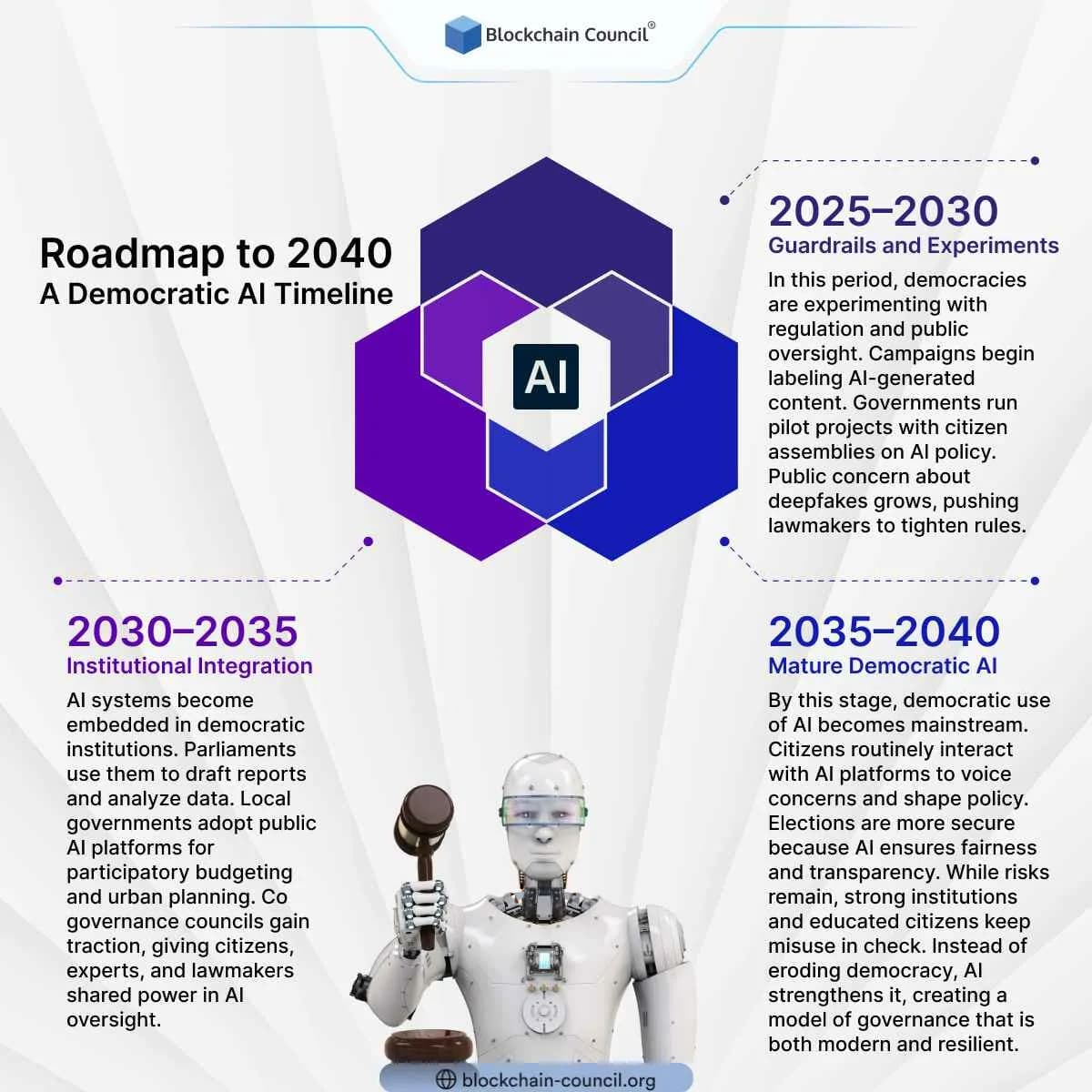
To understand how we might navigate between these futures, it helps to outline a roadmap.
2025–2030: Guardrails and Experiments
In this period, democracies are experimenting with regulation and public oversight. Campaigns begin labeling AI-generated content. Governments run pilot projects with citizen assemblies on AI policy. Public concern about deepfakes grows, pushing lawmakers to tighten rules.
2030–2035: Institutional Integration
AI systems become embedded in democratic institutions. Parliaments use them to draft reports and analyze data. Local governments adopt public AI platforms for participatory budgeting and urban planning. Co-governance councils gain traction, giving citizens, experts, and lawmakers shared power in AI oversight.
2035–2040: Mature Democratic AI
By this stage, democratic use of AI becomes mainstream. Citizens routinely interact with AI platforms to voice concerns and shape policy. Elections are more secure because AI ensures fairness and transparency. While risks remain, strong institutions and educated citizens keep misuse in check. Instead of eroding democracy, AI strengthens it, creating a model of governance that is both modern and resilient.
This roadmap highlights an important truth: the democratic future of AI is not automatic. It requires deliberate effort and long-term investment.
Inequality and Global Power Shifts
One of the biggest risks is inequality. Democracies that adopt AI responsibly may flourish, while others may fall behind. Countries with limited access to AI infrastructure could struggle to compete, leading to geopolitical imbalances. Within societies, the benefits of AI could flow disproportionately to those who already have wealth and influence.
The challenge is ensuring that AI does not deepen divides. Public investment in digital infrastructure, fair access to data, and international cooperation will all play roles. Democracies that share resources and collaborate on standards will be better positioned to protect fairness and inclusion.
The Role of Citizens
Citizens will not be passive in this future. Their choices matter as much as institutional design. A society that trains its people to identify manipulated content, question opaque algorithms, and demand transparency will be stronger. Civic education in the age of AI is not only about history and government but also about digital literacy.
Just as voters once had to learn how to read newspapers critically or evaluate campaign speeches, they will now need to learn how to assess AI-generated media. Democracies that invest in this kind of education will create resilient citizens who can withstand manipulation.
Building Skills for a Democratic AI Future
As AI becomes part of governance, professionals across industries will need to adapt. Policymakers, civic leaders, and technologists must build expertise in AI to ensure that it serves democratic ends. One path is through structured programs like the agentic ai certification, which equips learners to understand how autonomous AI agents can be designed and managed responsibly.
Broader tech certifications also play a role, giving professionals a foundation in emerging technologies that connect directly to civic and democratic contexts. For those focusing on transparency and accountability, blockchain technology courses offer practical insights into how tamper-proof systems can safeguard elections, policymaking, and public records. Exploring technology as a civic tool highlights how AI, blockchain, and data systems together can support democratic resilience.
These programs do more than boost individual careers. They prepare citizens to take part in building the frameworks that will define how democracy interacts with AI.
Risks on the Horizon
Even with strong safeguards, risks will remain. Democracies will face constant pressure from actors who want to exploit AI for power. Cyberattacks targeting election infrastructure will grow more sophisticated. Disinformation will become harder to spot as AI models improve.
There is also the risk of overreliance. If citizens or governments depend too heavily on AI systems, they may lose the human judgment that is central to democracy. Machines can provide insights, but they cannot replace ethical reasoning, empathy, or lived experience.
Another risk is complacency. If citizens assume that AI systems are neutral and trustworthy, they may stop questioning decisions. Democracy requires vigilance, and AI governance is no exception.
Why Hope Still Matters
Despite these challenges, there are reasons to be optimistic. Democracies have faced disruptive technologies before—printing presses, telegraphs, radios, and the internet. Each one reshaped politics, but democracy adapted. AI is more powerful, but it is still a tool. How it is used will depend on collective choices.
If democracies embrace transparency, build strong institutions, educate their citizens, and invest in ethical design, AI could become a cornerstone of democratic renewal. It could reduce inequality by making participation easier. It could make governments more responsive by highlighting public priorities. And it could rebuild trust by ensuring fairness and accountability.
Conclusion
The future of democracy in the age of AI is not predetermined. It will not collapse automatically under the weight of deepfakes, nor will it be saved effortlessly by new regulations. The path forward lies in deliberate action: clear guardrails, inclusive governance, public AI options, civic education, and responsible design.
AI can be a threat or a partner. It can concentrate power or distribute it. It can divide societies or bring them together. The outcome will depend on whether democracies rise to the challenge.
For individuals, the role is equally important. By building skills through agentic ai certification, tech certifications, and blockchain technology courses, citizens and professionals alike can ensure they are ready to shape this future. By engaging with technology as a civic resource, they can help guide its use toward fairness and accountability.
The question “Will AI shape the future of democracy?” has already been answered—it is happening now. The real question is whether democracy can shape the future of AI. If the answer is yes, then the digital age may not erode freedom but renew it, offering citizens new ways to engage, participate, and govern together.
Related Articles
View All
AI & ML
NVIDIA’s New AI Models: Nemotron 3.5 Lightning, Cosmos 3 and the Future of Agentic AI
Explore NVIDIA Nemotron 3.5 Lightning and Cosmos 3, how they support agentic and Physical AI, and what these models reveal about NVIDIA’s broader vision for autonomous intelligent systems.

AI & ML
The Future of System One Models
Explore the future of System One Models, including how fast, structured, probabilistic AI could reshape automation, real-time software, decision systems, and machine-native intelligence.

AI & ML
AI Video Generator: The Future of Video Production
### Excerpt AI video generators are transforming video production by enabling creators and businesses to generate high-quality videos from text, images, scripts, and prompts. Explore how AI video generation is shaping the future of content creation, filmmaking, marketing, and automated video production.
Trending Articles
The Role of Blockchain in Ethical AI Development
How blockchain technology is being used to promote transparency and accountability in artificial intelligence systems.
How Blockchain Secures AI Data
Understand how blockchain technology is being applied to protect the integrity and security of AI training data.
Claude AI Tools for Productivity
Discover Claude AI tools for productivity to streamline tasks, manage workflows, and improve efficiency.