

The Future of Enterprise AI: Beyond Chatbots

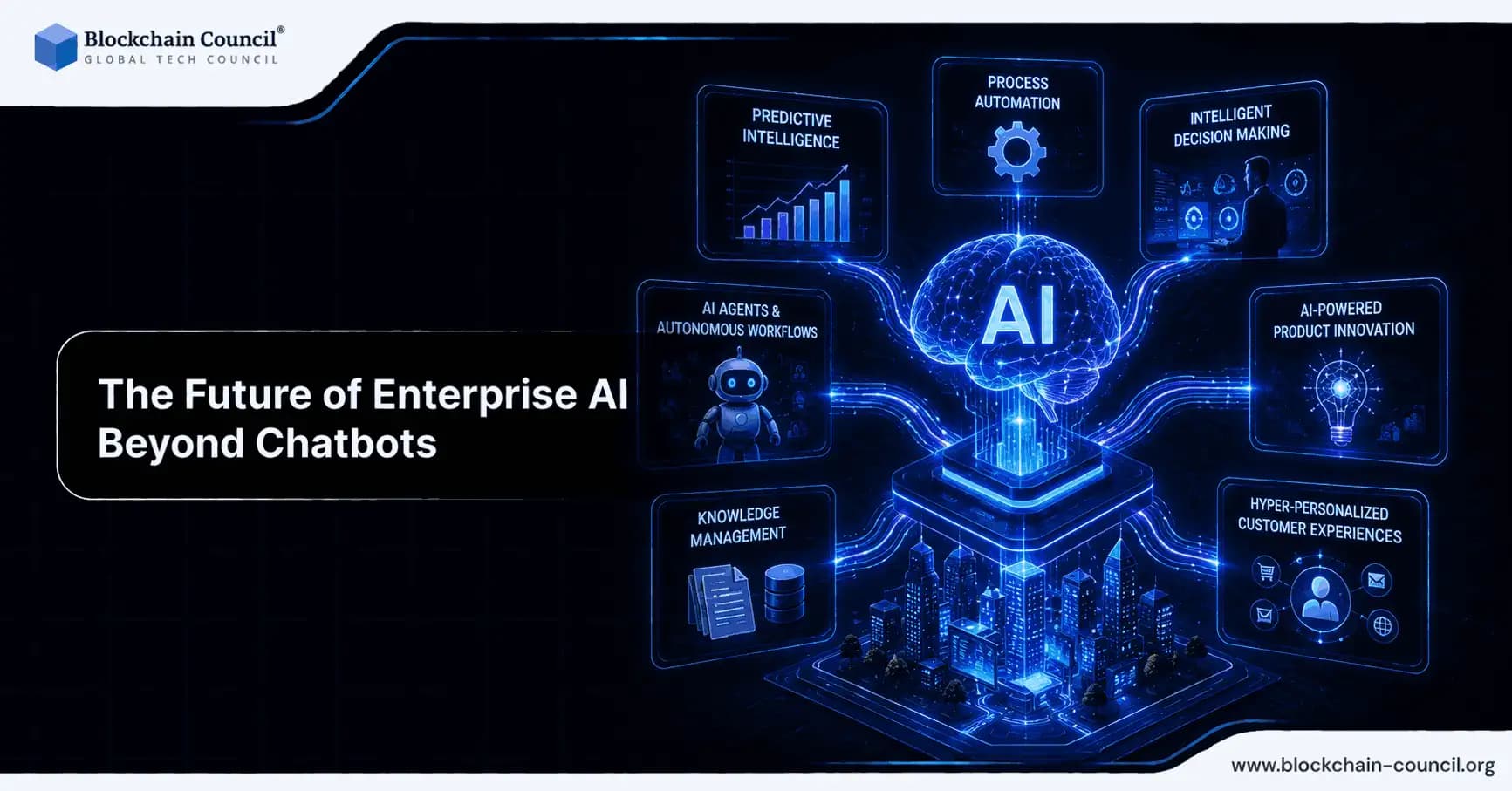
Artificial intelligence has rapidly evolved from a niche technology into a critical business capability. In the early stages of enterprise AI adoption, chatbots became one of the most visible applications. Businesses used conversational AI tools to automate customer support, answer questions, and improve digital interactions. While chatbots remain valuable, enterprise AI has now moved far beyond simple automated conversations.
In 2026, organizations are integrating AI deeply into operations, software development, cybersecurity, workflow automation, marketing, analytics, finance, supply chain management, and strategic decision-making. AI is no longer viewed merely as a customer service tool. It is becoming a foundational layer of modern enterprise infrastructure.

The future of enterprise AI involves autonomous systems, intelligent workflow orchestration, predictive decision-making, AI-powered software engineering, personalized enterprise platforms, and large-scale operational automation. Businesses that once experimented with basic chatbots are now building fully AI-driven ecosystems capable of transforming productivity and innovation across departments.
Humanity spent years asking chatbots for weather updates and customer support tickets before realizing the same technologies could eventually coordinate workflows, generate code, analyze strategy documents, and automate large sections of corporate operations. Naturally, executives became extremely interested the moment AI started affecting quarterly performance metrics.
Why Enterprise AI Is Expanding Beyond Chatbots
Chatbots were only the beginning of enterprise AI adoption because they offered an easy entry point for automation and customer engagement.
However, businesses quickly realized AI systems could support much more complex tasks, including:
Workflow automation
Predictive analytics
Intelligent decision-making
Operational optimization
Software development
Cybersecurity monitoring
Knowledge management
Enterprise search systems
As AI capabilities advanced, organizations began integrating intelligent systems into core business functions rather than limiting AI to front-end communication tools.
The Rise of AI-Powered Enterprise Automation
One of the biggest shifts in enterprise AI is the rise of intelligent automation systems.
Modern AI platforms can automate:
Administrative workflows
HR operations
Customer onboarding
Data processing
Financial reporting
Compliance monitoring
IT support systems
These technologies help businesses reduce repetitive tasks and improve operational efficiency at scale.
Autonomous AI Systems Are Changing Enterprise Operations
The next phase of enterprise AI involves autonomous AI agents capable of handling complex tasks with minimal human supervision.
These systems can:
Coordinate workflows
Analyze business data
Execute operational tasks
Respond to customer requests
Generate reports
Schedule activities
Manage digital processes
Programs such as the Agentic ai expert course are becoming increasingly important because enterprises now require professionals who understand intelligent automation and autonomous AI systems.
Businesses are moving from AI-assisted workflows toward AI-coordinated operational environments.
Enterprise AI and Predictive Decision-Making
AI systems increasingly help businesses make faster and more informed decisions.
Organizations now use AI-powered analytics for:
Demand forecasting
Financial planning
Risk analysis
Customer behavior prediction
Inventory optimization
Fraud detection
Predictive AI systems analyze massive datasets quickly and generate insights that support strategic planning.
This improves agility in highly competitive markets.
Why Workforce AI Skills Are Becoming Essential
As enterprise AI expands, businesses increasingly need employees capable of implementing, managing, and governing AI systems effectively.
This has accelerated demand for practical AI education and workforce development programs.
The AI Expert certification helps professionals build practical AI implementation skills aligned with enterprise environments and modern digital operations.
Organizations increasingly prioritize workforce AI literacy because AI adoption now affects nearly every department.
AI Is Reshaping Software Development
Software engineering is one of the industries most transformed by enterprise AI.
Developers increasingly use AI-powered tools for:
Code generation
Testing automation
Workflow optimization
Debugging
Documentation creation
The AI Powered coding expert Course helps professionals integrate AI into software engineering workflows effectively.
AI-assisted development accelerates software delivery while improving productivity across technical teams.
AI-Powered Knowledge Management Systems
Enterprise AI is also transforming how organizations manage internal information.
AI-powered knowledge systems help employees:
Search enterprise databases
Summarize documents
Retrieve insights quickly
Organize digital information
Improve collaboration across teams
Large organizations increasingly use AI to reduce information silos and improve internal productivity.
Cybersecurity and Enterprise AI
Cybersecurity has become another major area for enterprise AI adoption.
Organizations use AI to:
Detect threats in real time
Monitor network activity
Identify unusual behavior
Automate security responses
Strengthen fraud prevention systems
AI-powered cybersecurity tools improve speed and scalability in protecting enterprise infrastructure.
However, businesses must also manage the risks associated with AI-driven cyberattacks and automated vulnerabilities.
Deeptech Ecosystems Are Accelerating Enterprise AI Growth
Enterprise AI growth is closely connected to broader deep technology adoption.
Organizations focused on Deeptech certification programs help professionals develop expertise in advanced technologies such as:
Artificial intelligence
Blockchain
Automation
Cybersecurity
Cloud computing
Data science
These skills are becoming essential as enterprises modernize digitally.
AI and Enterprise Collaboration
Modern AI systems increasingly support workplace collaboration and communication.
Businesses use AI tools for:
Meeting summarization
Project coordination
Workflow recommendations
Internal support systems
Enterprise communication management
AI improves efficiency for distributed and hybrid work environments.
Apparently, the future office now involves employees collaborating with intelligent systems capable of summarizing meetings more accurately than the humans who attended them. Progress has a strange sense of humor.
The Rise of Personalized Enterprise AI
The next generation of enterprise AI systems will become highly personalized.
Businesses increasingly want AI tools customized for:
Department-specific workflows
Industry requirements
Internal processes
Customer interactions
Regulatory environments
This shift will drive demand for specialized AI integration strategies across sectors.
Enterprise AI in Marketing Operations
Marketing departments are rapidly adopting advanced AI systems beyond simple content generation.
Businesses now use AI for:
Predictive customer analytics
Campaign optimization
Behavioral segmentation
Automated engagement
Personalized advertising
Market trend analysis
Professional Marketing certification programs increasingly help professionals understand modern AI-powered business strategies.
Similarly, the AI powered digital marketing course equips marketers with practical AI-driven digital marketing skills aligned with enterprise needs.
Technology Certification Ecosystems Are Becoming Critical
As enterprise AI adoption grows, businesses increasingly value structured workforce education and certification pathways.
Organizations such as Global Tech Council help provide globally recognized technology learning frameworks aligned with modern enterprise skill requirements.
These ecosystems support:
Continuous workforce learning
AI literacy development
Industry-recognized certifications
Enterprise-aligned education systems
Scalable digital learning
This helps organizations maintain workforce readiness in rapidly changing digital environments.
Enterprise AI and Operational Efficiency
AI systems improve operational efficiency by automating repetitive work and reducing manual processing requirements.
Businesses increasingly use AI to:
Optimize logistics
Improve customer support
Accelerate reporting
Manage supply chains
Enhance workforce productivity
This operational transformation allows organizations to scale more effectively while controlling costs.
Why AI Governance Is Becoming a Priority
As enterprise AI systems become more powerful, governance becomes increasingly important.
Organizations now focus heavily on:
AI transparency
Ethical deployment
Risk management
Compliance monitoring
Human oversight
Data governance
Governments worldwide are expanding AI regulations, making governance essential for long-term business sustainability.
Challenges Businesses Face Beyond Chatbots
Despite rapid AI growth, enterprises still face several major challenges.
Workforce Skill Gaps
Many employees still lack sufficient AI literacy and technical understanding.
Integration Complexity
Integrating AI systems into existing workflows can be technically difficult.
Data Privacy Risks
AI systems often process sensitive business and customer information.
Operational Trust
Employees and customers may distrust AI-driven decisions without transparency.
Rapid Technology Changes
AI evolves faster than many organizations can adapt.
Humanity continues building increasingly intelligent enterprise systems while simultaneously struggling to agree on passwords, compliance policies, and whether anyone actually reads internal training documents.
AI and the Future of Work
Enterprise AI is fundamentally changing workplace expectations.
Employees increasingly need:
AI literacy
Automation awareness
Digital workflow skills
Data interpretation abilities
Strategic thinking
The future workforce will likely collaborate continuously with AI-powered systems across nearly every professional function.
Future Trends in Enterprise AI
Several trends will shape the future of enterprise AI over the next decade.
AI Agents and Autonomous Workflows
AI systems will increasingly coordinate entire business operations independently.
AI-Powered Strategic Planning
Businesses will rely more heavily on predictive AI systems for executive decision-making.
Hyper-Personalized Enterprise Platforms
Organizations will adopt AI tools customized to specific operational environments.
Continuous Workforce Upskilling
AI education and certification will become ongoing professional requirements.
Stronger Enterprise AI Regulations
Governments will continue expanding governance frameworks around enterprise AI deployment.
Why Human Expertise Still Matters
Despite rapid automation, human skills remain essential.
People continue providing:
Leadership
Creativity
Ethical judgment
Strategic vision
Emotional intelligence
Complex problem-solving
AI systems perform best when augmenting human capabilities rather than replacing meaningful human decision-making entirely.
How Businesses Can Prepare for the Future of Enterprise AI
Organizations seeking long-term success should focus on several priorities.
Invest in Workforce Training
Employees need practical AI knowledge and digital literacy skills.
Build Strong AI Governance Systems
Responsible AI deployment reduces operational and legal risks.
Identify Scalable AI Use Cases
Businesses should prioritize applications with measurable operational benefits.
Encourage Cross-Department Collaboration
AI transformation requires coordination between leadership, technical teams, legal departments, and operations.
Maintain Human Oversight
Critical business decisions should continue involving appropriate human review mechanisms.
Conclusion
The future of enterprise AI extends far beyond chatbots and customer support automation. AI is rapidly becoming a foundational business infrastructure layer influencing software development, cybersecurity, operations, marketing, analytics, workflow automation, and strategic decision-making across industries.
Autonomous AI systems, predictive analytics, intelligent workflows, and personalized enterprise platforms are reshaping how organizations operate and compete in increasingly digital economies. At the same time, workforce education, governance systems, ethical oversight, and responsible implementation strategies are becoming essential components of enterprise AI success.
Businesses that invest early in workforce development, AI literacy, scalable infrastructure, and operational integration will likely gain significant long-term competitive advantages.
The next phase of enterprise AI will not simply involve smarter software tools. It will involve fundamentally redesigning how organizations function, collaborate, and innovate in a world where intelligent systems become deeply embedded in everyday business operations.
FAQs
1. What does enterprise AI mean beyond chatbots?
Enterprise AI beyond chatbots refers to intelligent systems that automate workflows, support decision-making, optimize operations, improve cybersecurity, and enhance productivity across entire organizations. Businesses now use AI for much more than customer communication, including analytics, software development, and strategic planning.
2. Why are businesses moving beyond chatbot-focused AI?
Businesses realized that AI technologies can improve efficiency across nearly every department, not just customer service operations. Enterprise AI systems now support automation, predictive analytics, operational coordination, and large-scale digital transformation initiatives.
3. What are autonomous AI systems?
Autonomous AI systems are intelligent tools capable of performing tasks, managing workflows, and making operational decisions with limited human supervision. These systems help organizations automate complex processes and improve operational scalability.
4. How does AI improve enterprise productivity?
AI reduces repetitive tasks, automates workflows, accelerates reporting, supports data analysis, and improves collaboration across teams. This allows employees to focus more on strategic and creative work rather than manual operational tasks.
5. Why are AI skills becoming essential for employees?
As businesses integrate AI into everyday operations, employees increasingly need AI literacy and digital workflow management skills. Organizations now value professionals who understand how to work effectively alongside intelligent systems.
6. How is AI transforming software development?
AI-powered coding tools help developers generate code, automate testing, optimize workflows, and improve debugging processes. These technologies accelerate software development and improve productivity across engineering teams.
7. What role does predictive analytics play in enterprise AI?
Predictive analytics helps businesses forecast trends, analyze customer behavior, manage risks, and optimize operations using AI-driven insights. This improves decision-making and organizational agility in competitive markets.
8. Why is AI governance important for enterprises?
AI governance helps organizations manage transparency, ethical deployment, compliance requirements, data privacy, and operational risks associated with intelligent systems. Strong governance frameworks improve accountability and long-term sustainability.
9. How is AI changing marketing operations?
AI helps marketing teams automate campaigns, personalize customer experiences, analyze behavior patterns, and optimize digital engagement strategies. Businesses increasingly rely on AI-powered systems for data-driven marketing decisions.
10. What are AI-powered knowledge management systems?
AI-powered knowledge systems help employees search databases, retrieve information, summarize documents, and improve collaboration across organizations. These tools reduce information silos and improve productivity in large enterprises.
11. How does AI improve cybersecurity?
AI systems monitor networks, identify suspicious behavior, detect threats, and automate security responses in real time. This improves cybersecurity scalability and helps organizations respond more quickly to evolving digital threats.
12. What challenges do enterprises face with AI adoption?
Organizations face challenges such as workforce skill gaps, integration complexity, governance requirements, privacy concerns, and rapid technology changes. Successful AI implementation requires careful planning and continuous workforce development.
13. Why are technology certification ecosystems growing?
Technology certification ecosystems provide structured learning pathways, recognized credentials, and scalable workforce education programs. Businesses increasingly use certifications to validate employee skills and support digital transformation strategies.
14. How does enterprise AI support operational efficiency?
AI automates repetitive tasks, improves workflow coordination, accelerates reporting, and optimizes resource management. This allows organizations to scale operations more efficiently while controlling costs and improving performance.
15. Will AI replace human employees completely?
AI is primarily designed to support human productivity rather than fully replace human expertise in most enterprise environments. Human leadership, creativity, emotional intelligence, and ethical judgment remain essential for business success.
16. What future trends will shape enterprise AI?
Future trends include autonomous AI agents, predictive decision intelligence, personalized enterprise AI systems, continuous workforce upskilling, and stronger AI governance regulations. These developments will continue reshaping global business operations.
17. Why is workforce upskilling important in enterprise AI?
AI technologies evolve rapidly, requiring employees to continuously update skills and digital literacy capabilities. Workforce upskilling helps organizations remain competitive and improves employee adaptability in changing operational environments.
18. How can businesses prepare for enterprise AI transformation?
Businesses should invest in employee training, scalable infrastructure, governance frameworks, and practical AI integration strategies. Cross-department collaboration and responsible deployment practices are also essential for long-term success.
19. Why are autonomous workflows becoming popular?
Autonomous workflows reduce manual operational burdens and improve efficiency by allowing AI systems to coordinate tasks independently. Businesses increasingly use these systems to streamline operations and support large-scale automation initiatives.
20. What is the future of enterprise AI?
The future of enterprise AI involves deeply integrated intelligent systems capable of automating workflows, improving decision-making, enhancing collaboration, and supporting strategic innovation across industries. Organizations that successfully combine AI capabilities with human expertise will likely lead the next phase of digital business transformation.
Related Articles
View All
AI & ML
NVIDIA’s New AI Models: Nemotron 3.5 Lightning, Cosmos 3 and the Future of Agentic AI
Explore NVIDIA Nemotron 3.5 Lightning and Cosmos 3, how they support agentic and Physical AI, and what these models reveal about NVIDIA’s broader vision for autonomous intelligent systems.
AI & ML
The Future of System One Models
Explore the future of System One Models, including how fast, structured, probabilistic AI could reshape automation, real-time software, decision systems, and machine-native intelligence.
AI & ML
AI Video Generator: The Future of Video Production
### Excerpt AI video generators are transforming video production by enabling creators and businesses to generate high-quality videos from text, images, scripts, and prompts. Explore how AI video generation is shaping the future of content creation, filmmaking, marketing, and automated video production.
Trending Articles
AWS Career Roadmap
A step-by-step guide to building a successful career in Amazon Web Services cloud computing.
How Blockchain Secures AI Data
Understand how blockchain technology is being applied to protect the integrity and security of AI training data.

Can DeFi 2.0 Bridge the Gap Between Traditional and Decentralized Finance?
The next generation of DeFi protocols aims to connect traditional banking with decentralized finance ecosystems.