AI and Philosophy
 Michael Willson
Artificial intelligence has always carried a philosophical weight. From the moment Alan Turing asked, “Can machines think?” the discussion has stretched far beyond engineering and computer science. AI is not just a set of tools or algorithms. It forces us to revisit age-old questions about the mind, knowledge, morality, and the meaning of intelligence. The rapid rise of advanced systems like large language models makes these questions urgent rather than abstract. This article explores the relationship between AI and philosophy, showing how both fields shape each other and what it means for the future. If you are curious about building expertise in this space, pursuing an AI certification is a practical first step.
Overview of AI in Philosophy
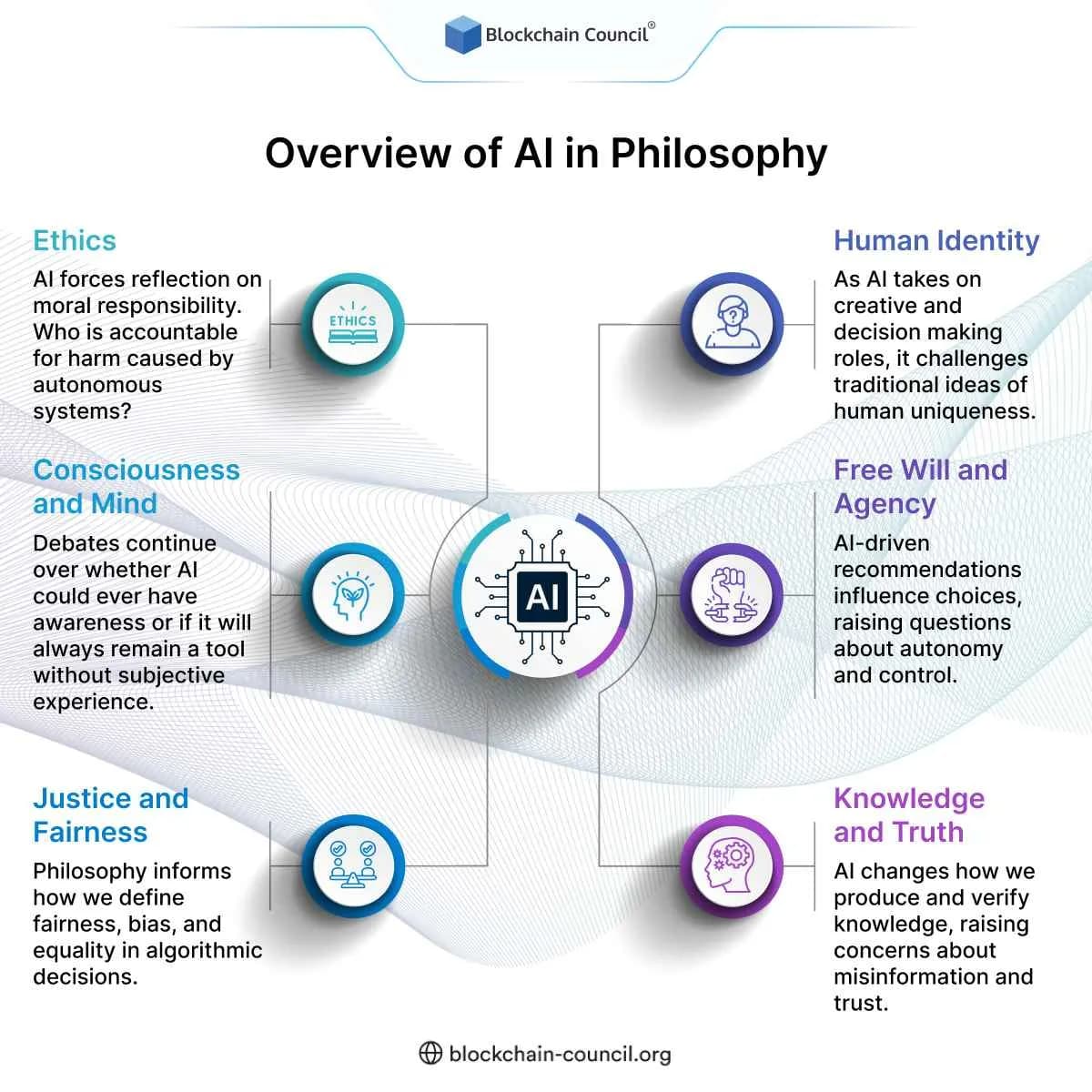

- Ethics
AI forces reflection on moral responsibility. Who is accountable for harm caused by autonomous systems?
- Consciousness and Mind
Debates continue over whether AI could ever have awareness or if it will always remain a tool without subjective experience.
- Human Identity
As AI takes on creative and decision-making roles, it challenges traditional ideas of human uniqueness.
- Free Will and Agency
AI-driven recommendations influence choices, raising questions about autonomy and control.
- Justice and Fairness
Philosophy informs how we define fairness, bias, and equality in algorithmic decisions.
- Knowledge and Truth
AI changes how we produce and verify knowledge, raising concerns about misinformation and trust.
Philosophy’s Long Shadow Over AI
Philosophy is not just background reading for AI—it is built into the discipline’s DNA. The philosophy of mind, for example, explores whether consciousness is purely physical or whether it has dimensions machines cannot replicate. These ideas frame debates over whether AI systems merely simulate thought or genuinely engage in it. Philosophers like John Haugeland, who coined the phrase “Good Old-Fashioned AI,” used philosophical reasoning to highlight the limits of symbolic systems.
The philosophy of language is also central. AI must interpret and generate words in ways that appear meaningful. But philosophers from Ludwig Wittgenstein to John Searle have pointed out that meaning depends on use, intention, and social context—not just symbols. The famous Chinese Room argument by Searle illustrates this: a system can appear to understand language by following rules but may not have real understanding. AI systems today raise the same issue. Do they “know,” or are they simply manipulating patterns?
Consciousness and the Machine Question
Few questions in AI and philosophy spark as much debate as consciousness. Can machines have it? Some philosophers take a functionalist view, arguing that if AI performs the same functions as the brain, it might be conscious. Others insist that subjective experience, or qualia, is tied to biology and cannot be reproduced in silicon.
The “Machine Question” pushes this further by asking whether we should ever grant moral standing to AI systems. If an AI becomes advanced enough to mimic human behavior convincingly, should it be treated as an entity with rights? Or is it always just a sophisticated tool? These questions may sound speculative, but as systems grow more complex, they are pressing. For instance, if an AI agent causes harm, who should be held responsible? The programmer, the user, or the AI itself?
Ethics and Moral Agency
The ethical side of AI is one of the most urgent philosophical challenges today. AI systems influence hiring, policing, healthcare, and even defense. This raises the question: can AI act morally, or does it only simulate morality? A recent study suggested that AI can imitate ethical reasoning, such as applying Kantian principles, but this does not make it a moral agent. The responsibility still lies with humans who design and deploy the systems.
At the same time, philosophy provides frameworks for thinking about alignment. Utilitarianism, for example, pushes AI designers to maximize outcomes for the greatest number of people. Virtue ethics suggests focusing on the character of decision-makers. Deontological ethics stresses rules and duties. These schools of thought are not abstract—they shape the principles behind AI regulation and policy. By applying them, we can better ensure fairness, accountability, and responsibility in AI systems.
Knowledge, Learning, and Epistemology
Philosophers of knowledge have long asked: what does it mean to “know” something? AI challenges this in new ways. A neural network can predict outcomes based on patterns, but does prediction equal knowledge? Epistemology helps unpack this. Knowledge traditionally involves justification, truth, and belief. AI models cannot believe or justify in the human sense. They generate outputs based on probabilities, which may or may not align with truth.
This distinction matters because it shapes how we interpret AI’s role in decision-making. When an AI system suggests a medical treatment or an investment strategy, we must ask: is this genuine knowledge or a statistical guess? The difference has real-world consequences. It also highlights why training in data handling and model evaluation, such as through a Data Science Certification, is essential for professionals who rely on AI in practice.
Free Will, Agency, and Autonomy
Philosophy has always wrestled with free will. Are humans free agents, or are we determined by biology and environment? AI introduces new angles. If a machine makes decisions independently, does that count as agency? Many argue no: machines follow programmed rules, even if those rules are complex. Others suggest that once an AI system adapts, learns, and operates without direct control, it takes on a kind of practical autonomy.
This matters because autonomy influences responsibility. Autonomous vehicles, for instance, make split-second decisions in traffic. When something goes wrong, questions of agency and accountability follow. These are not just technical challenges but deep philosophical ones that society must resolve.
Philosophy Shaping AI Design
Philosophy does not just critique AI—it actively shapes how systems are built. The push for explainable AI is partly driven by epistemology. If a system cannot justify its decisions, can we trust it? Metaphysics plays a role too. How we define identity, continuity, or intentionality influences how we build models of the self or agents.
The idea that “philosophy eats AI” is gaining traction. It argues that ethical and ontological frameworks should guide AI development from the start, not just constrain it afterward. This shift moves philosophy from the margins to the core of AI design.
Philosophy in Practice: Real-World Impact
Beyond theory, philosophical debates influence practical decisions. Central banks use AI to forecast inflation, but must also grapple with questions of trust and accountability. Defense organizations explore autonomous systems while weighing the ethics of delegating life-and-death decisions to machines. In education, philosophers question whether using AI to write essays undermines human creativity. These debates show that philosophy is not abstract—it is a toolkit for navigating real dilemmas AI creates.
Professionals who want to link these insights to strategy can benefit from training like the Marketing and Business Certification. Understanding how to integrate ethical AI forecasting into planning campaigns, evaluating markets, and guiding decisions is a skill in growing demand.
AI as a Tool for Philosophy
Interestingly, AI is not only shaped by philosophy but is also reshaping philosophy itself. Scholars now use AI to analyze texts, trace the evolution of arguments, and even simulate philosophical dialogues. While this expands research possibilities, it raises concerns about bias and homogenization. If philosophers rely too heavily on algorithms, will their thinking become limited by the system’s patterns? This risk highlights the need for diversity in philosophical perspectives, especially non-Western traditions often underrepresented in AI ethics.
The Expanding Ethical Horizon of AI and Philosophy
As artificial intelligence advances, philosophers are confronted with questions that were once hypothetical but are now urgent. The debate no longer rests solely on whether machines can think. It now extends into moral standing, accountability, and how we should integrate AI into human society. This next part explores these issues in depth, while keeping the focus on practical implications for professionals and institutions.
The Moral Standing of Machines
One of the most fascinating debates in philosophy today is whether AI systems deserve any moral consideration. Traditional ethics has always applied to beings with consciousness or sentience, such as humans and, in some arguments, animals. AI complicates this because advanced models can mimic reasoning, conversation, and even emotions without actually experiencing them. Should these simulations be treated as real?
Philosophers remain divided. Some argue that if AI can convincingly act like a moral agent, it may warrant a form of standing—at least enough to guide how we interact with it. Others maintain that without subjective experience, machines can never cross that threshold. Still, even the possibility forces policymakers and businesses to reflect on how they design and deploy systems. The outcome of this debate will influence everything from customer service chatbots to autonomous weapons.
Accountability and Responsibility
Another pressing issue is responsibility. If an autonomous trading algorithm causes billions in losses or an AI-driven car causes harm, who is accountable? Unlike human actors, AI cannot be punished, rehabilitated, or held liable in the traditional sense. Responsibility usually falls on developers, companies, or users. Yet, the complexity of modern AI systems often blurs the line between human input and machine output.
This uncertainty has led to calls for clearer frameworks. Philosophers of law and ethics argue for shared accountability, where designers, operators, and organizations all bear responsibility for outcomes. At the same time, engineers are encouraged to build transparency into their systems so that mistakes can be traced. Training programs, such as the agentic ai certification, highlight these issues by preparing professionals to work with AI that acts with a degree of independence while still requiring human oversight.
Regulation and Governance
Philosophy also informs governance. Regulators worldwide face the challenge of balancing innovation with safety. Ethical frameworks such as utilitarianism, deontology, and virtue ethics guide their decisions. For example, rules about bias and fairness in AI often rely on philosophical reasoning about justice and equality.
Debates are also ongoing about whether AI should be regulated as a tool or as an agent. If treated as a tool, responsibility remains entirely with humans. If treated as an agent, new categories of law may be needed. The outcomes will shape industries ranging from healthcare to finance. Professionals who understand these philosophical underpinnings will be better prepared to navigate the evolving landscape.
Philosophers Shaping AI Development
Several thinkers stand out in these debates. Mariarosaria Taddeo has contributed extensively to digital ethics, especially in the context of defense and AI governance. Her work emphasizes accountability and the need for human control over autonomous systems. Joscha Bach, a cognitive scientist and philosopher, examines questions of consciousness, selfhood, and how they might be replicated—or not—in AI. Others focus on how classical philosophy, from Kant to Aristotle, can provide a framework for modern AI ethics.
By bringing philosophy into AI development, these thinkers highlight that technical solutions alone are not enough. Systems reflect values, whether intentionally or not. Without explicit ethical grounding, AI risks reproducing or even amplifying harmful biases and structures.
The Problem of Understanding and Meaning
One of the deepest questions in philosophy is what it means to understand. Humans grasp concepts through context, lived experience, and intention. AI, in contrast, processes symbols and probabilities. Even when it generates text that appears meaningful, critics argue that it lacks true comprehension.
This is not just abstract theory. In practice, misunderstandings can lead to serious errors. For example, a model analyzing financial statements may flag a company as stable while missing subtle contextual clues that a human analyst would catch. The difference between appearing to understand and actually understanding can have material consequences.
For this reason, ongoing research explores whether AI could ever develop something closer to genuine understanding. Some argue that functional equivalence—acting as though it understands—is enough. Others believe there will always be a gap. Regardless of the outcome, professionals must recognize this limitation when relying on AI systems in high-stakes settings.
Epistemology in the Age of AI
Knowledge has always been a central concern of philosophy, and AI changes the way we think about it. Traditionally, knowledge involves justified true belief. AI systems cannot believe, but they can generate patterns that align with truth. This leads to a new kind of epistemology—one where probability and pattern recognition form the backbone of “knowledge.”
The question then becomes: should we treat AI-generated insights as knowledge or as tools for guiding human judgment? Many argue for the latter. AI may provide signals and probabilities, but humans must interpret and justify them. This perspective reinforces the idea that AI should augment human knowledge rather than replace it.
Preparing Professionals for AI’s Philosophical Challenges
The philosophical challenges of AI are not only for academics. Businesses, policymakers, and professionals face them daily. For instance, a marketing team using AI to predict consumer behavior must consider the ethical implications of bias. A financial analyst must decide how much trust to place in a black-box model. A government agency deploying AI in law enforcement must address accountability and fairness.
Professionals can prepare through continuous education. Broad tech certifications help learners understand the digital infrastructure that supports AI, ensuring they are not blindsided by the technical side of philosophical issues. Similarly, exploring blockchain technology courses can strengthen knowledge in transparency and trust, areas where AI and blockchain increasingly intersect.
AI and Global Philosophy
Another important angle is the diversity of perspectives. Most discussions about AI and philosophy come from Western traditions. However, non-Western philosophies provide valuable insights. For example, Buddhist thought challenges the idea of fixed identity, offering unique ways to think about AI agents. African philosophies emphasizing community and relational ethics can inform discussions on value alignment. Expanding the philosophical base beyond Western ideas is crucial to creating AI systems that reflect global values.
AI as a Partner in Philosophy
Interestingly, AI is now being used as a tool within philosophy itself. Scholars employ AI to analyze centuries of texts, trace the development of concepts, and simulate dialogues between thinkers. While this expands research possibilities, it raises ethical questions. If AI begins to shape the questions philosophers ask, does it narrow the scope of inquiry? Could reliance on algorithms create a kind of intellectual monoculture?
Philosophers caution that while AI can support research, it must not replace human creativity and diversity of thought. The goal should be partnership, not dependence.
The Future of AI and Philosophy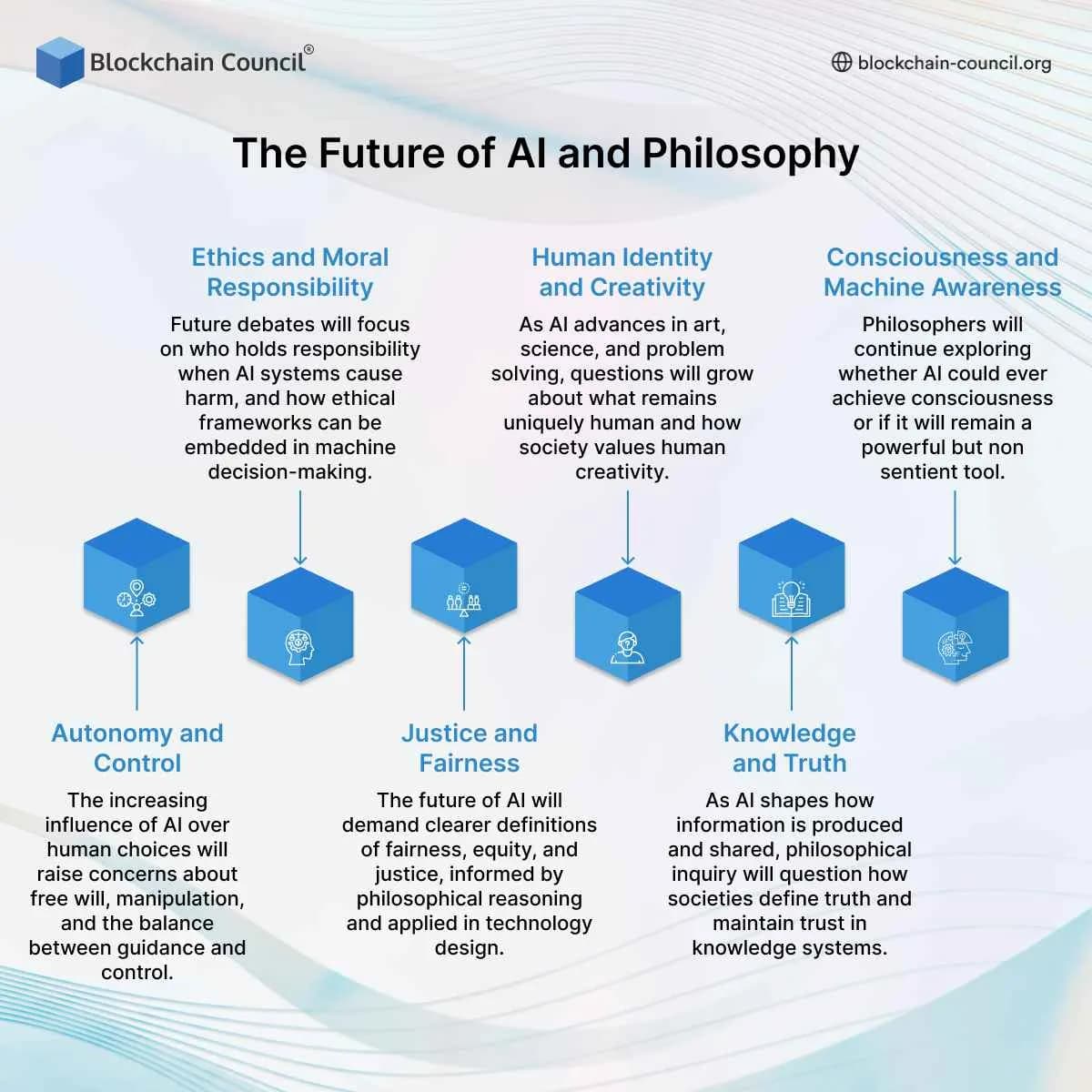
Artificial intelligence is evolving so quickly that philosophy can no longer stand at the sidelines. The debates are moving from theory to practice, from lecture halls to boardrooms and government agencies. What once seemed like speculative thought experiments—machines with agency, algorithms that mimic morality, and systems that shape knowledge—are now part of everyday life. The task ahead is to weave philosophy and AI together in a way that ensures both progress and responsibility.
Ethics and Moral Responsibility
Future debates will focus on who holds responsibility when AI systems cause harm, and how ethical frameworks can be embedded in machine decision-making.
Human Identity and Creativity
As AI advances in art, science, and problem-solving, questions will grow about what remains uniquely human and how society values human creativity.
Consciousness and Machine Awareness
Philosophers will continue exploring whether AI could ever achieve consciousness or if it will remain a powerful but non-sentient tool.
Autonomy and Control
The increasing influence of AI over human choices will raise concerns about free will, manipulation, and the balance between guidance and control.
Justice and Fairness
The future of AI will demand clearer definitions of fairness, equity, and justice, informed by philosophical reasoning and applied in technology design.
Knowledge and Truth
As AI shapes how information is produced and shared, philosophical inquiry will question how societies define truth and maintain trust in knowledge systems.
Philosophy as a Guide for Design
One of the most promising shifts is treating philosophy not only as a critique of AI but as a guide for building it. Developers are beginning to realize that every design choice reflects philosophical assumptions. When an algorithm is optimized for efficiency, that reflects utilitarian reasoning. When fairness metrics are enforced, it echoes theories of justice. When transparency is prioritized, it invokes epistemology and the need for justified knowledge.
This recognition pushes AI development toward deliberate philosophical grounding. Instead of asking only, “What can AI do?” the question becomes, “What should AI do, and why?” Answering this requires engineers to work with philosophers, ethicists, and policymakers, creating truly interdisciplinary design processes.
Education and Professional Growth
For individuals, this convergence means that new skills are required. AI is no longer just the domain of coders; it also demands knowledge of ethics, governance, and human behavior. Professionals who understand both the technical and philosophical dimensions will stand out.
Education is rising to meet this need. Programs such as the AI certification give professionals a grounding in how models are built and applied. Beyond this, the Data Science Certification equips learners with the ability to manage and interpret the data that feeds AI systems. Business leaders can benefit from the Marketing and Business Certification, which shows how to apply predictive insights responsibly in strategy and customer engagement. Each of these learning paths reflects the reality that working with AI now requires more than technical know-how—it requires philosophical literacy.
The Role of Autonomy and Agentic AI
One of the most transformative developments is the rise of agentic AI, systems that operate with a degree of independence. These agents can plan, adapt, and interact with other systems in ways that go beyond programmed responses. They bring new questions of autonomy, responsibility, and trust.
For example, if an agentic AI manages a portfolio, is it simply following orders, or is it exercising a form of judgment? If it interacts with customers, does it carry moral responsibility for the outcomes of those conversations? These questions echo debates about human autonomy and free will but applied in a technological setting.
Professionals exploring this frontier will find structured guidance in programs like the agentic ai certification, which link philosophical debates about autonomy to practical applications.
Trust, Transparency, and Governance
Trust remains one of the central issues in the relationship between AI and society. Without trust, even the most advanced systems will face resistance. This is why governance frameworks emphasize transparency, fairness, and accountability. Philosophers contribute by clarifying what these terms mean in practice.
For instance, transparency in philosophy is not just about showing data but about enabling genuine understanding. Fairness is not only statistical balance but also a moral commitment to justice. Accountability requires clear lines of responsibility, something that is complicated when AI is involved. These philosophical insights help transform vague principles into concrete standards that guide governance.
Expanding Philosophical Voices
Another crucial step for the future is expanding the range of philosophical traditions engaged in AI. Much of the current discourse is shaped by Western thought, but other traditions offer unique perspectives. Confucian philosophy, with its focus on harmony and relational ethics, can enrich discussions of alignment. African philosophies that emphasize community and interdependence can balance the individualism often assumed in Western frameworks. Indigenous worldviews bring insights about stewardship, sustainability, and respect for non-human actors.
Incorporating these perspectives ensures that AI reflects the values of a diverse global population. It also guards against epistemic monoculture, where one worldview dominates and narrows the possibilities for ethical design.
AI as a Philosophical Partner
AI is also starting to influence philosophy itself. By analyzing massive bodies of text, AI can identify patterns in arguments, trace the evolution of ideas, and even generate new combinations of thought. This creates opportunities for scholars but also raises concerns. If philosophers rely too heavily on algorithms, will their creativity be constrained by the limitations of the models?
The answer may lie in balance. AI can act as a research assistant, accelerating literature reviews and mapping debates, but humans must remain the ones who interpret, critique, and innovate. Philosophy thrives on creativity, dissent, and diversity of thought—qualities that cannot be outsourced to machines.
Blockchain and the Question of Trust
Another intersection of philosophy and AI is the role of blockchain. Trust has always been a philosophical problem, and blockchain offers a technological solution by creating systems that do not require central authority. When paired with AI, blockchain can enhance transparency, prevent data tampering, and build confidence in decision-making.
This is why learning pathways such as blockchain technology courses are valuable. They show professionals how to combine AI’s predictive power with blockchain’s reliability, creating systems that are not only smart but also trustworthy.
Practical Paths for Professionals
As AI and philosophy converge, the career landscape changes. Professionals no longer need to choose between technical or humanistic paths. Instead, the most effective leaders will combine both.
- Analysts with data skills and ethical reasoning will design better systems.
- Business strategists who understand both markets and moral philosophy will make more balanced decisions.
- Policymakers who can interpret technical details and philosophical arguments will craft stronger regulations.
Broad tech certifications support this journey by giving professionals the digital foundations they need while encouraging them to engage with the ethical and philosophical implications.
The Final Question
So, can philosophy keep pace with AI? The answer is yes, but only if it evolves alongside the technology. Philosophy must remain critical, asking whether machines can think, whether they deserve standing, and how they shape society. But it must also become constructive, guiding the design and deployment of systems in ways that align with human values.
AI, for its part, forces philosophy to sharpen its questions and test its theories against real-world applications. Together, they form a feedback loop: AI challenges philosophy, and philosophy shapes AI.
Conclusion
The relationship between AI and philosophy is not an optional side conversation. It is central to how we design, use, and govern technology in the twenty-first century. Whether we are asking about consciousness, ethics, knowledge, or trust, philosophical reasoning provides the tools to navigate these issues.
For professionals, this means preparing for a world where technical skills and philosophical insight go hand in hand. Certifications in AI, data science, business strategy, blockchain, and technology education provide the knowledge needed to engage with both sides of the equation. The result is a workforce ready to harness AI responsibly, guided by principles as old as philosophy itself.
The future of AI and philosophy is not about machines replacing thinkers or thinkers rejecting machines. It is about building a partnership that combines the speed and scale of algorithms with the depth and wisdom of human reflection. That partnership will determine not only how AI evolves but also how society itself is shaped in the years to come.