
Is Agentic AI Reliable for Compliance and Risk Management?

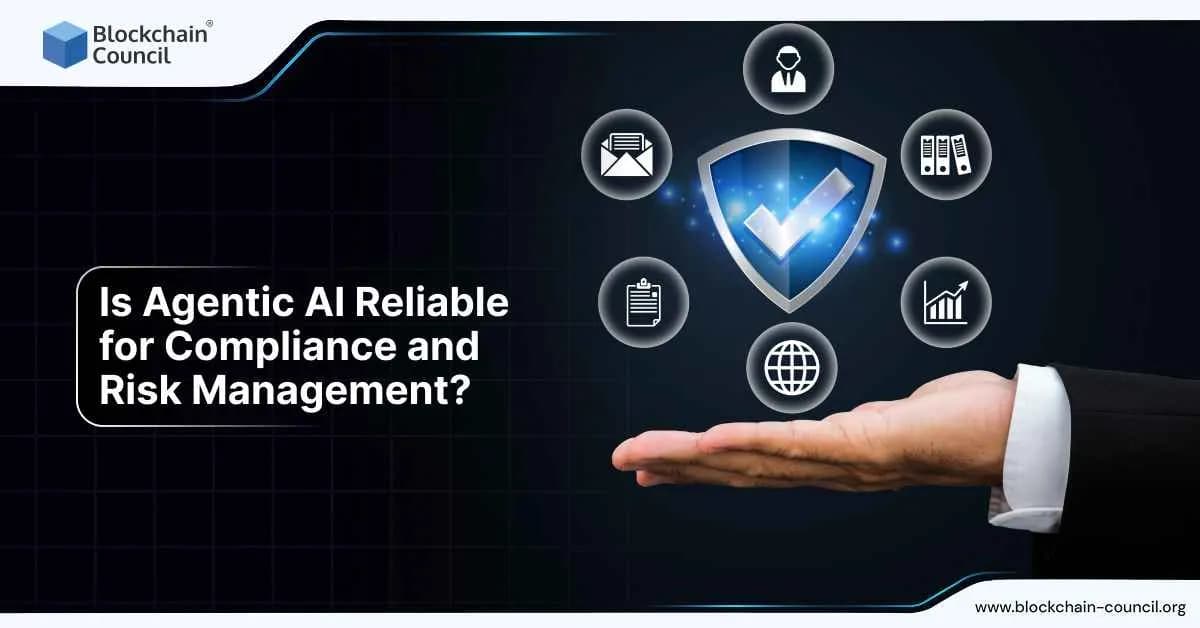
Businesses across industries are under constant pressure to comply with regulations, manage risk, and prevent fraud. Traditional systems rely heavily on manual reviews and fixed rules, but those are often too slow for today’s dynamic environments. Agentic AI—artificial intelligence that can sense, reason, and act independently—is emerging as a game changer. It can process data in real time, flag risks, and even automate parts of compliance reporting. For professionals who want to understand and apply these capabilities, earning an AI certification is a powerful first step.
Why Agentic AI Matters for Compliance
Agentic AI does not just follow pre-set instructions. It evaluates complex situations, adapts to new information, and makes recommendations or takes actions without constant oversight. In compliance, this translates to automated policy checks, monitoring transactions, detecting anomalies, and managing audit trails at a scale no human team could match.

Current Industry Adoption
Thomson Reuters has highlighted how agentic AI workflows are being used in fraud investigations, pulling data from multiple sources and drafting suspicious activity reports faster than traditional methods. Meanwhile, risk technology providers like SoftWeb Solutions are integrating agentic agents into systems for third-party risk management, predictive analytics, and real-time compliance updates. To stay aligned with these industry shifts, professionals can explore AI certs that cover applied AI in governance and risk settings.
Strengths That Make Agentic AI Appealing
The main advantage is speed. Compliance checks that once took days can now be performed in minutes. Another strength is consistency, since autonomous agents apply the same logic across all cases. This reduces human error and improves regulatory reporting. A Data Science Certification can help practitioners understand the analytics foundations that power these outcomes.
Key Benefits of Agentic AI in Compliance and Risk
| Benefit | Description |
| Real-Time Monitoring | Tracks activities and flags suspicious actions instantly |
| Consistency | Applies uniform rules across all compliance cases |
| Predictive Insights | Anticipates risks before they escalate |
| Faster Fraud Detection | Automates checks that previously relied on manual review |
| Dynamic Compliance | Adjusts to regulatory updates without long delays |
| Audit Support | Generates clear, traceable logs for regulators |
| Third-Party Risk Management | Continuously evaluates supplier and partner risks |
| Scalability | Handles massive data volumes without extra manpower |
| Proactive Governance | Ensures policies are enforced automatically |
| Improved Efficiency | Reduces the overall cost of compliance operations |
Challenges and Concerns
Despite the advantages, agentic AI is not risk-free. Surveys show that most executives see extra compliance challenges with autonomous AI because it can make decisions that are difficult to audit or explain. Privacy concerns are also high, as these systems often process sensitive data across multiple jurisdictions. Another issue is over-reliance: assuming the AI will handle everything without proper oversight may create blind spots. For leaders looking to balance opportunity with caution, a Marketing and Business Certification can provide strategies to integrate AI responsibly into broader business frameworks.
Research and Frameworks Improving Reliability
Recent academic work is addressing gaps in safety and trust. The MAESTRO framework focuses on defending agentic systems from memory poisoning and denial-of-service attacks. The MI9 protocol emphasizes runtime governance through continuous monitoring and drift detection. There is also research on agentic AI for anti-money laundering, where specialized systems automate compliance reports while leaving final review to humans. For those who want to specialize in this exact area, the agentic AI certification delivers advanced training in agent-based security and governance.
The Role of Technology in Risk Management
The future of compliance will be shaped not just by regulations but also by technology that enables trust at scale. Agentic AI will work alongside humans, acting as a watchdog that is always active, while people focus on strategy, ethics, and decision-making. For professionals interested in securing digital ecosystems, blockchain technology courses provide essential knowledge about decentralized verification and tamper-proof records.
Conclusion
So, is agentic AI reliable for compliance and risk management? The answer is that it is becoming reliable, but only when paired with strong governance, observability, and human oversight. It accelerates compliance processes, strengthens fraud detection, and reduces costs. At the same time, businesses must remain cautious about explainability, privacy, and evolving regulation. For professionals and leaders, the right mix of technical skills and strategic certifications today will ensure they are ready to guide agentic AI adoption responsibly tomorrow.
Related Articles
View All
AI & ML
AI Security in Finance: Fraud Detection Hardening, Model Risk Management, and Compliance Best Practices
Learn AI security in finance with practical fraud detection hardening, model risk management controls, and compliance-ready audit trails for modern regulators.

AI & ML
AI Data Privacy Compliance
AI data privacy compliance in 2026 blends GDPR, HIPAA, and the EU AI Act with expanding state laws. Learn how to implement inventories, DPIAs, BAAs, and human oversight.

AI & ML
Fine-Tuning for Domain-Specific AI in Healthcare, Finance, and Legal: Data Prep, Evaluation, and Compliance
Learn how fine-tuning for domain-specific AI improves accuracy and compliance in healthcare, finance, and legal, with best practices for data prep, evaluation, and governance.
Trending Articles
The Role of Blockchain in Ethical AI Development
How blockchain technology is being used to promote transparency and accountability in artificial intelligence systems.
AWS Career Roadmap
A step-by-step guide to building a successful career in Amazon Web Services cloud computing.
Top 5 DeFi Platforms
Explore the leading decentralized finance platforms and what makes each one unique in the evolving DeFi landscape.