

Fine-Tuning for Domain-Specific AI in Healthcare, Finance, and Legal: Data Prep, Evaluation, and Compliance
 Suyash Raizada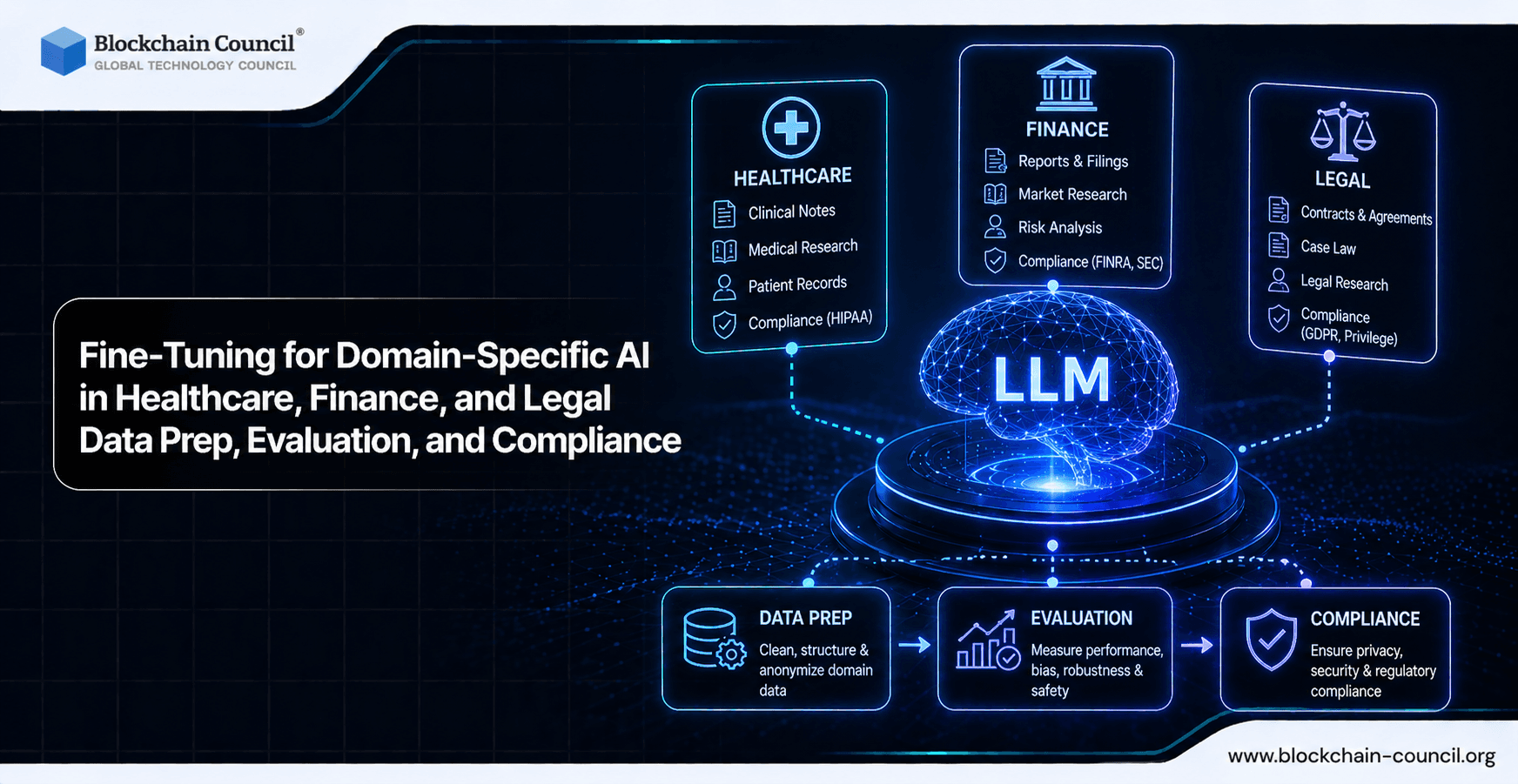
Fine-tuning for domain-specific AI has become a practical requirement in regulated industries like healthcare, finance, and legal. General-purpose large language models (LLMs) are adequate for low-risk tasks, but high-stakes workflows demand stronger accuracy, clearer reasoning, and reliable regulatory controls. Domain-specific language models (DSLMs) address this by adapting pre-trained models on curated, industry-relevant data so the model learns the terminology, workflows, and risk boundaries that matter in production.
As organizations deploy AI in regulated environments, professionals are increasingly pursuing an AI Certification to strengthen their understanding of model development, governance, and responsible AI practices, while an AI Security Certification helps build expertise in securing AI systems, protecting sensitive data, and managing emerging AI-related risks.

Industry analysts increasingly expect specialty-focused models to dominate regulated fields by 2026 because they are easier to govern, safer for high-impact decisions, and more aligned with real operational needs. This shift is also driven by expanding governance requirements, including state-level frameworks such as the Texas Responsible Artificial Intelligence Governance Act (TRAIGA), effective January 1, 2026.
Why Fine-Tuning for Domain-Specific AI Matters in Regulated Industries
Fine-tuning adapts a strong base model to a specific domain by training it further on domain datasets and task-specific examples. In healthcare, finance, and legal, the goal is not just better answers, but better answers under constraints:
Higher domain accuracy: correct medical dosing context, correct financial risk terminology, correct legal interpretation patterns.
Lower operational risk: fewer false positives in fraud detection, fewer hallucinations in clinical summaries, fewer confidentiality failures in legal review.
Compliance-by-design: policies and guardrails aligned to HIPAA, GDPR, SOX, FINRA and SEC expectations, PCI-DSS for payments, and emerging AI governance laws.
A commonly cited finance outcome is that AI-driven fraud detection can cut false alarms by nearly 50% while detecting complex schemes that are difficult to spot manually. Surveys also reflect broad momentum: a 2025 PwC survey found 73% of financial institutions planning DSLM adoption for compliance and risk mitigation.
Current State in 2026: DSLMs, Multi-Agent Systems, and Embedded Governance
Three trends define fine-tuning for domain-specific AI in 2026:
Domain-specific models outperform general LLMs on regulated tasks because they are trained on the right language, workflows, and failure modes.
Multi-agent architectures are increasingly common, especially in healthcare, where smaller specialized models collaborate - for example, one agent for summarization, one for coding, and one for guideline checks.
Embedded governance is treated as a core feature rather than an add-on, including access control, encryption, audit logging, and continuous monitoring for drift and policy violations.
In healthcare, domain-focused models often integrate biomedical corpora, clinical ontologies, and interoperability standards like FHIR to support tasks such as clinical documentation, care coordination, and drug discovery. In finance, models are increasingly connected to transaction systems to support fraud detection and AML-KYC workflows. In legal, confidentiality and chain-of-custody requirements are driving encryption-first designs and strict access controls.
Data Preparation for Fine-Tuning Domain-Specific AI
Data preparation is the biggest determinant of success. In regulated industries, the question is not only whether you have enough data, but whether you have the right data, with the right permissions, handled the right way.
1) Start with Workflow and Risk Analysis
Before collecting data, map the workflow the model will support. A useful starting point is to define:
User journeys (clinician documentation, fraud investigator triage, contract review).
Decision points (what the model recommends vs. what humans must approve).
Failure modes (unsafe medical advice, missed fraud signals, privilege leaks).
Regulatory constraints that apply to each step.
2) Curate Domain Datasets That Match Real Tasks
Domain fine-tuning typically combines several dataset types:
Healthcare: EHR notes, discharge summaries, lab narratives, radiology reports, clinical guidelines, coding references, and de-identified patient communications.
Finance: transaction logs, SAR narratives where permissible, policy manuals, KYC forms, risk reports, product disclosures, and internal controls documentation relevant to SOX.
Legal: contracts, clauses, playbooks, litigation documents, case summaries, internal memos, e-discovery labels, and due diligence checklists.
For higher quality, prioritize task-aligned examples such as annotated contract clauses for specific obligations or fraud investigator notes that explain why an alert is valid or invalid. High-quality labels often outweigh raw volume.
3) Privacy, De-identification, and Secure Handling
Privacy engineering is not optional. Common approaches include:
De-identification and pseudonymization for HIPAA and GDPR-aligned handling of personal data.
Role-based access control to restrict who can view raw training data and evaluation outputs.
Encryption in transit and at rest, especially for legal confidentiality and financial data protection.
Data minimization: only train on what is needed for the intended task.
Many enterprises also prefer locally hosted or tightly controlled environments for fine-tuning and inference to reduce exposure risk.
4) Standardization and Formatting for Consistency
Domain standards help reduce ambiguity and improve interoperability:
Healthcare: align structured fields and references to FHIR where applicable.
Finance: ensure payment-related data handling aligns with PCI-DSS expectations where relevant.
Legal: preserve document structure, versioning, and metadata needed for chain-of-custody and audit trails.
5) Continuous Data Updates for Drift and Regulation Changes
In regulated industries, the operating environment changes constantly - new fraud patterns, new medical guidelines, new reporting formats, and new AI governance requirements all demand an adaptive data strategy. Build a controlled pipeline that includes:
Refresh cycles (monthly or quarterly updates for policy and fraud pattern shifts).
Approval workflows for new training data additions.
Dataset versioning so you can reproduce model behavior during audits.
Evaluation: What to Measure Beyond General Benchmarks
General LLM benchmarks rarely reflect domain safety and compliance needs. Evaluation for fine-tuned domain-specific AI should test performance in real workflows, under real constraints.
Core Evaluation Dimensions
Domain accuracy and relevance: correctness under domain terminology and edge cases.
Risk reduction: fewer high-impact errors and safer handling of uncertain queries.
Explainability and traceability: ability to provide rationale, citations to internal policy text, or structured reasoning artifacts where required.
Robustness: resistance to prompt injection, data leakage, and adversarial inputs.
Examples of Domain-Specific Metrics
Finance fraud and AML: false positive rate reduction, precision-recall at fixed investigation capacity, time-to-triage, and policy adherence checks. Industry data points to false alarm reductions approaching 50% in well-implemented systems.
Healthcare documentation: guideline consistency, dosage limit checks, contraindication awareness, and clinician-rated usefulness of summaries. Domain-focused models have shown consistent outperformance on clinical safety and relevance tasks compared to general models.
Legal review: clause extraction accuracy, obligation and risk classification accuracy, confidentiality compliance, and auditability of outputs used in due diligence.
Evaluation Methods That Work Well
Golden datasets: curated test sets with expert-reviewed answers and edge cases.
Human-in-the-loop review: domain experts score correctness, completeness, and safety.
Policy and compliance test suites: prompts designed to trigger restricted behaviors and verify the model refuses or escalates appropriately.
Regression testing: ensure updates do not break prior capabilities or compliance guarantees.
Compliance-by-Design: HIPAA, GDPR, SOX, FINRA, SEC, and Emerging AI Governance
Compliance is both a training concern and a deployment concern. Fine-tuning alone does not guarantee compliance, but it can encode domain policies and improve the model's ability to follow constraints when combined with governance controls.
Common Compliance Controls in Domain-Specific AI Systems
Automated flagging of sensitive content and restricted topics.
Role-based access and least-privilege permissions.
Encrypted handling and secure key management for confidential legal and financial data.
Audit logs for prompts, outputs, and model versions used in decisions.
Local deployment options for environments that cannot send data externally.
In healthcare, HIPAA-aligned handling and careful de-identification are central requirements. In finance, aligning model behavior to FINRA and SEC expectations and maintaining auditable records supports governance. SOX-related workflows often require traceability around controls and reporting. GDPR applies across sectors with requirements around lawful processing, minimization, and rights handling. Payments and cardholder data handling may require PCI-DSS-aligned safeguards.
Organizations are also preparing for AI governance laws such as TRAIGA, which reinforces the need for documented oversight, accountability, and risk management practices in AI systems used for consequential decisions.
Real-World Use Cases: How Fine-Tuned Models Differ by Industry
Healthcare: Clinical Documentation and Personalized Treatment Support
Fine-tuned healthcare models can summarize encounters, draft clinical notes, and support treatment planning by interpreting patient history and relevant biomedical context. In practice, these systems are positioned to augment clinicians rather than replace them, with careful guardrails for safety and escalation.
Finance: Fraud Detection and AML-KYC Triage
Finance models learn customer-specific behavioral patterns and detect anomalies. When integrated with transaction systems and compliance workflows, they can reduce false positives and improve investigator efficiency while documenting why an alert was raised.
Legal: E-Discovery, Contract Automation, and Due Diligence
Legal domain models can classify, summarize, and extract obligations from large document collections. Strong implementations emphasize encrypted handling, strict access control, and defensible audit trails to support confidentiality and chain-of-custody requirements.
Skills and Training: What Teams Need to Implement Fine-Tuning Safely
Deploying fine-tuning for domain-specific AI requires cross-functional capability:
ML engineering for training pipelines, evaluation harnesses, and monitoring.
Data governance for lineage, permissions, and retention.
Security for encryption, access control, and threat modeling.
Domain expertise for labeling, evaluation, and policy alignment.
Compliance and legal for controls mapping and audit readiness.
For internal upskilling, Blockchain Council offers relevant learning paths including certifications in AI and Machine Learning, Generative AI, Data Science, and Cybersecurity, along with specialized programs covering governance, risk, and secure AI deployment.
Many professionals also complement these pathways with a Tech Certification to deepen their understanding of emerging technologies, systems architecture, and digital transformation, while a Marketing Certification helps connect technical capabilities with business strategy, stakeholder communication, and market adoption.
Conclusion: A Practical Blueprint for Fine-Tuning in High-Stakes Domains
Fine-tuning for domain-specific AI is increasingly the standard approach for building reliable AI in healthcare, finance, and legal environments. The pattern that works is consistent: start from real workflows, curate compliant domain datasets, evaluate using domain and risk metrics rather than generic benchmarks, and embed governance controls from day one.
As regulations tighten and enterprise expectations rise, DSLMs and multi-agent systems are likely to continue displacing general-purpose LLMs for high-risk decisions, while general models remain useful for low-risk administrative tasks. Organizations that invest early in data preparation, evaluation rigor, and compliance-by-design will be best positioned to scale AI safely across regulated operations.
FAQs
1. What is domain-specific AI fine-tuning?
Domain-specific fine-tuning adapts a pre-trained model to specialized fields like healthcare, finance, or legal. It uses targeted datasets to improve accuracy. This ensures the model understands domain-specific language and context.
2. Why is fine-tuning important for healthcare, finance, and legal AI?
General models may lack accuracy in specialized domains. Fine-tuning improves reliability and relevance. This is critical for compliance, safety, and decision-making.
3. What type of data is required for domain-specific fine-tuning?
High-quality, domain-relevant, and labeled data is required. This includes clinical records, financial reports, or legal documents. Data must be accurate and representative of real use cases.
4. How do you prepare data for fine-tuning in regulated industries?
Data preparation includes cleaning, anonymization, and formatting. Sensitive information must be removed or masked. Proper preprocessing ensures compliance and model performance.
5. What are the key challenges in domain-specific fine-tuning?
Challenges include data privacy, limited labeled data, and regulatory constraints. Domain complexity also increases difficulty. Careful planning and validation are required.
6. How does fine-tuning improve model accuracy in specialized domains?
Fine-tuning aligns the model with domain-specific terminology and patterns. It reduces errors and improves contextual understanding. This leads to more reliable outputs.
7. What evaluation metrics are used for domain-specific AI models?
Metrics include accuracy, precision, recall, and F1 score. Domain-specific benchmarks and human evaluation are also important. Evaluation ensures model reliability.
8. How is compliance handled in AI fine-tuning?
Compliance involves following regulations like HIPAA, GDPR, and financial standards. Data handling and model usage must meet legal requirements. Regular audits help maintain compliance.
9. What is the role of data anonymization in fine-tuning?
Anonymization removes personally identifiable information from datasets. It protects user privacy and ensures regulatory compliance. This is essential in healthcare and finance.
10. How can bias be reduced in domain-specific AI models?
Bias can be reduced by using diverse and balanced datasets. Regular evaluation and monitoring help identify issues. Adjustments improve fairness and accuracy.
11. What tools are used for fine-tuning domain-specific AI?
Tools include Hugging Face Transformers, PyTorch, and TensorFlow. Specialized platforms support secure data handling. These tools enable efficient model training.
12. How does fine-tuning impact risk in regulated industries?
Fine-tuning can reduce risk by improving model accuracy. However, improper training can introduce errors. Strict validation and monitoring are necessary.
13. Can small datasets be used for domain-specific fine-tuning?
Yes, small datasets can work with techniques like transfer learning and PEFT. Quality is more important than quantity. Augmentation can also help.
14. What is the role of human review in domain-specific AI?
Human review ensures outputs are accurate and compliant. Experts validate model decisions. This is critical in high-risk industries.
15. How do you test AI models in healthcare and finance?
Testing involves validation datasets, simulations, and expert evaluation. Real-world scenarios are used to assess performance. Continuous testing ensures reliability.
16. What are common use cases of domain-specific fine-tuned models?
Use cases include medical diagnosis support, fraud detection, and legal document analysis. These applications require high accuracy. Fine-tuning enables better performance.
17. How can organizations ensure data security during fine-tuning?
They should use secure storage, encryption, and access controls. Data should be handled in compliance with regulations. Regular audits improve security.
18. What are best practices for fine-tuning in regulated industries?
Use high-quality data, ensure compliance, and validate models thoroughly. Monitor performance continuously. Documentation is essential.
19. How does fine-tuning support decision-making in these industries?
Fine-tuned models provide accurate and context-aware insights. This improves decision-making processes. It reduces errors and enhances efficiency.
20. What is the future of domain-specific AI fine-tuning?
The future includes more efficient methods and better compliance tools. AI will become more specialized and reliable. Adoption will grow across regulated industries.
Related Articles
View All
AI & ML
OpenAI Launches GPT-6.1 Terra: What’s New?
OpenAI has launched GPT-6.1 Terra, a faster and cheaper mid-tier model with stronger computer use, better image understanding and fewer errors. See what is new, what it costs, and who can use it.

AI & ML
Built to Catch AI Cheating: Rethinking Pre-Employment Assessments with HireValid
Explore how HireValid is rethinking pre-employment assessments with AI-resistant test design, integrity signals, candidate evidence, and human review to address AI-assisted cheating.

AI & ML
AI-Era Hiring Needs AI-Proof Tests: How HireValid Is Redefining Talent Assessment
Explore how HireValid is rethinking talent assessment for the AI era with job-relevant tests, anti-cheating design, integrity signals, and human-reviewed evidence of candidate ability.
Trending Articles
The Role of Blockchain in Ethical AI Development
How blockchain technology is being used to promote transparency and accountability in artificial intelligence systems.

Top 5 DeFi Platforms
Explore the leading decentralized finance platforms and what makes each one unique in the evolving DeFi landscape.
What is AWS? A Beginner's Guide to Cloud Computing
Everything you need to know about Amazon Web Services, cloud computing fundamentals, and career opportunities.