

How AI Agents Plan, Reason, and Act: Inside the Agentic AI Lifecycle

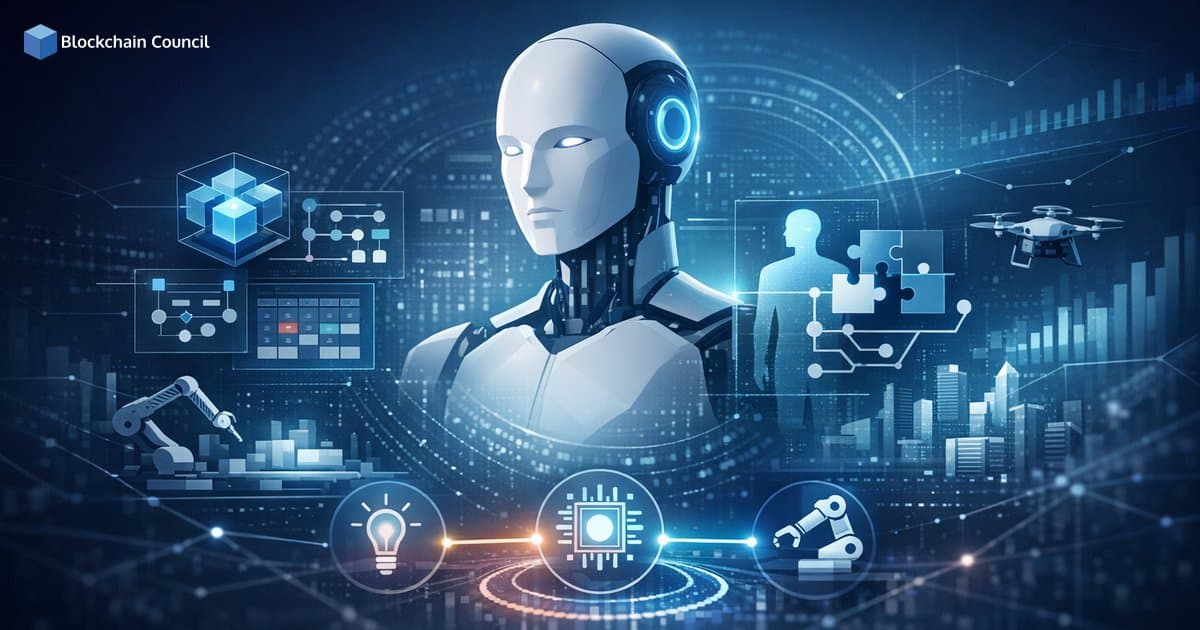
Agentic AI lifecycle design is rapidly becoming a practical blueprint for building systems that do more than generate a single response. AI agents can perceive context, plan a workflow, reason through decisions, and act using tools and APIs, repeating this loop until a goal is met. Major industry definitions from IBM, AWS, and Google Cloud converge on the same core idea: agentic systems combine large language models (LLMs) with memory, tool access, and control logic so they can autonomously pursue multi-step objectives in real environments.
This article explains how AI agents plan, reason, and act within the agentic lifecycle, what architectures enable reliability, and what trends are shaping agentic AI from 2024 through 2026.

What is Agentic AI?
Agentic AI refers to AI systems that can autonomously perform tasks on behalf of a user by designing workflows, selecting tools, making decisions, and taking actions in external systems. IBM describes agentic AI as having the agency to design its own workflow and use available tools beyond what is directly stored in model parameters. AWS frames the agent loop as perceive, reason, act, and learn. Google Cloud similarly defines AI agents as goal-driven software systems that use reasoning, planning, and memory to complete tasks.
Agentic AI builds on generative AI. The LLM provides flexible natural language understanding and general reasoning, while the agent layer adds:
Tools (APIs, search, code execution, enterprise apps)
Memory (short-term context and longer-term user or task state)
Control logic (planning, routing, constraints, approvals, retries)
Feedback (evaluation signals, user corrections, monitoring)
The Agentic AI Lifecycle: Perceive, Plan, Reason, Act, and Learn
Across modern implementations, the agentic AI lifecycle operates as an iterative loop:
Perceive (understand the goal and context)
Plan and reason (decide what to do and how)
Act (execute using tools and systems)
Evaluate and learn (reflect, update memory, adjust)
This loop is critical because real-world objectives are rarely solved in a single step. Agents must handle dependencies, partial progress, new information, and failures while keeping the end goal in view.
How AI Agents Perceive Context and Constraints
Perception in agentic systems extends well beyond human-like sensing. It includes any method of ingesting signals that define the current state of the world and the user's intent. Typical inputs include:
User instructions (natural language prompts, form inputs)
Documents and knowledge bases (policies, manuals, tickets)
Application state via APIs (CRM records, inventory, logs)
Sensor and IoT streams (telemetry, anomalies, alerts)
The LLM is often used to translate raw inputs into a structured representation of the task, including objectives, constraints, and success criteria. For enterprise scenarios, this stage is also where governance begins: identifying what the agent is permitted to access, which actions carry high risk, and what requires human approval.
How AI Agents Plan: From Goals to Executable Workflows
Planning is what differentiates agentic AI from basic chat experiences. Rather than producing a final answer immediately, the agent constructs a multi-step workflow and refines it during execution.
Common Planning Patterns in Agentic AI
Many production systems implement a loop commonly described as Plan-Act-Reflect-Repeat. A related enterprise workflow approach, sometimes called an agentic planning pattern, typically follows these steps:
Interpret the goal and form a high-level strategy
Generate tasks by breaking the goal into smaller steps
Assign work to tools or specialized worker agents
Replan based on outcomes, errors, or new data
Iterate until the success criteria are met
This approach mirrors structured human problem-solving: create a plan, test it against real conditions, and adjust based on feedback.
What Makes Agentic Planning Difficult
Long-horizon planning is fragile because small errors can cascade across steps. Common failure modes include:
Error propagation when early assumptions are incorrect
Brittle reasoning when tasks involve many dependencies
Tool misuse such as calling the wrong API or relying on stale data
Ambiguous success criteria leading to premature task completion
Robust agent designs therefore pair planning with verification, observability, and guardrails rather than relying solely on the LLM.
How AI Agents Reason: LLMs, Verification, and Tool-Augmented Thinking
In most agentic systems, the LLM serves as the central reasoning engine. To improve reliability, teams commonly add reasoning enhancements and separate planning logic from execution.
Reasoning Mechanisms Used in Modern Agents
Stepwise reasoning prompts (chain-of-thought or scratchpad style) to encourage structured decision-making
Planner-executor architectures where one component proposes a plan and another executes or validates it
Self-reflection where the agent critiques its own results and revises subsequent steps
Tool-augmented reasoning using search, calculators, code execution, or domain-specific engines to reduce hallucinations
Why Multi-Agent Systems Are Gaining Traction
A significant architectural trend is multi-agent orchestration. Rather than relying on a single generalist agent, systems coordinate multiple specialized agents:
A planner to decompose the goal and schedule work
A researcher to gather evidence from approved sources
A builder (coder or workflow executor) to implement actions
A tester or verifier to check outputs against requirements
This mirrors how human teams operate and can reduce risk, particularly when combined with enterprise policy checks and action approvals.
How AI Agents Act: Tool Use, APIs, and Real-World Execution
In the agentic AI lifecycle, acting means the agent changes state in external systems, not just generating text. Common action categories include:
Software actions: calling REST APIs, creating tickets, updating CRM records, sending emails, triggering workflows
Data actions: querying databases, retrieving documents, logging steps, running analytics jobs
IoT and operations actions: monitoring telemetry, sending commands to devices, adjusting parameters, raising alerts
Because actions can have real consequences, modern agent designs apply least-privilege access controls, approval checkpoints for high-risk operations, and detailed logging for auditability.
Evaluate and Learn: Reflection, Memory, and Adaptation
After acting, the agent evaluates outcomes against its goals. This is where many systems implement reflection and replanning, especially when tool calls fail or results fall short of the required criteria.
How Agents Adapt in Production
Fully autonomous continual learning is still emerging, but many deployed systems rely on:
Episodic memory to preserve context across steps and sessions
User preference learning by tracking feedback and prior choices
Feedback loops that prompt the agent to gather more data or request clarification
AWS describes this as a perceive-reason-act-learn loop where new data and outcomes continuously refine agent behavior. In enterprise settings, this learning is typically constrained and monitored to prevent behavioral drift and maintain compliance.
Real-World Use Cases for the Agentic AI Lifecycle
Agentic systems are best suited for complex, multi-step workflows that span multiple tools and require stateful execution.
Enterprise Process Automation
Marketing campaign management: monitoring performance metrics, adjusting audience segments, updating content, and iterating based on results
Customer support: retrieving account context, drafting responses, updating tickets, and triggering follow-ups
Document workflows: extracting fields, validating data, routing for approvals, and updating systems of record
Data and Analytics Orchestration
Research and reporting: searching approved sources, querying internal databases, running analyses, and generating summaries
Knowledge management: synthesizing answers from enterprise content with memory for continuity across sessions
Operations, IoT, and Healthcare Decision Support
Real-time monitoring: detecting anomalies and escalating incidents with recommended actions
Clinical decision support: monitoring patient data and surfacing updated recommendations for clinician review, subject to strict oversight given safety and regulatory requirements
Architectural Trends Shaping Agentic AI (2024-2026)
Guidance from major vendors and industry practitioners points to several consistent directions:
Agent frameworks for orchestration, tool calling, and monitoring are becoming standard building blocks
Hybrid AI and deterministic programming is the established norm: LLMs handle unstructured reasoning, while conventional code enforces policy, security, and correctness
Standardized tool and memory interfaces are improving portability and composability across platforms
Observability and governance are receiving greater emphasis, including audit logs, approval flows, and role-based access constraints
Alongside these advances, practitioners continue to grapple with known limitations: hallucinations, brittle long-horizon reasoning, and the operational challenge of supervising semi-autonomous systems. These factors are pushing teams toward verification-heavy designs and clearer accountability models.
Skills and Governance: What Professionals Should Learn
Designing reliable agentic systems requires cross-disciplinary capability across AI engineering, security, and operations. Key competencies include:
Workflow decomposition and planning pattern design
Tool registry design, API safety, and permissioning
Memory design (what to store, retention policies, privacy constraints)
Evaluation using task-based metrics, sandbox testing, and red-teaming
Governance including approvals, audits, and incident handling
For professionals building formal expertise, relevant learning paths include Blockchain Council programs such as the Certified AI Professional (CAIP), Certified Prompt Engineer, and security-focused credentials that support safe tool integration and governance. Teams working at the intersection of AI and Web3 may also find blockchain and cybersecurity certifications valuable as complementary foundations for auditability, access control, and secure automation.
Conclusion: Inside the Agentic AI Lifecycle
The agentic AI lifecycle transforms LLMs from conversational systems into goal-driven operators that perceive context, plan multi-step workflows, reason with tools and memory, act in external environments, and adapt through feedback. The most consequential shift is not autonomy alone, but iteration: agents continually re-evaluate and replan as they interact with the world.
As agent frameworks mature and enterprises adopt hybrid AI-programming architectures, the competitive advantage will come from building agents that are not only capable, but also reliable, observable, and governable. For professionals, understanding how planning, reasoning, tool use, and feedback loops fit together is now a core competency for deploying agentic AI safely at scale.
Related Articles
View All
Agentic AI
Human-in-the-Loop AI Agents: Why Oversight Matters in Agentic Workflows
Human-in-the-loop AI agents add approval gates, escalation, audit trails, and human judgment to agentic workflows where errors carry real business risk.

Agentic AI
Fine-Tuning vs Prompting for AI Agents: When to Customize Models for Agentic Tasks
Learn when prompting plus RAG is enough for AI agents and when fine-tuning delivers better reliability, domain control, and cost-efficiency at scale.

Agentic AI
Agentic Wallet on Blockchain: How AI Agents Transact On-Chain
Learn how an agentic wallet on blockchain enables AI agents to transact, trade, and pay autonomously with guardrails, monitoring, and governance.
Trending Articles
How Blockchain Secures AI Data
Understand how blockchain technology is being applied to protect the integrity and security of AI training data.
Claude AI Tools for Productivity
Discover Claude AI tools for productivity to streamline tasks, manage workflows, and improve efficiency.
How to Install Claude Code
Learn how to install Claude Code on macOS, Linux, and Windows using the native installer, plus verification, authentication, and troubleshooting tips.