

Agentic Wallet on Blockchain: How AI Agents Transact On-Chain
 Suyash Raizada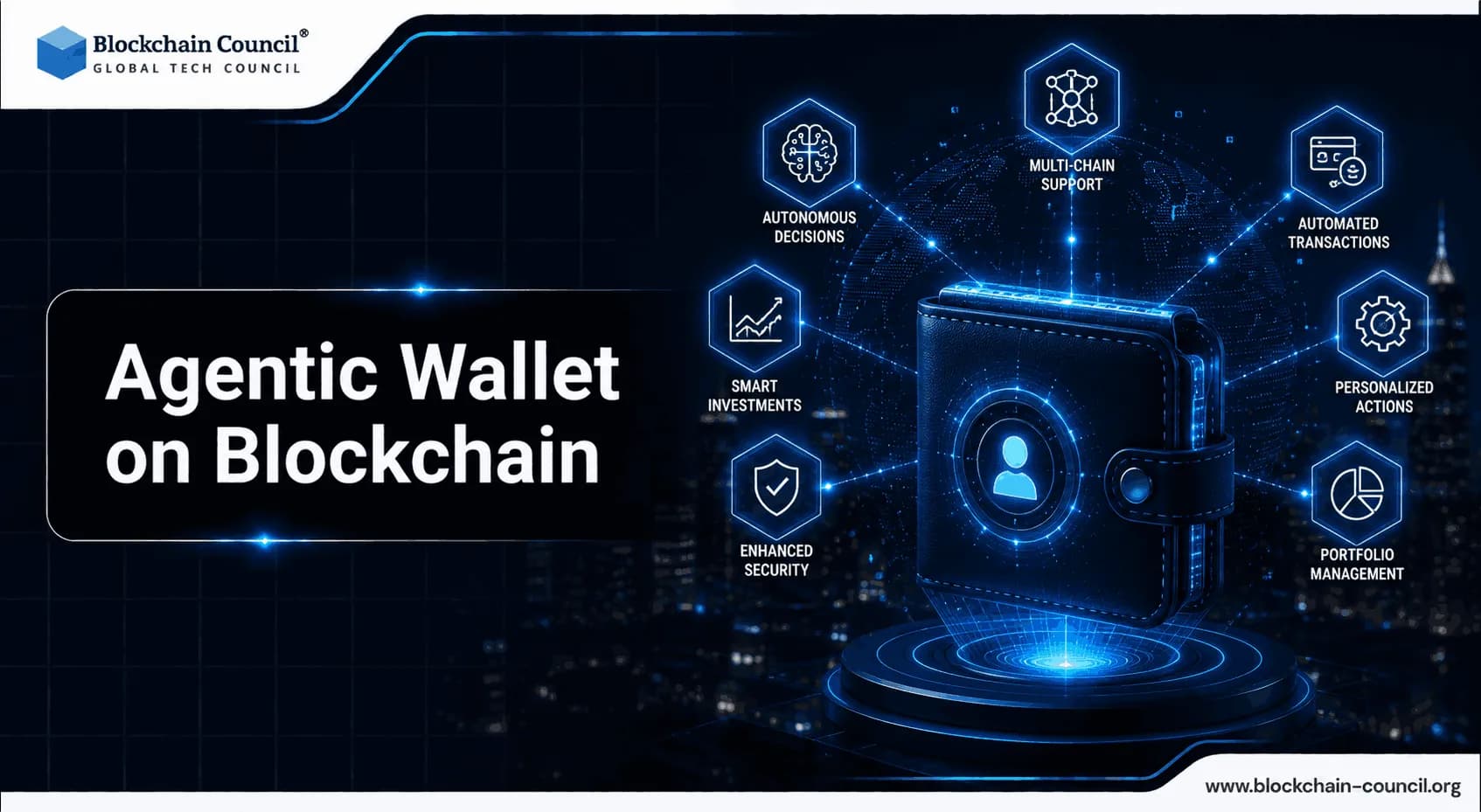
An agentic wallet on blockchain is a crypto wallet or wallet-like account designed for AI agents to hold assets and execute on-chain actions under human-defined rules. Instead of only advising a user, an AI agent can pay for services, trade tokens, rebalance portfolios, or participate in DeFi through a wallet that enforces limits, permissions, and monitoring.
This concept is moving from research to early production. Coinbase, Binance, Crossmint, MoonPay, Lightning Labs, Google, and other infrastructure providers have introduced tools for agentic payments and AI-controlled wallets. For developers, enterprises, and risk teams, the topic is no longer theoretical. It is becoming a practical layer in AI, Web3, payments, and digital asset operations.
Professionals who want to deepen their understanding can explore Blockchain Council learning paths such as Certified Blockchain Expert, Certified Blockchain Developer, Certified AI Expert, and Web3 security focused programs.

What Is an Agentic Wallet on Blockchain?
An agentic wallet is a wallet, sub-wallet, or programmable account that an AI agent can control through APIs, tools, or delegated signing flows. The agent can initiate transactions without a manual checkout process, but only within boundaries set by the user, enterprise, or platform.
Core characteristics include:
Programmatic control: AI agents can call wallet functions through SDKs, APIs, OpenAPI interfaces, or agent frameworks.
Asset ownership and transfer: The wallet can hold stablecoins, crypto assets, NFTs, or tokenized balances.
Guardrails: Spending limits, whitelisted assets, approved merchants, time limits, approval thresholds, and transaction caps reduce risk.
Monitoring: Logs, alerts, dashboards, and revocation controls help humans audit agent behavior.
Multi-chain access: Many implementations support Ethereum, Base, BNB Chain, Solana, Bitcoin Lightning, and other networks.
In simple terms, an agentic wallet gives AI agents controlled financial agency. This is the foundation of agentic commerce, where software agents initiate and complete transactions for individuals or organizations.
Why Agentic Wallets Are Emerging Now
Agentic wallets are becoming relevant because three trends are converging: more capable AI agents, programmable blockchain payment rails, and the growth of stablecoins. AI systems can now plan tasks, call tools, compare prices, and interact with APIs. Blockchains provide settlement layers that are open, programmable, and globally accessible. Stablecoins add a practical unit of account for machine-to-machine payments.
Coinbase has described agentic wallets as autonomous money management tools for AI agents, built around its AgentKit developer framework and x402 payment protocol. The x402 protocol adapts the HTTP 402 Payment Required concept for instant stablecoin payments.
Binance has launched a keyless Agentic Wallet under a user account, with a separate balance, configurable permissions, real-time monitoring, and support for networks such as BNB Smart Chain, Solana, Ethereum, and Base. Crossmint offers programmable wallets and agentic payment infrastructure with spending limits and approval controls. MoonPay Agents aims to connect AI agents to wallets, funds, and fiat on-ramps. Lightning Labs has demonstrated AI payments over the Bitcoin Lightning Network through L402-style flows.
How Agentic Wallet Architecture Works
Wallet or Sub-Account Layer
The wallet may be custodial, semi-custodial, or non-custodial. In custodial models, a platform abstracts private key management and creates a dedicated wallet or sub-account for the agent. In non-custodial models, the user or application retains stronger control over keys, while the agent receives limited signing authority.
Policy and Permission Layer
The policy layer defines what the AI agent can do. For example, an enterprise may allow an agent to pay approved cloud providers up to a monthly limit, but block token swaps, unknown smart contracts, and unapproved addresses. A DeFi agent may be allowed to trade only whitelisted assets and keep exposure below a defined risk level.
Agent Interface Layer
Agents interact with wallets through APIs, SDKs, command-line interfaces, Model Context Protocol integrations, or tool-calling frameworks. This lets the wallet become part of an AI workflow, similar to how agents already call search, databases, analytics tools, or productivity apps.
Monitoring and Revocation Layer
Because AI agents can operate continuously, visibility is essential. Logs, notifications, risk scoring, and kill switches allow users and administrators to pause or revoke access when behavior deviates from policy.
Key Use Cases for Agentic Wallets
DeFi Trading and Portfolio Management
One of the earliest use cases is automated DeFi activity. An AI agent can monitor liquidity pools, track token prices, rebalance a portfolio, harvest yield, or execute arbitrage based on predefined rules. The agentic wallet holds only the funds allocated for this strategy, while the main wallet remains isolated.
For example, a trader may fund an agentic wallet with stablecoins, set a maximum daily loss, limit trading to selected decentralized exchanges, and allow the AI agent to rebalance positions when market conditions change.
Machine-to-Machine Payments
AI agents increasingly need to pay for digital resources such as APIs, compute, storage, premium datasets, or model access. Agentic wallets allow these payments to happen instantly through stablecoins or Bitcoin Lightning micropayments. This supports pay-per-request, pay-per-token, and usage-based business models without manual invoicing.
Enterprise Procurement and Operations
In a business setting, an AI procurement agent could monitor software licenses, compare vendor pricing, renew subscriptions, and pay approved invoices. The wallet would enforce approval thresholds and limit payments to verified vendors. This can reduce operational friction while preserving governance.
Creator Economy and Digital Content
Agentic wallets may also support creator payments, NFT purchases, content subscriptions, gaming assets, and revenue splits. An AI agent could pay for licensed content, tip creators, or manage tokenized access rights on behalf of a user.
Security and Risk Considerations
Agentic wallets introduce a powerful capability, but also a serious risk surface. If an AI agent, API key, prompt context, or wallet integration is compromised, losses can happen quickly. Analysts have warned that mistakes and losses can accumulate at machine speed when controls are weak.
Important risks include:
Agent compromise: Attackers may manipulate the agent through prompt injection, stolen credentials, or malicious tools.
Model error: The AI may make incorrect decisions, overpay for services, or interact with risky smart contracts.
API abuse: Poorly secured wallet APIs can become high-value attack targets.
Smart contract risk: Agents may approve malicious contracts or fall for spoofed DeFi opportunities.
Compliance gaps: Organizations need clear accountability for actions taken by non-human actors.
Best practice is to design for least privilege. Each agent should have its own wallet, narrow permissions, limited balances, whitelisted counterparties, and continuous monitoring. Enterprises should also create incident response procedures for agent failures, including rapid revocation of signing rights and account access.
Regulatory and Governance Questions
Regulation for agentic wallets is still developing, but several issues are clear. Custodial platforms must consider liability when enabling AI agents to act on user assets. KYC and AML controls must identify the human or organization behind each agent. Transaction monitoring systems must adapt to machine-speed behavior patterns.
Governance is equally important inside enterprises. Teams need policies for who can deploy an AI agent, who approves wallet scopes, what logs are retained, and how exceptions are reviewed. Explainability will matter, especially when an agent makes financial decisions that affect customers, vendors, or treasury assets.
Developer Considerations
Developers building with agentic wallets should treat them as critical infrastructure, not simple payment plugins. Practical design steps include:
Separate funds: Use dedicated agent wallets rather than giving agents access to primary treasury wallets.
Define policies first: Write spending, trading, and approval rules before connecting the agent to funds.
Use deterministic APIs: Wallet calls should produce predictable outcomes and clear errors.
Log every action: Maintain transaction history, agent reasoning traces where appropriate, and policy decisions.
Test adversarial inputs: Simulate prompt injection, spoofed merchants, malicious contracts, and abnormal market data.
Professionals who want to deepen their understanding can explore Blockchain Council learning paths such as Certified Blockchain Expert, Certified Blockchain Developer, Certified AI Expert, and Web3 security focused programs.
The Future of Agentic Wallets
Industry leaders expect agent-driven stablecoin flows to grow. Circle CEO Jeremy Allaire has predicted that billions of AI agents may transact with crypto and stablecoins within the next several years. Whether that timeline proves exact or not, the direction is clear: autonomous agents need programmable money rails.
Future agentic wallets are likely to combine on-chain settlement, fiat payment handlers, identity systems, hardware-backed signing, and compliance monitoring. Payment standards from major companies and crypto-native protocols such as x402 and L402 may eventually interoperate, letting agents choose the best payment route based on cost, speed, geography, and policy.
Conclusion
An agentic wallet on blockchain is a foundational building block for AI systems that do more than generate recommendations. It allows agents to transact, trade, pay, and participate in digital economies under programmable constraints.
For enterprises, the opportunity is efficient automation across payments, procurement, treasury, and data access. For developers, it is a new design pattern for AI-native applications. For security and compliance teams, it is a new class of actor that requires strict governance. The organizations that succeed will be those that combine innovation with disciplined controls, clear accountability, and strong blockchain security practices.
Faqs
1. What is an Agentic Wallet on Blockchain?
Answer: An Agentic Wallet is a blockchain wallet designed for AI agents, enabling them to securely hold digital assets, interact with smart contracts, and execute on-chain transactions autonomously based on predefined rules, permissions, and policies.
2. How does an AI agent use a blockchain wallet to transact on-chain?
Answer: AI agents analyze data, decide on an action, generate a transaction, sign it securely using wallet credentials or MPC, broadcast it to the blockchain, and verify the outcome while adhering to user-defined policies.
3. Why do AI agents need blockchain wallets instead of traditional digital wallets?
Answer: Traditional wallets require human approval for every transaction. Agentic wallets support programmable automation, policy enforcement, smart contract interaction, and autonomous execution, making them suitable for AI-driven operations.
4. What are the core components of an Agentic Wallet?
Answer: An Agentic Wallet typically includes an AI decision engine, secure key management, policy engine, transaction signer, blockchain interface, smart contract integration, monitoring system, and audit logs.
5. How do Agentic Wallets securely sign blockchain transactions?
Answer: They use cryptographic private keys protected by technologies such as Multi-Party Computation (MPC), Hardware Security Modules (HSMs), threshold signatures, or secure enclaves to authorize transactions safely.
6. What is Account Abstraction (ERC-4337), and why is it important?
Answer: ERC-4337 enables programmable smart accounts instead of traditional externally owned accounts (EOAs). It allows features like spending limits, social recovery, session keys, gas sponsorship, and automated transaction execution.
7. How do smart contracts enable autonomous AI transactions?
Answer: Smart contracts execute predefined rules automatically when conditions are met. AI agents use them to perform actions such as payments, staking, governance voting, and DeFi interactions without manual intervention.
8. What role does Multi-Party Computation (MPC) play in Agentic Wallets?
Answer: MPC enhances security by splitting private key control among multiple parties, preventing any single entity from accessing the complete key and reducing the risk of compromise.
9. How do AI agents decide when to execute an on-chain transaction?
Answer: AI agents analyze market data, user goals, blockchain state, and predefined policies. They evaluate risk and opportunity before triggering transactions that align with authorized objectives.
10. What security risks are associated with Agentic Wallets?
Answer: Risks include private key theft, prompt injection attacks, compromised smart contracts, malicious AI decisions, phishing, unauthorized permissions, and vulnerabilities in third-party protocols.
11. Can AI agents independently own and manage crypto assets?
Answer: AI agents can manage assets on behalf of users or organizations within predefined permissions, but legal ownership generally remains with the individual, organization, or smart contract controlling the wallet.
12. What are the most common use cases for Agentic Wallets?
Answer: Popular use cases include autonomous trading, DeFi portfolio management, DAO governance, automated treasury management, recurring payments, NFT licensing, machine-to-machine payments, and AI-powered commerce.
13. How do Agentic Wallets interact with decentralized applications (dApps)?
Answer: They connect through wallet protocols or APIs, authenticate securely, execute smart contract calls, sign transactions, and interact with DeFi platforms, NFT marketplaces, and decentralized services.
14. How can developers build an Agentic Wallet?
Answer: Developers combine blockchain SDKs, AI frameworks, account abstraction, secure key management, policy engines, smart contracts, and transaction monitoring to create programmable AI-enabled wallets.
15. Which blockchain networks are best suited for Agentic Wallets?
Answer: Ethereum, Base, Arbitrum, Optimism, Polygon, Solana, Avalanche, BNB Chain, Sui, and Aptos are popular choices due to their smart contract capabilities and growing AI ecosystems.
16. How do Agentic Wallets support cross-chain transactions?
Answer: They integrate with interoperability protocols and cross-chain bridges to transfer assets, execute transactions, and interact with smart contracts across multiple blockchain networks.
17. What is the role of decentralized identity (DID) in Agentic Wallets?
Answer: Decentralized Identity allows AI agents to prove identity, verify credentials, establish trust, and access blockchain services without relying on centralized authentication systems.
18. How are Agentic Wallets transforming decentralized finance (DeFi)?
Answer: They automate portfolio rebalancing, yield farming, lending, borrowing, arbitrage, liquidity management, and risk analysis, improving efficiency while reducing manual intervention.
19. How can businesses use Agentic Wallets?
Answer: Enterprises use Agentic Wallets for automated treasury operations, supplier payments, payroll, compliance workflows, tokenized assets, supply chain settlements, and AI-driven financial automation.
20. What are the advantages and limitations of Agentic Wallets?
Answer: Advantages include automation, efficiency, scalability, and continuous operation. Limitations involve security risks, governance complexity, regulatory uncertainty, AI reliability, and smart contract vulnerabilities.
21. How do Agentic Wallets differ from smart wallets, multisig wallets, and custodial wallets?
Answer: Agentic Wallets add AI-driven autonomous decision-making. Smart wallets focus on programmable logic, multisig wallets require multiple approvals, and custodial wallets rely on third-party key management.
22. What are the best tools and frameworks for developing Agentic Wallets?
Answer: Popular tools include ERC-4337 SDKs, Safe Smart Accounts, Fireblocks, Coinbase Developer Platform, WalletConnect, Alchemy, LangChain, CrewAI, AutoGen, OpenAI Agents SDK, and ElizaOS.
23. What is the future of Agentic Wallets in AI-powered Web3?
Answer: Agentic Wallets are expected to become core infrastructure for autonomous commerce, decentralized organizations, machine economies, AI-powered financial services, and intelligent digital ecosystems.
24. What career opportunities exist in Agentic Wallet and AI blockchain development?
Answer: Roles include Blockchain Developer, Smart Contract Engineer, AI Engineer, Web3 Architect, DeFi Developer, Security Engineer, AI Product Manager, Blockchain Consultant, and Protocol Researcher.
25. Which certifications and skills help build expertise in Agentic Wallets?
Answer: Professionals should learn blockchain fundamentals, smart contracts, AI agents, cryptography, account abstraction, DeFi, decentralized identity, Solidity, Python, and Web3 development. Certifications in Blockchain, AI, and Web3 provide structured learning.
26. What is the future of AI agents performing on-chain transactions?
Answer: AI agents will increasingly negotiate contracts, manage digital assets, optimize investments, execute machine-to-machine payments, and collaborate across decentralized networks. Secure Agentic Wallets, identity systems, and programmable governance will be essential for enabling trusted autonomous participation in the Web3 economy.
Related Articles
View All
Agentic AI
How AI Agents in On-Chain Analytics Improve Blockchain Data Intelligence
Learn how AI agents in on-chain analytics turn blockchain records into real-time intelligence for compliance, trading, security, and DeFi operations.

Agentic AI
Human-in-the-Loop AI Agents: Why Oversight Matters in Agentic Workflows
Human-in-the-loop AI agents add approval gates, escalation, audit trails, and human judgment to agentic workflows where errors carry real business risk.

Agentic AI
Decentralized AI Agents: How Blockchain Enables Trust, Transparency, and Automation
Decentralized AI agents use blockchain for auditable actions, smart contract limits, trusted data, and autonomous Web3 workflows across DeFi, gaming, and enterprise systems.
Trending Articles
The Role of Blockchain in Ethical AI Development
How blockchain technology is being used to promote transparency and accountability in artificial intelligence systems.
How Blockchain Secures AI Data
Understand how blockchain technology is being applied to protect the integrity and security of AI training data.
What is AWS? A Beginner's Guide to Cloud Computing
Everything you need to know about Amazon Web Services, cloud computing fundamentals, and career opportunities.