

Payment Orchestration with Agentic AI: Improving Speed, Cost, and Reliability
 Suyash Raizada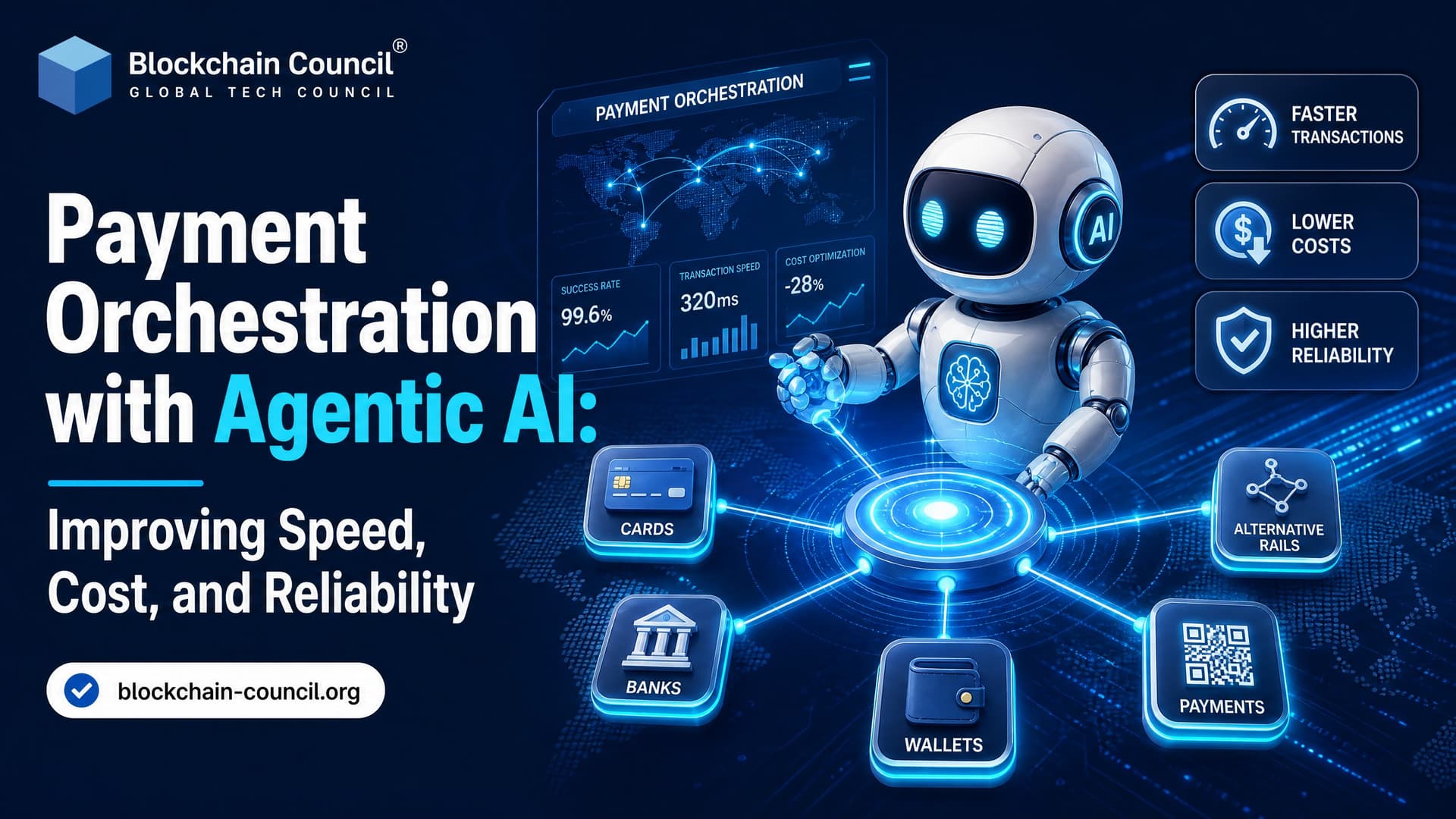
Payment orchestration with agentic AI is becoming a practical architecture for merchants, platforms, and Web3 teams that need faster approvals, lower processing costs, and fewer payment failures across multi-provider stacks. The short version: orchestration gives you the control layer, while agentic AI makes real-time decisions inside that layer.
That matters because payments are no longer a single gateway problem. A global business may use card acquirers, wallets, ACH, local bank rails, fraud tools, crypto settlement, and payout providers at the same time. Without orchestration, each provider becomes another integration to maintain. Without intelligent decisioning, routing rules go stale fast.

As payment ecosystems become more complex, an AI Agentic Finance and Payment Certification can help professionals understand how AI agents orchestrate payment workflows, optimize routing decisions, and manage financial operations across multiple systems while maintaining governance and control.
What Payment Orchestration Does
Payment orchestration is a technology layer that connects payment service providers, acquiring banks, payment methods, fraud systems, tokenization tools, reconciliation engines, and reporting into one operating layer. Think of it as a traffic controller for money movement.
A typical orchestration platform handles:
Smart transaction routing across multiple acquirers or processors
Retries after soft declines or temporary provider failures
Support for local payment methods and alternative rails
Tokenization and payment method vaulting
Settlement reconciliation across providers
Centralized rules for geography, currency, card type, cost, and risk
Take a merchant selling in Brazil, Germany, and Singapore. It may route domestic cards to local acquirers, use wallet methods where conversion is higher, and fall back to a secondary acquirer when the primary provider starts timing out. That is orchestration in practice.
As payment ecosystems become more intelligent, agent identity, budgets, and programmable controls become essential infrastructure. Give your AI Agents a wallet, budget, and identity with Blockchain0x to autonomously pay, get paid, and build onchain.
Where Agentic AI Fits
Agentic AI refers to AI systems that can plan, decide, and act with a degree of autonomy. In payments, an agent may decide which payment rail to use, whether to trigger 3D Secure, when to retry a failed transaction, or how to schedule payouts based on cost and liquidity constraints.
The orchestration layer becomes the execution substrate. The agent does not need to integrate with every PSP directly. It calls orchestration APIs, reads performance data, applies policies, and selects the best action for a specific transaction.
This is where the architecture gets interesting. Static rules such as "route Visa UK cards to Acquirer A" are useful, but they miss live changes in approval rates, provider latency, fraud signals, and fee impact. An agentic model can update decisions continuously, as long as it is constrained by clear governance rules.
Why Speed Improves
Speed in payments means more than checkout latency. It covers authorization time, retry handling, settlement timing, dispute workflows, and back-office reconciliation. Payment orchestration with agentic AI can improve each of these.
Better routing to local and high-performing providers
Routing transactions to a local acquirer often improves authorization speed and acceptance because the transaction matches regional banking expectations. Stripe and other payment infrastructure providers describe intelligent routing as a way to choose paths based on card characteristics, geography, historical performance, and reliability.
The difference can be material. Cross-border card transactions may face extra checks, higher fees, and lower approval rates. Local acquiring cuts that friction.
Smarter retries
Retries are easy to do badly. A beginner mistake is retrying a declined card immediately through the same provider without checking the decline reason. You burn fees, annoy issuers, and sometimes increase fraud suspicion. For card payments, a soft decline such as insufficient funds is different from a hard decline such as a stolen card response.
An agent can evaluate the decline code, issuer behavior, transaction value, user history, and provider status before deciding whether to retry, delay, switch acquirer, or ask the user for another method.
One hard-won note from payment engineering: always use idempotency keys when retrying API calls that create or confirm payments. In Stripe, retrying a create request without an idempotency key after a network timeout can create duplicate objects. That is not an AI problem. It is basic payment hygiene, and agents must follow it.
Ensuring these systems remain reliable, scalable, and well-governed in production requires strong operational practices, which is why many professionals pursue an MLOps Certification to manage AI-powered applications and automation workflows effectively.
Fewer manual handoffs
Agentic systems can also cut delays in exception handling. Instead of sending every failed payout or reconciliation mismatch to an operations queue, the agent can classify the issue, attempt an approved fix, and escalate only when policy requires human review.
How Costs Come Down
Payment costs are not just processing fees. They include failed payments, chargebacks, customer support, reconciliation labor, foreign exchange spreads, integration maintenance, and provider downtime.
Orchestration lowers cost by giving businesses options. A multi-acquirer setup lets you route each transaction based on total cost and expected success, not just the headline processing rate.
Agentic AI improves that model by learning which combinations of provider, rail, payment method, authentication step, and timing produce the best net result. Net result is the key phrase. The cheapest route is not always the best route.
To be blunt, routing only by lowest fee is a bad strategy for high-value transactions. A low-cost provider with weak approval rates can lose more revenue than it saves. A good agent should optimize for margin after approvals, refunds, chargebacks, and operational cost.
Cost optimization commonly includes:
Routing domestic transactions to local acquirers to reduce cross-border fees
Choosing bank rails or wallets when card fees are too high
Reducing failed subscription renewals through better retry timing
Using lower-cost payout methods where speed requirements allow it
Reducing manual reconciliation through normalized reporting
In crypto and Web3 ecosystems, agentic payments may also use stablecoins or onchain settlement for microtransactions, machine-to-machine payments, and cross-border transfers. Chainlink and MoonPay have both pointed to decentralized infrastructure as a useful foundation for autonomous payments, especially where transparent settlement and programmable conditions matter.
Reliability: The Main Business Case
Reliability is often the strongest reason to adopt payment orchestration. Provider outages happen. Acquirer performance changes. Fraud tools misfire. Issuers decline legitimate customers. A single-gateway architecture leaves you exposed.
With multi-acquirer orchestration, transactions can route across two or more acquiring banks. If one provider is unreachable, traffic can move to another. If approval rates drop in a market, routing can shift before the revenue impact becomes severe.
Agentic AI adds live adaptation. It can watch authorization rates, latency, decline codes, fraud alerts, and settlement outcomes, then adjust routing within approved boundaries.
That last phrase matters: within approved boundaries. Payments cannot be a free-form AI playground. Agents need policy limits, audit logs, consent records, transaction caps, and human override paths.
Security, Consent, and Governance
Agentic payments raise a serious question: who authorized the payment, and under what conditions?
Google's Agent Payments Protocol, known as AP2, is an early attempt to standardize how AI agents authenticate, represent users, obtain consent, and transact with payment providers. Mastercard's Agent Pay also focuses on consent, fraud controls, and trusted agent-initiated payments on card rails. The Payments Association has warned that agentic AI in payments needs clear rules for liability, transparency, and misuse.
For enterprises, the baseline should include:
Explicit consent: Define what the agent can buy, pay, refund, or transfer.
Transaction limits: Set caps by amount, merchant, geography, asset, or time period.
Strong authentication: Align with SCA requirements where PSD2 applies.
PCI DSS controls: Keep card data protected under PCI DSS v4.0 expectations.
Audit trails: Log the model input, policy decision, route selected, and final outcome.
Fallback rules: Decide when the agent must stop and ask for human approval.
Do not let an AI agent hold unrestricted payment credentials. Use scoped tokens, wallet permissions, policy engines, and revocation paths.
Use Cases Across Commerce, B2B, and Web3
Global ecommerce
Large merchants use orchestration to support local payment methods, improve authorization rates, and cut checkout failures. Agentic AI can tune routing by market and transaction type instead of relying on quarterly rule reviews.
Subscription businesses
Failed renewals create involuntary churn. An agent can choose retry timing based on issuer patterns, payday cycles, prior user behavior, and decline reason. This is especially useful for SaaS and digital media subscriptions.
B2B payments
B2B platforms often combine card, ACH, bank transfer, invoice terms, and regional payment methods. Orchestration centralizes these flows. Agentic AI can assist with payment timing, risk checks, reconciliation, and exception handling.
Creator and gig payouts
Platforms that send thousands of small payouts need to balance speed and cost. An agent can decide whether instant payout is worth the fee, whether a batch transfer is better, or whether a user preference should override cost savings.
Crypto-native autonomous payments
AI agents can use blockchain rails for programmable settlement, stablecoin payments, escrow, and machine-to-machine commerce. This is not the right choice for every payment flow. It makes the most sense when programmability, global reach, and transparent settlement outweigh volatility, compliance, and user experience challenges.
Implementation Checklist for Teams
If you are evaluating payment orchestration with agentic AI, start small. Do not give an agent control over every payment flow on day one.
Map your payment stack: List PSPs, acquirers, wallets, bank rails, fraud tools, payout providers, and settlement processes.
Define success metrics: Track authorization rate, latency, cost per successful transaction, retry success, chargeback rate, and settlement delay.
Start with recommendations: Let the agent suggest routing changes before it executes them automatically.
Add guardrails: Use policy rules for transaction value, geography, customer segment, and risk level.
Run controlled tests: Compare AI-assisted routing against current rules using A/B tests.
Review audit logs: Make sure every decision is traceable and explainable enough for operations, compliance, and finance teams.
Skills Professionals Need Now
This field sits at the intersection of payments, AI governance, cybersecurity, and blockchain settlement. If you are building or auditing these systems, you need more than model knowledge.
Useful learning paths from Blockchain Council include the Certified Agentic AI Expert™ for agent design and governance, the Certified AI Expert™ for applied AI foundations, the Certified Blockchain Expert™ for decentralized settlement concepts, and the Certified Blockchain Developer™ if you plan to build smart contract based payment flows. Professionals looking to strengthen their expertise in customer acquisition, brand strategy, and business growth may also benefit from a Marketing Certification.
What to Do Next
Payment orchestration with agentic AI works best when the agent has clean data, narrow permissions, and clear business objectives. Pick one flow first: failed subscription renewals, cross-border card routing, or high-volume payouts. Measure the current baseline, add orchestration rules, then introduce agentic decisioning under supervision.
If your goal is to design these systems, learn agentic AI governance and payment architecture together. Build a small routing simulator, feed it real decline categories, and test whether your agent improves approval rate without raising cost or risk. That exercise will teach you more than a slide deck.
FAQs
1. What Is Payment Orchestration with Agentic AI?
Payment orchestration with Agentic AI refers to the use of autonomous AI systems to manage, optimize, and automate payment processes across multiple payment providers, gateways, banks, and financial networks to improve transaction performance.
2. What Is Payment Orchestration?
Payment orchestration is the process of coordinating multiple payment methods, gateways, processors, and financial services through a unified platform to streamline payment operations.
3. How Does Agentic AI Enhance Payment Orchestration?
Agentic AI can analyze transaction conditions in real time, make routing decisions, optimize payment flows, and automatically respond to issues without requiring constant human oversight.
4. Why Is Payment Orchestration Important for Modern Businesses?
As businesses operate across multiple markets and payment channels, payment orchestration helps improve transaction efficiency, increase approval rates, and simplify payment management.
5. How Can Agentic AI Improve Payment Speed?
AI agents can select the fastest payment routes, identify processing bottlenecks, and dynamically adjust transaction paths to reduce delays and accelerate settlements.
6. How Does Agentic AI Help Reduce Payment Costs?
By comparing processing fees, exchange rates, gateway charges, and transaction costs, AI can automatically choose the most cost-effective payment option.
7. What Is Intelligent Payment Routing?
Intelligent payment routing uses AI to determine the optimal path for each transaction based on factors such as approval probability, processing speed, cost, risk, and customer preferences.
8. How Can Agentic AI Improve Payment Reliability?
AI continuously monitors payment networks and can reroute transactions, resolve failures, and select alternative providers when disruptions occur.
9. What Role Does Agentic AI Play in Payment Failure Reduction?
AI agents can detect potential issues before submission, validate transaction data, and automatically retry or reroute failed payments to improve success rates.
10. How Does Agentic AI Support Multi-Provider Payment Strategies?
It can dynamically distribute transactions across multiple processors and gateways to maximize performance, reduce dependency risks, and improve resilience.
11. Can Agentic AI Improve Cross-Border Payments?
Yes, AI can optimize international payment routing, manage currency conversions, reduce intermediary costs, and accelerate settlement times.
12. How Does Agentic AI Support Fraud Prevention?
AI agents continuously analyze transaction behavior, assess risk levels, detect suspicious activity, and initiate security measures in real time.
13. What Benefits Does Agentic AI Offer Merchants?
Merchants can benefit from higher authorization rates, lower processing costs, faster transactions, reduced payment failures, and improved customer experiences.
14. How Can Financial Institutions Use Agentic AI in Payment Orchestration?
Banks and fintech companies can automate transaction management, improve operational efficiency, optimize payment infrastructure, and enhance customer services.
15. What Role Does Real-Time Data Play in Payment Optimization?
Real-time data enables AI agents to make informed decisions based on current network conditions, transaction performance, fraud signals, and market factors.
16. How Can Agentic AI Improve Customer Experience During Payments?
Customers benefit from faster checkouts, fewer declined transactions, smoother payment experiences, and more reliable payment processing.
17. Which Industries Benefit Most from AI-Powered Payment Orchestration?
E-commerce, fintech, banking, travel, subscription services, marketplaces, telecommunications, and global enterprises can all benefit significantly.
18. What Challenges Exist When Implementing Agentic AI for Payment Orchestration?
Challenges include system integration, regulatory compliance, cybersecurity requirements, data quality issues, governance concerns, and operational complexity.
19. What Risks Should Organizations Consider?
Organizations should evaluate model accuracy, decision transparency, security controls, regulatory obligations, and business continuity planning. Moving payments intelligently across multiple networks can create major efficiencies, but it also requires careful oversight to ensure automation remains reliable and compliant.
20. How Will Agentic AI Shape the Future of Payment Orchestration?
Agentic AI is expected to transform payment orchestration by enabling autonomous transaction management, real-time optimization, predictive routing, adaptive fraud prevention, and highly resilient payment infrastructures. As digital commerce continues to expand globally, AI-driven payment orchestration will become increasingly important for businesses seeking faster, cheaper, and more reliable payment experiences.
Related Articles
View All
Agentic AI
How Businesses Can Prepare for Agentic AI-Powered Payment Automation
Learn how businesses can prepare for agentic AI-powered payment automation with modern AP systems, stronger data, clear controls, and safe pilots.

Agentic AI
Security Challenges of Agentic AI in Finance and Payment Ecosystems
Agentic AI in finance can approve payments, trade assets, and call APIs. Learn the main security, fraud, identity, and governance risks.
Agentic AI
How Agentic AI Fraud Detection Automates Payment Systems
Agentic AI fraud detection helps payment teams monitor transactions, verify identity, triage cases, and act on fraud risk in real time.
Trending Articles
AWS Career Roadmap
A step-by-step guide to building a successful career in Amazon Web Services cloud computing.
What is AWS? A Beginner's Guide to Cloud Computing
Everything you need to know about Amazon Web Services, cloud computing fundamentals, and career opportunities.
Claude AI Tools for Productivity
Discover Claude AI tools for productivity to streamline tasks, manage workflows, and improve efficiency.