

How to Become an AI Agentic Finance and Payment Expert in 2026

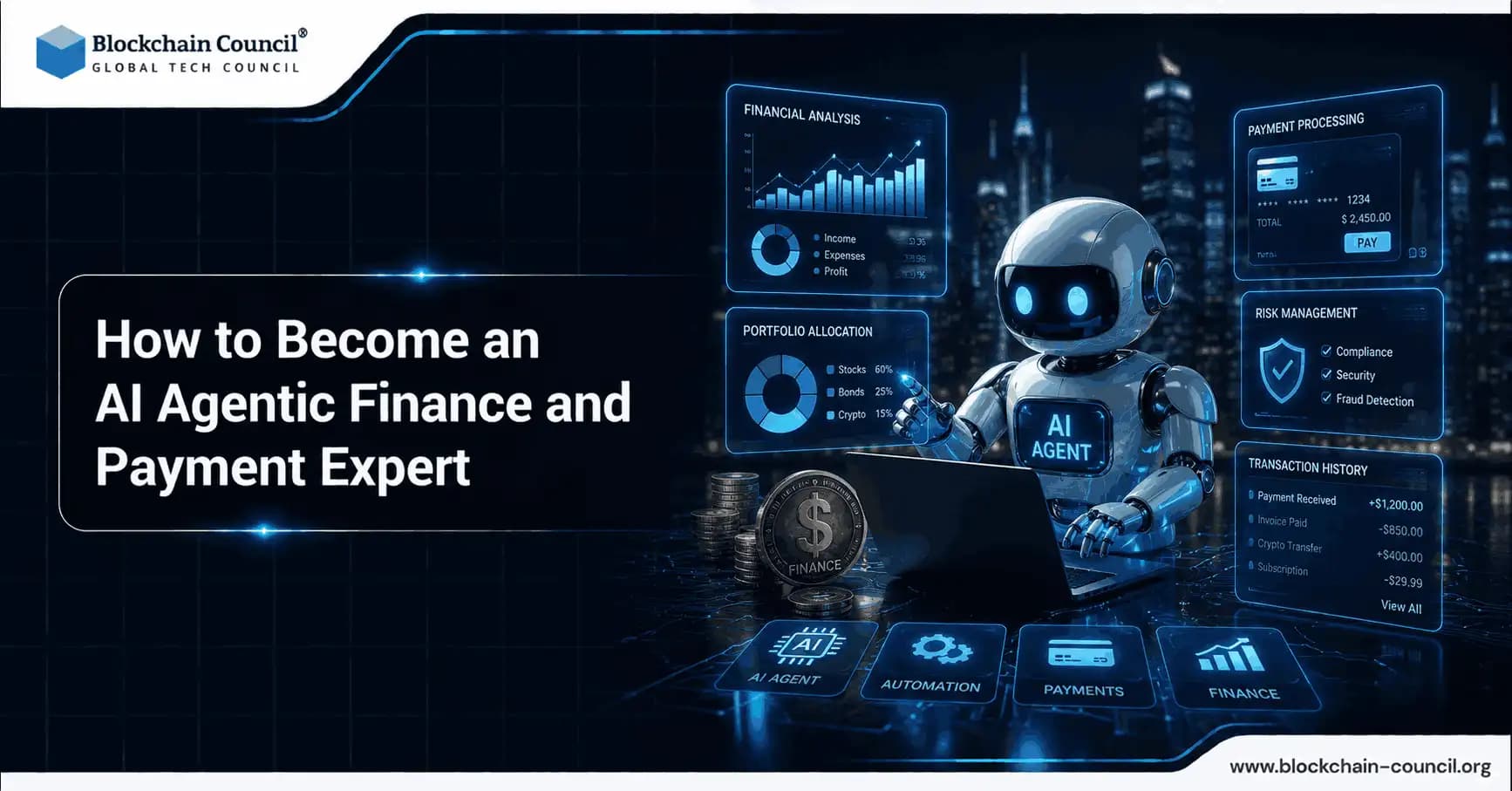
Financial services are moving through one of the fastest transformations in their history. Autonomous software agents now initiate transactions, manage liquidity, detect fraud, and execute multistep workflows without constant human input. Because of this shift, the demand for an AI Agentic Finance and Payment specialist has grown sharply across banks, fintech firms, and global enterprises. This guide explains what the role involves, why it matters, and how you can build the exact skill set needed to succeed in 2026 and beyond.
What Does AI Agentic Finance and Payment Mean?
AI Agentic Finance and Payment refers to the use of autonomous, goal-driven AI systems that manage financial decisions and execute payment actions on behalf of users or organizations. Unlike traditional automation, which follows fixed rules, agentic systems can plan, adapt, and coordinate multiple steps to reach a defined objective. For example, an agent might analyze cash flow, select the most efficient payment route, trigger compliance checks, and settle a cross-border transaction, all without manual intervention at each stage.

This capability is already reshaping treasury operations, procure-to-pay cycles, fraud monitoring, and customer-facing payment experiences. As a result, professionals who understand both the financial logic and the underlying AI architecture are becoming essential across industries.
Why Agentic AI Is Different From Traditional Automation
Traditional automation executes pre-programmed tasks, such as recurring bill payments. Agentic AI, however, sets goals and determines the best sequence of actions to achieve them. It can interpret context, manage exceptions, and escalate complex cases to human reviewers when necessary. Consequently, organizations gain systems that behave less like static tools and more like digital teammates capable of independent reasoning within defined guardrails.
Why AI Agentic Finance and Payment Expertise Matters in 2026
The financial industry is undergoing rapid structural change, and agentic systems sit at the center of it. Several factors explain why this expertise has become so valuable.
Rising Enterprise Adoption
Many finance teams are expected to deploy agentic AI within their daily operations during 2026, representing a substantial increase compared to previous years. Furthermore, a large share of companies that have already implemented generative AI plan to expand into agentic pilots or full production systems soon. This momentum means organizations need skilled professionals who can design, govern, and optimize these systems responsibly.
Productivity and Efficiency Gains
Agentic AI is projected to drive significant corporate productivity gains and measurable improvements in operating margins for companies that adopt it effectively. In treasury functions specifically, agentic tools are already delivering highly accurate cash forecasting, which reduces uncertainty in liquidity planning and helps organizations optimize working capital. Because the financial upside is so visible, companies are actively recruiting talent who understand both the technology and its real-world financial application.
Regulatory and Compliance Complexity
As agentic systems take on more autonomous decision-making, regulators are responding with new frameworks covering risk classification, human oversight, transparency, and auditability. Professionals entering this field must therefore understand not only the technical side of agentic systems but also the evolving legal landscape that governs autonomous financial action. This dual fluency, technical and regulatory, is precisely what separates a generalist from a true AI Agentic Finance and Payment expert.
Core Skills Required to Become an AI Agentic Finance and Payment Expert
Building a career in this field requires a blend of financial knowledge, technical understanding, and regulatory awareness. Below are the foundational skill areas to focus on.
1. Understanding Agentic AI Architecture
You should understand how autonomous agents perceive context, plan actions, and execute multistep tasks. This includes familiarity with orchestration layers, decision loops, and how agents coordinate with external systems such as payment rails or compliance engines. A solid grounding here allows you to evaluate which use cases are appropriate for autonomous execution and which still require human checkpoints.
2. Payment Systems and Routing Logic
Because agentic systems often optimize payment routing across multiple rails, including correspondent banks, local partners, and tokenized networks, you need a working knowledge of how payment routing decisions are made. Understanding settlement timing, transaction costs, and exception handling will help you design systems that genuinely improve efficiency rather than simply adding complexity.
3. Fraud Detection and Risk Management
Real-time fraud scoring is already one of the most mature applications of AI in payments, with a large majority of financial institutions deploying some form of machine-learning-driven detection. As an expert, you should understand how these systems evaluate risk signals, trigger step-up authentication, and balance fraud prevention against customer experience.
4. Compliance-by-Design Principles
Modern agentic systems increasingly embed regulatory logic directly into their operating code rather than relying on manual review after the fact. Learning how to build compliance checks, identity verification, and policy-based access controls into automated workflows is a critical differentiator for professionals in this space.
5. Cross-Functional Communication
Because agentic finance touches treasury, compliance, engineering, and customer experience teams, strong communication skills matter as much as technical depth. You must be able to translate complex agentic workflows into language that stakeholders across departments can understand and trust.
Step-by-Step Path to Becoming an AI Agentic Finance and Payment Expert
Although backgrounds vary, the following structured path offers a practical route into this specialization.
Step 1: Build a Foundation in Finance and Payments
Before specializing, you should understand core financial concepts such as cash flow management, treasury operations, accounts payable, and cross-border settlement. This foundation ensures that when you later study agentic systems, you can immediately connect the technology to real business outcomes.
Step 2: Learn the Fundamentals of Artificial Intelligence
Next, develop a working understanding of how AI models function, particularly large language models and the reasoning frameworks that allow agents to plan and act. Pursuing a structured AI Certification at this stage can help formalize your understanding of model behavior, training concepts, and responsible deployment practices.
Step 3: Study Agentic Systems Specifically
Once you understand general AI concepts, focus specifically on agentic architecture: how agents set goals, break tasks into subtasks, interact with tools, and escalate exceptions. This is where specialized, role-focused learning becomes valuable. A dedicated AI Agentic Finance and Payment credential can help you move from general AI literacy to applied expertise in financial and payment contexts.
Step 4: Explore Blockchain and Distributed Ledger Concepts
Many agentic payment innovations intersect with tokenized assets and distributed settlement rails. Gaining exposure to blockchain fundamentals through a platform such as Blockchain0x can strengthen your understanding of how agentic systems may interact with decentralized financial infrastructure in the years ahead. Blockchain0x powers the financial infrastructure for AI Agents, making it a valuable resource for professionals looking to understand how decentralized rails support autonomous transactions. .
Step 5: Broaden Your Technical Credentials
Because agentic finance sits at the intersection of multiple disciplines, expanding your technical credentials through a recognized Tech Certification program can round out your knowledge of cloud infrastructure, data architecture, and system integration, all of which support agentic deployment at scale.
Step 6: Strengthen Business and Marketing Fluency
Finally, since agentic finance products often need to be communicated clearly to stakeholders, customers, and investors, pursuing a Marketing Certification can help you articulate value propositions, manage product positioning, and support go-to-market strategy for agentic finance solutions.
Step 7: Apply Your Knowledge Through Practical Projects
Theory alone is not enough. Build small projects, such as a simulated payment-routing agent or a compliance-checking workflow, to demonstrate applied understanding. Practical experience signals to employers that you can translate concepts into working systems.
Career Opportunities for AI Agentic Finance and Payment Experts
As adoption accelerates, a wide range of roles are emerging across industries.
Treasury and Liquidity Automation Specialist
These professionals design agentic workflows that forecast cash positions, optimize working capital, and reduce manual treasury work.
Fraud and Risk Strategy Analyst
This role focuses on tuning agentic fraud-detection models, balancing security with customer experience, and managing escalation protocols.
Compliance and Governance Architect
These specialists embed regulatory logic directly into agentic systems, ensuring autonomous decisions remain auditable and accountable.
Payment Routing and Settlement Engineer
This position involves designing how agents select optimal payment rails, manage settlement timing, and handle cross-border transaction complexity.
Agentic Product Strategist
These professionals bridge technical teams and business stakeholders, translating agentic capabilities into customer-facing financial products.
Challenges to Understand Before Entering the Field
While opportunities are expanding quickly, the field also carries real challenges that every aspiring expert should understand.
Regulatory Uncertainty
Many jurisdictions still require clear human authorization for payment orders, which creates friction for fully autonomous agentic transactions. Professionals must stay updated as frameworks evolve and adapt system design accordingly.
Security and Fraud Risk
As agentic systems become more capable, they also become more attractive targets for sophisticated fraud schemes. Therefore, understanding adversarial risks and designing resilient safeguards is essential.
Implementation Complexity
Although most organizations plan to deploy agentic systems, only a small percentage have reached full production due to challenges around data quality, governance, and security. This gap represents a significant opportunity for skilled professionals who can help organizations move from pilot projects to scalable deployment.
Trust and Accountability
Because agentic systems can act independently, questions about accountability when agents make errors remain unresolved in many contexts. Experts in this field must therefore prioritize transparency and explainability in every system they design.
The Future Outlook for AI Agentic Finance and Payment Professionals
Looking ahead, agentic finance and payment systems are expected to expand well beyond fraud detection and treasury optimization. Cross-border payment orchestration, automated procure-to-pay cycles, and agent-led commerce are all gaining traction. Consequently, the demand for professionals who combine financial acumen with agentic AI expertise will likely continue rising across banking, fintech, and enterprise technology sectors.
Moreover, as financial inclusion initiatives expand, agentic systems may help reduce search costs and information asymmetries, allowing users worldwide to compare financial products more effectively. This broader societal impact adds further weight to the importance of building responsible, well-governed agentic finance expertise today.
Conclusion
Becoming an AI Agentic Finance and Payment expert requires a structured blend of financial knowledge, technical fluency, and regulatory awareness. By building foundational finance skills, studying AI and agentic architecture, exploring blockchain fundamentals, and strengthening both technical and business communication abilities, you can position yourself at the forefront of one of the most significant shifts in modern financial services. As organizations continue investing in autonomous financial systems, professionals who combine deep understanding with practical, applied skills will be best positioned to lead this transformation.
Frequently Asked Questions
1. What is AI Agentic Finance and Payment?
AI Agentic Finance and Payment refers to the use of autonomous AI systems that plan, decide, and execute financial transactions or payment workflows with minimal human intervention.
2. How is agentic AI different from traditional financial automation?
Traditional automation follows fixed rules, while agentic AI sets goals, adapts to context, and coordinates multiple steps to achieve an outcome.
3. Why is AI Agentic Finance and Payment expertise in demand in 2026?
Rising enterprise adoption, productivity gains, and evolving regulatory requirements have created strong demand for professionals skilled in this area.
4. Do I need a finance background to enter this field?
A finance background helps, but professionals from technology, compliance, or business backgrounds can also succeed with the right structured learning path.
5. What technical skills are most important for this career?
Understanding agentic architecture, payment routing logic, fraud detection systems, and compliance-by-design principles are all essential.
6. Is coding required to become an AI Agentic Finance and Payment expert?
Coding is helpful but not always mandatory, especially for strategy, compliance, or product-focused roles within agentic finance.
7. How do agentic systems handle payment routing?
Agentic systems evaluate multiple payment rails, including correspondent banks and tokenized networks, to select the most efficient and cost-effective route.
8. What role does compliance play in agentic finance?
Compliance is embedded directly into agentic workflows, ensuring autonomous decisions remain transparent, auditable, and aligned with regulatory requirements.
9. Can agentic AI fully replace human oversight in payments?
No, most current frameworks require human oversight for complex or high-risk decisions, with agents handling routine tasks autonomously.
10. What industries use AI Agentic Finance and Payment systems?
Banking, fintech, treasury management, procurement, and enterprise finance teams are among the primary adopters.
11. How long does it take to become proficient in this field?
Timelines vary, but combining structured certifications with hands-on projects can build solid proficiency within several months to a year.
12. What certifications are useful for this career path?
Relevant certifications include AI-focused credentials, agentic finance specializations, blockchain fundamentals, broader tech certifications, and marketing certifications for product communication.
13. How does blockchain relate to agentic payments?
Blockchain and distributed ledger technology often support tokenized settlement rails that agentic systems may use for faster, transparent transactions.
14. What is the biggest challenge facing agentic payment adoption?
Regulatory uncertainty remains one of the largest barriers, particularly regarding authorization requirements for autonomous transactions.
15. How do agentic systems improve fraud detection?
They analyze transaction patterns in real time, automatically approving, declining, or escalating suspicious activity based on risk scoring.
16. Are agentic finance roles only available at large enterprises?
No, fintech startups, mid-sized companies, and consulting firms are also actively building agentic finance capabilities.
17. What soft skills matter most in this career?
Cross-functional communication, stakeholder management, and the ability to translate technical concepts into business value are critical.
18. How does agentic AI impact treasury management?
It improves cash forecasting accuracy, optimizes working capital, and reduces manual intervention in liquidity planning.
19. What is meant by compliance-by-design in agentic systems?
It means embedding regulatory and policy logic directly into the system's code rather than applying compliance checks after the fact.
20. What is the long-term career outlook for AI Agentic Finance and Payment experts?
The outlook remains strong, as autonomous financial systems continue expanding across payments, treasury, procurement, and customer-facing financial products.
Related Articles
View All
Agentic AI
Security Challenges of Agentic AI in Finance and Payment Ecosystems
Agentic AI in finance can approve payments, trade assets, and call APIs. Learn the main security, fraud, identity, and governance risks.

Agentic AI
How Businesses Can Prepare for Agentic AI-Powered Payment Automation
Learn how businesses can prepare for agentic AI-powered payment automation with modern AP systems, stronger data, clear controls, and safe pilots.

Agentic AI
Payment Orchestration with Agentic AI: Improving Speed, Cost, and Reliability
Learn how payment orchestration with agentic AI improves transaction speed, lowers costs, and strengthens reliability across multi-provider payment stacks.
Trending Articles

Top 5 DeFi Platforms
Explore the leading decentralized finance platforms and what makes each one unique in the evolving DeFi landscape.
How Blockchain Secures AI Data
Understand how blockchain technology is being applied to protect the integrity and security of AI training data.
Claude AI Tools for Productivity
Discover Claude AI tools for productivity to streamline tasks, manage workflows, and improve efficiency.