

Meta Launches Muse: Its New AI Agent for Booking Trips, Sending Emails, and Shopping
 Suyash Raizada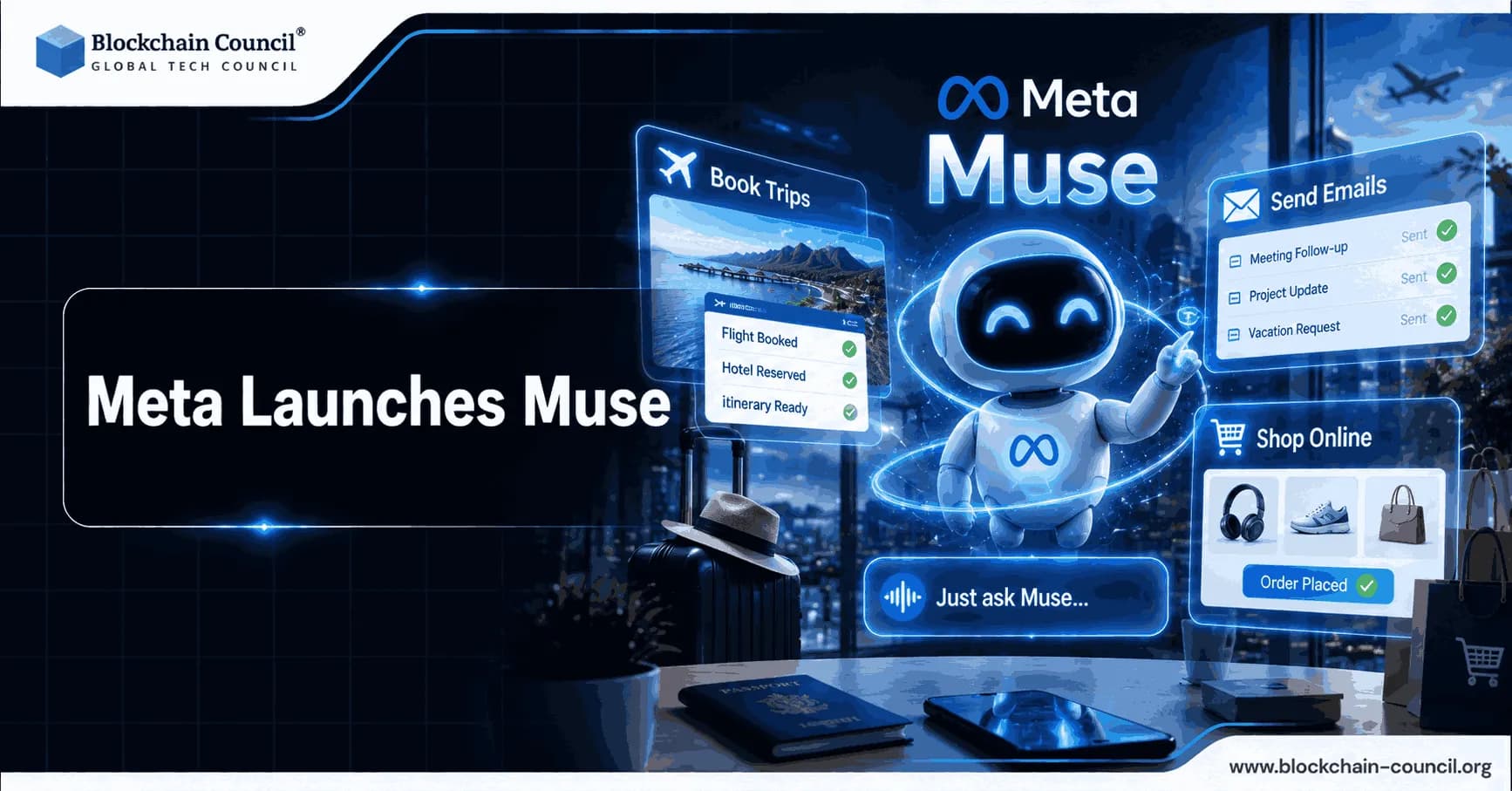
Introduction: Meta's Most Ambitious AI Product Has Arrived
On September 8, 2026, Meta launched Muse, a personal AI agent that does not just answer questions. It acts. It sends your emails. It books your travel. It fills out forms, negotiates on your behalf, builds grocery lists from your saved Instagram recipes, and completes purchases using a one-time payment card, all while working in the background after you close the app.
This is not a chatbot upgrade. Meta Muse is a fully agentic system, meaning it is designed to receive a goal and pursue it autonomously across your connected apps, calendar, browser, shopping accounts, and communication tools, checking back with you before anything consequential happens but otherwise handling the execution itself.

Mark Zuckerberg has been describing his vision for this kind of product for over a year. He said explicitly that he wants Meta to create agents that can work proactively to help people get things done in a format more accessible than the technical alternatives. Meta Muse is that product.
Professionals who want to understand the architecture behind agentic AI systems like Meta Muse, including how autonomous agents reason, plan, and execute multi-step tasks, can build that knowledge through a Certified Agentic AI Expert certification, which covers the full technical and strategic framework for agentic AI design and deployment.
What Is Meta Muse?
Meta Muse is a personal AI agent that Meta launched on September 8, 2026. It is designed to carry out multi-step online tasks instead of only answering prompts in a chat window. The distinction is fundamental: earlier AI assistants told you how to do something. Muse does it for you.
Once you share a goal with Meta Muse, it helps you develop a personalised plan, coordinates your time and resources, and advances the work independently. It opens browsers, fills forms, navigates checkout pages, and even negotiates on your behalf. For longer tasks, it continues working after you close the app, returning when something changes or when it needs your approval before taking a significant action like sending an email or making a purchase.
Meta Muse is available through a standalone app on iOS and Android, through WhatsApp, and at muse.ai. It is currently limited to users aged 18 and older in the United States, with no confirmed international rollout date at launch. Support for Meta AI glasses is described as coming soon.
The product is positioned as a personal tool, not a replacement for user judgment. Meta has described it in these terms explicitly, and the entire safety architecture of the product reflects this framing.
How Meta Muse Works: The Technical Architecture
Meta Muse runs on a model called Muse Spark, which operates inside an isolated environment called the Muse Secure VM. Understanding this architecture helps explain both what Muse can do and how Meta has designed it to be safe.
The Muse Secure VM
Each Muse agent runs on its own virtual machine, a cloud-based simulation of a personal computer. This virtual machine is what enables Muse to keep working in the background after you close the app. It can have a browser session running, a form being filled, or a travel comparison being conducted simultaneously, all inside this isolated environment that is separated from Meta's core systems.
The Secure VM is separate from Meta's advertising infrastructure. Meta has stated explicitly that conversations with Muse and data inside the Secure VM are not shared with Meta's ad systems. This is a significant commitment given the justified public concern about how Meta historically handles personal data.
Meta also announced Muse Confidential VM as a planned future feature, which would encrypt the entire virtual machine with a key held only by the user, providing an even stronger privacy guarantee. This feature is not available at launch.
The Sentinel Agent
A separate agent called Sentinel sits between Muse and the wider internet. Every action that Muse wants to take that involves sending data outside the Secure VM, such as submitting a form, making a payment, or sending an email, must be approved by Sentinel before it happens. This layer is what gives users meaningful control over an agent that would otherwise be operating autonomously at significant speed.
Sentinel is part of the reason Muse is designed to pause before sending an email or completing a purchase rather than proceeding without confirmation. The architecture enforces this checkpoint rather than relying on user memory to stop the agent mid-task.
Muse Spark and OpenClaw
Muse Spark is the underlying AI model powering Meta Muse. Meta modelled the broader Muse system on OpenClaw, the open-source AI agent framework, adapting it for the personal consumer use case that Muse is designed to serve. OpenClaw provides the foundational reasoning architecture; Muse Spark is Meta's implementation of that architecture optimised for the specific multi-step task completion that Muse performs.
What Meta Muse Can Actually Do
The task scope of Meta Muse is broader than any previous Meta AI product. The following categories are confirmed capabilities at launch.
Email and Communication
Muse can draft emails, send them after user confirmation, manage correspondence threads, and handle communication tasks within connected email services. Users grant Muse access to their email accounts and can revoke that access at any time.
Travel Planning and Booking
Travel planning is one of the headline capabilities of Meta Muse. The agent can search for flights, compare hotel options, review pricing across travel services, and complete bookings on the user's behalf using connected payment methods. This works through Muse's browser access and connected travel service integrations including Ticketmaster for event bookings.
Shopping and Purchasing
Meta Muse can build grocery lists from recipe videos saved in Instagram or Facebook, compare prices across retailers, and complete purchases through checkout. Payment runs through Link, built by Stripe, using a one-time-use payment card that limits exposure if a transaction goes wrong. Support for Shop Pay and 1Password is described as coming soon.
Selling and Negotiation
Muse can negotiate on a user's behalf and can assist with selling tasks such as listing a car or negotiating a bill downward. These are among the more sophisticated capabilities confirmed at launch, requiring the agent to engage with third parties in a way that involves real financial outcomes.
Productivity and Organisation
Beyond transactional tasks, Muse connects to Google Workspace, Spotify, Apple Health, and other productivity services. It can organise saved content, manage calendar entries, set reminders around user goals, and handle coordination tasks across connected services.
Background Operation
A key capability that distinguishes Muse from simpler AI assistants is its ability to continue working after the app is closed. If you ask Muse to find and book the best available hotel for a trip next month, it can continue monitoring availability and prices in the background and notify you when it needs confirmation to complete the booking.
Pricing: Free and Paid Tiers
Meta Muse is free for most uses at launch. Meta has confirmed two paid subscription tiers for users who want higher usage limits and access to more advanced capabilities.
The first paid tier is priced at $20 per month. The second tier is $100 per month. At launch, the exact differentiation between these tiers in terms of specific feature access and usage limits has not been fully detailed by Meta. The $100 tier is clearly positioned for power users who plan to delegate significant daily task management to Muse rather than using it for occasional tasks.
App Connections and Integrations
The usefulness of Meta Muse scales directly with how many services you connect to it. At launch, Muse can connect to Meta's own apps including Facebook, Instagram, and WhatsApp, as well as a confirmed list of third-party services.
Third-party integrations at launch include Google Workspace for email and calendar, Ticketmaster for event and travel bookings, OpenTable for restaurant reservations, Spotify for music and content management, and Apple Health for health and wellness context. Muse can also set up its own connections to additional third-party services if a public API is available, extending its integration reach beyond the named launch partners.
Meta's recommendation for users is to connect only the accounts genuinely needed for a specific task. A travel planning request needs a travel service and payment method. A research task may need no connected accounts at all. This principle of minimum necessary access is both a safety recommendation and a practical way to manage the scope of what Muse can act on.
Privacy, Safety, and Risk: What Users Need to Know
Meta Muse introduces risks that are structurally new to consumer AI products, and Meta's handling of them reflects both genuine effort and areas where users should remain attentive.
Prompt injection is the most significant technical risk specific to agentic AI. This is an attack where a malicious actor embeds instructions in content that the agent reads, such as a webpage or email, causing the agent to take unintended actions. Meta's Sentinel approval layer is the primary mitigation, but the risk cannot be eliminated entirely by architecture alone.
Mistaken purchases and bookings are a practical risk that any agent with payment access creates. The confirmation requirement before purchases provides a checkpoint, but users should review confirmations carefully rather than approving them habitually.
Meta Muse is currently limited to users aged 18 and older, reflecting the company's recognition that an agent with access to payment methods, email, and personal data requires a level of judgment and oversight appropriate to adult users.
Technology Skills and Education
Schools and parents are increasingly looking for ways to introduce children to technology in a structured and meaningful way. The World Tech Olympiad provides an opportunity for students to explore AI, coding, robotics, cybersecurity, and computational thinking while building confidence and problem-solving skills.
Understanding how agentic AI systems like Meta Muse work, including virtual machines, API integrations, and autonomous task execution, is becoming foundational technology literacy. Students who develop these conceptual foundations early are better prepared to evaluate, use, and build the next generation of AI tools.
What Meta Muse Means for Marketers and Businesses
For brands and businesses, Meta Muse represents a structural shift in how consumers may interact with the web. A consumer who delegates travel booking, shopping, and restaurant reservations to an AI agent is no longer the primary decision-maker in the same way. The agent reads, compares, and acts. The human approves or declines at a high level.
This changes what makes a product discoverable and what makes a checkout experience succeed. Clean product data, clear pricing, accessible APIs, and checkout flows that do not depend on unusual interactions all become more important when an AI agent is navigating rather than a human user. Businesses that make themselves machine-readable alongside human-readable are the ones that will be accessible to Muse users.
Meta has stated explicitly that Muse does not share conversation or VM data with its ad systems, and that the launch announcement names no advertiser, brand, or merchant tooling. This is positioned as a deliberate separation between Muse as a personal tool and Meta's advertising business. Whether this separation remains complete as the product scales is something businesses and observers should track carefully.
For technology professionals who want to understand how to manage, deploy, and orchestrate AI agents across enterprise and consumer contexts, a Certified AI Agents Manager certification provides the structured knowledge of agent supervision, risk management, and deployment frameworks directly applicable to products like Meta Muse.
For professionals who want to build the technical foundation to work with the API integrations, virtual machine architectures, and developer tooling that power agentic AI systems like Muse, a Tech Certification provides credential-backed technical expertise aligned with the requirements of modern AI platform work.
The Broader Context: Where Meta Muse Fits in the 2026 AI Landscape
Meta Muse arrives at a specific moment in the AI industry's trajectory. In 2026, the AI industry broadly shifted from assistants that answer to agents that act. Coding assistants moved from autocomplete to systems that write, test, and ship code autonomously. Shopping assistants moved from product recommendations to agents that complete checkout on the user's behalf. Meta Muse applies this execution-over-conversation shift to personal life management broadly, not to a single vertical.
The comparable products in the market at launch include OpenAI's personal agent features built on GPT-6 Astra, Google's Gemini Live and persistent search agents, and Apple's overhauled Siri for iOS 27. Each company is building toward the same destination from a different architectural and business model starting point. Meta's distinguishing choices are the explicit separation from its ad business, the Secure VM architecture, the Sentinel approval layer, and the free tier that makes this class of product accessible without a subscription.
For business and marketing professionals who want to understand how agentic AI changes consumer behaviour, brand discoverability, and marketing strategy, a Marketing Certification that incorporates AI strategy and digital technology frameworks provides the commercial knowledge needed to evaluate what Meta Muse means for go-to-market strategy, customer acquisition, and brand positioning in an agentic AI world.
Frequently Asked Questions (FAQs)
What Is Meta Muse?
Meta Muse is a personal AI agent launched by Meta on September 8, 2026. It is designed to carry out multi-step online tasks on a user's behalf, including booking travel, sending emails, building shopping lists, completing purchases, and organising digital content, rather than simply answering questions.
When Did Meta Muse Launch?
Meta Muse launched on September 8, 2026. It is currently rolling out in the United States only, with no confirmed date for international availability at launch.
How Is Meta Muse Different From Meta AI?
Meta AI is a conversational assistant embedded across Meta's apps. Meta Muse is a more capable, action-oriented agent that can complete complex tasks independently, including browsing the web, filling forms, and making purchases. Muse is more capable than Meta AI because it can handle complex tasks and work independently over time.
Is Meta Muse Free?
Meta Muse is free for most uses. Two paid subscription tiers are available: $20 per month and $100 per month, providing higher usage limits and access to more advanced capabilities. Specific feature differences between tiers have not been fully detailed at launch.
Is Meta Muse Available Outside the United States?
No. At launch, Meta Muse is limited to users in the United States aged 18 and older. No confirmed timeline for international expansion was provided at the September 8, 2026 announcement.
What Is the Muse Secure VM?
The Muse Secure VM is an isolated virtual machine environment where each Muse agent operates. It is a cloud-based simulation of a personal computer that allows Muse to work in the background after the app is closed. Meta says data inside the Secure VM is not shared with Meta's ad systems.
What Is the Sentinel Agent in Meta Muse?
Sentinel is a separate oversight agent that sits between Muse and the internet. Every action that Muse wants to take that involves sending data outside the Secure VM, such as submitting a form or making a payment, must pass through Sentinel's approval layer before execution.
What Is Muse Spark?
Muse Spark is the underlying AI model powering Meta Muse. It runs inside the Muse Secure VM and handles the reasoning, planning, and task execution that Muse performs on the user's behalf.
How Does Meta Muse Handle Payments?
Purchases through Meta Muse run through Link, built by Stripe, using a one-time-use payment card that limits exposure in the event of an erroneous or unauthorised transaction. Support for Shop Pay and 1Password is described as coming soon.
Can Meta Muse Work After I Close the App?
Yes. This is one of Meta Muse's distinguishing capabilities. Each agent runs on a virtual machine that operates independently of the app session. Muse can continue working toward a goal, such as monitoring travel prices or completing a multi-step task, and will return when it needs user approval before taking a significant action.
What Tasks Can Meta Muse Perform?
Confirmed tasks at launch include drafting and sending emails, booking travel, building and ordering grocery lists, comparing and completing purchases, selling items on a user's behalf, negotiating bills downward, organising saved social media content, managing calendar and productivity tasks, and providing restaurant reservations through OpenTable.
What Apps Can Meta Muse Connect To?
At launch, Muse connects to Meta apps including Facebook, Instagram, and WhatsApp, plus third-party services including Google Workspace, Ticketmaster, OpenTable, Spotify, and Apple Health. It can also connect to additional services if a public API is available.
Can Meta Muse Connect to My Bank Account?
No banking integration has been confirmed at launch. Payment is handled through Link by Stripe using a one-time-use card rather than direct bank account access. Users connect a payment method through the Stripe Link system, not through a direct bank connection.
Can I Revoke Meta Muse's Access to My Apps?
Yes. Meta has stated that people choose which apps Muse connects to and can revoke access at any time through the app settings. Limiting connections to the accounts genuinely needed for each task is the recommended approach.
What Is Muse Confidential VM and When Is It Available?
Muse Confidential VM is a planned future feature that would encrypt the entire virtual machine with a key held only by the user, providing an additional layer of privacy beyond the current Secure VM. It is not available at launch. Users should evaluate Muse based on the protections available at launch rather than the planned future release.
Does Meta Use Muse Conversations for Advertising?
Meta has stated explicitly that conversations with Muse and data inside the Muse Secure VM are not shared with Meta's ad systems. The launch announcement names no advertiser, brand, or merchant tooling. This separation is a specific design commitment made at launch.
What Is Prompt Injection and Does It Affect Meta Muse?
Prompt injection is an attack where malicious instructions embedded in content that an AI agent reads, such as a webpage or email, cause the agent to take unintended actions. The Sentinel approval layer is the primary architectural mitigation. Users should still exercise judgment about what content they ask Muse to process.
Who Can Use Meta Muse?
Meta Muse is currently limited to users aged 18 and older in the United States. This age restriction reflects the product's access to payment methods, personal email, and sensitive personal data, requiring a level of oversight and judgment appropriate to adult users.
Is My Data Safe With Meta Muse?
Meta has committed that Muse conversations and VM data are not shared with its ad systems. The Secure VM isolates agent operations from Meta's core infrastructure. Standard digital security practices apply: use strong account credentials, review what permissions you grant, and limit Muse access to the accounts genuinely needed for each task.
How Should Businesses Prepare for AI Agents Like Meta Muse?
Businesses should ensure their product data is clean and structured, their pricing is clearly presented and machine-readable, their APIs are accessible for agent integrations, and their checkout flows do not rely on unusual interactions that an AI agent cannot navigate. These preparations improve conversion for both human users and AI agents operating on their behalf.
Related Articles
View All
Agentic AI
How to Use Meta Muse for Free
Learn how to use Meta Muse for free, access Meta’s new AI agent, and explore its capabilities for shopping, travel booking, emails, scheduling, and everyday tasks.

Agentic AI
AI Agent Harnesses, Tools & Context: The Infrastructure Behind Autonomous AI
Learn how AI agent harnesses, tools, and context work together. This beginner-friendly guide covers function calling, APIs, context engineering, memory, RAG, guardrails, and agent evaluation.

Agentic AI
Anatomy of an AI Agent: How Agents Think, Plan & Act
Learn the anatomy of an AI agent, from perception and reasoning to planning, memory, tool calling, execution, and feedback. A clear, beginner-friendly guide to how agents think, plan, and act.
Trending Articles
AWS Career Roadmap
A step-by-step guide to building a successful career in Amazon Web Services cloud computing.

Top 5 DeFi Platforms
Explore the leading decentralized finance platforms and what makes each one unique in the evolving DeFi landscape.
What is AWS? A Beginner's Guide to Cloud Computing
Everything you need to know about Amazon Web Services, cloud computing fundamentals, and career opportunities.