

AI Agent Platforms Explained: Architecture, Tooling, and Deployment Best Practices for Enterprise Automation

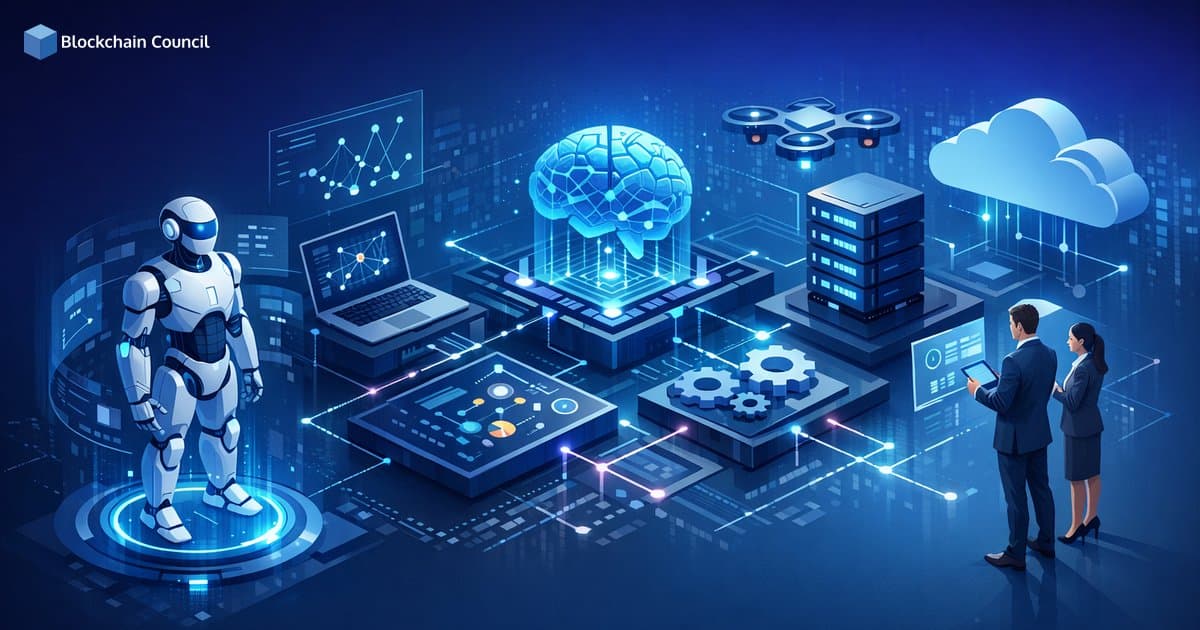
AI agent platforms are becoming a foundational layer for enterprise automation. They sit between large language models (LLMs) and the systems where work happens, such as ERP, CRM, IAM, data warehouses, ticketing tools, and collaboration apps. Instead of stopping at chat-based assistance, these platforms help organizations build agents that can plan multi-step workflows, call tools, update state, and execute actions with governance and observability.
Guidance from IBM on agentic architecture, Microsoft's orchestration patterns, and enterprise best practices from vendors focused on monitoring and safety converge on a consistent point: the value of agentic AI depends less on the LLM itself and more on the architecture that constrains, coordinates, and evaluates agent behavior in real business environments.

What Is an AI Agent Platform in an Enterprise Context?
An enterprise-grade AI agent platform typically provides:
- Agent runtime to run one or more agents that can perceive, reason, and act
- Orchestration to coordinate multi-step workflows and multi-agent collaboration
- Tooling and integrations to safely connect agents to APIs, databases, and SaaS applications
- Memory and knowledge layers for context retention and grounded responses (often via RAG)
- Governance and safety controls such as access policies, guardrails, and approvals
- Observability and evaluation through logs, traces, metrics, and test harnesses
IBM's framing of agentic architecture highlights four properties that enterprises need in production: intentionality (planning), forethought (anticipating outcomes), self-reactiveness (adapting to feedback), and self-reflectiveness (evaluating and correcting behavior). In practical platform design, these map to planning routines, monitoring loops, error recovery, and evaluation pipelines.
Core Architecture of AI Agent Platforms for Enterprise Automation
While implementations vary across cloud services and open source frameworks, most enterprise platforms converge on a layered architecture.
1) Interface Layer
This is where users and systems invoke the agent:
- Chat and collaboration: Slack, Microsoft Teams
- Web apps and portals
- Email and messaging
- APIs for application-to-agent calls
- Process tooling: ITSM, BPM, and RPA triggers
2) Agent Layer
The agent layer defines the roles and responsibilities of each agent, including:
- System policy and constraints (what the agent can and cannot do)
- Tool access (which functions, APIs, and datasets are permitted)
- State configuration (session context, working memory, long-term memory)
- Objectives aligned to a workflow outcome, not just a conversation goal
Common patterns include reactive agents for simple tasks, deliberative agents with planning and task decomposition, BDI-inspired designs (beliefs, desires, intentions), and hierarchical manager-worker structures used in multi-agent systems.
3) Orchestration Layer
Orchestration is the difference between a prompt loop and a production workflow. Microsoft's AI agent orchestration patterns describe several common approaches:
- Sequential: step-by-step chains (classify, retrieve, decide, act)
- Concurrent: parallel agents or tool calls for lower latency and broader coverage
- Group chat: multiple agents collaborate within shared context
- Handoff: routing work to specialized agents or escalating to a human
Modern frameworks frequently model orchestration as an explicit graph. This improves debuggability, simplifies reviews for risk and compliance teams, and supports deterministic nodes alongside LLM-based nodes.
4) Tooling and Environment Layer
Tools are how agents interact with the enterprise environment. Typical connectors include:
- Business systems: ERP, CRM, HRIS, procurement, finance, order management
- IT systems: ServiceNow, Jira, monitoring and logging platforms
- Data sources: warehouses, lakehouses, vector databases, document stores
- External services: scheduling, communications, payments (often tightly constrained)
- Legacy UI automation: RPA bots for systems without stable APIs
For enterprise automation, tool execution should be sandboxed and validated. The platform should assume that model output can be wrong or unsafe, then enforce policy through code and controls rather than relying on the model alone.
5) Memory and Knowledge Layer
Enterprise agents often need both short-term context and long-term continuity:
- Short-term memory: session context, intermediate results, task state
- Long-term memory: user preferences, case history, project state, embeddings, and audit logs
- RAG pipelines: retrieval over curated knowledge bases to keep outputs grounded
6) Governance, Safety, and Observability Layer
This layer is central for production readiness:
- IAM integration: SSO, RBAC, and permission mapping into allowed actions
- Policy enforcement: tool-level allowlists, scope limits, spend thresholds
- Telemetry: logs, traces, and metrics for model and tool performance
- Evaluation: offline test suites, online monitoring, and regression testing
7) Infrastructure and Deployment Layer
Enterprise deployments must address scaling, reliability, and compliance:
- High availability and cost controls
- Model hosting choices: SaaS APIs, private cloud, or on-premises for sensitive data
- Data residency and regulatory requirements
- Secrets management and secure networking
Tooling in AI Agent Platforms: How Agents Perceive, Reason, and Act
In enterprise automation, tools typically fall into four categories:
- Data access tools: vector retrieval, SQL queries, document loaders, knowledge base search
- Application and workflow tools: CRUD actions in CRM or ERP, ticket creation, approvals, messaging
- Compute and analysis tools: Python execution, analytics queries, ML model calls
- Control and monitoring tools: audit logging, PII detection, DLP checks, evaluation scoring
There are also distinct patterns for tool calling:
- LLM-native function calling, where the model selects tools using a structured schema
- Orchestrator-controlled calls, where the workflow routes requests and validates model intent
- Deterministic subroutines, where critical steps such as validation, transformations, and policy checks run as code rather than prompts
A common design pattern for enterprise reliability is to keep decision-making flexible while keeping execution strict. The model can propose an action, but deterministic validators then check permissions, inputs, thresholds, and required approvals before any write operation is allowed.
Deployment Best Practices for Enterprise AI Agent Platforms
As enterprises move from copilots toward agents that act autonomously, production constraints around safety, reliability, and governance become more critical. The following practices appear consistently across enterprise reference architectures and platform guidance.
1) Start with Well-Scoped Workflows and Measurable SLAs
Select processes with clear inputs, defined outcomes, and measurable metrics:
- Ticket triage and routing
- Invoice matching and exception handling
- Lead enrichment and assignment
- Report generation and reconciliation support
Avoid open-ended agents that can access many systems without strict boundaries in early production deployments.
2) Prefer Explicit Orchestration over Monolithic Prompts
Model your agent workflow as a graph with nodes for retrieval, planning, tool calls, validation, and escalation. Explicit orchestration improves:
- Debugging and root-cause analysis
- Change control and approvals
- Observability and performance tuning
- Compliance reviews and auditability
3) Separate Policy, Tools, and Prompts
Do not rely on prompts alone for business rules. Keep:
- Policies in configuration and code (permissions, thresholds, approvals)
- Tools as validated modules with strong contracts
- Prompts focused on reasoning and instruction, versioned like code
4) Engineer for Failure: Retries, Fallbacks, and Safe Degradation
Production systems should assume tools fail and outputs drift over time:
- Retries with exponential backoff
- Fallback models for lower-risk subtasks
- Branching logic when retrieval is weak or confidence is low
- Escalation paths to humans for high-impact actions
5) Security and Compliance: Treat Agents as Untrusted by Default
Because agents can trigger real actions, the security posture must be stricter than for chatbots:
- Least privilege per agent and per tool
- Enterprise IAM and SSO integration with permission mapping
- Data governance including residency, retention, and encryption
- Guardrails for PII, sensitive data, and policy violations
- High-risk action controls such as dual approval and transaction caps
Safety-focused guidance consistently recommends validating every external action, implementing kill switches, and restricting write access until agents have demonstrated reliability under controlled testing.
6) Observability and Evaluation as First-Class Requirements
Moving from prototype to enterprise automation requires comprehensive instrumentation:
- Logs and traces for prompts, tool calls, responses, and outcomes
- Metrics for completion rate, error types, latency, and cost per workflow
- Evaluation using curated test sets, regression suites, and shadow mode
- Outcome-based KPIs such as ticket resolution accuracy or reconciliation correctness, not just response quality
7) Human-in-the-Loop Design for Controlled Autonomy
Many enterprises use a staged autonomy model:
- Read-only: summarize, recommend, draft
- Assisted actions: execute with approval
- Constrained autonomy: execute within strict limits under continuous monitoring
Design review queues and interfaces for approval, editing, and override, and ensure all decisions are auditable.
Real-World Enterprise Use Cases for AI Agent Platforms
- IT operations: ticket triage, incident investigation, runbook preparation, post-incident reporting
- Customer support: account lookups, safe record updates, ticket creation, escalation routing
- Finance and back office: invoice extraction, PO matching, exception workflows, reconciliation support
- Sales and CRM: lead enrichment, routing, compliant outreach drafting and scheduling
- Data and analytics: query generation and execution, dashboard creation, scheduled reporting
These domains are well suited to agent platforms because they are process-rich, measurable, and policy-constrained, which makes them compatible with explicit orchestration and governance controls.
Future Direction: From Copilots to Constrained Autonomy at Scale
Three trends are shaping the next phase of AI agent platforms:
- Greater autonomy in bounded domains, where policies, budgets, and approvals are explicitly defined
- Standardization of tool interfaces using schemas and reusable patterns for state, memory, and evaluation
- Integration with automation stacks such as BPM, RPA, and DevOps, giving rise to an emerging discipline of AI agent operations
Multi-agent ecosystems are expanding as well, with specialized agents coordinating like a distributed team. For enterprises, this raises the bar for auditability, coordination controls, and system-level evaluation.
Conclusion: How to Evaluate AI Agent Platforms for Enterprise Automation
The most important question is not whether a model can produce impressive output, but whether the AI agent platform can reliably execute real workflows under enterprise constraints. Prioritize explicit orchestration, strict tool boundaries, strong IAM integration, continuous evaluation, and comprehensive observability. Start with measurable, well-scoped workflows, add human-in-the-loop approvals for higher-risk actions, and expand autonomy only when reliability has been demonstrated in production.
For teams building capability in this space, internal training paths that map to platform engineering, security, and applied AI skills provide a structured foundation. Relevant certifications from Blockchain Council include the Certified Artificial Intelligence (AI) Expert, Certified Prompt Engineer, Certified Machine Learning Expert, and role-aligned tracks in Cybersecurity and Blockchain for governance and audit readiness in automated systems.
Related Articles
View All
Agentic AI
AI Agent Security Best Practices for Enterprise Environments
Learn AI agent security best practices for enterprise environments, including identity, least privilege, monitoring, red teaming, and governance.

Agentic AI
AI Agent Governance Best Practices for Safe and Scalable Adoption
Learn AI agent governance best practices for safe enterprise adoption, including access control, data governance, monitoring, human oversight, and shutdown plans.

Agentic AI
Managing Multi-Agent AI Systems: Best Practices for Enterprise Leaders
Best practices for managing multi-agent AI systems in enterprises, covering architecture, governance, security, oversight, metrics, and team design.
Trending Articles
AWS Career Roadmap
A step-by-step guide to building a successful career in Amazon Web Services cloud computing.
How Blockchain Secures AI Data
Understand how blockchain technology is being applied to protect the integrity and security of AI training data.

Can DeFi 2.0 Bridge the Gap Between Traditional and Decentralized Finance?
The next generation of DeFi protocols aims to connect traditional banking with decentralized finance ecosystems.