

How to Build and Lead a High-Performing AI Agent Team
 Suyash Raizada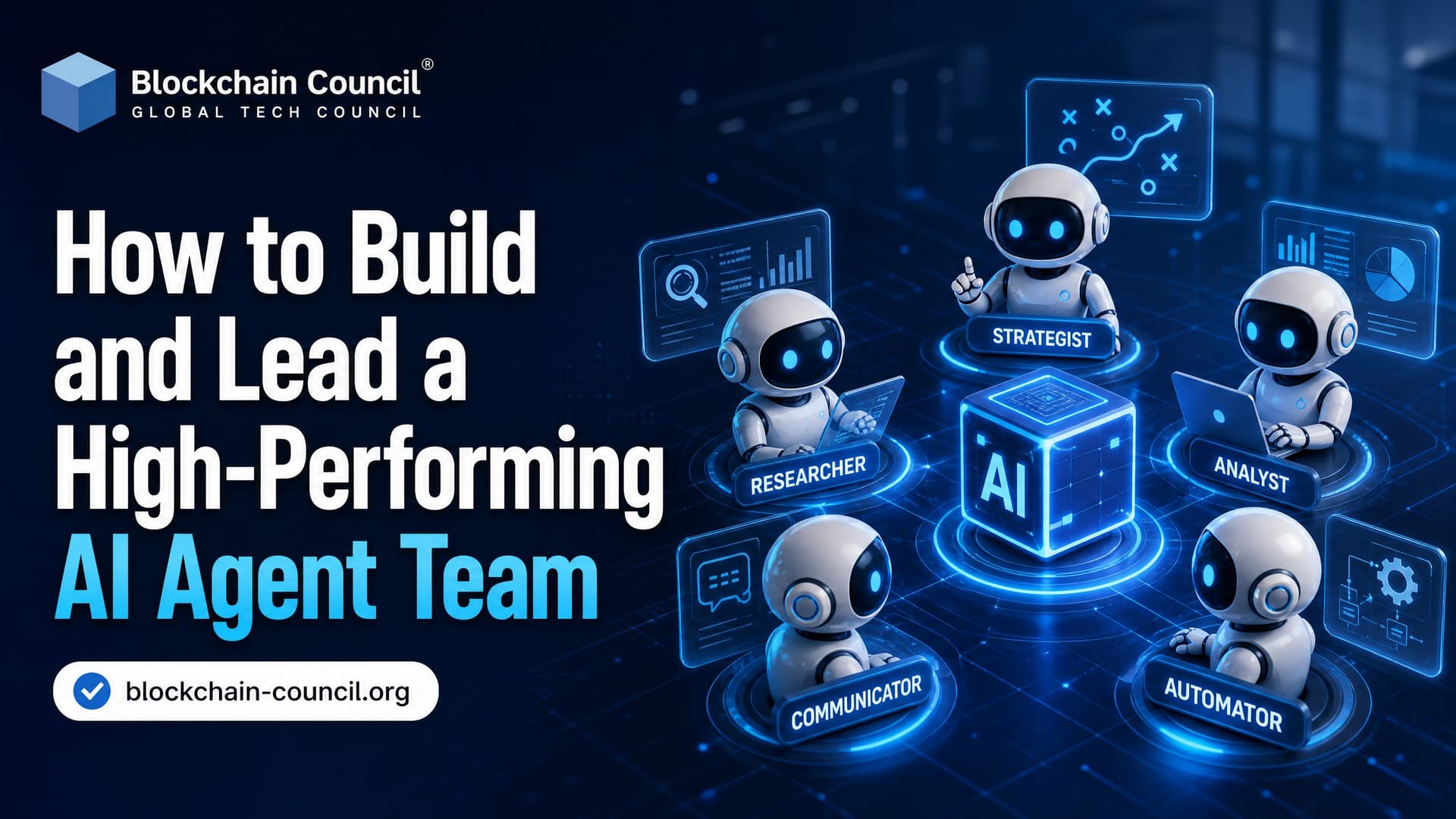
An AI agent team works best when you design it like an operating system, not like a chatbot. A high-performing AI agent team needs narrow tasks, clear tools, measurable outcomes, and human supervision where mistakes carry real cost. The model matters, but the system around the model matters more.
OpenAI describes modern agents as systems with three core parts: a model for reasoning, tools for action, and instructions that define behavior. That structure is useful. It also explains why many early agent projects fail. Teams spend weeks testing bigger models, then forget to define who can call the refund API, what happens after three failed retries, or which knowledge base is the authoritative one.

As organizations scale AI initiatives across engineering, operations, and business teams, professionals with a Certified Scrum Master Expert™ background can help coordinate iterative delivery, improve cross-functional collaboration, and establish governance practices that keep agent development aligned with business goals.
What Is an AI Agent Team?
An AI agent team is a coordinated group of LLM-powered agents, where each agent handles a specific part of a workflow. One agent may plan. Another may retrieve data. Another drafts a response, and a final one reviews the output before a human sees it.
This is different from giving one general assistant a long prompt and hoping it handles everything. That approach can work for simple tasks. It breaks down fast when the workflow has dependencies, risk, or many data sources.
In practice, agent teams often resemble small product teams:
Planner agent: breaks the goal into steps and routes work.
Research agent: searches approved documents, databases, or websites.
Execution agent: writes code, drafts emails, updates tickets, or calls APIs.
Review agent: checks quality, policy compliance, and missing context.
Escalation agent: flags cases that need human approval.
Enterprise adoption keeps moving in this direction, especially for customer service, risk workflows, reporting, and operations. The pattern is clear: one broad assistant becomes a set of smaller, more accountable agents.
Start With Tasks, Not Job Titles
Here is the blunt rule: do not build a Customer Success Agent or a Marketing Agent first. Build a ticket classification agent, a refund eligibility agent, a reply drafting agent, or an SEO brief agent.
Human job titles carry messy responsibilities. Tasks are easier to test. If the refund eligibility agent makes a poor decision, you know where to look. If your all-purpose support agent fails, you may spend hours guessing whether the issue came from retrieval, policy interpretation, tone, or tool use.
A better decomposition pattern
For a content workflow, avoid one Content Development Agent. Use this structure instead:
Research agent: gathers facts from approved sources.
Outline agent: builds structure and search intent coverage.
Drafting agent: writes the first version.
Editing agent: checks clarity, accuracy, and brand tone.
SEO agent: reviews headings, keyphrase placement, metadata, and internal link opportunities.
That may sound like extra work. It is not. It gives you clean failure points and better logs. It also lets you use cheaper, faster models for simple steps and stronger reasoning models only where they are needed.
Building reliable multi-agent workflows requires more than selecting capable models. Many developers, architects, and technology leaders strengthen their understanding of orchestration, autonomous workflows, and governance through a Certified Agentic AI Expert™ program before deploying production-grade AI agent teams.
Choose the Right Architecture
A strong AI agent team usually needs four architectural layers.
1. Model layer
Pick models by task. A fast, lower-cost model may be enough for classification. A reasoning-heavy model is better for planning, policy decisions, or complex code review.
Temperature settings matter more than many teams expect. For classification and compliance checks, use low temperature values such as 0 or 0.2. For brainstorming, 0.7 may be acceptable. If your review agent gives different answers every run, check this setting before blaming the model.
2. Tool layer
Tools are how agents act. They may call a CRM API, query a vector database, create a Jira ticket, run a test suite, or send a Slack notification.
Use strict schemas. If a tool expects an integer and the model sends a string, you will see failures like pydantic_core._pydantic_core.ValidationError in Python agent stacks that use Pydantic. I have seen teams waste time rewriting prompts when the real fix was a clearer input schema and a validation retry step.
3. Context layer
Context is not the same as dumping your whole company knowledge base into a prompt. Give agents only what they need. OpenAI's agent guidance stresses clear instructions and relevant tools, and this applies directly to context.
Use approved sources, retrieval filters, freshness rules, and document ownership. A support agent should not cite a three-year-old pricing PDF if the billing team updated the policy last week.
4. Orchestration layer
Orchestration decides which agent runs next. Simple workflows can use fixed steps. Complex workflows may need a planner agent that selects routes based on the case.
Common patterns include:
Sequential pipeline: planner to executor to reviewer.
Router pattern: one agent classifies the request and sends it to the right specialist.
Manager pattern: a supervisor agent delegates tasks and checks completion.
Human approval gate: agent pauses before a high-risk action.
Define Governance Before Scale
Governance is not paperwork. It is how you keep agents from doing expensive or unsafe things.
Write a playbook before production. It should define:
What data each agent can access.
Which tools each agent can call.
Which actions require human approval.
Retry limits and failure thresholds.
Logging requirements for audit trails.
Escalation paths for sensitive or uncertain cases.
OpenAI recommends human intervention for high-risk actions such as payment authorization, large refunds, and order cancellations. That is sensible. Let the agent prepare the case, gather evidence, and recommend an action. Keep the final approval with a human until the system has earned trust through measured performance.
Use Culture as Code
High-performing human teams have norms. Agent teams need them too.
A practical setup includes three files in your repository or workspace:
README: explains the mission, users, success criteria, and constraints.
AGENTS.md: lists every agent, its responsibilities, tools, inputs, outputs, and escalation rules.
SCORECARD.md: defines how each agent is evaluated.
This sounds simple because it is. It works because agents perform better when instructions are consistent and easy to retrieve. In software projects, a predictable repository skeleton also helps agents understand where source files, tests, documentation, and configuration live.
For example, a development agent team might follow this sequence: Planner, Coder, UX Polisher, Optimizer, Reviewer. The reviewer should not merely say good job. It should run tests, check acceptance criteria, inspect security concerns, and return structured feedback.
Measure What High Performance Means
You cannot lead an AI agent team with vibes. Define metrics early.
Useful metrics include:
Accuracy: percentage of correct classifications, answers, or decisions.
Resolution rate: percentage of tasks completed without human rework.
Escalation rate: how often agents ask humans for help.
Latency: time from request to completed workflow.
Tool failure rate: failed API calls, schema errors, authentication failures.
User satisfaction: feedback from employees or customers using the system.
Cost per task: model, retrieval, infrastructure, and human review cost.
Do not optimize only for automation rate. A low escalation rate can be dangerous if the agent is confidently wrong. In regulated financial, healthcare, or cybersecurity workflows, a healthy escalation rate is a feature, not a bug.
Train Humans to Work With Agents
Agent leadership is partly people leadership. Employees need to know when to trust an agent, when to challenge it, and how to give feedback that improves the system.
Set clear working rules:
Use agents for repetitive research, drafting, classification, and first-pass analysis.
Require human review for irreversible, sensitive, or legally material actions.
Ask staff to report bad outputs with the original input, expected answer, and business impact.
Hold weekly retrospectives on failures, not only wins.
This is where professional training helps. Blockchain Council's Certified Agentic AI Expert™ can be a strong fit for leaders and builders designing multi-agent workflows. Teams working heavily with prompts and evaluation may also consider the Certified Prompt Engineer™ program. For broader AI strategy, Certified AI Expert™ is a useful path for readers building foundational knowledge.
A Practical Build Plan
If you are starting this quarter, use this sequence:
Pick one workflow: choose a task with clear inputs, outputs, and business value.
Map the task: break it into agent-sized steps.
Define tools: list approved APIs, databases, documents, and actions.
Write AGENTS.md: document responsibilities and boundaries.
Create test cases: include normal cases, edge cases, and known bad examples.
Run a pilot: keep humans in review mode.
Measure results: track quality, speed, cost, escalation, and user feedback.
Expand only after proof: add agents once the first one performs reliably.
Where AI Agent Teams Are Heading
Agent teams will become narrower, more specialized, and more governed. No-code and low-code platforms will make simple operational agents easier to deploy. Technical teams will still own the hard parts: model selection, tool security, observability, evaluation, and compliance.
The winning teams will not be the ones with the most agents. They will be the ones with the clearest task design, the best feedback loops, and the discipline to stop an agent from acting when confidence is low.
Your next step: choose one workflow where errors are visible but not catastrophic. Build one focused agent, write its scorecard, test it against real cases, and then decide whether it deserves a place on your AI agent team.
As AI agent teams increasingly support customer engagement, sales enablement, and digital business operations alongside technical workflows, professionals who complement their AI expertise with a Marketing Certification are better positioned to connect intelligent automation with stronger customer experiences and measurable business growth.
FAQs
1. What is an AI agent team?
An AI agent team is a group of specialized AI agents that work together to complete tasks, automate workflows, and solve complex business problems. Each agent has a specific role, such as research, planning, coding, data analysis, or customer support, while collaborating to achieve shared objectives.
2. Why should businesses build an AI agent team?
Building an AI agent team helps organizations automate repetitive work, improve operational efficiency, reduce manual effort, enhance decision-making, and scale business processes without significantly increasing workforce demands.
3. What roles should an AI agent team include?
A high-performing AI agent team may include a planner agent, research agent, data analyst agent, customer support agent, coding agent, content generation agent, quality assurance agent, and an orchestration agent that coordinates tasks among all agents.
4. How do AI agents collaborate within a team?
AI agents collaborate by sharing information, dividing responsibilities, exchanging task updates, and coordinating workflows through an orchestration system. This allows each agent to focus on its area of expertise while contributing to a common goal.
5. What are the benefits of a multi-agent AI team?
A multi-agent AI team improves task specialization, workflow efficiency, scalability, faster problem-solving, better resource utilization, and higher-quality outcomes compared to relying on a single AI agent for every task.
6. How do you build an effective AI agent team?
Start by identifying business goals, defining clear agent responsibilities, selecting appropriate AI models, designing communication workflows, integrating business tools, implementing governance policies, and continuously monitoring team performance.
7. What is the role of an AI orchestrator in an AI agent team?
The AI orchestrator acts as the team coordinator by assigning tasks, managing communication, resolving conflicts, tracking progress, and ensuring each AI agent contributes effectively toward completing business objectives.
8. How can businesses assign tasks to AI agents efficiently?
Organizations should assign tasks based on each agent's specialization. For example, one agent can conduct research, another can generate content, another can analyze data, while another reviews outputs for accuracy before delivery.
9. Which industries benefit most from AI agent teams?
Industries such as healthcare, finance, retail, education, manufacturing, logistics, legal services, marketing, software development, and customer service benefit from AI agent teams that automate workflows and improve operational efficiency.
10. How do AI agent teams improve customer support?
AI agent teams can divide responsibilities by handling customer inquiries, retrieving knowledge, analyzing customer sentiment, escalating complex issues, summarizing conversations, and assisting human agents in real time.
11. What leadership strategies help manage AI agent teams?
Effective leadership involves defining measurable objectives, establishing governance policies, monitoring performance, maintaining human oversight, encouraging continuous improvement, and ensuring AI systems align with business priorities.
12. How can businesses measure AI agent team performance?
Performance can be measured using key performance indicators (KPIs) such as response accuracy, task completion rates, workflow efficiency, customer satisfaction, automation levels, operational cost savings, and overall productivity improvements.
13. What challenges do organizations face when managing AI agent teams?
Common challenges include coordinating multiple agents, maintaining consistent communication, managing security, preventing duplicated work, ensuring regulatory compliance, handling errors, and continuously optimizing system performance.
14. How important is governance for AI agent teams?
Governance is essential because it establishes policies for responsible AI use, defines accountability, protects sensitive data, ensures regulatory compliance, and provides oversight for AI-generated decisions across the organization.
15. Can AI agent teams work alongside human employees?
Yes. AI agent teams are designed to augment human expertise rather than replace it. They automate repetitive tasks while employees focus on strategic planning, relationship management, creative work, and complex decision-making.
16. What tools help manage AI agent teams?
Organizations often use AI orchestration platforms, workflow automation software, APIs, analytics dashboards, project management tools, monitoring systems, security solutions, and governance platforms to coordinate AI agent operations.
17. How can businesses scale AI agent teams successfully?
Businesses can scale AI agent teams by standardizing workflows, documenting processes, implementing centralized governance, monitoring performance, optimizing communication between agents, and expanding automation gradually based on business needs.
18. What skills do leaders need to manage AI agent teams?
Leaders should understand AI strategy, workflow automation, governance, data security, change management, performance measurement, business operations, and collaboration between AI systems and human teams.
19. What are the best practices for building a high-performing AI agent team?
Best practices include defining clear objectives, assigning specialized roles, implementing strong governance, enabling secure communication, continuously testing performance, monitoring business outcomes, maintaining human oversight, and regularly updating AI workflows.
20. Why are AI agent teams important for the future of enterprise AI?
AI agent teams represent the next stage of enterprise automation by combining multiple specialized AI systems into coordinated workflows. This approach improves scalability, operational efficiency, decision-making, and business agility, enabling organizations to handle increasingly complex tasks while maintaining control, security, and long-term performance.
Related Articles
View All
Agentic AI
AI Agent MLOps Playbook: How to Build, Deploy, Monitor, and Govern Autonomous Agents at Scale
A practical AI Agent MLOps playbook to design, deploy, monitor, and govern autonomous agents with secure tooling, observability, CI/CD, and policy controls.

Agentic AI
AI Agent Orchestration Guide: Coordinating Tools, Tasks, and Multi-Agent Systems
A practical guide to AI agent orchestration, covering tools, task routing, shared state, governance, platforms, and multi-agent system patterns.

Agentic AI
AI Agent Workflow Automation: How Managers Can Streamline Business Processes
Learn how AI agent workflow automation helps managers reduce manual work, speed up approvals, improve governance, and scale business processes.
Trending Articles
AWS Career Roadmap
A step-by-step guide to building a successful career in Amazon Web Services cloud computing.

Top 5 DeFi Platforms
Explore the leading decentralized finance platforms and what makes each one unique in the evolving DeFi landscape.
Claude AI Tools for Productivity
Discover Claude AI tools for productivity to streamline tasks, manage workflows, and improve efficiency.