

How AI Agents in NFT Creation Are Changing Curation and Marketplace Discovery
 Suyash Raizada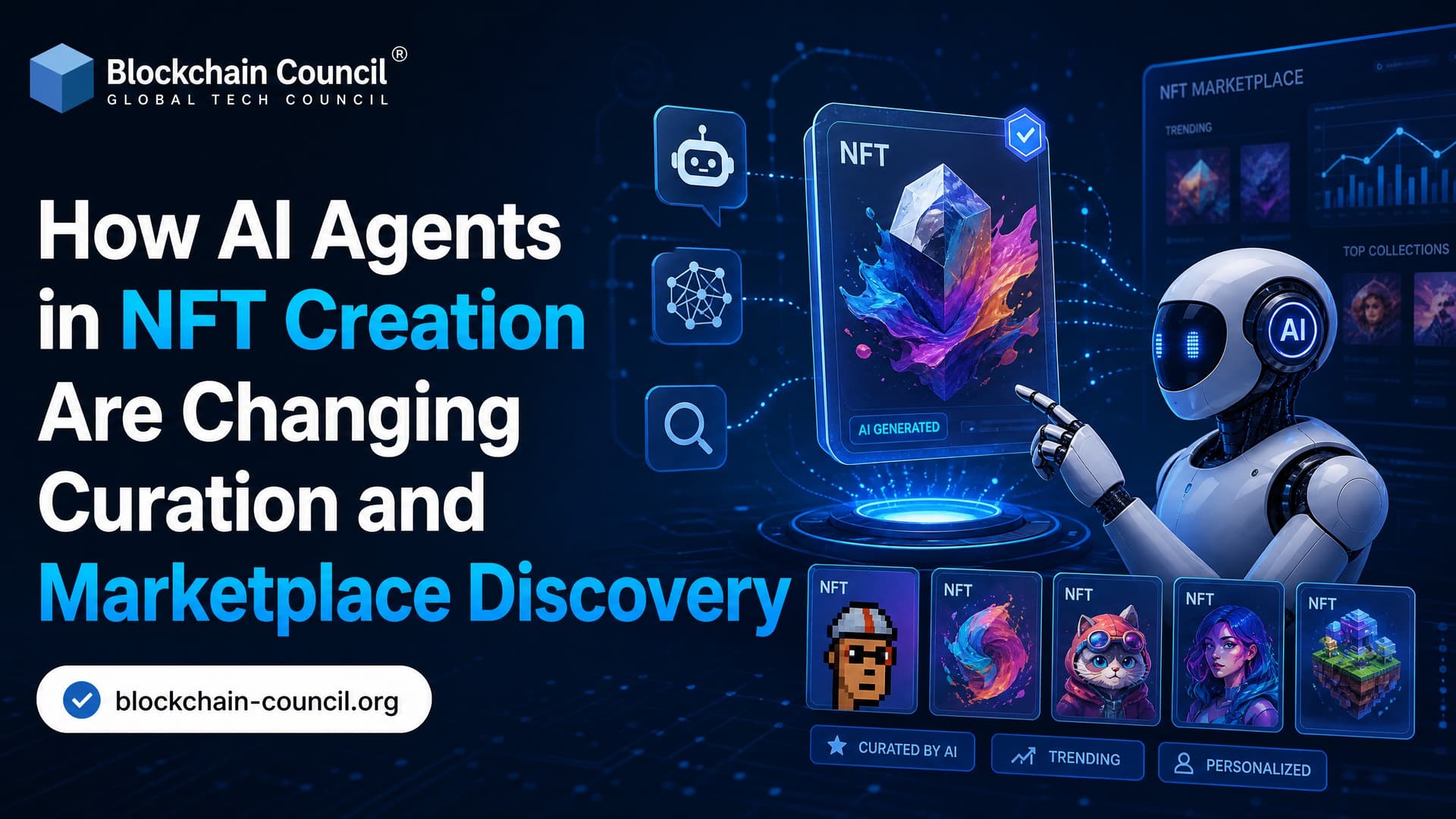
AI agents in NFT creation are no longer just prompt helpers sitting outside the marketplace. They can generate assets, prepare metadata, call smart contracts, rank collections, flag fraud, and in early experiments, trade NFTs with other agents. That changes the NFT stack from a human-driven mint-and-list workflow into a semi-autonomous system where agents act as creators, curators, and market participants.
The shift matters because NFTs are becoming more than static JPEGs. They can represent AI characters, agent identities, credentials, model ownership, and rights to interact with software. If you build marketplaces, manage digital assets, or study Web3 architecture, this is one of the areas where AI and blockchain are starting to meet in production, not just in pitch decks. Artificial intelligence is transforming how NFTs are created, curated, and discovered across decentralized marketplaces. Pursuing a Tech Certification helps professionals build expertise in AI, blockchain, smart contracts, cloud computing, and Web3 technologies. These industry-recognized certifications prepare creators, developers, and entrepreneurs to leverage intelligent automation for NFT generation, metadata optimization, recommendation systems, and marketplace innovation while staying ahead in the rapidly evolving digital asset ecosystem.

What Are AI Agents in the NFT Lifecycle?
An AI agent is a goal-directed system that can plan, use tools, remember context, and act with some degree of autonomy. In Web3, the serious version of this idea goes further: an agent may hold or control a wallet, sign transactions through approved policies, call smart contracts, read marketplace data, and operate across chains.
That does not mean you should hand an unrestricted private key to a chatbot. Please do not. Good agent design uses spending limits, allowlisted contracts, transaction simulation, human approval for high-risk actions, and clear logs. The difference between a useful agent and a dangerous one is often one missing policy check.
In NFTs, agents are now appearing in three main roles:
Creation: generating images, traits, metadata, and mint transactions.
Curation: scoring quality, detecting duplicates, estimating value, and building collections.
Discovery and trading: searching marketplaces, monitoring floors, recommending assets, and sometimes executing transactions.
AI Agents in NFT Creation
From prompt to mint-ready collection
AI-generated NFTs are the most visible use case. Tools such as ChainGPT and other NFT generator platforms let creators turn prompts into images, produce variations, define traits, and export assets for minting. This lowers the technical barrier, especially for artists who do not want to write a Solidity contract or manage a metadata pipeline by hand.
The real work starts after the image looks good. Marketplaces expect clean metadata, consistent trait names, valid image links, and contract behavior that follows standards such as ERC-721 or ERC-1155. A small formatting issue can break the user experience. I have seen collections where the art was fine, but the marketplace showed blank tiles because the metadata JSON used an HTTP gateway link in one file and an ipfs:// URI in another. Boring detail. Expensive mistake.
On Ethereum, a typical ERC-721 collection still needs a contract, token URI handling, storage, and mint logic. If you call tokenURI before a token exists in OpenZeppelin Contracts 4.x, you may hit execution reverted: ERC721: invalid token ID. In OpenZeppelin Contracts 5.x, custom errors changed how some reverts appear, so the same condition surfaces as ERC721NonexistentToken. Agents that mint NFTs must understand these version differences, not just paste code.
Intelligent NFTs and agent ownership
The more interesting development is the rise of intelligent NFTs, often called iNFTs. Instead of representing only a file or artwork, the NFT may represent an AI character, agent configuration, access rights, or a bundle of behavior tied to ownership.
A proposed standard, ERC-7857, has been discussed for intelligent NFTs aimed at AI agents. The idea is simple but powerful: ownership of an NFT can map to ownership or control of an AI agent, including its configuration, permissions, and possibly model-related assets. If this pattern matures, you could buy an agent the way you buy an NFT, delegate it limited authority, upgrade it, or transfer it to another wallet.
This turns NFTs into containers for active software. That is useful for games, metaverse characters, brand mascots, AI companions, and on-chain service agents. It also creates hard questions. Who is responsible if the agent mints infringing art? What happens if a transferred agent retains private memory? Can an agent be paused if it behaves badly? Smart contracts can enforce some rules, but governance has to be designed before launch.
AI Agents in NFT Curation and Quality Control
Machine learning curation at marketplace scale
NFT marketplaces have a scale problem. Open listing platforms can contain thousands or millions of assets across collections, chains, and formats. Human curators cannot inspect everything. AI systems can help by extracting features from artwork, metadata, creator history, wallet activity, rarity traits, and past sales.
For collectors, this can produce better shortlists. For funds, it can support due diligence. For marketplaces, it can improve search ranking and reduce spam. A model can be trained to find works with a specific visual style, detect unusual trait combinations, or compare an asset against similar sales to estimate whether it is underpriced or overpriced.
Do not treat those scores as truth. NFT valuation is thin, noisy, and easy to manipulate. A model trained mostly on blue-chip collections may underrate experimental work or overrate familiar aesthetics. Human curators still matter, especially in art-led markets such as SuperRare and Foundation, where provenance, artist intent, and cultural context carry weight that a model may miss.
Fraud detection and authenticity checks
AI-based curation is not only about taste. It is also about trust. Marketplaces can use computer vision to compare new uploads against existing collections and flag near-duplicates. Graph models can inspect wallet networks for wash trading, sybil behavior, or coordinated floor-price manipulation.
This matters more as autonomous agents enter the market. If agents can mint and trade continuously, a marketplace needs automated policy enforcement. Manual review alone will not keep up. A practical setup might combine:
Image similarity detection for copied or lightly edited art.
Metadata checks for suspicious links, broken files, or trait stuffing.
Wallet behavior analysis for circular trades and fake volume.
Reputation scoring for creators, agents, and collections.
The trade-off is false positives. Overaggressive filters can punish legitimate derivative art or artists with similar styles. The best systems keep humans in the appeal loop.
AI Agents in NFT Marketplace Discovery
Personalized NFT search
Marketplace discovery is where AI agents may have the largest near-term impact. Search by collection name and trait filters is not enough when assets are spread across OpenSea-style marketplaces, curated galleries, aggregators, gaming platforms, and chain-specific venues.
An agent can learn what you collect, inspect your wallet, watch floor prices, track artist activity, and monitor listings across markets. Instead of asking you to refresh dashboards, it can answer questions like: Which new generative art mints match my past purchases? Which listings have rare traits below the current trait floor? Which collections have rising volume but concentrated buyer activity?
That last caveat matters. Rising volume is not always demand. Sometimes it is the same wallets trading back and forth. A useful discovery agent should show the reason behind a recommendation, not just a buy button. The convergence of AI and NFTs requires professionals who understand both creative technologies and decentralized infrastructure. Becoming a Deeptech Expert equips learners with practical knowledge of AI models, blockchain architecture, decentralized storage, and intelligent content generation. This interdisciplinary expertise enables professionals to develop AI agents capable of improving NFT curation, authenticity verification, personalized recommendations, and efficient marketplace discovery.
Autonomous shoppers and portfolio agents
Crypto already has early examples of on-chain AI agents in adjacent markets. Virtuals Protocol's Luna and AIXBT are often cited as agentic systems that interact with communities and market data. Most current activity centers on fungible tokens, but the same architecture can apply to NFTs.
An NFT portfolio agent could:
Track floor, trait floor, bid depth, and listing velocity.
Watch multiple marketplaces and chains.
Recommend bids within a budget.
List assets when liquidity improves.
Generate tax and performance reports from wallet history.
Full autonomy should be limited. For high-value NFTs, keep human approval in the loop. For low-value assets, controlled automation may make sense, especially if policies cap spend and restrict contracts. To be blunt, an agent that can sign anything is not an innovation. It is an incident waiting to happen.
Enable AI-Powered NFT Commerce
AI is transforming how NFTs are created, discovered, and managed. As autonomous agents become active participants in NFT ecosystems, secure blockchain payment infrastructure becomes increasingly important. Blockchain0x helps developers build AI agents capable of securely managing blockchain wallets and programmable payments across NFT marketplaces and Web3 applications.
Agent Identity, Reputation, and Credential NFTs
If agents trade with users and other agents, identity becomes a market infrastructure issue. Wallet addresses alone are not enough. A new wallet has no history. A compromised wallet may have a good history but bad current control.
Credential NFTs can help. They may represent verified capabilities, marketplace approvals, compliance checks, creator status, or performance records. NFT.NYC programming has already highlighted AI identity tokenization as a topic, which signals growing attention to verifiable agent reputation.
Picture a marketplace where only agents holding a valid credential NFT can auto-list collections, submit curation scores, or access higher transaction limits. That is a cleaner model than trusting off-chain claims. It also fits well with standards such as ERC-721, ERC-1155, soulbound-style credentials, and future intelligent NFT specifications. Success in the NFT ecosystem depends not only on technology but also on visibility and community engagement. A Marketing Certification helps creators and entrepreneurs master digital branding, community building, content marketing, and growth strategies. These skills enable NFT projects to reach the right audiences, strengthen creator communities, and improve marketplace adoption in an increasingly competitive Web3 landscape.
What Developers and Enterprises Should Learn Now
If you want to work in this space, learn both sides of the stack. AI skill without smart contract literacy is risky. Smart contract skill without ML basics will limit what you can build.
For developers: study ERC-721, ERC-1155, wallet security, transaction simulation, agent tool-calling, computer vision, and recommender systems. Hardhat and Foundry are both worth learning. Foundry is faster for contract testing once you are comfortable with Solidity 0.8.x.
For marketplace teams: invest in fraud detection, explainable recommendations, agent permissions, and dispute processes for AI-generated content.
For enterprises: define who is accountable for an agent's action before you deploy it. Legal review of model licenses and training data sources is not optional.
Blockchain Council learning paths can support this mix of skills. Useful options include the Certified Blockchain Expert, Certified Smart Contract Developer, Certified Artificial Intelligence (AI) Expert, Certified Prompt Engineer, and Certified Web3 Expert. If your role touches NFT marketplaces or AI product design, pair blockchain fundamentals with practical AI training rather than treating them as separate tracks.
The Next Step for NFT Professionals
AI agents in NFT ecosystems will not replace artists, collectors, or curators. They will change the workflow around them. The strongest use cases are not magic art buttons. They are agent-assisted minting, safer marketplace discovery, faster fraud detection, and verifiable agent reputation.
Start small. Build or audit a simple ERC-721 minting flow, add metadata validation, then connect an AI agent that can recommend but not execute transactions. Once you understand the failure modes, move into curation models, marketplace analytics, and intelligent NFT standards. That path will prepare you for the agent-driven NFT market that is already forming.
FAQs
1. What Are AI Agents in NFT Creation?
AI agents in NFT creation are intelligent software systems that assist with generating, curating, analyzing, and managing non-fungible tokens (NFTs). They use artificial intelligence to automate creative workflows, optimize collections, and improve NFT discovery across blockchain marketplaces.
2. How Do AI Agents Improve NFT Creation?
AI agents can generate digital artwork, optimize metadata, suggest design improvements, analyze market trends, recommend pricing strategies, and streamline the NFT creation process for artists, creators, and businesses.
3. How Are AI Agents Transforming NFT Marketplace Discovery?
AI agents analyze user behavior, NFT collections, transaction history, creator reputation, and market trends to deliver personalized recommendations, making it easier for collectors to discover relevant digital assets.
4. Can AI Agents Curate NFT Collections Automatically?
Yes. AI agents can organize NFT collections based on rarity, artistic style, creator reputation, market demand, utility, and historical performance, helping collectors and marketplaces improve content discovery.
5. How Do AI Agents Recommend NFTs to Buyers?
AI agents use machine learning algorithms to analyze browsing history, wallet activity, purchasing behavior, preferences, and blockchain data to recommend NFTs that match individual interests and investment goals.
6. What Role Does Blockchain Play in AI-Powered NFT Creation?
Blockchain provides secure ownership records, transparent transaction history, smart contract functionality, and creator verification, while AI agents enhance the creative process and improve marketplace intelligence.
7. How Can AI Help NFT Artists Create Better Collections?
AI assists artists by generating creative ideas, producing artwork variations, enhancing image quality, optimizing metadata, identifying market trends, and providing insights into collector preferences.
8. How Do AI Agents Improve NFT Marketplace Search?
AI-powered search engines understand user intent, semantic keywords, visual similarities, collection trends, and blockchain metadata to deliver more accurate NFT search results and improve marketplace navigation.
9. Can AI Agents Detect Fake or Plagiarized NFTs?
Yes. AI agents can compare artwork, analyze metadata, detect duplicate content, identify suspicious minting patterns, and help marketplaces reduce fraud by flagging potentially copied or counterfeit NFTs.
10. How Do AI Agents Determine NFT Rarity?
AI analyzes artwork traits, collection attributes, metadata, ownership distribution, minting statistics, and market activity to calculate rarity scores and help collectors evaluate NFT uniqueness.
11. What Are the Benefits of AI Agents for NFT Marketplaces?
Benefits include improved content recommendations, faster asset discovery, fraud detection, creator verification, automated moderation, personalized search, dynamic pricing insights, and enhanced user engagement.
12. Can AI Agents Automate NFT Metadata Generation?
Yes. AI agents can automatically generate titles, descriptions, keywords, categories, traits, and metadata optimized for NFT marketplaces, improving discoverability and search performance.
13. How Do AI Agents Help NFT Collectors Make Better Decisions?
AI agents provide analytics on creator reputation, rarity, historical transactions, collection performance, wallet activity, and market trends, enabling collectors to make more informed purchasing decisions.
14. What Challenges Do AI Agents Face in NFT Ecosystems?
Challenges include copyright verification, AI-generated content authenticity, market volatility, blockchain interoperability, regulatory uncertainty, metadata standardization, and ensuring fair recommendation algorithms.
15. Which Industries Can Benefit From AI-Powered NFT Technology?
Industries including digital art, gaming, entertainment, music, sports, fashion, ticketing, education, intellectual property management, and virtual real estate can benefit from AI-enhanced NFT solutions.
16. What Skills Should Developers Learn for AI and NFT Applications?
Developers should understand artificial intelligence, machine learning, blockchain development, NFT standards, smart contracts, computer vision, Python, Solidity, data analytics, and decentralized storage technologies.
17. How Is AI Changing NFT Marketplaces in 2026?
AI is enabling intelligent NFT search, automated collection curation, personalized recommendations, creator analytics, fraud detection, dynamic pricing, AI-generated digital assets, and smarter marketplace management.
18. What Career Opportunities Are Emerging in AI-Powered NFT Ecosystems?
Growing adoption is creating demand for AI engineers, NFT platform developers, blockchain developers, digital artists, machine learning specialists, Web3 product managers, smart contract developers, and AI content strategists.
19. Will AI Replace Human NFT Artists and Curators?
AI is expected to enhance rather than replace human creativity. Artists, collectors, and curators will continue to provide originality, artistic direction, cultural context, and strategic decision-making while AI automates repetitive and data-intensive tasks.
20. What Is the Future of AI Agents in NFT Creation, Curation, and Marketplace Discovery?
AI agents are expected to become essential tools for NFT creators, collectors, and marketplaces by automating content creation, improving asset discovery, detecting fraud, optimizing marketplace recommendations, and enhancing user experiences. As artificial intelligence and blockchain continue to evolve, AI-powered NFT ecosystems will become more intelligent, personalized, secure, and efficient, driving the next generation of digital ownership and creator economies.
Related Articles
View All
Agentic AI
The Agentic AI Loop: How AI Agents Learn, Reason & Self-Correct
Discover how the agentic AI loop works. Learn how AI agents observe, reason, plan, act, evaluate, and self-correct, and how memory, feedback, and human oversight make them more autonomous.
Agentic AI
Anatomy of an AI Agent: How Agents Think, Plan & Act
Learn the anatomy of an AI agent, from perception and reasoning to planning, memory, tool calling, execution, and feedback. A clear, beginner-friendly guide to how agents think, plan, and act.
Agentic AI
AI Agents with MCP Explained: What Managers Need to Know
A manager-focused guide to AI agents with MCP, covering architecture, benefits, risks, governance, use cases, and practical next steps.
Trending Articles
AWS Career Roadmap
A step-by-step guide to building a successful career in Amazon Web Services cloud computing.
What is AWS? A Beginner's Guide to Cloud Computing
Everything you need to know about Amazon Web Services, cloud computing fundamentals, and career opportunities.

Can DeFi 2.0 Bridge the Gap Between Traditional and Decentralized Finance?
The next generation of DeFi protocols aims to connect traditional banking with decentralized finance ecosystems.