

Agentic AI in Crypto: Use Cases, Benefits, and Key Risks
 Suyash Raizada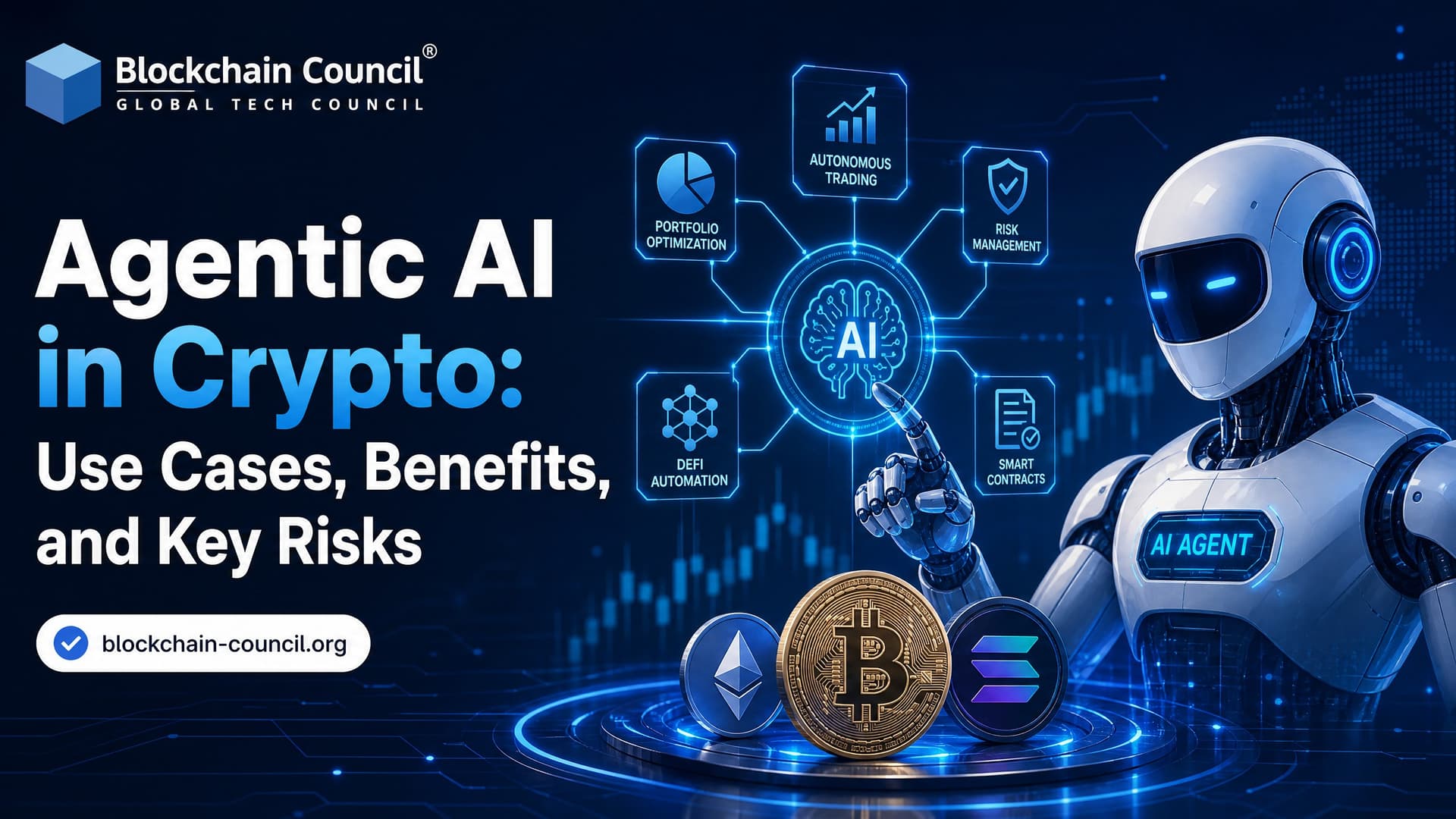
Agentic AI in crypto is the shift from AI tools that answer questions to autonomous agents that hold wallets, sign transactions, interact with smart contracts, and pursue goals onchain. That changes the risk profile. A chatbot can give bad advice. An onchain AI agent can move your funds.
The sector is no longer a side experiment. a16z has named AI and crypto convergence as a major crypto theme, Coinbase Institute has written about AI-managed financial operations, and Web3 agent sector trackers count hundreds of projects with several billion dollars in combined value. The excitement is real. So are the failure modes.

What Is Agentic AI in Crypto?
Agentic AI systems observe, plan, act, and adjust over time. In crypto, that usually means an AI model wired into transaction infrastructure. The agent reads market data, checks wallet balances, inspects smart contract state, picks an action, then submits a transaction.
A typical crypto AI agent includes:
A wallet or smart-contract account that can hold ETH, stablecoins, governance tokens, NFTs, or protocol-specific assets.
Onchain rules for spending limits, whitelisted protocols, emergency stops, and access control.
Offchain intelligence, often a large language model, a forecasting model, a reinforcement learning system, or a hand-coded strategy engine.
Data connections to exchanges, DeFi protocols, blockchain indexers, price oracles, governance forums, and risk feeds.
Execution tooling for signing, gas estimation, nonce handling, transaction simulation, and multi-chain routing.
That last point is where beginners get hurt. If you build an agent that fires transactions quickly on an EVM chain, nonce management turns into a real engineering problem. The familiar error replacement transaction underpriced usually means your agent tried to replace a pending transaction without bumping fees enough under EIP-1559 rules. It is boring. It also stops production bots cold.
As autonomous AI systems become more capable, an Agentic AI Certification can help professionals develop practical skills in AI agent design, decision-making, governance, and the secure deployment of autonomous systems across blockchain networks.
Why Agentic AI and Crypto Fit Together
Crypto gives AI agents something most software environments do not: programmable money, open settlement rails, and public state. An agent does not need a bank API approval to interact with an ERC-20 token contract or a lending protocol. If it has permission and gas, it can act.
AI brings adaptive decision-making. Crypto brings custody, identity primitives, verifiable records, and settlement. Put them together and you get autonomous software that can participate in financial networks.
That is powerful. It is not always wise. If your use case needs strict human judgment, legal review, or low tolerance for loss, full autonomy is the wrong starting point. Begin with recommendation agents and human approval. Let the system earn more authority over time.
Professionals looking to strengthen their understanding of digital assets and blockchain ecosystems may also benefit from becoming a Cryptocurrency Expert, building practical knowledge of cryptocurrencies, wallets, tokenomics, decentralized finance, and crypto market operations.
Market Landscape: From Bots to Onchain AI Agents
Crypto already has a long history of automation. Arbitrage bots, liquidation bots, market makers, and MEV searchers have run for years. Agentic AI adds a planning layer and a broader scope.
A few signals show how quickly the category is growing:
AI-related crypto tokens were among the strongest crypto sectors in 2024, with agent-focused tokens drawing particular investor attention.
Web3 agent sector research has identified several hundred agent-focused projects and estimated sector capitalization in the billions.
Some industry forecasts have discussed an AI crypto market reaching roughly 10 billion dollars.
The crypto trading bot market is projected to grow sharply over the next decade, helped by 24/7 markets and fragmented liquidity.
Do not read those numbers as a guarantee. Crypto sectors inflate fast, then deflate. Still, the direction is clear. Autonomous AI agents are becoming a serious product category, not just a Twitter narrative.
Explore Practical Infrastructure for Agentic AI
As Agentic AI becomes increasingly capable of executing blockchain-based tasks, developers need reliable infrastructure for secure financial interactions. Blockchain0x provides AI agent wallets, programmable payments, spending controls, and developer APIs that simplify building autonomous blockchain-enabled applications while maintaining oversight of digital transactions.
Core Use Cases of Agentic AI in Crypto
1. Autonomous Trading and Portfolio Management
This is the most mature use case. Crypto markets never close, liquidity sits across centralized exchanges and DeFi protocols, and price differences appear constantly.
Trading agents can monitor:
Order books and spreads across exchanges.
Funding rates on perpetual futures.
Onchain liquidity in automated market makers.
Gas costs, slippage, and pending transactions.
Risk limits such as maximum drawdown or leverage.
A practical agent might rebalance a portfolio of stablecoins, ETH, and BTC every six hours, but only if slippage stays below 30 basis points and the wallet keeps enough ETH for gas. Keep the mandate narrow. Broad instructions like maximize yield are dangerous, because the model may chase unsustainable incentives or wander into unaudited pools.
2. DeFi Agents for Yield and Collateral Management
DeFi agents can move assets across lending markets, staking products, liquidity pools, and vaults. They can also watch collateral health. If a lending position drifts toward liquidation, the agent can repay debt, add collateral, or cut exposure.
Useful, yes, but it needs hard guardrails. Your agent should know which contracts are allowed. It should cap exposure to any single protocol. It should simulate transactions before sending them. Blind interaction with a freshly deployed contract is not innovation. It is a donation to attackers.
3. DAO Governance and Treasury Operations
DAOs are information-heavy. Proposals change fee parameters, treasury allocation, token emissions, validator rules, or protocol upgrades. Agentic AI can help by summarizing proposals, modeling outcomes, flagging conflicts, and recommending votes based on a delegate mandate.
Some agents may eventually vote directly. Be careful here. For serious governance, AI should support human delegates before it replaces them. Voting rights are financial power, and bad delegation logic can compound across many DAOs.
4. Compliance, Monitoring, and Risk Management
Agentic AI in crypto is not only about trading. Defensive agents may turn out to be more valuable for enterprises.
Compliance agents can flag interactions with sanctioned addresses or suspicious transaction patterns.
Treasury agents can enforce concentration limits and approved counterparty policies.
Risk agents can stress-test DeFi positions against liquidity shocks and oracle failures.
Accounting agents can map wallet activity to financial reporting workflows.
Coinbase Institute has pointed to AI-managed financial operations as an emerging policy area. That matters, because enterprise adoption will hinge on controls, audit trails, and explainability, not just model quality.
5. Machine-to-Machine Payments
Autonomous agents need to pay for data, compute, API access, and services. The x402 payment standard has drawn attention as a design built for AI agents, including micropayments and recurring payments.
This points toward machine-to-machine commerce. Picture an agent that pays a data provider for a volatility feed, pays another agent to simulate a transaction, then pays a solver to route execution. Small payments. Many of them. Crypto rails fit that pattern far better than card networks.
6. Onchain Entrepreneurship and Token Operations
The truth_terminal and GOAT memecoin episode in 2024 showed how AI agents can become onchain economic actors, not just assistants. Agents may launch tokens, manage treasuries, talk to communities, and run small services.
This area is overhyped, but worth watching. Most agent-launched tokens will not become durable businesses. The more interesting pattern is an agent that earns revenue by providing a useful onchain service, with transparent wallets and measurable performance.
Benefits of Agentic AI in Crypto
Always-on operation: Crypto markets run 24/7. Agents can watch positions while you sleep.
Faster execution: Agents react to market and protocol changes faster than manual teams.
Better operational discipline: A well-designed agent enforces limits every time, not just when someone remembers.
Composability: Wallets and smart contracts can interact with DeFi, NFTs, DAOs, bridges, and data services.
Lower access barriers: Smaller teams can use agent interfaces for strategies that once required dedicated quant or treasury staff.
The phrase well-designed carries a lot of weight here. A poorly designed autonomous agent just fails faster.
A Tech Certification can further strengthen these capabilities by expanding your understanding of emerging technologies, cloud infrastructure, AI systems, and the digital tools that support secure blockchain and autonomous applications.
Key Risks You Cannot Ignore
Security and Custody Risk
If an agent controls assets, it becomes a target. Private key compromise, smart contract bugs, malicious approvals, prompt injection, bad oracle data, and unsafe plugins can all lead to losses.
Use multi-signature wallets, spending caps, contract allowlists, transaction simulation, and emergency pause functions. For smart contracts, lean on established tools such as Foundry, Hardhat, and Slither, and add formal verification where the value at risk justifies it.
AI Misalignment and Bad Objectives
Agents optimize what you specify, not what you meant. Tell a DeFi agent to maximize APY without risk constraints and it may enter a fragile pool with high rewards and thin liquidity. That is not intelligence. That is bad product design.
Market Manipulation and Feedback Loops
Automated trading already dominates many traditional markets. In crypto, liquidity can be thinner and more fragmented. If many agents follow similar signals, they can amplify volatility, crowd into the same trade, or trigger cascading liquidations.
Legal Accountability
Who is responsible when an autonomous agent breaks a rule or causes a loss? The developer, the deployer, the DAO, the user, governance token holders, or the infrastructure provider? Regulators are still working through these questions.
AML, KYC, sanctions screening, securities rules, and travel rule obligations get harder when the transaction initiator is software acting under delegated authority. Bring legal and compliance teams in before agents touch production funds.
How Developers and Professionals Should Prepare
If you want to work in this field, do not study AI or blockchain in isolation. You need both, plus risk management.
Learn smart contract basics: Solidity 0.8.x, ERC-20, ERC-721, EIP-1559 gas mechanics, access control, and upgrade patterns.
Build a limited agent: Start with read-only portfolio analysis. Then add human-approved transactions. Only then test autonomy with small funds.
Practice threat modeling: Ask what happens if the model is wrong, the oracle is wrong, the signer is compromised, or the target contract changes.
Study compliance workflows: This is where many enterprise projects get approved or rejected.
For structured learning, Blockchain Council programs such as Certified Blockchain Expert™, Certified Blockchain Developer™, Certified Smart Contract Developer™, Certified Artificial Intelligence (AI) Expert™, and Certified Web3 Expert™ give you credible grounding before you design or supervise autonomous AI agents.
The Practical Path Forward
Agentic AI in crypto will produce useful infrastructure, failed experiments, regulatory disputes, and a few genuinely new business models. The safest bet is not full autonomy on day one. Build agents with narrow permissions, visible logs, transaction simulation, human overrides, and clear accountability.
If you are a developer, build a testnet agent that reads Aave-style health factors, drafts a repayment transaction, and waits for human approval. If you are a risk or compliance professional, learn how wallets, smart contracts, and AI orchestration fit together. Start there. Then decide how much autonomy your organization can responsibly allow.
As AI-powered crypto products continue to reach broader markets, a Marketing Certification can also help professionals understand product positioning, user education, community engagement, and go-to-market strategies for blockchain and AI-driven solutions.
FAQs
1. What Is Agentic AI in Cryptocurrency?
Agentic AI in cryptocurrency refers to autonomous AI systems that can analyze blockchain data, make decisions, and execute tasks such as portfolio management, trading, payments, and blockchain monitoring with limited human intervention.
2. How Does Agentic AI Work in Crypto?
Agentic AI combines artificial intelligence, blockchain data, smart contracts, and automation to monitor market conditions, evaluate opportunities, execute predefined actions, and optimize cryptocurrency-related workflows.
3. Why Is Agentic AI Important for the Crypto Industry?
Agentic AI helps automate complex blockchain operations, improve decision-making, enhance efficiency, reduce manual work, and support faster responses to changing market conditions.
4. What Are the Main Use Cases of Agentic AI in Crypto?
Common use cases include automated trading, portfolio management, DeFi optimization, fraud detection, blockchain analytics, smart contract monitoring, crypto payments, compliance, and customer support.
5. How Can Agentic AI Improve Cryptocurrency Trading?
Agentic AI can monitor market trends, analyze on-chain data, identify trading opportunities, optimize execution strategies, and automate trading decisions based on predefined rules and risk parameters.
6. How Does Agentic AI Support DeFi?
AI agents can automate lending, borrowing, staking, liquidity management, yield optimization, portfolio rebalancing, and transaction monitoring across decentralized finance protocols.
7. Can Agentic AI Help Manage Crypto Portfolios?
Yes. Agentic AI can monitor portfolio performance, track asset allocation, identify market trends, recommend rebalancing strategies, and automate portfolio management based on user-defined objectives.
8. How Does Agentic AI Improve Blockchain Analytics?
AI agents analyze blockchain transactions, wallet activity, smart contract interactions, and network trends to generate insights that support investment decisions, compliance, and risk management.
9. What Role Does Agentic AI Play in Crypto Payments?
Agentic AI can automate payment processing, optimize transaction routing, monitor wallet balances, schedule recurring payments, and improve payment efficiency across blockchain networks.
10. How Can Agentic AI Strengthen Crypto Security?
AI agents continuously monitor blockchain activity, identify suspicious wallet behavior, detect transaction anomalies, flag potential threats, and support faster responses to security incidents.
11. Can Agentic AI Support AML and Compliance?
Yes. AI agents can screen wallet addresses, monitor transactions, identify unusual activity, assist with Anti-Money Laundering (AML) processes, and support regulatory compliance efforts.
12. How Does Agentic AI Improve Smart Contract Monitoring?
AI agents monitor smart contract activity, identify unexpected behavior, detect operational risks, and notify users or administrators about potential security concerns or abnormal transactions.
13. What Technologies Power Agentic AI in Crypto?
Core technologies include artificial intelligence, machine learning, blockchain, smart contracts, large language models (LLMs), blockchain analytics, decentralized applications (DApps), APIs, and digital wallets.
14. Which Industries Can Benefit from Agentic AI in Crypto?
Cryptocurrency exchanges, fintech companies, financial institutions, blockchain startups, payment providers, investment firms, cybersecurity companies, and enterprise blockchain organizations can benefit from Agentic AI.
15. What Are the Benefits of Agentic AI in Crypto?
Benefits include faster automation, improved operational efficiency, enhanced decision-making, continuous market monitoring, better risk management, reduced manual effort, and scalable blockchain operations.
16. What Are the Key Risks of Agentic AI in Crypto?
Key risks include smart contract vulnerabilities, inaccurate AI outputs, cybersecurity threats, volatile market conditions, regulatory uncertainty, excessive automation, and potential misuse if proper safeguards are not implemented.
17. How Can Businesses Prepare for Agentic AI Adoption?
Organizations should establish AI governance, audit smart contracts, implement strong cybersecurity measures, define operational limits, monitor AI performance, and train employees on responsible AI use.
18. What Skills Are Needed to Work with Agentic AI in Crypto?
Professionals should understand blockchain technology, cryptocurrency, smart contracts, artificial intelligence, DeFi, blockchain analytics, cybersecurity, risk management, and regulatory compliance.
19. What Common Mistakes Should Organizations Avoid When Implementing Agentic AI?
Avoid granting unrestricted wallet permissions, relying on unaudited smart contracts, deploying AI agents without monitoring, ignoring governance policies, and assuming AI can eliminate all financial or operational risks. Human oversight, security audits, and clearly defined risk controls remain essential.
20. What Is the Future of Agentic AI in Cryptocurrency?
Agentic AI is expected to play an increasingly important role in cryptocurrency by enabling intelligent automation across trading, payments, compliance, blockchain analytics, and decentralized finance. As AI capabilities and blockchain infrastructure continue to evolve, autonomous agents will likely become valuable tools for improving efficiency, supporting better decision-making, and simplifying complex crypto operations. However, long-term success will depend on strong governance, cybersecurity, transparency, and responsible deployment.
Related Articles
View All
Agentic AI
Agentic AI in Finance: Use Cases, Benefits, and Real-World Applications
Agentic AI in finance is changing banking, trading, risk, accounting, and compliance through supervised AI agents that plan, act, and monitor workflows.

Agentic AI
Agentic AI vs. Generative AI FAQs: Key Differences, Capabilities, and Use Cases
Learn the key differences between agentic AI and generative AI, plus enterprise capabilities, risks, governance needs, and practical use cases.

Agentic AI
AI Agents for Enterprise Operations: Use Cases, Benefits, and Challenges
AI agents for enterprise operations automate cross-system workflows in IT, finance, HR, supply chain, and support, but governance is critical.
Trending Articles
The Role of Blockchain in Ethical AI Development
How blockchain technology is being used to promote transparency and accountability in artificial intelligence systems.

Top 5 DeFi Platforms
Explore the leading decentralized finance platforms and what makes each one unique in the evolving DeFi landscape.
What is AWS? A Beginner's Guide to Cloud Computing
Everything you need to know about Amazon Web Services, cloud computing fundamentals, and career opportunities.