

Agentic AI in Finance: Use Cases, Benefits, and Real-World Applications
 Suyash Raizada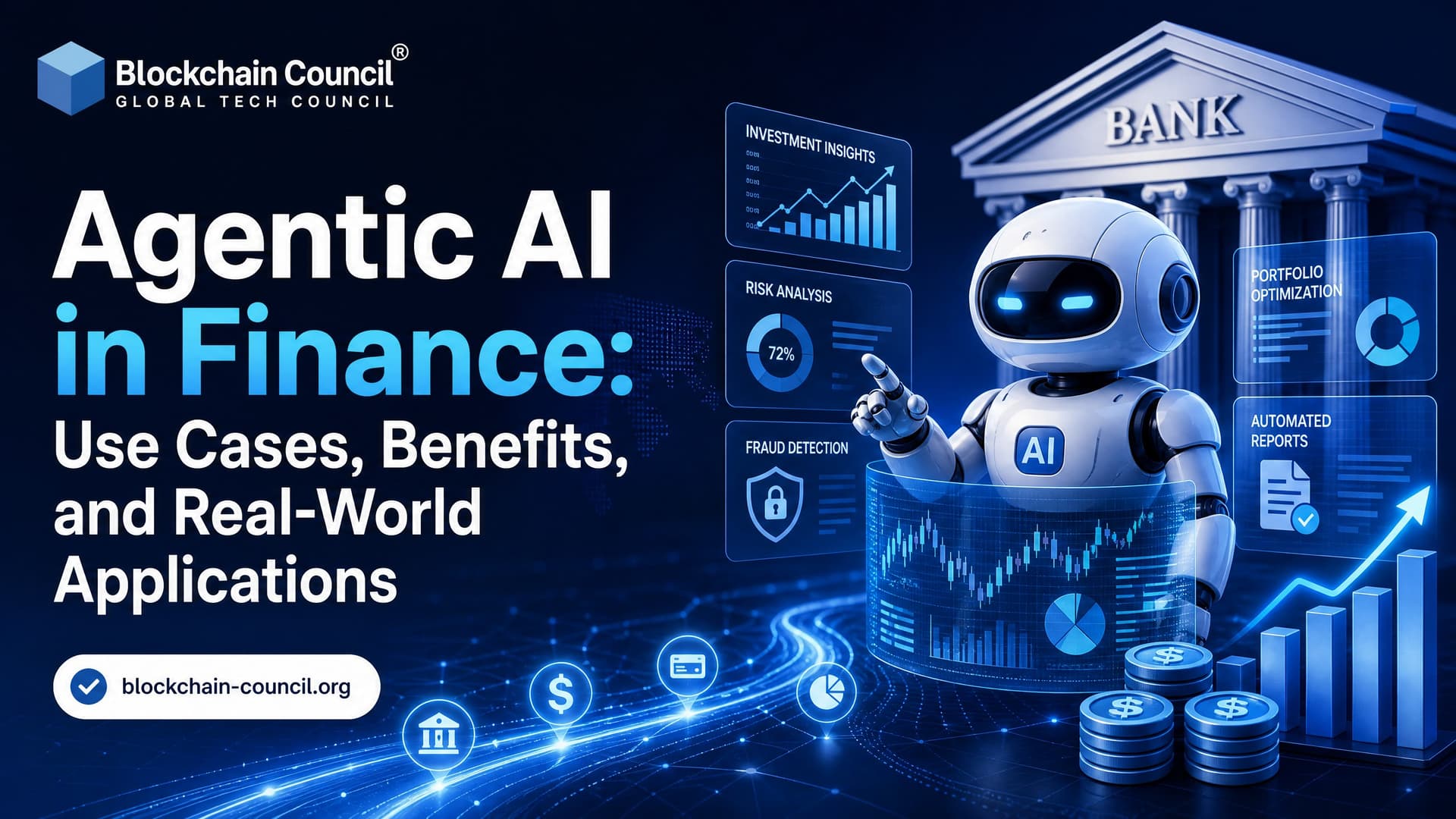
Agentic AI in finance is moving from lab demos to live workflows in banking, trading, risk, compliance, and finance operations. The core change is simple. Instead of waiting for a fixed command, an AI agent can interpret a goal, plan steps, use tools, check results, and take an approved action.
That does not mean banks should let agents move money with no guardrails. They should not. Finance is a high-control environment. The useful version of agentic AI is supervised, logged, policy-bound, and connected to the right systems through narrow permissions.

For professionals looking to build expertise in this rapidly evolving field, an AI Agentic Finance and Payment Certification provides practical knowledge of autonomous payment systems, financial governance, risk controls, and AI-driven transaction workflows.
What Is Agentic AI in Finance?
Agentic AI describes AI systems that can act with a degree of autonomy. In financial services, these agents may read documents, inspect transaction data, call APIs, run checks, update records, escalate exceptions, or generate recommendations for a human reviewer.
A traditional chatbot answers a question. A robotic process automation script follows a fixed path. An agent can do more. It can decide that a missing KYC document needs to be requested, check whether the customer already uploaded it, compare it with policy rules, create a case, and notify the onboarding team.
In practice, most financial agents combine:
Language models for interpreting instructions, policies, emails, and documents.
Tool use through APIs, databases, workflow systems, trading platforms, or CRM tools.
Planning logic that breaks a goal into steps.
Memory and context for customer history, case status, or portfolio exposure.
Human approval for high-risk actions such as credit decisions, trade execution, or account restrictions.
A small implementation detail matters here. If you let an agent write payment amounts as free text, you will eventually get values like USD 1,200 instead of 1200.00. That can fail downstream validation or, worse, pass the wrong parser. Use typed schemas. Use strict JSON. Make the agent prove what it is doing.
Building reliable agentic systems requires strong coding and validation practices, making a Programming Certification valuable for professionals developing production-ready AI applications.
This is also why agent identity, permissions, and transaction controls are becoming increasingly important in autonomous payment systems. Give your AI Agents a wallet, budget, and identity with Blockchain0x to autonomously pay, get paid, and build onchain. With clearly defined credentials and programmable financial controls, agents can operate more securely while maintaining accountability across payment workflows.
Why Financial Firms Are Moving From Bots to Agents
Banks and fintechs have used automation for years. What changed in 2024 and 2025 is the move from single-task bots to agents that coordinate work across systems. Deloitte describes AI agents in banking as systems that can reason, execute complex tasks, and work toward targeted goals across onboarding, servicing, and back-office operations. Other vendors describe agents that operate across front, middle, and back office workflows rather than staying inside one screen.
Salesforce has pointed to banking uses such as autonomous decision support, fraud detection, compliance monitoring, and personalized customer service. Citi has discussed agentic AI for onboarding, compliance checks, fraud detection, and customer journeys. Moody's frames the shift as a move from rule-based automation to intelligent decision augmentation, especially in credit and risk.
The adoption curve is still early, and public numbers are limited. But the direction is clear. Finance teams want systems that do not just flag work. They want systems that help finish it.
Top Use Cases of Agentic AI in Finance
Retail and Digital Banking
AI agents in banking can handle multi-step customer journeys. Think account opening, card disputes, loan servicing, address updates, or fee waiver requests. Instead of handing a customer from chatbot to call center to operations queue, an agent can gather data, verify eligibility, trigger a risk check, and update the customer record.
This is where agentic AI in finance becomes practical. A good agent does not just say "Please contact support." It checks what is missing and starts the next step.
Risk Management and Fraud Detection
Risk teams are strong candidates for agentic AI because their work is investigative. Agents can continuously monitor transactions, counterparties, vendor files, sanctions data, communications, and account behavior.
Finance agents can scan vendor and transaction records to identify duplicate payments, policy breaches, or suspicious activity. Others consolidate data, detect irregularities, and trigger risk or compliance workflows. Citi has also discussed use cases around deepfake detection, transaction monitoring, and automated compliance checks.
The trade-off is serious. A fraud agent that blocks too aggressively can harm customers. A weak one lets bad activity through. Use staged autonomy: alert first, recommend second, act only after policy testing and approval.
Finance and Accounting Operations
Accounts payable, reconciliations, expense processing, and month-end close are full of repeatable judgment calls. Agentic AI can read invoices, compare them against purchase orders, validate tax fields, check approval rules, route exceptions, and prepare payment batches.
For controllers, the best early use case is not a flashy CFO assistant. It is exception handling. Let the agent find unmatched invoices, duplicate vendor bank accounts, missing receipts, unusual journal entries, and aging reconciliation items. Then let a human approve the fix.
Month-end close is another strong fit. Agents can track task completion, ping owners, gather evidence, summarize blockers, and escalate late items. Small gains add up when a close process depends on dozens of handoffs.
Trading, Asset Management, and Crypto
Autonomous trading agents are gaining attention because markets provide constant data, feedback, and execution paths. Some platforms let traders create agents that translate natural language strategy ideas into trading logic, analyze market data, and place orders. Others describe a fully automated, agent-native trading environment where multiple agents generate, test, and execute strategies.
There are public experiments too. Reported setups have used dozens of autonomous agents running thousands of trades, with specialized tools and feedback loops over several days. Crypto markets are an especially active testbed because they run 24/7 and support API-based execution across exchanges.
To be blunt, this is not where beginners should start with real capital. Agentic trading can fail fast. Bad prompts, stale data, missing risk limits, or an API permission error can create losses before anyone notices. Start in paper trading. Add position limits, kill switches, slippage assumptions, and audit logs.
Customer Onboarding and KYC
Onboarding is paperwork-heavy and policy-heavy. That makes it a natural home for agentic AI. Agents can request documents, check whether forms are complete, run KYC and AML checks, compare customer information across systems, and create cases for human review.
Citi has highlighted onboarding and compliance as key agentic AI areas. Industry reporting also suggests banks are planning intelligent agents that move beyond rule-based workflows and coordinate exceptions with human staff.
The practical value is faster onboarding with fewer abandoned applications. The compliance value is consistency. Every file should be checked against the same policy, with evidence stored for review.
Credit and Portfolio Decision Support
Moody's emphasizes agentic AI as decision augmentation for credit, risk, and portfolio monitoring. Here the agent gathers data, runs models, prepares scenarios, highlights covenant issues, and explains why a borrower or portfolio needs attention.
Final decisions should stay with accountable humans, especially for regulated credit decisions. The EU AI Act treats many creditworthiness and credit scoring systems as high-risk, which means firms need transparency, oversight, data governance, and clear accountability.
Benefits of Agentic AI in Finance
The main benefits are not theoretical. They show up in operational queues, risk reviews, and customer response times.
Faster cycle times: Agents can perform data gathering, checks, routing, and updates without waiting for manual handoffs.
Lower manual workload: Finance teams spend less time copying data between systems and more time reviewing exceptions.
Better risk detection: Continuous monitoring helps catch anomalies, duplicate payments, suspicious patterns, and compliance gaps earlier.
More consistent decisions: Agents can apply policy rules and model outputs the same way across cases, as long as the rules are well designed.
Personalized service: Banking agents can provide proactive alerts, tailored recommendations, and 24/7 support within approved limits.
New product models: Personal financial agents, agent-native trading platforms, and embedded finance assistants can create new service models.
Risks and Governance Challenges
Agentic AI introduces new failure modes. An agent can pursue the wrong goal, call the wrong tool, repeat a failed action, or create cascading errors across connected systems. In trading, multiple agents can interact in unexpected ways. In lending, an unexplained recommendation can create regulatory and fairness problems.
Financial institutions should set hard controls before production:
Define autonomy levels. Decide what the agent may read, recommend, draft, update, or execute.
Use human approval for high-risk actions. Credit denial, transaction blocking, large payments, and live trades need stricter review.
Log every step. Store prompts, tool calls, data sources, outputs, approvals, and errors.
Test with adversarial cases. Include prompt injection, missing data, duplicate records, market spikes, and policy conflicts.
Monitor drift. Models, data feeds, customer behavior, and fraud patterns change.
Apply model risk management. Documentation, validation, explainability, and ownership are not optional in regulated finance.
A useful rule: if you would not let a junior analyst take the action without review, do not let an agent take it without review either.
Real-World Direction for 2026 and Beyond
Expect three shifts. First, banks will move from pilots to cross-domain agents that manage full customer and operations journeys. Second, personal financial agents will grow as open banking and embedded finance mature. The World Economic Forum has described this future as AI agents that can aggregate consumer financial data across institutions and act within user-defined constraints.
Third, risk and compliance teams will adopt agents as always-on monitoring layers. These systems will not replace expert judgment. They will compress the time between signal and action.
Crypto and capital markets will remain early laboratories for autonomous trading agents, partly because APIs are accessible and markets never close. Traditional institutions will move more slowly, and rightly so. The cost of an uncontrolled agent is higher when the system touches regulated accounts, customer assets, or credit decisions.
Skills Professionals Need Now
If you work in finance, you do not need to become a machine learning researcher to use agentic AI well. You do need to understand workflows, controls, data quality, model behavior, and AI governance.
For structured learning, consider Blockchain Council programs such as the Certified Artificial Intelligence (AI) Expert™ for AI foundations and the Certified Blockchain Expert™ if your work touches digital assets, tokenization, or blockchain-based settlement. Developers building financial agents should also study API security, audit logging, prompt injection defenses, and tool-calling patterns. Professionals looking to complement their technical expertise with business growth and customer engagement skills may also benefit from a Marketing Certification.
Start with one contained workflow: invoice exception review, KYC document collection, fraud alert triage, or paper-trading strategy testing. Map every system the agent touches. Define what it cannot do. Then run it in shadow mode before allowing action. That is how agentic AI in finance becomes useful, safe, and worth scaling.
FAQs
1. What Is Agentic AI in Finance?
Agentic AI in finance refers to AI systems that can autonomously analyze information, make decisions, execute tasks, and adapt to changing conditions within predefined rules and governance frameworks. Unlike traditional AI, Agentic AI can proactively take action rather than simply provide recommendations.
2. How Is Agentic AI Different from Traditional Financial AI?
Traditional AI focuses on predictions, analytics, and recommendations, while Agentic AI can independently initiate workflows, automate decisions, and complete financial tasks with limited human intervention.
3. Why Is Agentic AI Becoming Important in Financial Services?
Financial institutions are adopting Agentic AI to improve efficiency, reduce costs, enhance customer experiences, strengthen risk management, and automate increasingly complex operations.
4. What Are the Main Use Cases of Agentic AI in Finance?
Common use cases include fraud detection, loan processing, customer support, portfolio management, payment automation, compliance monitoring, financial planning, and risk assessment.
5. How Does Agentic AI Improve Fraud Detection?
Agentic AI continuously analyzes transaction data, identifies suspicious activities, investigates anomalies, and can automatically trigger preventive actions before fraud escalates.
6. How Can Agentic AI Support Digital Payments?
It can optimize payment routing, reduce transaction failures, detect fraudulent transactions, automate dispute resolution, and improve payment processing efficiency.
7. What Role Does Agentic AI Play in Customer Service?
Agentic AI can handle customer inquiries, resolve account issues, provide financial guidance, process requests, and deliver personalized support around the clock.
8. How Does Agentic AI Improve Loan Processing?
It can analyze applicant data, verify documentation, assess creditworthiness, perform risk evaluations, and accelerate loan approval workflows.
9. Can Agentic AI Assist with Investment Management?
Yes, Agentic AI can monitor markets, analyze portfolios, recommend asset allocations, identify opportunities, and support investment decision-making processes.
10. How Is Agentic AI Used in Wealth Management?
Financial advisors and institutions can use Agentic AI to provide personalized recommendations, automate portfolio reviews, and deliver customized financial insights.
11. What Is the Role of Agentic AI in Risk Management?
Agentic AI can identify emerging risks, monitor financial activities, assess exposures, and recommend or execute mitigation strategies in real time.
12. How Does Agentic AI Support Regulatory Compliance?
It can automate compliance monitoring, perform transaction screening, generate reports, track regulatory changes, and reduce compliance-related operational burdens.
13. How Can Agentic AI Improve Financial Forecasting?
By analyzing historical data, market trends, and economic indicators, Agentic AI can generate more accurate forecasts and business projections.
14. What Benefits Does Agentic AI Offer Financial Institutions?
Benefits include increased operational efficiency, lower costs, faster decision-making, improved customer satisfaction, enhanced security, and greater scalability.
15. How Does Agentic AI Enhance Personalization in Finance?
It can tailor financial products, investment recommendations, payment options, and customer communications based on individual behavior and preferences.
16. What Real-World Applications of Agentic AI Are Emerging?
Applications include autonomous financial assistants, AI-powered lending platforms, intelligent fraud prevention systems, automated compliance solutions, and smart payment orchestration platforms.
17. Which Financial Sectors Benefit Most from Agentic AI?
Banking, fintech, insurance, investment management, wealth advisory, lending, payments, and capital markets can all benefit from Agentic AI technologies.
18. What Challenges Come with Implementing Agentic AI?
Challenges include regulatory compliance, cybersecurity risks, governance requirements, model transparency, integration complexity, and maintaining human oversight.
19. What Risks Should Financial Institutions Consider?
Organizations must carefully manage risks related to biased decisions, inaccurate outputs, privacy concerns, operational failures, and regulatory scrutiny. Giving AI authority to act on financial matters requires considerably more caution than letting it draft an email or summarize a meeting.
20. How Will Agentic AI Shape the Future of Finance?
Agentic AI is expected to become a core component of modern financial services by enabling autonomous operations, real-time decision-making, intelligent customer engagement, advanced risk management, and highly efficient financial ecosystems. Institutions that successfully balance automation, governance, and trust will likely gain a significant competitive advantage in the years ahead.
Related Articles
View All
Agentic AI
Agentic AI in Crypto: Use Cases, Benefits, and Key Risks
Agentic AI in crypto lets autonomous agents hold wallets, trade, manage DeFi positions, and support DAOs, but security and regulation remain critical.

Agentic AI
AI Agents for Enterprise Operations: Use Cases, Benefits, and Challenges
AI agents for enterprise operations automate cross-system workflows in IT, finance, HR, supply chain, and support, but governance is critical.

Agentic AI
Agentic AI vs. Generative AI FAQs: Key Differences, Capabilities, and Use Cases
Learn the key differences between agentic AI and generative AI, plus enterprise capabilities, risks, governance needs, and practical use cases.
Trending Articles
AWS Career Roadmap
A step-by-step guide to building a successful career in Amazon Web Services cloud computing.
What is AWS? A Beginner's Guide to Cloud Computing
Everything you need to know about Amazon Web Services, cloud computing fundamentals, and career opportunities.
How to Install Claude Code
Learn how to install Claude Code on macOS, Linux, and Windows using the native installer, plus verification, authentication, and troubleshooting tips.