

Agentic AI for Supply Chain

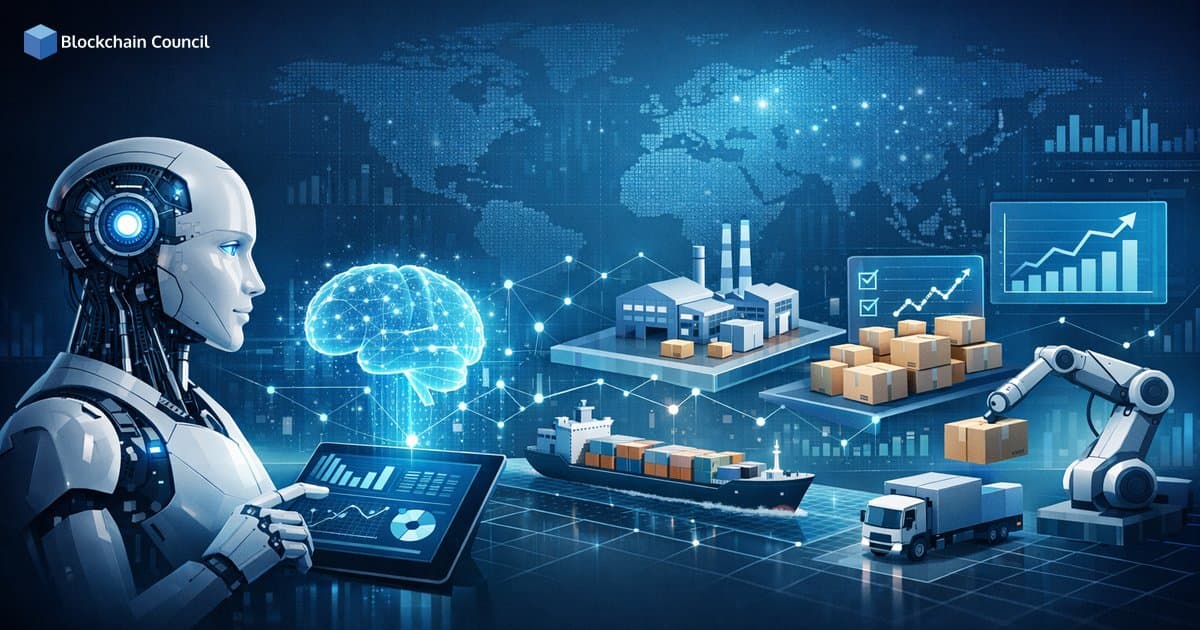
Agentic AI for supply chain is moving from experimentation to production as organizations seek faster, more resilient planning across demand forecasting, inventory decisions, and procurement. Unlike analytics that stop at predictions, agentic systems can pursue goals, run multi-step workflows, call enterprise tools, and trigger actions within governed boundaries. Analysts and vendors broadly expect intelligent agents to augment or autonomously execute a meaningful share of supply chain decisions by 2030, particularly in forecasting-driven planning, replenishment, and sourcing.
This article explains what agentic AI means in a supply chain context, how it is being implemented today, and which practical patterns deliver value in forecasting, inventory optimization, and procurement orchestration.

What Is Agentic AI in a Supply Chain Context?
In supply chain planning and execution, agentic AI refers to AI systems that can:
Pursue explicit goals - for example, maximize service at a target fill rate while minimizing working capital.
Make multi-step decisions and adapt as conditions change.
Use tools and data autonomously, including querying databases, running simulations, and interacting with ERP, WMS, TMS, APS, and e-procurement systems through APIs.
Most production deployments use a large language model (LLM) as a coordination and reasoning layer, while domain tools handle optimization and constraints. The LLM does not replace solvers and planners. It orchestrates them, explains decisions, and routes exceptions to the appropriate workflow.
Current State: From Pilots to Governed Production Workflows
Across the market, the typical maturity pattern looks like this:
Limited-scope agents - demand sensing, inventory monitoring, and logistics assistance - are the most common production form today.
End-to-end autonomy across planning and execution remains rare, primarily because accountability, data quality, and risk controls require human oversight and strong governance.
Prompts alone are not sufficient. Successful teams embed agents into repeatable workflows with trusted systems of record, business rules, validation steps, and audit trails.
Technical Patterns in Agentic Supply Chain Systems
Continuous context building from internal data (orders, POS, inventory, production plans, supplier metrics) combined with external signals (weather, macro indicators, news, IoT).
Goal-seeking planning with scenario evaluation, where agents compare tradeoffs across service, cost, and risk before recommending or executing decisions.
Tool orchestration, such as calling inventory models, network flow solvers, and querying data warehouses, then writing decisions back to enterprise systems.
Multi-agent architectures with specialized agents covering forecasting, inventory policy, supplier risk, and logistics, coordinated by a higher-level control agent.
Adoption Momentum and Impact Expectations
Many organizations are already building generative AI foundations that directly support agentic deployments. Industry forecasts suggest that by 2030, intelligent agents will autonomously execute decisions across a large share of cross-functional supply chain management solutions. Separate estimates indicate that AI and generative AI in supply chains can reduce total supply chain costs by roughly 3 to 4 percent of functional costs, with major value pools coming from lower excess inventory, fewer expedited shipments, and higher planner productivity.
Agentic AI in Demand Forecasting: From Prediction to Continuous Refinement
Traditional forecasting focuses on selecting a model and producing a statistical prediction. Agentic AI for supply chain demand forecasting extends this by making forecasting a continuous, goal-driven process connected to downstream decisions.
How Agents Improve Forecasting in Practice
Continuous forecast performance monitoring: the agent tracks error, bias, and forecast value add by product, channel, and region.
Adaptive model management: the agent can trigger retraining, switch model families, adjust segmentation, or change time granularity when demand patterns shift.
Unstructured signal interpretation: agents can process news, weather alerts, and disruption indicators, then map their effects to specific products and locations to adjust assumptions.
Common Demand Forecasting Agent Patterns
Demand sensing agent: ingests POS data, orders, web traffic, promotions, and external indicators to detect near-term demand shifts and adjust short-horizon forecasts.
New product introduction (NPI) agent: uses similarity search on product attributes to build an initial forecast and rapidly recalibrates with early sales data.
Collaborative forecasting agent: collects inputs from sales, finance, and partners through conversational workflows, compares scenarios, and documents assumptions for auditability.
The key shift is that the forecast is no longer a static artifact. It becomes an evolving input to replenishment, allocation, and procurement decisions, with defined policies for when the agent can act independently and when it must escalate.
Agentic AI in Inventory Decisions: Dynamic Policies and Autonomous Replenishment
Inventory management is where agentic systems often show fast ROI because decisions are frequent, data-rich, and tightly connected to service levels and working capital. Agentic AI for supply chain inventory optimization typically combines real-time monitoring with policy automation.
What Changes Compared to Conventional Inventory Planning?
Dynamic safety stock and reorder point tuning based on current demand signals, lead time changes, capacity constraints, and risk indicators.
Continuous monitoring of multi-node inventory, including in-transit stock and upstream supplier positions where data sharing is available.
Automated replenishment triggers operating within guardrails such as minimum order quantities, batching rules, transport capacity, and budget thresholds.
Inventory Agent Use Cases That Map Well to Governance
Autonomous reorder agent: creates purchase requisitions or stock transfer proposals when conditions meet policy rules, then routes for approval or auto-executes based on defined thresholds.
Parameter tuning agent: adjusts SKU parameters such as safety factors and service targets after analyzing stockouts, obsolescence, and forecast bias, then logs all changes for review.
Multi-echelon optimization agent: coordinates policies across plants, distribution centers, and stores to optimize system-wide cost and service rather than local KPIs alone.
Collaborative Inventory Across Partners
Agentic systems can support vendor-managed inventory and joint planning by sharing projected demand and inventory positions under explicit data-sharing agreements. When a supplier encounters a constraint, the agent can propose alternative allocations or re-optimize volumes across the supplier base.
Agentic AI in Procurement: Risk-Aware Sourcing and Orchestration
Procurement has long used automation, but agentic AI adds goal-driven reasoning and continuous risk sensing. Agentic AI for supply chain procurement is particularly relevant where supply volatility and multi-tier dependencies require faster decisions than traditional sourcing cycles allow.
Where Agentic Procurement Goes Beyond RPA
Goal-driven sourcing: agents balance cost, risk diversification, and sustainability targets, then propose sourcing strategies aligned to organizational policy.
Real-time supplier risk monitoring: agents ingest delivery performance, quality data, and external signals such as disruption news to update risk scores continuously.
RFQ and negotiation support: agents can draft RFQs, normalize bids, and recommend awards for human review, improving both speed and consistency.
Typical Procurement Agent Patterns
Supplier monitoring agent: continuously updates category and supplier risk scores and triggers mitigation playbooks when thresholds are breached.
Sourcing design agent: runs scenario analyses for single vs. multi-sourcing, nearshoring vs. offshoring, and contract structures in collaboration with inventory and logistics agents.
Purchase execution agent: generates purchase orders consistent with contracts, tracks confirmations, and triggers replanning when suppliers deviate from commitments.
Architecture and Governance: What Makes Agentic AI Safe and Useful
Because agents can both recommend and execute decisions, operational controls matter as much as model quality. Successful programs typically implement:
Clear guardrails: defined boundaries for what the agent can do, including spending limits, service constraints, and escalation rules.
Human-in-the-loop approvals: required for high-impact categories, new suppliers, or policy changes.
Auditability: decision logs capturing inputs, assumptions, tool calls, and final actions.
Secure-by-design access: least-privilege permissions, strong authentication, and monitored transactional write access to ERP and procurement systems.
Data foundations: master data management, data lineage, and harmonized definitions for demand, inventory, lead times, and service metrics.
These controls also reduce the risk of amplifying bad data or silently propagating errors across a supply network.
Implementation Roadmap: Where to Start with Agentic AI for Supply Chain
For teams evaluating production use, starting where decisions are high-frequency and outcomes are measurable provides the clearest path to demonstrable value:
Demand sensing for a constrained scope - one region, category, or channel - with clear KPIs such as forecast bias and near-term accuracy.
DC replenishment automation with approval thresholds and exception workflows tied to fill rate and inventory turns.
Supplier risk monitoring for a critical category, with defined playbooks for alternate sourcing and lead time adjustments.
Multi-agent coordination only after individual agents prove stable, with shared context and consistent objectives across functions.
For professionals building skills in this area, training paths that combine LLM tool orchestration, supply chain analytics, and governance frameworks are most relevant. Blockchain Council offers programs including the Certified Agentic AI Expert, Certified AI and Machine Learning Professional, Certified Generative AI Expert, and role-aligned programs in cybersecurity for professionals responsible for securing agent tooling and integrations.
Conclusion: Toward Continuous, Resilient Decisioning
Agentic AI for supply chain functions as a decision operating layer - systems that continuously ingest signals, simulate options, and coordinate actions across forecasting, inventory, and procurement within defined guardrails. Near-term value is strongest in data-rich processes like demand sensing, replenishment, and supplier risk response, where speed and consistency are critical and outcomes can be directly measured.
As governance frameworks, enterprise integrations, and multi-agent architectures mature, supply chains will likely shift from periodic planning cycles to continuous, exception-driven orchestration. Organizations that invest in data foundations, define clear KPIs and controls, and develop planners capable of supervising specialized agent fleets will be best positioned to capture that value.
Related Articles
View All
Agentic AI
Human-in-the-Loop AI Agents: Why Oversight Matters in Agentic Workflows
Human-in-the-loop AI agents add approval gates, escalation, audit trails, and human judgment to agentic workflows where errors carry real business risk.
Agentic AI
Agentic AI in Crypto: Use Cases, Benefits, and Key Risks
Agentic AI in crypto lets autonomous agents hold wallets, trade, manage DeFi positions, and support DAOs, but security and regulation remain critical.

Agentic AI
How Businesses Can Prepare for Agentic AI-Powered Payment Automation
Learn how businesses can prepare for agentic AI-powered payment automation with modern AP systems, stronger data, clear controls, and safe pilots.
Trending Articles

Top 5 DeFi Platforms
Explore the leading decentralized finance platforms and what makes each one unique in the evolving DeFi landscape.
How Blockchain Secures AI Data
Understand how blockchain technology is being applied to protect the integrity and security of AI training data.

Can DeFi 2.0 Bridge the Gap Between Traditional and Decentralized Finance?
The next generation of DeFi protocols aims to connect traditional banking with decentralized finance ecosystems.