

Web3 Infrastructure (Nodes, Validators, RPC Networks): A Practical Guide

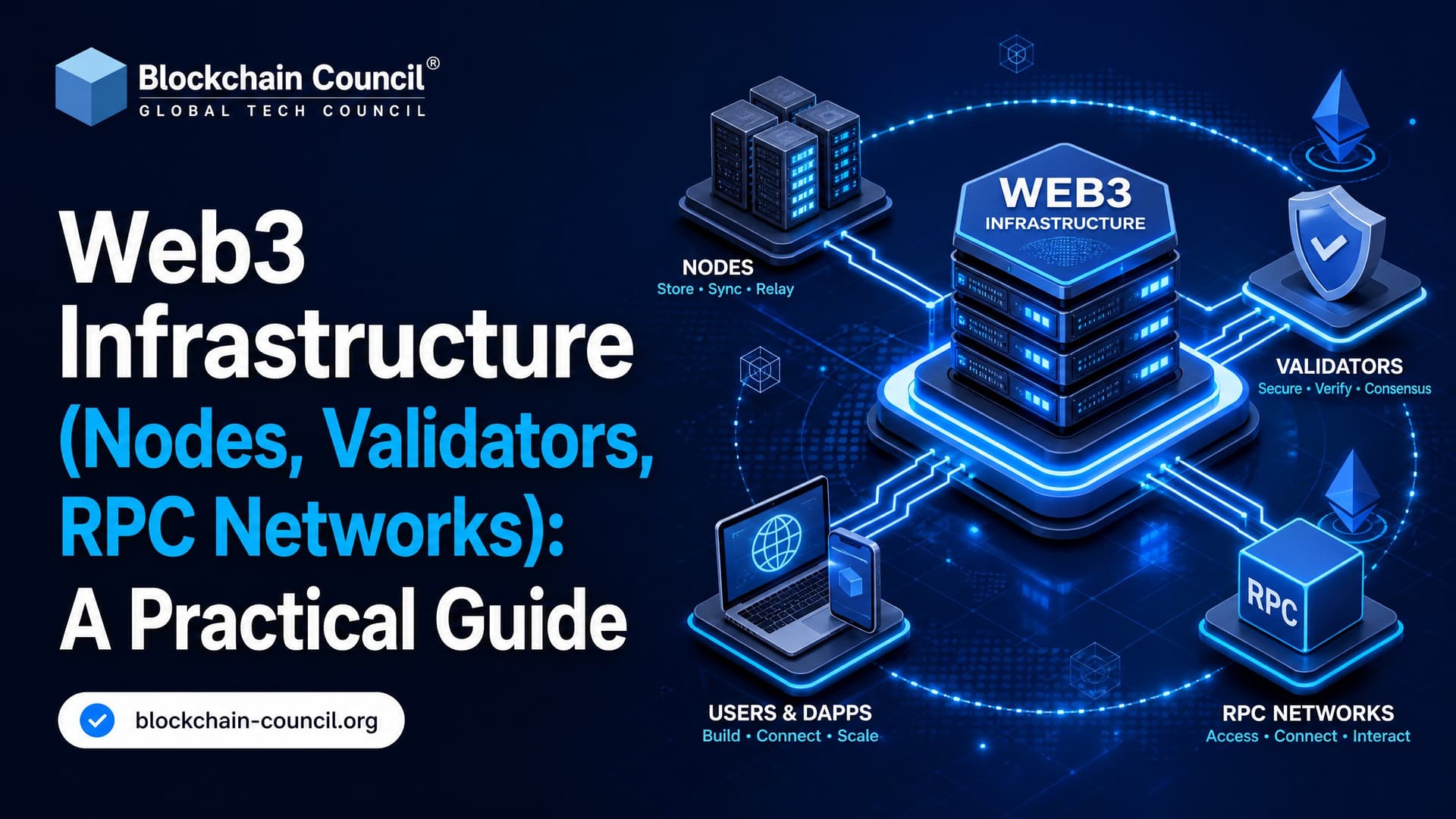
Web3 Infrastructure (Nodes, Validators, RPC Networks) is the operational layer that keeps blockchains alive and usable. Validators secure consensus. Nodes store and verify data. RPC networks give wallets, dApps, trading systems, explorers, and enterprise backends a way to read blockchain state and submit transactions.
That sounds simple until you run it in production. A public RPC endpoint that feels fine during testing can start returning stale reads, rate-limit errors, or the dreaded missing trie node response when your backend queries old Ethereum state from a pruned full node instead of an archive node. Small detail. Big outage.

What Web3 infrastructure actually does
At a high level, Web3 infrastructure is distributed computing for blockchains. It maintains state, propagates transactions, validates blocks, and exposes data through APIs. Nodes are the computers running client software that verify and share blockchain data across the peer-to-peer network. In practice the stack splits into three layers:
- Blockchain nodes: Machines running client software to store, verify, and share network data.
- Validator nodes: Nodes that participate in consensus by proposing or attesting to blocks.
- RPC nodes: API-facing nodes that answer application requests and broadcast signed transactions.
In modern production setups, these roles should not be casually mixed. To be blunt, putting public API traffic on the same machine that signs validator duties is asking for trouble. Validators need stability and isolation. RPC nodes need scale, caching, rate limiting, and protection from unpredictable user traffic.
Nodes, validators, and RPC networks explained
Validator nodes
A validator node takes part in blockchain consensus. In proof of stake systems, validators propose blocks, verify other blocks, sign attestations, and help enforce protocol rules. If they go offline or behave incorrectly, they can lose rewards or face penalties, depending on the network.
On Ethereum, a validator runs both a consensus client and an execution client. Client diversity matters because a serious bug in one dominant client can become a network-wide risk. Operators are encouraged to run different client implementations for exactly that reason, so no single bug can take down most of the validator set at once.
On Solana, validators act as trust anchors for the network. They vote on blocks, help secure the ledger, and contribute to decentralization metrics such as the Nakamoto coefficient. As of the 2025 to 2026 period, Solana ran several thousand nodes globally, including more than a thousand validators, with a Nakamoto coefficient in the high teens. Treat published figures as a snapshot and check current data before you plan capacity.
RPC nodes
RPC stands for Remote Procedure Call. In Web3, it usually means your application sends a JSON-RPC or WebSocket request to a node and receives blockchain data in return. A wallet asks for a token balance. A dApp reads contract state. A backend broadcasts a signed transaction. All of that touches RPC infrastructure.
RPC nodes are the interface layer between applications and chains. If the RPC endpoint lags, your app appears broken even when the blockchain itself is healthy.
Common RPC operations include:
- Reading account balances and token holdings
- Fetching blocks, logs, receipts, and contract state
- Broadcasting signed transactions
- Subscribing to live events through WebSockets
- Serving dashboards, bots, wallets, explorers, and analytics systems
RPC nodes do not participate in consensus. Their job is API performance. That means low latency, fresh data, reliable transaction propagation, and clean failure handling.
Full nodes, archive nodes, and light clients
A full node verifies blocks and keeps the current state needed to follow the chain. An archive node stores historical state as well. That distinction matters more than beginners expect.
For example, an Ethereum full node can usually answer current-state queries. But ask for contract storage at a block from two years ago, and a pruned full node may fail. You need an archive node for that. This is where many analytics teams get bitten during their first serious data project.
Light clients store less data and verify using headers, summaries, or proofs. They suit resource-constrained environments, but they still depend on full nodes for detailed data access.
Why validator and RPC roles are now separated
The separation between validators and RPC nodes is one of the clearest shifts in Web3 infrastructure design. The standard recommendation now is to keep validators dedicated to consensus while RPC nodes handle external requests. The reason is practical, not ideological.
Validator workloads are predictable and security-sensitive. RPC workloads are noisy. A popular mint, a trading bot loop, or a broken frontend can flood an endpoint with requests. If that endpoint sits on your validator, the validator can miss duties or become unstable.
A safer architecture looks like this:
- Keep validator nodes private, hardened, and minimally exposed.
- Run separate RPC node fleets for public or internal application traffic.
- Place RPC endpoints behind load balancers and API gateways.
- Monitor p95 and p99 latency, error rates, request volume, and chain head lag.
- Use at least two RPC providers, or one managed provider plus a self-hosted fallback, for critical systems.
This resembles traditional infrastructure design. Keep the control plane protected. Scale the data plane separately.
Performance expectations now
Web3 infrastructure is no longer a hobby server under someone's desk. High-throughput chains, Layer 2 networks, and institutional applications have pushed node operations into serious SRE territory.
Solana is the clearest case study. The network processes tens of millions of transactions per day with sub-second finality and very low fees. Market makers and high-frequency DeFi teams often target sub-50 millisecond RPC response times. In that world, jitter is not cosmetic. It can decide whether a transaction lands in the intended slot.
Hardware expectations have risen too. Solana validator and RPC setups commonly require high core counts, large memory footprints, fast NVMe storage, careful kernel tuning, and continuous monitoring. Plan for 16 or more physical CPU cores and 256 GB of RAM as a starting point, with 512 GB often preferred for headroom.
Ethereum and Layer 2 environments have different bottlenecks, but the procurement questions are similar:
- How fresh are reads during congestion?
- What are the p95 and p99 response times by region?
- What happens when a provider rate limit is reached?
- Does WebSocket delivery degrade under load?
- Can the provider support archive queries?
- How fast is incident response when transaction propagation slows?
Geography matters more than people assume. A London-based backend and a Singapore-based user can have very different experiences on the same provider, which is why teams measure endpoint performance from multiple global locations rather than one.
RPC networks for Layer 2 and multichain applications
Layer 2 networks such as Base, built on the OP Stack, rely heavily on RPC providers for developer access. Provider choice directly affects dApp reliability, scalability, and the user experience on the network.
The same pattern appears across Ethereum, Solana, Polygon, Arbitrum, Optimism, and newer appchains. Most teams do not want to maintain every node type themselves. They use managed RPC providers such as Chainstack, QuickNode, Alchemy, or Infura, or specialized decentralized RPC networks, then add their own monitoring and fallback logic.
My view: if you are building a wallet, trading product, or enterprise backend, one shared public RPC endpoint is not a production plan. It is a test setup. Use dedicated endpoints, regional routing, and a backup provider. If you need deep historical analytics, budget for archive access early.
Real-world use cases
Wallets and consumer dApps
Wallets use RPC endpoints to refresh balances, estimate gas, fetch NFTs, and submit signed transactions. When RPC data is stale, users blame the wallet, not the node provider. Fair or not, that is how support tickets arrive.
DeFi and trading systems
Market makers, liquidators, and arbitrage systems care about latency, transaction propagation, and read freshness. On Solana, MEV-aware infrastructure such as Jito has made validator and RPC strategy part of the trading stack.
Enterprise systems
Enterprises often use managed RPC services, self-hosted nodes, or hybrid models. A common pattern is a managed provider for scale, a self-hosted node for verification, and an indexing layer for application-specific queries.
Skills you need to work with Web3 infrastructure
If you want to work seriously with Web3 infrastructure, learn both blockchain fundamentals and infrastructure operations. You should understand consensus, the transaction lifecycle, JSON-RPC, WebSockets, Linux operations, monitoring, cloud networking, and security hardening.
For structured learning, Blockchain Council readers can explore certifications such as Certified Blockchain Expert™, Certified Blockchain Developer™, Certified Web3 Expert™, and Certified Smart Contract Developer™. Pair those concepts with hands-on practice using tools such as Hardhat, Foundry, MetaMask, Geth, Nethermind, Erigon, the Solana CLI, and real RPC dashboards.
How to choose the right infrastructure approach
Use the job to be done as your guide:
- Learning or prototyping: Start with a managed RPC endpoint and a testnet.
- Production dApp: Use dedicated RPC endpoints, monitoring, and fallback routing.
- Analytics: Use archive nodes or indexed data services. Full nodes are not enough for historical state.
- Validator operations: Isolate validators from public traffic and invest in uptime, key security, and alerting.
- High-frequency DeFi: Measure regional latency, jitter, propagation speed, and failure behavior under load.
Do not choose purely by advertised latency. Test the provider during network congestion. Check rate limits. Ask about archive support. Review status history. Run your own synthetic checks from the regions where your users or bots operate.
Next step
Set up a simple Web3 infrastructure lab this week: run a local development chain, connect to a managed Ethereum or Base RPC endpoint, subscribe to new blocks over WebSockets, and compare responses with a second provider. Then build toward certification with Certified Web3 Expert™ if you want architecture depth, or Certified Blockchain Developer™ if your goal is to build and deploy applications on top of this stack.
Related Articles
View All
Web3
Web3 Infrastructure Stack 2026: RPCs, Indexers, Oracles, Layer-2s, and Storage
A practical guide to the Web3 infrastructure stack in 2026: RPCs, indexers, oracles, Layer-2s, storage, and what you actually need for production reliability.

Web3
From Web2 to Web3: A Practical Migration Blueprint for Businesses (Wallets, Smart Contracts, and Token Incentives)
A practical Web2 to Web3 migration blueprint for businesses covering wallet integration, smart contract deployment, token incentives, hybrid architecture, and compliance.
Web3
How to Build a Web3 Startup? A Step-by-Step Guide
Summary Starting a Web3 startup involves understanding Blockchain basics and navigating decentralized finance (DeFi). Blockchain technology, evolving into Blockchain 4.0, is crucial for secure transactions, especially in the Metaverse with NFTs. Cryptocurrencies, like Bitcoin and Ether, play a…
Trending Articles

Top 5 DeFi Platforms
Explore the leading decentralized finance platforms and what makes each one unique in the evolving DeFi landscape.
How Blockchain Secures AI Data
Understand how blockchain technology is being applied to protect the integrity and security of AI training data.

Can DeFi 2.0 Bridge the Gap Between Traditional and Decentralized Finance?
The next generation of DeFi protocols aims to connect traditional banking with decentralized finance ecosystems.