

Verifiable Credentials in Web3: Trust Without Central Authorities

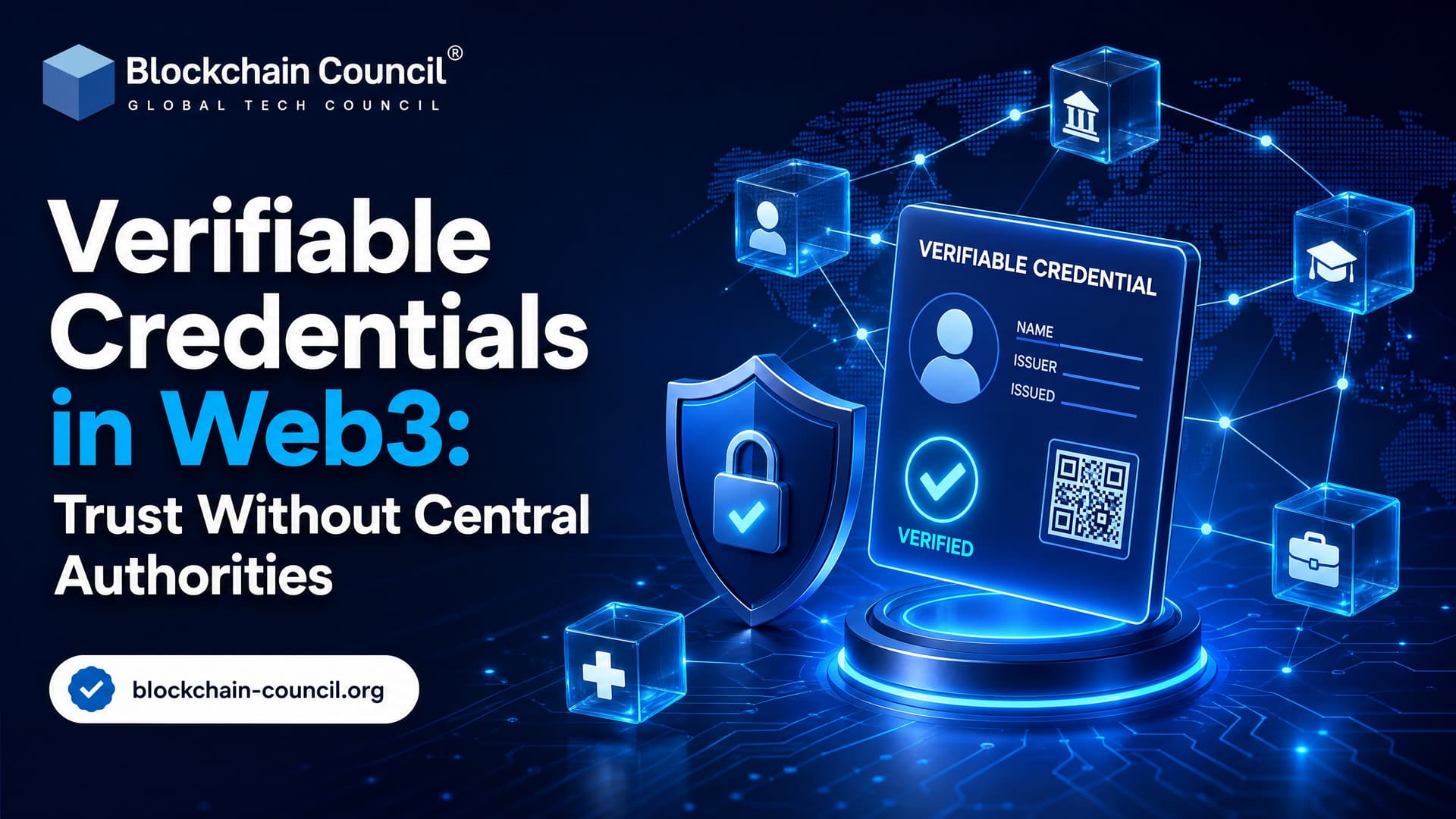
Verifiable Credentials in Web3 give people, organizations, devices, and AI agents a way to prove claims without asking one central database for permission. The short version: an issuer signs a claim, a holder stores it in a wallet, and a verifier checks the signature, status, and trust policy before accepting it.
That sounds simple. In practice, it changes how identity works online. Instead of uploading a passport scan to every exchange, job portal, DAO, or public service, you present a cryptographic proof that says only what the verifier needs to know. Passed KYC. Holds a valid license. Completed a certification. Is over 18. No extra document dump required.

What Are Verifiable Credentials?
A verifiable credential, often shortened to VC, is a tamper-evident digital credential. It may represent a degree, a government ID attribute, employment status, a product certificate, a KYC result, DAO membership, or machine identity.
The W3C Verifiable Credentials Data Model defines three main roles:
- Issuer: The party that creates and signs the credential, such as a university, bank, regulator, certification body, or enterprise.
- Holder: The person, organization, device, or agent that stores the credential, usually in a digital wallet.
- Verifier: The party that checks the credential and decides whether to accept it.
The credential is signed using public key cryptography. Change even one field after issuance and verification fails. Anyone who has worked with JSON-LD credentials has hit this the hard way: a changed @context URL, a mismatched verification method, or an expired key produces a blunt proof verification failed result. That is not a UX bug. It is the point.
In Web3, VCs are often tied to decentralized identifiers, or DIDs. The W3C DID Core specification describes DIDs as identifiers controlled by the subject, with DID documents that publish public keys and service endpoints. Common DID methods include did:key, did:web, did:ethr, and did:ion. Each has trade-offs. For a quick prototype, did:key is easy. For enterprise trust and domain control, did:web is usually more practical. For on-chain identity flows, did:ethr fits Ethereum-based stacks.
How Trust Works Without a Central Authority
Verifiable credentials do not remove trust. To be blunt, nothing in identity does. VCs make trust smaller, clearer, and testable.
Here is the usual verification path:
- The verifier receives a credential or a proof presentation from the holder.
- The verifier checks the issuer's digital signature against the issuer's public key.
- The public key is resolved through a DID document, a domain-based method, or a trusted registry.
- The verifier checks whether the credential has expired or been revoked.
- The verifier applies its own trust policy: which issuers count, what claims are required, and what risk level is acceptable.
No single platform has to sit in the middle of every transaction. A blockchain or distributed ledger may anchor identifiers, public keys, credential schemas, or revocation data. It acts as shared infrastructure, not as an all-knowing identity provider.
This is a useful distinction. A ledger can prove that a DID document existed at a point in time, or that a credential status list was updated. It cannot decide whether a university is legitimate, whether a bank performed KYC correctly, or whether a regulator should be trusted. Governance still matters.
Selective Disclosure and Zero-Knowledge Proofs
The strongest privacy case for VCs comes from selective disclosure. A holder should not need to reveal a full birth date just to prove age, or a full address just to prove jurisdiction.
With selective disclosure and zero-knowledge proof techniques, you can prove a property derived from a credential without exposing the raw credential data. For example:
- Prove you are over 18 without showing your date of birth.
- Prove you passed KYC without sharing a passport image.
- Prove you hold a professional certification without exposing your full learning record.
- Prove a supplier has a valid compliance certificate without publishing confidential trade data.
This matters for Web3 because public blockchains are bad places to put personal data. If an app writes personal identity information directly on-chain, that data is very hard to remove later. A better pattern is to keep sensitive claims off-chain, issue them as VCs, and use cryptographic proofs or hashes where on-chain logic needs verification.
Where Verifiable Credentials Are Being Used
Finance and KYC
Financial services are an obvious fit. A regulated institution can issue a credential stating that a user passed KYC, AML screening, or accredited investor checks. The user can then present that credential to another exchange, DeFi front end, tokenized asset platform, or lending service.
The verifier still makes its own decision. It may accept only credentials from certain banks, require a recent issuance date, or check sanctions-related attestations. The payoff is less document sharing, less repeated onboarding, and less sensitive data scattered across vendor systems.
Education and Professional Certifications
Degrees, course completions, and professional certifications are strong VC use cases. Employers and marketplaces can verify a credential instantly instead of emailing an institution or trusting a PDF.
For Blockchain Council learners, this area connects naturally with credentials such as Certified Web3 Expert™, Certified Blockchain Expert™, Certified Blockchain Developer™, and Certified Smart Contract Developer™. These are useful learning paths for professionals who want to understand both the technical stack and the trust model behind decentralized identity.
Supply Chain and Product Provenance
GS1, known globally for supply chain standards and product identifiers, has explored how verifiable credentials and DIDs can work with product and logistics data. The idea is practical: a product claim such as organic status, safety testing, customs clearance, or origin can be issued by a trusted body and verified by partners downstream.
This beats relying on a static logo or a scanned certificate. A verifier can check who issued the claim, whether it has been revoked, and whether it maps to the right product identifier.
Government Identity and Public Services
Government identity moves slower, but the fit is clear. VCs can represent digital identity cards, visas, permits, licenses, eligibility proofs, and public benefit credentials. Offline verification is especially valuable at borders, field offices, and disaster response sites where a live database call may not be available.
The hard part is not signing a credential. It is legal recognition, recovery after key loss, dispute handling, and cross-border trust. Those questions need policy work, not just better cryptography.
DAO Access, Reputation, and Web3 Governance
VCs can also support Web3-native reputation. A DAO may accept credentials for past contributions, conference attendance, code commits, governance participation, or identity verification. Smart contracts can use proofs derived from credentials to grant access or voting rights.
Be careful here. Reputation systems can turn into social credit systems if badly designed. Avoid permanent public identity trails unless users clearly understand the consequences.
AI Agents Need Verifiable Identity Too
As AI agents begin to book services, request data, sign transactions, and interact with Web3 protocols, they need a way to prove what they are allowed to do. Verifiable credentials can attach provenance to data and authority to actions.
An AI logistics agent, for example, may need to verify that a carrier has valid insurance and licensing before booking a shipment. A financial agent may need proof that a user meets eligibility rules before interacting with a tokenized asset market. A data marketplace may require credentials that show a dataset came from an approved source.
If you work in AI as well as Web3, pair decentralized identity study with Blockchain Council's Certified AI Expert™. The overlap is growing fast, especially around provenance, agent permissions, and machine-verifiable trust.
Challenges You Should Not Ignore
VC architecture is promising, but it is not magic. The main problems are practical:
- Interoperability: Wallets, DID methods, credential schemas, proof formats, and trust registries still vary widely.
- Key recovery: Lose your keys and you may lose access to credentials unless recovery is designed carefully.
- Correlation risk: Reusing the same DID everywhere can let verifiers track a person across contexts.
- Revocation privacy: Checking credential status can leak when and where a credential is used if the design is careless.
- Issuer trust: A signed credential from a weak issuer is still a weak credential.
- Centralization pressure: A few wallets, exchanges, or identity vendors could become gatekeepers if ecosystems do not stay open.
My view: for most enterprise projects, start with a narrow credential flow before building a full identity ecosystem. Pick one use case, one schema, one issuer group, one wallet model, and one revocation method. Measure verification success rates. Watch where users get stuck. Then expand.
What Developers and Enterprises Should Learn Next
If you are building with verifiable credentials in Web3, focus on these skills first:
- Understand the W3C Verifiable Credentials Data Model and DID Core concepts.
- Learn how credential schemas, issuer keys, DID documents, and status lists fit together.
- Use privacy-first patterns: selective disclosure, pairwise identifiers, and off-chain storage for personal data.
- Study zero-knowledge proof basics before connecting credentials to smart contracts.
- Write clear trust policies. Do not accept every credential just because the signature is valid.
The next practical step is simple: build a small issuer-holder-verifier demo, then test the failure cases. Revoke a credential. Rotate an issuer key. Change a credential field and confirm verification fails. After that, deepen your background with Certified Web3 Expert™ for architecture, or Certified Blockchain Developer™ if you want to build production-grade identity and smart contract integrations.
Related Articles
View All
Web3
Soulbound Tokens and Web3 Identity: Reputation, Credentials, and Trust
Soulbound Tokens bring non-transferable credentials, reputation, and identity attestations to Web3, with major promise and serious privacy trade-offs.

Web3
Web3 Identity for the Metaverse: Building Trust Across Virtual Worlds
Web3 identity for the metaverse uses DIDs, verifiable credentials, wallets, and soulbound tokens to build portable trust across virtual worlds.
Web3
Web3 Identity for DeFi: Reduce Fraud Without Exposing Users
Web3 identity for DeFi can reduce fraud with zk-KYC, verifiable credentials, and onchain reputation while limiting unnecessary user data exposure.
Trending Articles
The Role of Blockchain in Ethical AI Development
How blockchain technology is being used to promote transparency and accountability in artificial intelligence systems.

Can DeFi 2.0 Bridge the Gap Between Traditional and Decentralized Finance?
The next generation of DeFi protocols aims to connect traditional banking with decentralized finance ecosystems.
How to Install Claude Code
Learn how to install Claude Code on macOS, Linux, and Windows using the native installer, plus verification, authentication, and troubleshooting tips.