

How to Choose the Right Web3 Course: A Checklist for Smart Contracts, DeFi, NFTs, and DAOs


Choosing the right Web3 course is no longer about memorizing blockchain definitions. Modern Web3 education has shifted toward builder-ready skills: writing and deploying smart contracts, understanding DeFi protocol mechanics, working with NFT standards and metadata, and designing DAO governance and treasury controls. If your goal is to ship production-grade applications, your course should emphasize hands-on tooling, security practices, and real-world use cases rather than theory alone. Learners who want to develop a broader understanding of the ecosystem can explore Certified Web3 Expert.
This checklist helps you evaluate Web3 training programs across smart contracts, DeFi, NFTs, and DAOs, along with ecosystem relevance and security depth. Use it to compare curricula, avoid outdated material, and select a course aligned with your target role.

Step 1: Start with Your Target Role
The best Web3 course for you depends on what you want to build or contribute within the ecosystem. Before comparing modules, clarify your target outcome.
Smart contract developer: prioritize Solidity, testing, deployment, upgradeability, and security fundamentals.
dApp or full-stack Web3 developer: add wallet flows, indexing, off-chain integration, and product-oriented architecture.
DeFi builder or analyst: prioritize AMMs, lending, staking, oracle design, and protocol risk analysis.
NFT product developer: prioritize token standards, metadata, minting logic, marketplace mechanics, and use-case design.
DAO contributor or governance designer: prioritize proposal systems, voting models, treasury control, and governance failure modes.
Security-focused engineer: prioritize threat modeling, audit readiness, incident analysis, and secure development patterns.
For role-based skill validation, consider aligning your learning path with a role-specific credential such as Blockchain Council's smart contract, Web3, DeFi, or blockchain developer certifications. Developers focusing on contract implementation can also explore Certified Smart Contract Developer.
Step 2: Apply the Web3 Course Checklist
Web3 course quality is easiest to judge when you treat it like an engineering curriculum. A credible program should teach how Web3 primitives work together in production, including limitations and trade-offs. Use the following sections as a pass-fail checklist.
1) Smart Contracts: Does the Course Teach the Full Lifecycle?
Smart contracts are the execution layer behind most Web3 applications, but professional development requires more than syntax. Look for courses that cover the end-to-end lifecycle: design, implementation, testing, deployment, and review for security issues such as reentrancy and access-control failures.
What to Look For
Solidity (or a major contract language) with clear patterns for production contracts
Local development and testing frameworks covering unit tests, integration tests, and mocking
Deployment practice to Ethereum or another EVM chain, including testnet and mainnet concepts
Security review basics covering common vulnerability classes
Upgradeability patterns and their limitations, including admin key risk
Questions to Ask Before Enrolling
Do I deploy contracts in hands-on labs, or is the course limited to lectures?
Does the curriculum teach how to design access control, roles, and permissions?
Are contract upgrades covered realistically, including governance and operational risk?
2) DeFi: Does It Explain Protocols and Risk, Not Just Terminology?
DeFi represents one of the clearest real-world applications of smart contracts, but it is also where architectural mistakes can become costly. A strong DeFi module should connect concepts to the underlying smart contract logic, token standards, oracle dependencies, liquidity risk, and security trade-offs.
What to Look For
AMMs and how pricing and liquidity work in practice
Lending markets, collateralization, and liquidation mechanics
Staking and yield mechanics, including where incentives can misalign
Oracle integration and price-feed design considerations
Attack surfaces and exploit patterns that appear in real protocols
Protocol walkthroughs that explain architecture rather than just UI usage
Green Flag vs. Red Flag
Green flag: The course explains how AMM swaps, lending interest, and liquidation logic are implemented and tested at the contract level.
Red flag: The course defines DeFi categories but avoids discussing oracle risk, liquidity risk, and common security failure modes.
3) NFTs: Does It Cover Utility, Standards, and Metadata?
NFTs are frequently mischaracterized as collectibles. In rigorous courses, NFTs are taught as on-chain ownership records that depend on token standards, transfer rules, and metadata storage decisions. A useful NFT module should go beyond minting basics and address how NFTs function in games, digital rights management, and broader asset systems.
What to Look For
ERC-721 fundamentals and, ideally, ERC-1155 for semi-fungible assets
Metadata design, storage patterns, and trade-offs including off-chain storage considerations
Minting, burning, and transfer logic with permissioning and safety checks
Royalties and provenance concepts along with their practical limitations
Use-case design in gaming and digital asset ownership
Market, legal, and design constraints so learners understand real-world boundaries
4) DAOs: Does It Teach Governance and Treasury Control Realistically?
DAOs are governance systems built from smart contracts: voting, proposal execution, and treasury management. A credible DAO module should show how governance works operationally and where it can fail, whether through low participation, governance capture, or over-centralized admin control.
What to Look For
Governance tokens and voting models including token-weighted, delegated, and quorum-based approaches
Treasury management logic and spend permissions
Proposal lifecycle from creation to on-chain execution
Multi-sig overlays and constitutional constraints for risk control
Case studies of working DAO structures and documented failure modes
5) Ecosystem Coverage: Does It Reflect Today's Web3 Stack?
Web3 development spans multiple chains. Many programs center on Ethereum and EVM-compatible networks such as Polygon and BNB Chain, while also acknowledging that non-EVM chains like Solana use different programming models. A strong Web3 course should clearly define its target stack and teach portability concepts so you understand what transfers across ecosystems.
What to Look For
EVM fundamentals covering accounts, transactions, gas, and contract calls
At least one non-EVM comparison to illustrate different execution models
Wallets, addresses, and transaction flows including signing, approvals, and user safety
dApp integration covering APIs and off-chain components
Oracles and indexing infrastructure to support production applications
6) Security: Does It Treat Audit Readiness as Standard Practice?
Security is a core differentiator between introductory content and builder-grade education. Smart contracts are public, often immutable, and frequently control significant assets. Your course should treat audit readiness and secure design as foundational requirements, not optional additions.
What to Look For
Common vulnerabilities and how they manifest in real contracts
Testing strategy including negative tests and edge cases, with fuzzing as a bonus topic
Audit preparation covering documentation, invariants, and review checklists
Admin key and upgrade risk with realistic operational controls
Incident analysis and postmortem-style learning to develop engineering intuition
Hands-On Proof: What Projects Should a Strong Web3 Course Include?
A practical Web3 course should include projects that reflect real production patterns and demonstrate how primitives connect. Look for hands-on work such as:
Token issuance and vesting implemented with smart contracts and role-based access controls
A minimal DeFi application demonstrating swap, lending, or staking logic with risk considerations
An NFT contract with metadata handling and safe mint and transfer flows
A DAO module covering proposal creation, voting, and treasury execution
An end-to-end dApp connecting wallet signing, contract interactions, and off-chain components
How to Evaluate Instructor and Curriculum Credibility
Because Web3 tooling evolves quickly, outdated examples can reinforce incorrect practices. Evaluate credibility using evidence of practical alignment:
Recency: does the course reference current tooling and modern development patterns?
Builder emphasis: are deployments and tests required to complete the course?
Realism: does the course acknowledge that smart contracts are not appropriate for every workflow and should be used selectively for trust-sensitive logic?
Integration: are DeFi, NFTs, and DAOs taught as interconnected primitives rather than isolated definitions?
For learners comparing technical programs across related fields, Tech Certification options may provide additional learning pathways to consider alongside Web3-specific training.
Assessing Candidates for Web3 Roles
As blockchain technology continues to transform industries, organisations need professionals who understand its practical applications and technical foundations. Hiring the right talent requires more than reviewing qualifications; employers must also evaluate relevant knowledge and problem-solving skills. Platforms like HireValid can help organisations explore structured candidate assessments for more informed hiring decisions.
Conclusion: Choose a Web3 Course That Builds Production Skills
The right Web3 course should prepare you to build and reason about real systems: smart contracts across their full lifecycle, DeFi protocol mechanics and risk, NFT standards and metadata design, and DAO governance with treasury control. Equally important, it should treat security as foundational and maintain current ecosystem coverage across EVM and non-EVM contexts.
When comparing options, prioritize hands-on deployment, testing, and audit readiness, along with projects that connect smart contracts, DeFi, NFTs, and DAOs into a coherent end-to-end application. If you are mapping your learning to a specific role, Blockchain Council offers complementary training and certification programs covering Web3 development, smart contracts, DeFi, and broader blockchain engineering. Professionals interested in the business and promotional aspects of technology can also explore Marketing Certification.
FAQs
1. What is a Web3 course?
A Web3 course teaches concepts and technologies behind decentralized applications, blockchain networks, smart contracts, and digital assets. Depending on the curriculum, it may cover decentralized finance (DeFi), non-fungible tokens (NFTs), decentralized autonomous organizations (DAOs), and practical blockchain development.
2. How do I choose the right Web3 course for my career goals?
Start by identifying your preferred career path, such as blockchain development, smart contract auditing, DeFi research, NFT development, or DAO governance. Compare courses based on their curriculum, practical projects, instructor expertise, prerequisites, and relevance to your target role.
3. What should I look for in a smart contract development course?
Look for Solidity fundamentals, smart contract architecture, testing, deployment, security vulnerabilities, and blockchain development tools. A strong course should include hands-on projects and explain how to identify common issues such as reentrancy, access-control failures, and unsafe external calls.
4. How can I choose the best course for learning decentralized finance (DeFi)?
Choose a DeFi course that explains decentralized exchanges, liquidity pools, lending protocols, yield mechanisms, tokenomics, and protocol risks. Practical exercises using test networks or simulations can help you understand how DeFi applications operate without risking real funds.
5. What should an NFT course include?
An NFT course should cover token standards, metadata, minting, marketplaces, digital ownership concepts, and relevant smart contract functionality. Depending on your goals, it may also explore NFT utility, intellectual property considerations, royalties, and security risks.
6. How do I select a course focused on decentralized autonomous organizations (DAOs)?
Look for lessons on DAO governance, voting mechanisms, treasury management, governance tokens, proposal systems, and community coordination. Practical case studies can help you understand how DAOs make decisions and address challenges such as low voter participation and concentrated voting power.
7. Do I need programming experience before taking a Web3 course?
Not always. Introductory courses can teach blockchain fundamentals without requiring coding experience. However, smart contract development generally benefits from basic programming knowledge, while advanced development and auditing courses may require familiarity with JavaScript, Solidity, or related technologies.
8. Should I choose a beginner, intermediate, or advanced Web3 course?
Choose a level that matches your existing knowledge and practical experience. Beginners should start with blockchain fundamentals, intermediate learners can explore application development and protocol mechanics, and advanced learners may focus on smart contract security, protocol architecture, or specialized research.
9. Why are hands-on projects important in a Web3 course?
Hands-on projects help turn theoretical knowledge into practical skills. Building a token, deploying a smart contract to a testnet, creating a simple NFT application, or simulating a DeFi protocol can demonstrate your ability to apply concepts in realistic development scenarios.
10. How important is smart contract security when choosing a Web3 course?
Smart contract security is essential because vulnerabilities can expose applications and users to significant financial losses. Look for courses that cover threat modeling, testing, access controls, common attack patterns, secure coding practices, and auditing techniques.
11. Are Web3 certifications valuable for career growth?
Web3 certifications can demonstrate structured learning and familiarity with specific technologies. However, their value depends on the issuing organization's credibility, assessment quality, curriculum relevance, and employer recognition. Practical projects and demonstrable technical skills are also important.
12. How can I evaluate the credibility of a Web3 course provider?
Review the provider's background, instructor qualifications, published curriculum, assessment methods, student feedback, and examples of learner projects. Check whether course claims are transparent and whether the provider distinguishes educational credentials from professional licenses or guaranteed job outcomes.
13. Should I choose a self-paced or instructor-led Web3 course?
Self-paced courses offer flexibility and may suit learners balancing education with work. Instructor-led courses can provide structured schedules, direct feedback, and opportunities to ask questions. Your choice should depend on your learning style, available time, budget, and need for mentorship.
14. How much should I spend on a Web3 course?
Set a budget based on your career goals and the practical value offered. Compare the curriculum, project access, instructor support, assessments, and any additional costs before paying. An expensive course is not automatically better than an affordable program with strong learning materials.
15. How can I compare Web3 courses effectively?
Use a checklist to compare curriculum depth, practical projects, security coverage, instructor expertise, learning support, cost, and credential credibility. Give greater weight to the criteria most relevant to your intended role instead of choosing solely by popularity or certificate title.
16. What tools should a practical Web3 development course teach?
Depending on the specialization, useful tools may include Solidity, Remix, Hardhat or Foundry, blockchain explorers, wallets, testnets, and version control with Git. Advanced courses may also introduce static analysis, automated testing, and smart contract auditing tools.
17. Can I learn Web3 through free courses?
Yes. Free documentation, tutorials, developer resources, and community learning materials can provide a strong foundation in blockchain and Web3. Before paying for a course, explore free introductory resources to identify your interests and understand which skills you want to develop further.
18. How do I know whether a Web3 course offers job-ready skills?
Look for practical assignments, portfolio projects, realistic development workflows, security testing, and feedback on your work. Compare the course outcomes with requirements in current job descriptions for roles such as Solidity developer, blockchain engineer, smart contract auditor, or DeFi analyst.
19. What red flags should I watch for when selecting a Web3 course?
Be cautious of guaranteed employment or income claims, vague curricula, unverifiable credentials, outdated technical content, and courses that promote speculative investments as guaranteed opportunities. A credible program should clearly explain its learning outcomes, costs, prerequisites, and limitations.
20. What is the final checklist for choosing the right Web3 course?
Before enrolling, confirm that the course aligns with your career goal, matches your skill level, teaches relevant technologies, includes practical projects, addresses security where appropriate, and comes from a credible provider. Review the total cost, support options, and assessment process to make an informed decision.
Related Articles
View All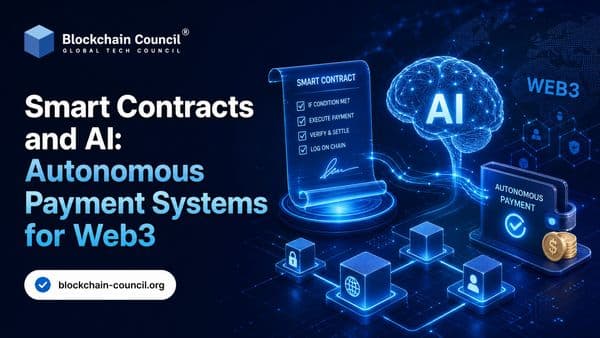
Web3
Smart Contracts and AI: Autonomous Payment Systems for Web3
Learn how smart contracts and AI agents create autonomous Web3 payment systems, including architecture, use cases, risks, and skills needed.

Web3
From Web2 to Web3: A Practical Migration Blueprint for Businesses (Wallets, Smart Contracts, and Token Incentives)
A practical Web2 to Web3 migration blueprint for businesses covering wallet integration, smart contract deployment, token incentives, hybrid architecture, and compliance.

Web3
Top Web3 Career Paths and the Courses You Need: From Smart Contract Developer to Web3 Product Manager
Explore top Web3 career paths, key skills, salary ranges, and role-based courses to become a smart contract developer, dApp builder, protocol engineer, or Web3 PM.
Trending Articles
AWS Career Roadmap
A step-by-step guide to building a successful career in Amazon Web Services cloud computing.
Top 5 DeFi Platforms
Explore the leading decentralized finance platforms and what makes each one unique in the evolving DeFi landscape.
Claude AI Tools for Productivity
Discover Claude AI tools for productivity to streamline tasks, manage workflows, and improve efficiency.