

Smart Contract Audit Checklist for Secure Blockchain Applications

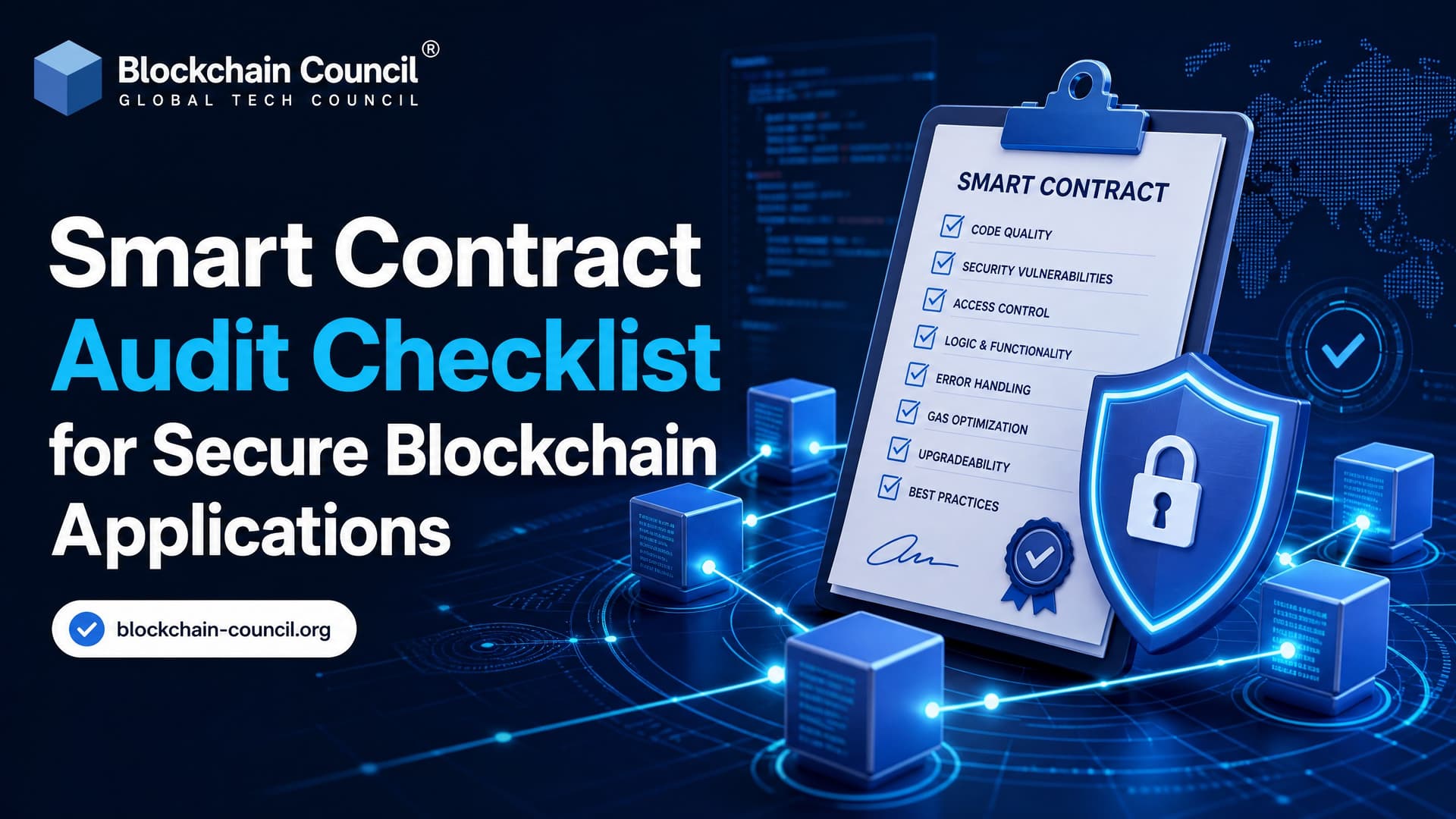
A smart contract audit checklist is not a paperwork exercise. It is the working map you use to freeze code, test assumptions, review risky logic, and deploy blockchain applications without leaving obvious attack paths open. If you are building a DeFi protocol, tokenization platform, NFT marketplace, DAO treasury, or enterprise blockchain workflow, the checklist below gives you a practical security baseline before an external auditor ever sees the repository.
To be blunt, an audit that starts with missing docs, moving commits, and half-written tests is already expensive. Auditors will spend paid time reconstructing intent instead of finding flaws. Prepare first.

What a Smart Contract Audit Checklist Should Cover
A modern smart contract audit checklist combines four areas:
- Preparation: scope, frozen commit, documentation, threat model, and test instructions.
- Security review: access control, reentrancy, arithmetic, validation, upgradeability, and business logic.
- Testing: unit tests, integration tests, fuzzing, invariant checks, coverage, and static analysis.
- Deployment controls: scripts, initialization, monitoring, timelocks, and post-audit change management.
Security firms such as Chainlink Labs, Quantstamp, and others describe similar audit phases: collect documentation, freeze code, run automated analysis, perform manual review, classify findings, fix issues, and publish a final report. The names differ. The discipline does not.
1. Define Audit Scope Before Reviewing Code
Start with scope. Not vibes. Exact files.
Create a frozen audit commit
Tag the repository before audit review, for example audit-v1. Auditors should know the exact commit hash. Do not keep merging features into the audit branch while review is in progress. If you must patch a critical issue, document it and agree whether the new commit is in scope.
List what is in scope and out of scope
Your scope document should include:
- Contract names and paths, such as
contracts/Vault.solorcontracts/governance/Timelock.sol. - Libraries written by your team.
- Upgradeable proxy contracts, initializers, and admin modules.
- External integrations, including oracles, bridges, staking contracts, and token contracts.
- Excluded files, such as mocks, test helpers, deployment experiments, and unmodified third party code.
For enterprise teams, add business acceptance criteria. Who can approve upgrades? What happens if a participant leaves the network? Which transactions are legally or operationally irreversible?
2. Prepare Documentation Auditors Can Use
Good documentation saves audit hours. It also forces your team to explain the protocol clearly enough to spot design gaps.
Write a protocol overview
Include the application purpose, system architecture, actor roles, trusted components, untrusted components, and flow of funds. A short diagram is helpful. A five-minute walkthrough video is even better when value moves through several contracts.
Document public interfaces with NatSpec
Every public and external function should include NatSpec annotations such as @notice, @param, and @return. Keep it specific. "Deposits funds" is weak. "Deposits USDC into the senior tranche and mints shares using the current exchange rate" is useful.
State assumptions and accepted risks
Write down assumptions that affect security:
- Oracle prices are fresh within a defined time window.
- Governance can pause withdrawals during emergency response.
- Block timestamps may drift slightly and must not decide large payouts alone.
- A listed external contract is trusted, semi-trusted, or untrusted.
This matters. Many audit findings are not Solidity bugs. They are incorrect assumptions written into code.
3. Review Core Smart Contract Security Controls
This is the heart of any smart contract audit checklist.
Access control
Check every sensitive function. Minting, burning, pausing, upgrading, changing fees, setting oracle addresses, withdrawing treasury assets, and assigning roles must be restricted.
If you use OpenZeppelin Ownable or AccessControl, test failure paths. A common Hardhat test failure looks like reverted with custom error 'OwnableUnauthorizedAccount(...)' in OpenZeppelin Contracts 5.x. That is good when it happens for unauthorized users. It is bad when your deployer is the only address that can act and you forgot to transfer ownership to a multisig.
External calls and reentrancy
Review all call, token transfers, callbacks, hooks, and cross-contract interactions. Use checks-effects-interactions where possible. For withdrawals, prefer pull payment patterns when the receiver may be untrusted.
Do not assume ERC-20 tokens behave perfectly. Some tokens do not return a boolean. Some charge transfer fees. Use audited helper libraries such as OpenZeppelin SafeERC20 when handling tokens.
Input validation
Treat every external input as hostile. Validate amounts, addresses, array lengths, deadlines, slippage limits, signatures, and role identifiers. Reject zero addresses where they would lock funds. Reject empty arrays when they create no-op governance actions that still emit misleading events.
Arithmetic, rounding, and financial logic
Solidity 0.8.x checks integer overflow and underflow by default, but that does not solve rounding risk. Financial contracts fail on precision errors all the time. Decide whether rounding favors the protocol, the user, or neither. Document it. Test tiny amounts, maximum amounts, and decimal mismatches between tokens such as USDC with 6 decimals and WETH with 18 decimals.
State machines and invariants
Define what must always be true. Examples:
totalAssets >= totalPrincipalfor a lending vault, if that is part of the design.sum(userBalances) == totalSupplyfor custom accounting.- A proposal cannot move from
Executedback toQueued.
Then test those invariants with tools, not hope.
Gas limits and denial of service
Unbounded loops are dangerous. A loop over all token holders, all voters, or all stakers may work in tests and fail on mainnet once the set grows. Design batch processing, pagination, or user-initiated claims instead.
Randomness and timing
Do not use block.timestamp, blockhash, or block.number for high-value randomness. Validators can influence timing within limits. If randomness matters, use a proven oracle design such as Chainlink VRF and still test callback behavior.
4. Test Before the External Audit
Auditors are not your QA department. Bring a passing test suite.
Coverage targets
Use coverage as a signal, not a trophy. A useful readiness target is at least 90 percent coverage for statements, functions, and branches, with 95 percent or higher branch coverage for critical contracts. For core accounting and upgrade paths, aim for 100 percent branch coverage where practical.
Branch coverage matters more than line coverage because the bug is often in the path you forgot: failed transfer, expired deadline, unauthorized caller, zero liquidity, stale oracle, or already-executed proposal.
Fuzz and invariant testing
Use Foundry, Echidna, or similar tools for property-based testing. In Foundry, invariant tests can run many random call sequences against your contracts. One real pattern that catches teams: the invariant passes for direct deposits and withdrawals, then fails when a fee-on-transfer token is substituted because internal accounting credits the requested amount, not the received amount.
Run fuzzers for long enough to matter. For high-risk code, a 24-hour run with no invariant violations is a reasonable pre-audit signal.
Static analysis and linting
Run Slither before audit submission. Fix the findings or document why they are false positives. Slither warnings about reentrancy, unchecked transfer return values, shadowing, and dangerous strict equality are not noise until you prove they are safe.
Add Solhint and Prettier-Solidity to CI. Style checks will not stop an exploit, but consistent code makes manual review faster and less error-prone.
5. Check Upgradeability and Deployment
Upgradeable contracts add operational risk. They are useful, but they are not free.
- Protect upgrade functions with strict admin controls, ideally a multisig and timelock for production systems.
- Give users an exit window before major upgrades when funds are at risk.
- Test initializer logic. Constructors do not initialize proxy storage.
- Verify storage layout changes before upgrades.
- Run deployment scripts on a forked network before mainnet.
A beginner mistake is testing the implementation contract directly, then deploying a proxy and finding key storage values are zero because initialize() was never called. Another classic is calling it twice. Older OpenZeppelin upgradeable contracts often revert with Initializable: contract is already initialized. Your tests should prove both paths.
6. Demand Evidence-Based Audit Findings
A useful audit report should not simply say "possible reentrancy." It should show the affected function, exploit path, severity, assumptions, proof of concept where appropriate, and remediation guidance.
Classify findings by severity:
- Critical: direct loss of funds or protocol takeover.
- High: serious exploit with realistic conditions.
- Medium: limited exploitability or dependent on specific conditions.
- Low: hard-to-exploit issue or defensive improvement.
- Informational: clarity, maintainability, or documentation issue.
After fixes, add regression tests. If a reentrancy bug was fixed, write a malicious receiver test. If access control was missing, prove the wrong caller reverts.
7. Monitor After Deployment
The audit does not end at deployment. Monitor events, admin actions, abnormal withdrawals, oracle updates, role changes, and upgrade proposals. Design events with enough context: caller, affected account, previous value, new value, amount, and relevant identifiers.
Keep static analysis in CI/CD. Re-audit meaningful changes, especially new external integrations, upgrade logic, accounting formulas, or governance changes.
Smart Contract Audit Checklist for Teams
- Freeze the code and tag the audit commit.
- Define exact in-scope and out-of-scope files.
- Prepare architecture docs, threat model, and flow of funds.
- Add NatSpec to all public and external interfaces.
- Review access control for every privileged function.
- Check reentrancy risks and external call ordering.
- Validate all inputs and untrusted contract responses.
- Test arithmetic, rounding, and decimal assumptions.
- Define invariants and run fuzz testing.
- Run Slither, linting, and coverage reports in CI.
- Test deployment scripts, proxy initialization, and upgrades.
- Add regression tests for every fixed finding.
- Monitor on-chain events and admin operations after launch.
Build the Skills Behind the Checklist
If you want to apply this checklist as a developer or security reviewer, study Solidity, EVM execution, common vulnerability classes, and testing tools such as Hardhat, Foundry, Slither, and Echidna. Blockchain Council readers can use this article as a practical companion while exploring learning paths such as Certified Smart Contract Developer™, Certified Blockchain Developer™, and Certified Blockchain Expert™.
Your next step is simple: take one contract in your current project, write three invariants for it, run Slither, and document every privileged function. That small exercise will tell you quickly whether your audit readiness is real or just assumed.
Related Articles
View All
Smart Contracts
Smart Contract Certification Guide: How to Validate Your Blockchain Skills
Learn how smart contract certification validates blockchain skills, which developer or auditor path to choose, and how to prove expertise with real projects.

Smart Contracts
Smart Contract Interview Questions and Answers for Blockchain Developers
Prepare for smart contract interviews with practical Solidity, EVM, gas, security, testing, DeFi, Layer 2, and upgradeability questions and answers.

Smart Contracts
Smart Contract Oracles Explained: Connecting Blockchain Apps to Real-World Data
Smart contract oracles connect blockchain apps to real-world data, enabling DeFi, insurance, IoT, gaming, compliance, and secure Web3 automation.
Trending Articles

Can DeFi 2.0 Bridge the Gap Between Traditional and Decentralized Finance?
The next generation of DeFi protocols aims to connect traditional banking with decentralized finance ecosystems.
Claude AI Tools for Productivity
Discover Claude AI tools for productivity to streamline tasks, manage workflows, and improve efficiency.
Blockchain in Supply Chain Provenance Tracking
Supply chains are under pressure to prove not just efficiency, but also authenticity, sustainability, and fairness. Customers want to know if their coffee really is fair trade, if the diamonds are con