

AI-Powered Smart Contract Auditing: Detecting Vulnerabilities Before Deployment
 Suyash Raizada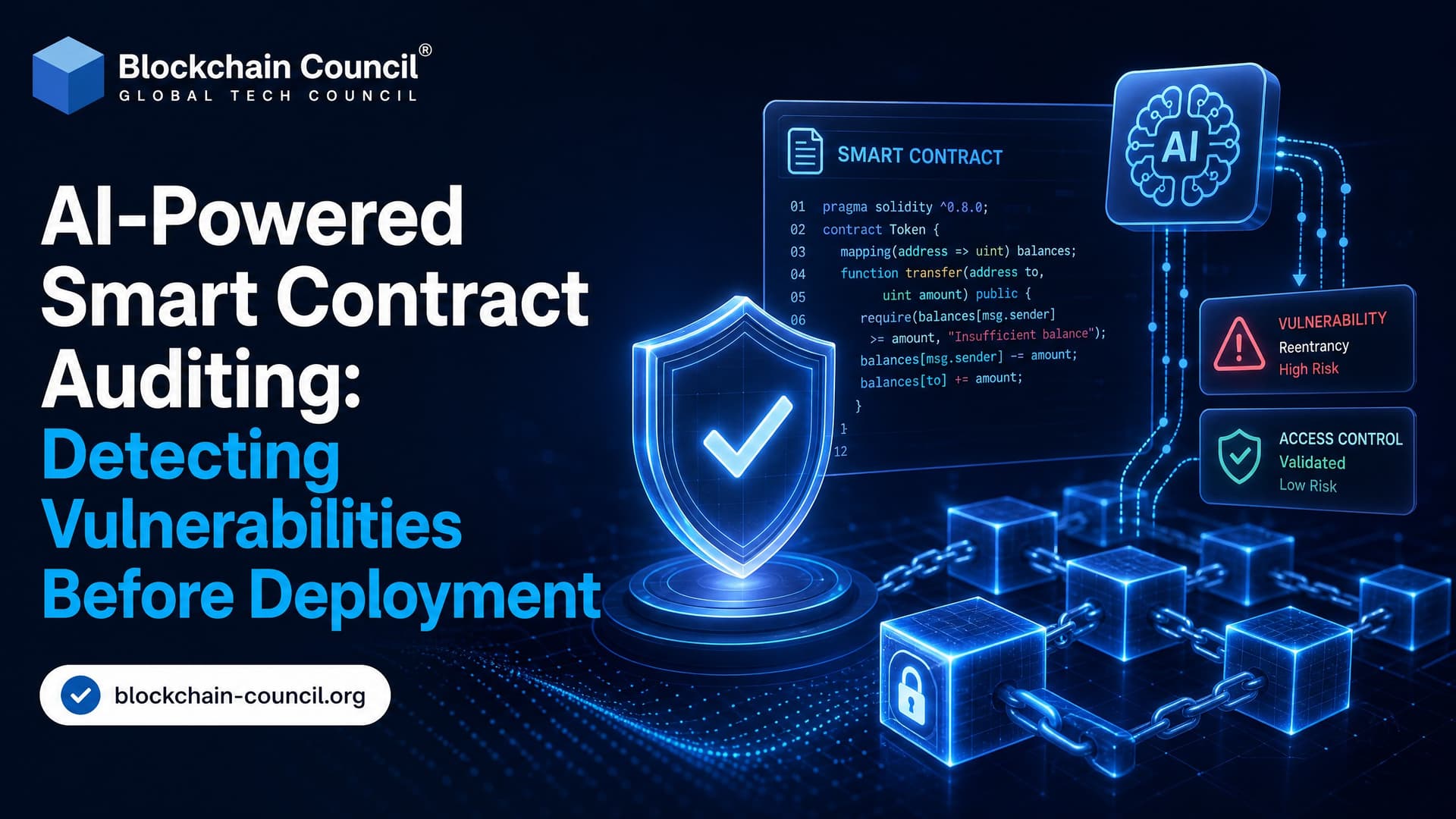
AI-powered smart contract auditing is becoming a practical security layer for Web3 teams that need to detect vulnerabilities before deployment. By combining machine learning, static analysis, fuzzing, and large language model reasoning, these systems help developers identify reentrancy risks, access control flaws, gas inefficiencies, and logic errors earlier in the software lifecycle.
While AI can accelerate review and reduce the burden on human auditors, it does not replace expert judgment. The strongest results come from using AI as a continuous development-time assistant and pairing it with professional audit review before contracts go live.

What Is AI-Powered Smart Contract Auditing?
AI-powered smart contract auditing is the process of analyzing, testing, and validating smart contract code with artificial intelligence and machine learning models. The goal is to improve security, correctness, and efficiency before immutable code is deployed on-chain.
Traditional smart contract audits rely heavily on manual code review by blockchain security engineers, supported by testing, static analyzers, and formal methods. AI-driven audits add another layer: pattern recognition trained on historical vulnerabilities, exploit data, audit reports, and ecosystem best practices.
This makes AI particularly useful for detecting recurring vulnerability classes such as:
- Reentrancy attacks caused by unsafe external calls.
- Access control failures that allow unauthorized users to execute privileged functions.
- Integer overflows and underflows in older Solidity patterns.
- Unsafe state transitions across complex contract functions.
- Gas inefficiencies that may increase cost or create denial-of-service risks.
- Logic errors that break intended protocol behavior.
For professionals building expertise in this area, Blockchain Council programs in smart contract development, blockchain security, and blockchain developer certification can provide useful foundations for understanding how audits fit into secure Web3 engineering.
Why AI Auditing Matters Before Deployment
Smart contracts are difficult to modify once deployed, especially when they manage assets, governance rights, or protocol-critical infrastructure. A vulnerability found after deployment can lead to emergency patches, governance interventions, reputational loss, or irreversible asset theft.
AI-powered smart contract auditing helps shift security left. Instead of waiting for a single pre-launch audit, teams can scan code continuously as developers write, update, and merge contracts. This development-time model reduces trivial and structural issues before a formal human audit begins.
AI systems can analyze contracts in minutes, while manual audits often take days or weeks depending on codebase size and complexity. This speed does not make AI more authoritative than human review, but it does create a faster feedback loop for engineering teams.
How AI-Powered Smart Contract Auditing Works
Training Data and Knowledge Sources
AI auditing tools are typically trained or calibrated on large collections of smart contract security knowledge. These may include previous audit reports, public exploit write-ups, known vulnerability databases, secure coding guidelines, and synthetic contracts designed to represent specific bug patterns.
Several commercial auditing tools state that their models draw on historical audit data, common and emerging vulnerabilities, past exploits, and current ecosystem standards. This reflects a broader industry trend toward data-driven audit assistance rather than static rule checking alone.
Static Analysis and Pattern Detection
Static analysis examines code without executing it. AI-enhanced static analysis can detect suspicious patterns such as external calls before state updates, missing access modifiers, unchecked return values, or insecure token transfer logic.
Pattern detection is valuable because many smart contract exploits reuse familiar structures. AI can rapidly compare new code against known insecure designs and flag likely risks for developer review.
Data-Flow and Control-Flow Analysis
Modern tools also analyze how data moves through a contract and how execution can flow across functions. This helps identify unsafe dependencies between state variables, user inputs, and privileged operations.
For example, if a contract allows a user-controlled value to influence withdrawal logic, an AI auditor may flag the path for deeper inspection. This is especially important in DeFi systems, where state transitions, incentives, and external calls interact in complex ways.
Fuzzing and Auto-Generated Tests
Fuzzing generates many inputs to explore unexpected behaviors. AI can make fuzzing more targeted by suggesting inputs, refining exploit hypotheses, and prioritizing branches that look security-sensitive.
Instead of relying only on predefined test cases, AI-assisted fuzzing can search for edge cases that developers may not have anticipated. This is useful for contracts with complex arithmetic, conditional logic, or multi-step workflows.
Large Language Model Reasoning
Large language models can read smart contract code and explain potential vulnerabilities in natural language. They can summarize intent, identify assumptions, and help developers understand why a pattern may be dangerous.
LLMs are also useful for generating remediation suggestions. However, developers should validate every suggested fix, because language models may misunderstand protocol context or produce incomplete recommendations.
Benefits of AI Smart Contract Audits
Faster Security Feedback
One of the clearest benefits is speed. AI tools can scan contracts quickly and give developers near real-time feedback in local environments, code review workflows, or CI/CD pipelines.
This helps teams fix issues while the code is still fresh, rather than discovering them during a late-stage audit when architectural changes are more expensive.
Greater Coverage at Scale
AI systems can process large codebases, repeated commits, and multiple contracts across networks. This scale is difficult for human teams to match manually, especially in fast-moving Web3 projects with frequent releases.
By scanning every pull request, AI auditors can prevent common defects from reaching final review. Human auditors can then focus on higher-value tasks such as threat modeling, exploitability analysis, and protocol economics.
Consistency Across Reviews
AI applies the same review logic consistently. It does not get tired, overlook repetitive patterns, or rush through routine checks. This consistency is useful for catching baseline issues such as missing role checks, unsafe approvals, or known reentrancy structures.
Better Documentation for Developers
Many AI auditing platforms provide severity labels, explanations, affected code locations, and suggested fixes. These reports help developers learn from findings and create an audit trail for remediation.
Teams building internal security maturity can combine these reports with training paths such as Blockchain Council blockchain, Web3, and cybersecurity certifications to strengthen both development and governance practices.
Limitations and Risks of AI Auditing
AI-powered smart contract auditing is powerful, but it has important limitations.
False Positives
AI tools may flag code that appears risky but is not exploitable in context. Too many false positives can slow teams down or create alert fatigue. Findings should be triaged by developers or auditors who understand the protocol.
Limited Context Understanding
Smart contract risk is not only about code syntax. It also depends on business rules, token economics, governance design, oracle assumptions, liquidity conditions, and cross-contract interactions. AI often lacks full contextual understanding in highly complex systems, especially DeFi protocols.
Novel and Economic Exploits
AI performs best when vulnerabilities resemble patterns found in training data. It is less reliable for entirely new bug classes or sophisticated economic attacks. Human auditors still outperform AI on complex exploitability judgments and system-wide behavior analysis.
Data Quality and Model Maintenance
AI auditors depend on current, high-quality datasets. As attackers discover new techniques, tools must be updated with recent exploits, audit findings, and emerging best practices. A stale model can miss modern attack patterns.
Best Practices for Using AI Before Deployment
Organizations should treat AI-powered smart contract auditing as part of a layered security strategy, not as a final approval mechanism.
- Integrate AI into development workflows: Run scans on commits, pull requests, and CI/CD builds.
- Prioritize high-severity findings: Focus first on asset loss, privilege escalation, and critical state manipulation risks.
- Validate results manually: Have engineers or auditors confirm exploitability and business impact.
- Use AI before formal audits: Remove routine issues so human auditors can focus on deeper risks.
- Combine with fuzzing and testing: Use unit tests, property tests, invariant tests, and AI-assisted fuzzing together.
- Maintain remediation records: Document findings, fixes, and retest results for accountability.
- Do not skip expert review: Use professional audits for production contracts, especially those handling funds or governance.
Future Outlook: Human-AI Collaboration in Smart Contract Security
The future of smart contract auditing is likely to be continuous, automated, and collaborative. AI systems will become standard in developer tooling, while auditors will use AI to map codebases, generate hypotheses, and prioritize complex review areas.
Autonomous auditing agents point toward workflows where AI proactively investigates Solidity contracts, highlights risk paths, and supports auditors with structured insights. At the same time, cross-chain protocols, modular architectures, and advanced DeFi mechanisms will require more human expertise, not less.
As models improve, they may handle broader vulnerability classes and provide better reasoning over protocol invariants. Final assurance, however, will still depend on skilled professionals who understand security engineering, blockchain architecture, economics, and adversarial thinking.
Conclusion
AI-powered smart contract auditing is already valuable for detecting vulnerabilities before deployment. It accelerates feedback, improves coverage, reduces routine audit workload, and helps teams identify common issues before they become expensive or irreversible.
Its best use is not as a replacement for human auditors, but as a force multiplier. Developers can use AI during coding and testing, auditors can use it to focus their efforts, and enterprises can integrate it into broader risk management processes.
For professionals aiming to build secure Web3 systems, combining practical AI audit tools with structured learning in smart contracts, blockchain development, and cybersecurity is a strong path forward. Blockchain Council certifications and courses can support that journey by helping teams understand both the technical foundations and the security practices required for production-grade blockchain applications.
Related Articles
View All
Smart Contracts
Best Smart Contract Development Tools for Solidity, Testing, and Auditing
A practical guide to the best smart contract development tools for Solidity, testing, fuzzing, auditing, formal verification, and monitoring.

Smart Contracts
Smart Contract Auditing Guide: Process, Tools, and Skills Required
Learn the smart contract audit process, key tools, common vulnerabilities, and skills needed to review Solidity and EVM contracts securely.

Smart Contracts
Common Smart Contract Vulnerabilities Every Developer Must Know
Learn the most common smart contract vulnerabilities, including access control flaws, reentrancy, oracle manipulation, flash loans, and upgrade risks.
Trending Articles

Top 5 DeFi Platforms
Explore the leading decentralized finance platforms and what makes each one unique in the evolving DeFi landscape.
How Blockchain Secures AI Data
Understand how blockchain technology is being applied to protect the integrity and security of AI training data.
What is AWS? A Beginner's Guide to Cloud Computing
Everything you need to know about Amazon Web Services, cloud computing fundamentals, and career opportunities.