

How to Audit a Smart Contract: Tools, Best Practices, and a Step-by-Step Workflow
 Suyash Raizada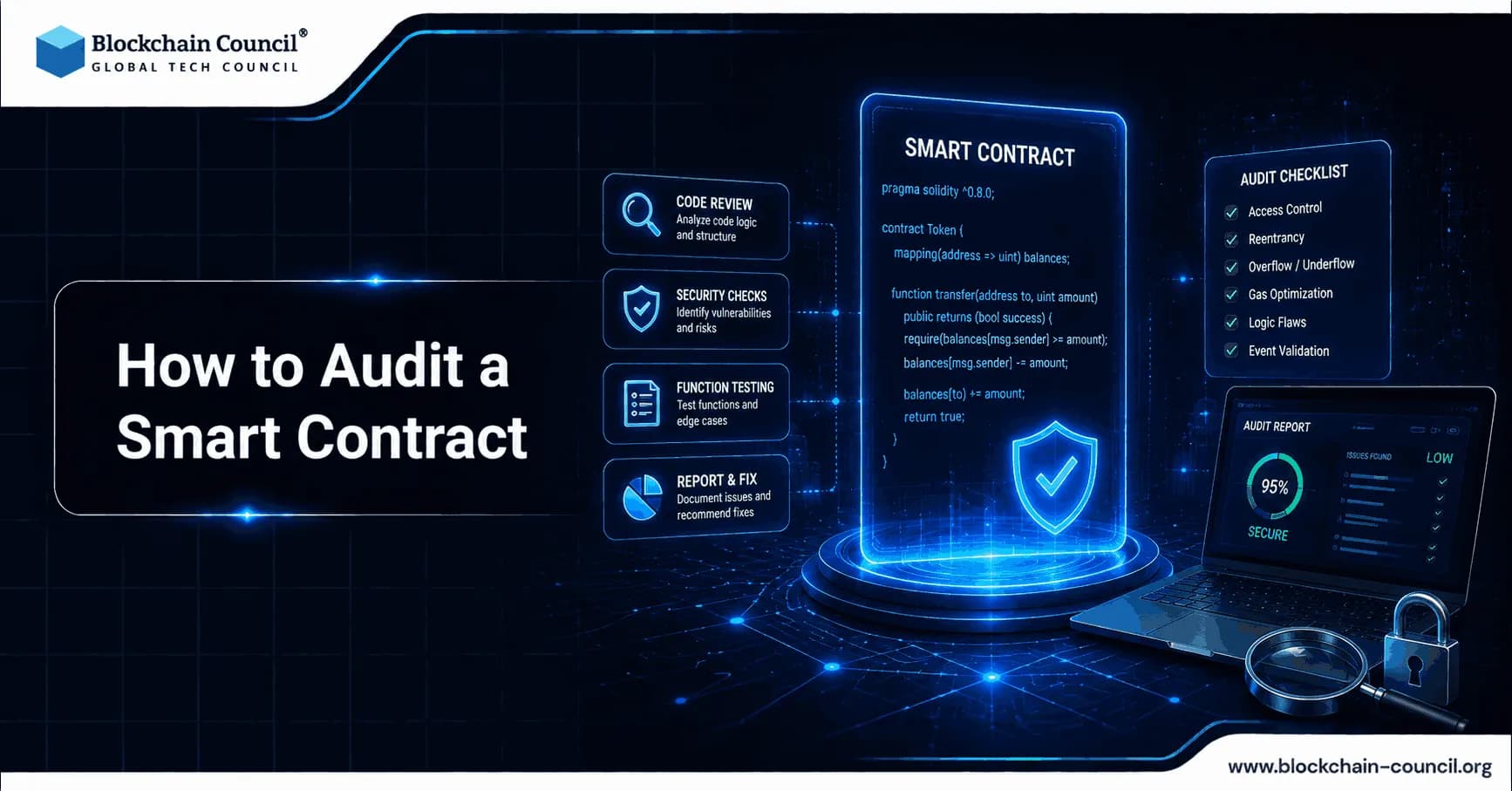
How to audit a smart contract is no longer a niche skill. It is a specialized security discipline that blends software engineering, cryptography, and adversarial thinking. The stakes are high because smart contracts often hold significant value, are transparent to attackers, and can be difficult or costly to change once deployed. Industry reporting from Immunefi and Chainalysis has consistently documented billions of dollars in annual losses, with a large share attributed to smart contract vulnerabilities and protocol logic flaws. That reality has made smart contract audits a baseline expectation for serious DeFi launches, NFT marketplaces, and enterprise blockchain deployments.
This guide presents a practical, research-driven workflow, the core tools used by professional auditors, and the best practices that help teams reduce risk before and after an audit.

As blockchain adoption continues to grow, organizations increasingly need professionals who can identify vulnerabilities before they become costly exploits. A Certified Smart Contract Auditor credential helps build practical expertise in security analysis, vulnerability assessment, testing methodologies, and blockchain risk management, providing a strong foundation for conducting effective smart contract reviews.
Why smart contract auditing is different from traditional security reviews
Smart contract audits differ from typical application security reviews in several important ways:
Immutability and upgrade risk: vulnerabilities can be permanent or require complex migrations to fix.
Direct financial impact: many issues convert immediately into fund loss, governance takeover, or protocol insolvency.
Attacker visibility: contracts are public, allowing attackers to simulate every execution path.
Composability: risks propagate across interconnected protocols, bridges, oracles, and liquidity venues.
Smart contract security also benefits from a broader understanding of software engineering, cloud infrastructure, cybersecurity, and modern development practices. A Tech Certification helps professionals strengthen these complementary technical skills, making it easier to evaluate blockchain applications within larger enterprise technology environments.
Modern audits therefore combine threat modeling, automated analysis, deep manual review, and operational security validation rather than relying on code scanning alone.
Step-by-step workflow: how to audit a smart contract
Methodologies vary by firm, but most professional audits follow a consistent sequence. Use the workflow below as a repeatable blueprint for internal reviews or third-party engagements.
Step 0: Pre-audit preparation (project team)
The fastest, highest-signal audits happen when the project team prepares the codebase and provides context upfront.
Code cleanliness: remove dead code, maintain a clear folder structure, add comments for non-obvious assumptions, and enforce consistent style with tools like solhint for Solidity.
Specifications and invariants: document functional intent, security assumptions, and invariants such as supply conservation, access boundaries, and parameter constraints.
Robust tests: ship unit and integration tests that cover edge cases, revert paths, and critical invariants. Add fuzz or invariant tests for core components.
Ops readiness: prepare deployment scripts, upgrade mechanisms, admin role documentation, and incident response procedures, including pause or circuit breaker logic where applicable.
Step 1: Information gathering and scoping
Auditors begin by defining what is being audited, under what assumptions, and what a realistic threat model looks like.
Business and protocol understanding: identify which assets are at risk, map the user flows, and define what failure looks like in practice.
Threat model: assess likely adversaries, capital requirements, MEV capabilities, governance influence, and attack motivations.
Dependencies: catalog oracles, DEX integrations, bridges, external protocols, and off-chain components.
Known issue research: reviewers consult public vulnerability databases and prior audit reports to identify recurring pitfalls in similar modules.
Deliverables at this stage typically include a written scope, list of contracts and commit hashes, environment versions, and an agreed communication process.
Step 2: Automated analysis and tooling
Automation improves coverage and catches common issues, but it does not replace human reasoning. A standard tool-assisted phase includes static analysis, fuzzing, and dependency checks.
2.1 Static analysis (pattern detection and symbolic reasoning)
Static tools scan source code or bytecode without executing the contract. Common options include:
Slither for Solidity vulnerability patterns, dangerous code smells, and design anti-patterns.
Mythril or MythX for symbolic execution and vulnerability discovery covering reentrancy and authorization issues.
Semgrep with Solidity rules and custom patterns tailored to the specific codebase.
Solhint for linting and style rules that often surface risky constructs early.
For non-EVM ecosystems, the equivalents are typically language toolchains combined with specialized rulesets, such as Clippy and cargo-audit for Rust (common in Solana and CosmWasm), alongside chain-specific frameworks like Anchor for Solana.
2.2 Fuzzing and property-based testing
Fuzzers generate large volumes of inputs to expose unexpected states and invariant violations. Widely used tools include:
Echidna for property-based fuzzing of Solidity contracts.
Foundry (forge fuzz and invariant testing) for fast fuzzing and test iteration.
Hardhat testing plugins, often combined with custom scripts.
Effective fuzzing depends on meaningful properties such as conservation of balances, monotonic parameter bounds, and correct access control under adversarial input sequences.
2.3 Gas and economic analysis
Not all security issues involve code bugs. Some stem from economics or runtime limits:
Gas profiling to detect gas griefing and denial-of-service risks from expensive loops or unbounded operations.
Simulations using tools like Tenderly to model abnormal flows, failure scenarios, and adversarial transaction ordering.
MEV and oracle stress testing to examine sandwich attacks, price manipulation, and flash-loan-driven conditions.
Step 3: Manual, context-aware code review
This is the core of how to audit a smart contract properly. Automated tools flag patterns, but human reviewers validate protocol intent, cross-contract interactions, and economic edge cases.
3.1 Walkthroughs, state machines, and invariant validation
Specification match: confirm that code behavior matches the documented design.
State transitions: check lifecycle steps such as initialization, pausing, liquidation, settlement, and upgrade flows.
Cross-function interactions: verify that calling sequences cannot bypass intended checks.
Invariant reasoning: validate properties such as supply conservation and correct accounting across all functions.
Many firms require at least two independent reviewers to reduce blind spots, then reconcile findings and validate hypotheses through targeted tests.
3.2 Vulnerability classes auditors commonly test
Reentrancy and callback flows, including cross-function reentrancy.
Access control flaws, role misconfiguration, and missing authorization checks.
Upgradeability risks in proxy patterns, initialization logic, and delegatecall usage.
Oracle manipulation and thin liquidity price references.
Flash loan and MEV surfaces, including governance manipulation and atomic price moves.
Math and precision issues, rounding errors, overflow or underflow in unchecked contexts, and fee distribution mistakes.
Denial of service via gas exhaustion, block limits, and unbounded loops.
Time assumptions involving block timestamp and block number in sensitive logic.
Signature verification, replay protection, and nonce handling.
External call trust and integration assumptions about third-party contracts.
3.3 Cryptography and protocol design review
When protocols use signatures, commitments, randomness, or advanced cryptographic flows, auditors validate:
correct primitive usage and domain separation
nonce uniqueness and replay protection
avoidance of weak randomness sources for security-critical decisions
Cryptographic mistakes can be subtle and catastrophic, particularly in bridges, authentication systems, and meta-transaction implementations.
Step 4: Infrastructure, deployment, and lifecycle review
Even a thoroughly reviewed contract can be compromised through operational failures. A holistic audit examines:
Deployment integrity: reproducible builds, verifiable bytecode, and confirmation that deployed contracts match the audited commit.
Key management: multisig usage, key storage practices, rotation and revocation plans, and monitoring of admin actions.
Upgrade and migration: governance processes, timelocks, upgrade authorization, and rollback strategies.
Emergency response: tested pause mechanisms, incident runbooks, and clear team responsibilities.
Supply chain security: pinned dependencies, regular dependency scanning via npm audit or cargo-audit, and controlled CI/CD pipelines.
Step 5: Findings, reporting, remediation, and retesting
Professional audit reports categorize issues by severity and provide exploit narratives alongside recommended fixes.
Critical or High: fund loss, protocol takeover, or bricking risk.
Medium: meaningful incorrect behavior under specific conditions.
Low: minor impact or narrow preconditions.
Informational: improvements, style guidance, monitoring recommendations, and gas suggestions.
After the team patches issues, auditors perform a focused retest and issue a final status update showing what was fixed, what changed in scope, and what remains as accepted risk.
Best practices that make audits more effective
For development teams
Shift left: conduct design-time threat modeling and security reviews before implementation begins.
Use battle-tested libraries: prefer well-reviewed components like OpenZeppelin for standards and access control.
Secure coding standards: apply checks-effects-interactions, minimize external calls, and guard them carefully.
Least privilege: enforce role separation, timelocks, and multisigs for sensitive operations.
Continuous security: re-audit after significant changes and periodically as dependencies and integrations evolve.
For auditors and security reviewers
Stay current: exploit patterns evolve quickly; public post-mortems and vulnerability databases should continuously feed checklists.
Scenario thinking: attackers chain small issues into large exploits, especially in composable systems.
Repeatable process plus creativity: structured methodology reduces misses, while custom scripts and targeted fuzzing handle novel logic.
Clear communication: explain impact, recommended fixes, and prevention strategies to raise the team's long-term security maturity.
Responsible disclosure: coordinate timelines so critical issues are not made public before mitigations are in place.
Where smart contract audits are heading
Several trends are reshaping the field:
More automation: static analysis and symbolic tooling continue to improve, including ML-assisted triage, though human judgment remains essential for economic and protocol reasoning.
Formal verification: increasingly applied to high-risk components such as bridges and stablecoin mechanics, though it remains specialized and resource-intensive.
Security standards: the ecosystem is converging on more consistent verification standards, similar in spirit to established web security baselines.
Runtime monitoring: on-chain alerting and automated protective responses are becoming part of ongoing security operations, not just pre-launch checks.
Cross-chain focus: bridges and messaging layers remain high-impact targets and require specialized review approaches.
Conclusion
Knowing how to audit a smart contract means combining structured methodology with adversarial creativity. A strong audit workflow starts with clear specifications and tests, moves through automated analysis and fuzzing, relies heavily on manual logic review, and extends into deployment, key management, and lifecycle controls. Reports and retests then close the loop so fixes are validated rather than merely suggested.
Audits reduce risk but do not eliminate it. Teams that pair audits with secure design practices, recurring reviews, dependency hygiene, and runtime monitoring consistently build more resilient protocols. For professionals seeking to develop deeper expertise in this area, structured learning in smart contract development and blockchain security provides a strong foundation for advancing in this field.
Technical expertise is only one part of successful blockchain adoption. A Marketing & Business Certification helps professionals develop stronger strategic planning and communication skills, enabling them to explain security risks clearly, support informed business decisions, and align blockchain security initiatives with broader organizational goals.
FAQs
1. What is a smart contract audit?
A smart contract audit is a detailed security review of blockchain smart contract code to identify vulnerabilities, logic errors, inefficiencies, and compliance issues before deployment. The goal is to reduce security risks and improve contract reliability.
2. Why is a smart contract audit important?
A smart contract audit helps prevent exploits, financial losses, protocol failures, and reputational damage. Since blockchain transactions are immutable, fixing vulnerabilities after deployment can be difficult and expensive.
3. When should a smart contract be audited?
A smart contract should be audited before mainnet deployment, after major code updates, before protocol upgrades, and whenever significant changes are introduced to the application's logic.
4. Who performs smart contract audits?
Smart contract audits are conducted by blockchain security firms, independent security researchers, and experienced blockchain developers with expertise in Solidity, Rust, or other smart contract programming languages.
5. What does a smart contract audit include?
A comprehensive audit typically includes:
Code review
Security testing
Logic verification
Access control analysis
Gas optimization review
Dependency analysis
Business logic validation
Audit report preparation
6. What are the common vulnerabilities found during smart contract audits?
Common findings include:
Reentrancy attacks
Access control issues
Oracle manipulation
Integer overflow
Front running
Flash loan vulnerabilities
Signature replay attacks
Denial of Service risks
7. What is the first step in a smart contract audit?
The first step is understanding the protocol's architecture, business logic, contract interactions, and intended functionality before reviewing the source code.
8. Why is manual code review important in smart contract audits?
Manual code review helps auditors identify complex logic flaws, insecure design patterns, and business logic issues that automated security tools may not detect.
9. What role do automated tools play in smart contract auditing?
Automated security tools quickly scan contracts for known vulnerabilities, coding issues, and insecure patterns, making the audit process faster and more comprehensive.
10. Which tools are commonly used for smart contract audits?
Popular auditing tools include:
Slither
Mythril
Foundry
Hardhat
Echidna
Manticore
Tenderly
Remix IDE
11. What is static analysis in a smart contract audit?
Static analysis examines smart contract source code without executing it to identify vulnerabilities, coding errors, and security weaknesses.
12. What is dynamic testing during a smart contract audit?
Dynamic testing executes the smart contract in simulated environments to evaluate its behavior under different conditions and identify runtime vulnerabilities.
13. What is fuzz testing in smart contract auditing?
Fuzz testing automatically generates random and unexpected inputs to discover hidden vulnerabilities, crashes, and edge cases that standard testing may overlook.
14. What is formal verification in smart contract security?
Formal verification uses mathematical methods to prove that a smart contract behaves according to its intended specifications under every possible scenario.
15. How are access controls verified during an audit?
Auditors review ownership functions, administrator permissions, role based access controls, and authorization logic to ensure only approved users can execute sensitive functions.
16. What is gas optimization in a smart contract audit?
Gas optimization focuses on reducing transaction costs by improving code efficiency while maintaining security and functionality.
17. Why is business logic verification important?
Business logic verification ensures the contract behaves as intended and prevents users from exploiting logical flaws that could bypass protocol rules.
18. What is dependency analysis in smart contract auditing?
Dependency analysis evaluates third party libraries, imported contracts, and external integrations to identify vulnerabilities that may affect the overall application.
19. How are audit findings categorized?
Audit findings are generally classified as:
Critical
High
Medium
Low
Informational
This prioritization helps development teams address the most severe issues first.
20. What should developers do after receiving an audit report?
Developers should fix all identified issues, perform regression testing, request a follow up review if necessary, and verify that vulnerabilities have been successfully resolved before deployment.
21. Can an audit guarantee complete smart contract security?
No. An audit significantly reduces risk but cannot guarantee that a smart contract is completely free from vulnerabilities or future attack methods.
22. How long does a smart contract audit take?
The duration depends on project complexity. Small projects may take several days, while large decentralized finance or enterprise blockchain applications can require several weeks.
23. How much does a smart contract audit cost?
Audit costs vary based on contract size, code complexity, blockchain platform, audit scope, and the experience of the auditing firm.
24. What is the smart contract audit workflow?
A standard audit workflow includes:
Project understanding
Architecture review
Manual code review
Automated security scanning
Functional testing
Vulnerability assessment
Report generation
Remediation verification
Final audit approval
25. What are the best practices for smart contract audits?
Best practices include:
Audit before deployment
Use multiple testing methods
Review business logic thoroughly
Validate external dependencies
Perform continuous monitoring
Conduct follow up audits after updates
Maintain detailed security documentation
26. Why should blockchain projects invest in professional smart contract audits?
Professional smart contract audits improve security, strengthen user trust, reduce financial risks, support regulatory compliance, enhance protocol reliability, and increase confidence among investors, developers, and the broader blockchain community.
Related Articles
View All
Smart Contracts
Smart Contract Security Guide: Principles, Tools, and Best Practices
A practical smart contract security guide covering principles, tools, lifecycle best practices, real incidents, audits, testing, and monitoring.

Smart Contracts
Best Smart Contract Development Tools for Solidity, Testing, and Auditing
A practical guide to the best smart contract development tools for Solidity, testing, fuzzing, auditing, formal verification, and monitoring.

Smart Contracts
Smart Contract Best Practices for Developers, Auditors, and Web3 Teams
Smart contract best practices for secure design, testing, audits, AI-assisted review, monitoring, and Web3 team security workflows.
Trending Articles
AWS Career Roadmap
A step-by-step guide to building a successful career in Amazon Web Services cloud computing.
What is AWS? A Beginner's Guide to Cloud Computing
Everything you need to know about Amazon Web Services, cloud computing fundamentals, and career opportunities.
Claude AI Tools for Productivity
Discover Claude AI tools for productivity to streamline tasks, manage workflows, and improve efficiency.