

The History of Smart Contracts: From Nick Szabo to Ethereum and Web3

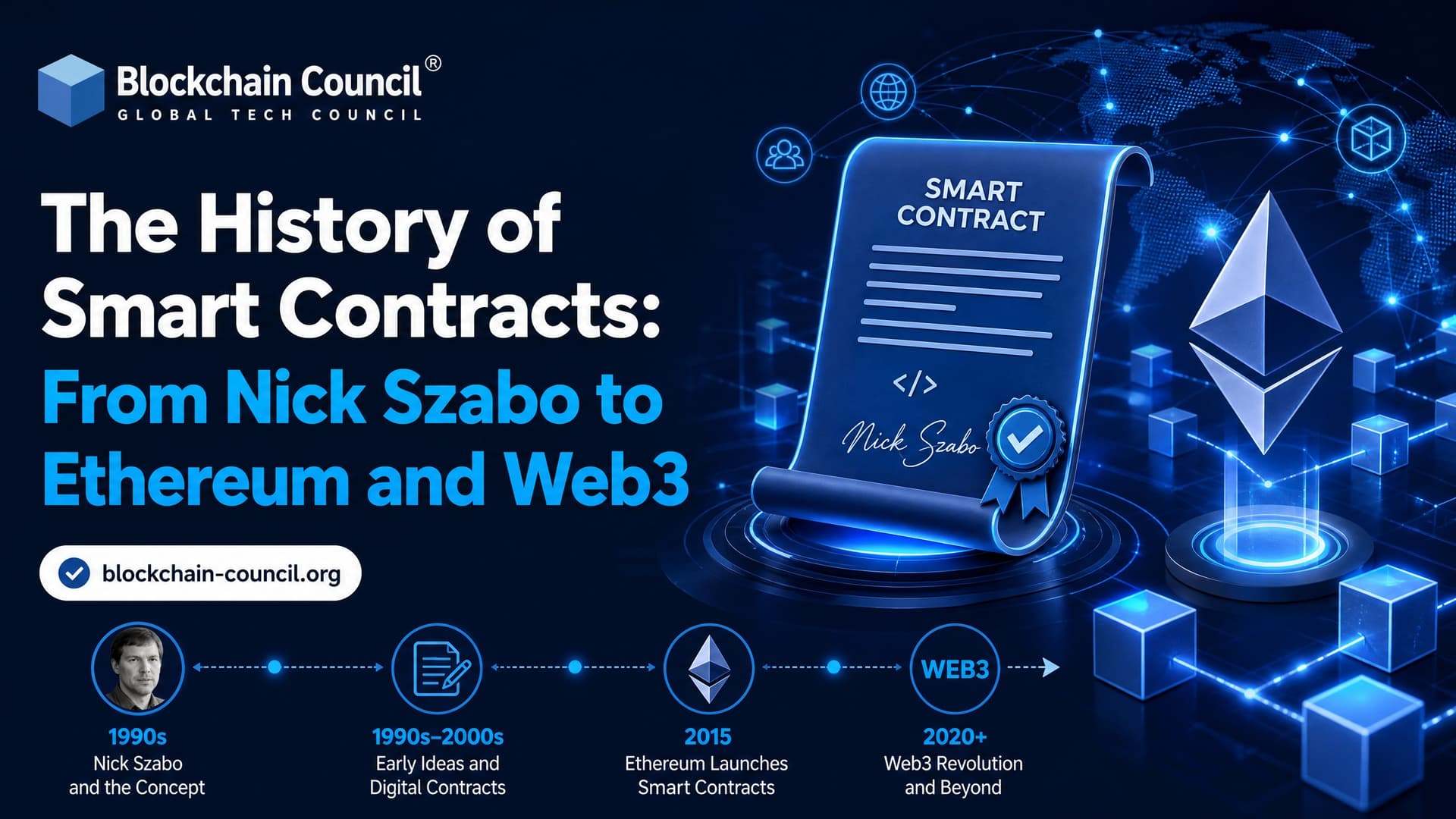
The history of smart contracts starts with a legal and computer science idea from Nick Szabo in the 1990s, then becomes real infrastructure through Bitcoin, Ethereum, and the Web3 applications you use today. If you work with DeFi, NFTs, DAOs, stablecoins, or tokenized assets, you are working inside the long arc of that idea.
Smart contracts are not magic contracts. They are programs that execute predefined rules on a blockchain or distributed system. The important part is not only automation. It is shared execution, public verification, and tamper resistance.

Nick Szabo and the Original Smart Contract Idea
American computer scientist and legal scholar Nick Szabo introduced the term smart contract in the mid-1990s. In his 1994 paper, Smart Contracts: Building Blocks for Digital Markets, he described a smart contract as a computerized transaction protocol that executes the terms of a contract.
That definition still holds up. Szabo wanted contractual clauses to move into code so agreements could run with less ambiguity and fewer trusted intermediaries. His favorite analogy was the vending machine. You insert money, select a product, and the machine enforces a simple agreement without a cashier, lawyer, or payment clerk.
That sounds obvious now. It was not obvious in 1994.
Szabo was writing in the context of the cypherpunk movement, where cryptographers and software builders were exploring privacy, digital cash, cryptographic signatures, and online markets. In 1998, he proposed Bit Gold, a digital currency design that anticipated several ideas later seen in Bitcoin, including proof-based scarcity and distributed verification.
Still, Szabo had a problem. The infrastructure did not exist yet. There was no widely adopted decentralized network that could run and enforce these agreements in a tamper-resistant way.
Bitcoin Brought Smart Contract Logic to a Live Network
Bitcoin launched in 2009 and gave the world the first large-scale blockchain where simple contract-like rules could be enforced. Bitcoin is not a general-purpose smart contract platform in the Ethereum sense, but it does have a scripting system.
At the most basic level, Bitcoin transactions enforce conditions. A user must prove control of a private key through a valid digital signature before spending BTC. That is contract logic, even if it is narrow.
By 2012, Bitcoin supported more advanced multisignature transactions, often called multisig. A 2-of-3 multisig wallet, for example, can require any two of three private keys to authorize a transaction. That enabled escrow-like workflows, shared custody, and basic organizational controls.
Bitcoin proved something critical: a blockchain could enforce rules without a central operator. But Bitcoin Script was intentionally limited. It was not designed for arbitrary business logic, complex lending markets, NFT collections, or decentralized organizations. For that, the ecosystem needed a programmable blockchain.
Ethereum Turned the History of Smart Contracts Into a Developer Platform
In 2013, Vitalik Buterin published the Ethereum whitepaper. The core proposal was simple and ambitious: build a blockchain that can run general-purpose smart contracts.
Ethereum launched in 2015. It became the first major platform where developers could deploy programs that live on-chain, hold assets, call other contracts, and execute the same way for every network participant. Ethereum mainnet uses chain ID 1, a small detail developers quickly learn when configuring wallets, RPC endpoints, and deployment scripts.
Ethereum smart contracts are commonly written in Solidity. They run on the Ethereum Virtual Machine, or EVM. Once deployed, contract code is difficult to change unless the developer deliberately builds an upgrade pattern. That is both the strength and the danger.
If you have deployed contracts in a real test environment, you know the small errors that teach hard lessons. In Solidity 0.8.x, arithmetic overflow reverts automatically with Panic(0x11). In older Solidity versions, you needed libraries such as SafeMath to avoid silent overflow bugs. Hardhat users also know the unhelpful message Transaction reverted without a reason string, which usually means you forgot a require message, hit a fallback, or called a function with the wrong state. Details like these are where smart contract theory becomes engineering.
What Ethereum Smart Contracts Can Do
Ethereum made Szabo's concept practical because contracts could now do far more than approve payments. They can:
- Create and manage ERC-20 tokens
- Mint and transfer ERC-721 NFTs
- Store application state on-chain
- Send ETH or tokens under predefined conditions
- Call other smart contracts
- Run governance votes and treasury rules
- Connect with off-chain data through oracles
This composability changed everything. A lending protocol can use a price oracle, accept an ERC-20 token as collateral, issue another token as debt, and trigger liquidation logic when collateral falls below a threshold. Each piece is a smart contract or a contract interface.
The DAO, MakerDAO, CryptoKitties, and the Early Web3 Era
Ethereum's early history was not tidy. The DAO, launched in 2016, became one of the first widely known decentralized autonomous organizations. It also exposed how dangerous contract bugs can be when real money is involved. The exploit and the later Ethereum hard fork shaped how developers think about audits, governance, and immutability.
Then came clearer signs of product-market fit. MakerDAO showed how smart contracts could manage collateralized lending and stablecoin issuance. CryptoKitties, which became popular in 2017, showed how unique digital collectibles could work through NFTs. It also clogged Ethereum badly enough that many developers got a practical lesson in gas limits and network congestion.
Ethereum's fee model changed later through EIP-1559, which introduced a base fee and priority fee model. If you have ever set maxFeePerGas and maxPriorityFeePerGas during deployment, you have touched the modern economics of smart contract execution.
Smart Contracts as the Foundation of Web3
Today, smart contracts are the application layer for much of Web3. They power systems where users interact through wallets instead of traditional accounts, and where rules are visible in code rather than hidden in a private database.
The main Web3 categories built on smart contracts include:
- DeFi: lending, borrowing, automated market makers, derivatives, and stablecoins
- NFTs: art, gaming assets, membership passes, identity credentials, and ticketing
- DAOs: voting, treasury management, protocol upgrades, and grants
- Stablecoins: programmable transfers, minting, redemption, and collateral rules
- On-chain governance: proposal creation, voting power, timelocks, and execution
To be blunt, not every process needs a smart contract. If a single company controls all participants, a normal database is often cheaper and easier. Smart contracts make sense when multiple parties need shared execution, auditability, and reduced dependence on one operator.
Beyond Ethereum: The Multi-Chain Smart Contract Market
Ethereum set the standard, but it is no longer the only serious platform. Smart contract ecosystems now include Solana, Avalanche, Polkadot, BNB Smart Chain, and many Layer 2 networks connected to Ethereum.
Each makes trade-offs. Ethereum has the deepest developer ecosystem and battle-tested tooling. Solana focuses on high throughput and low fees, but its programming model is different and often less friendly to EVM developers. Avalanche and BNB Smart Chain support EVM-style development, which makes migration easier. Polkadot takes a more modular approach through parachains.
If you are learning smart contract development for the job market, start with EVM fundamentals. Solidity, ERC standards, MetaMask, Hardhat, Foundry, OpenZeppelin Contracts, and Ethers.js are still the most transferable skills.
Real-World Use Cases Beyond Crypto Trading
Smart contracts began in digital currency culture, but their use cases now reach into traditional sectors. Some are mature. Others are still pilots.
Finance
Smart contracts automate token transfers, collateral management, decentralized exchange trades, interest-rate logic, and liquidation rules. This is where adoption is deepest because assets are already digital.
Real Estate
Tokenized property interests and automated escrow are common proposals. The harder part is not the code. It is legal recognition, identity, property registry integration, and dispute handling.
Healthcare
Contracts can manage consent, access permissions, and insurance claim triggers. Sensitive medical data should not be stored directly on public chains. Store proofs or access controls on-chain, not raw patient records.
Energy
Peer-to-peer energy trading can use contracts to settle usage and payments between producers and consumers. Oracles and metering integrity become the weak points.
Government and Education
Public grants, registries, academic credentials, and voting experiments can benefit from transparent execution. Blockchain Council's own education focus fits this pattern: verifiable credentials and technical literacy matter when institutions adopt Web3 systems.
Market Growth and Legal Recognition
Allied Market Research reported that the global smart contracts market surpassed 170 million USD in 2021 and projected a 17.4 percent compound annual growth rate from 2022 to 2030. Forecasts vary, but the direction is clear. Smart contracts are moving from experimental developer tooling into business infrastructure.
Legal systems are catching up more slowly. A smart contract can execute code, but legal enforceability still depends on offer, acceptance, consideration, identity, jurisdiction, and remedies. Code is not a complete replacement for law. The better view is that smart contracts automate performance, while legal contracts still define rights and responsibilities when things go wrong.
Key Timeline in the History of Smart Contracts
- 1994: Nick Szabo defines smart contracts as computerized transaction protocols that execute contractual terms.
- 1998: Szabo proposes Bit Gold, an early design for digital scarcity and decentralized money.
- 2009: Bitcoin launches with limited scripting for conditional transfers.
- 2012: Bitcoin multisig enables shared control and basic escrow-style arrangements.
- 2013: Vitalik Buterin publishes the Ethereum whitepaper.
- 2015: Ethereum mainnet launches with general-purpose smart contracts.
- 2016: The DAO demonstrates both the promise and risk of autonomous contract systems.
- 2017 onward: CryptoKitties, MakerDAO, DeFi, NFTs, DAOs, and Layer 2 networks expand the Web3 smart contract stack.
What You Should Learn Next
If you want to work with smart contracts, do not stop at history. Build something small. Deploy an ERC-20 token on a testnet. Write unit tests in Hardhat or Foundry. Break your own contract before someone else does.
For a structured path, consider Blockchain Council learning options such as Certified Smart Contract Developer™, Certified Blockchain Developer™, and Certified Web3 Expert™ as next steps. If your role is non-technical, start with architecture, use cases, token standards, wallets, and risk. If you are a developer, go straight into Solidity 0.8.x, EVM execution, gas, security patterns, and contract testing.
The next practical step: read Szabo's original definition, then deploy one simple contract yourself. The history of smart contracts makes more sense after your first failed transaction.
Related Articles
View All
Smart Contracts
AI and Smart Contracts: How Artificial Intelligence Is Transforming Web3 Automation
AI and smart contracts are turning Web3 automation into adaptive systems for DeFi, DAOs, insurance, gaming, and enterprise workflows.

Smart Contracts
Layer 2 Smart Contracts: Scaling Ethereum with Rollups and Sidechains
Layer 2 smart contracts use rollups and sidechains to scale Ethereum with lower gas fees, faster execution, and new security trade-offs.

Smart Contracts
Chainlink and Smart Contracts: How Decentralized Oracles Power Web3 Automation
Learn how Chainlink and smart contracts use decentralized oracles, Automation, VRF, Functions, and data feeds to power event-driven Web3 applications.
Trending Articles
The Role of Blockchain in Ethical AI Development
How blockchain technology is being used to promote transparency and accountability in artificial intelligence systems.

Top 5 DeFi Platforms
Explore the leading decentralized finance platforms and what makes each one unique in the evolving DeFi landscape.
How Blockchain Secures AI Data
Understand how blockchain technology is being applied to protect the integrity and security of AI training data.