

Common Smart Contract Vulnerabilities Every Developer Must Know
 Suyash Raizada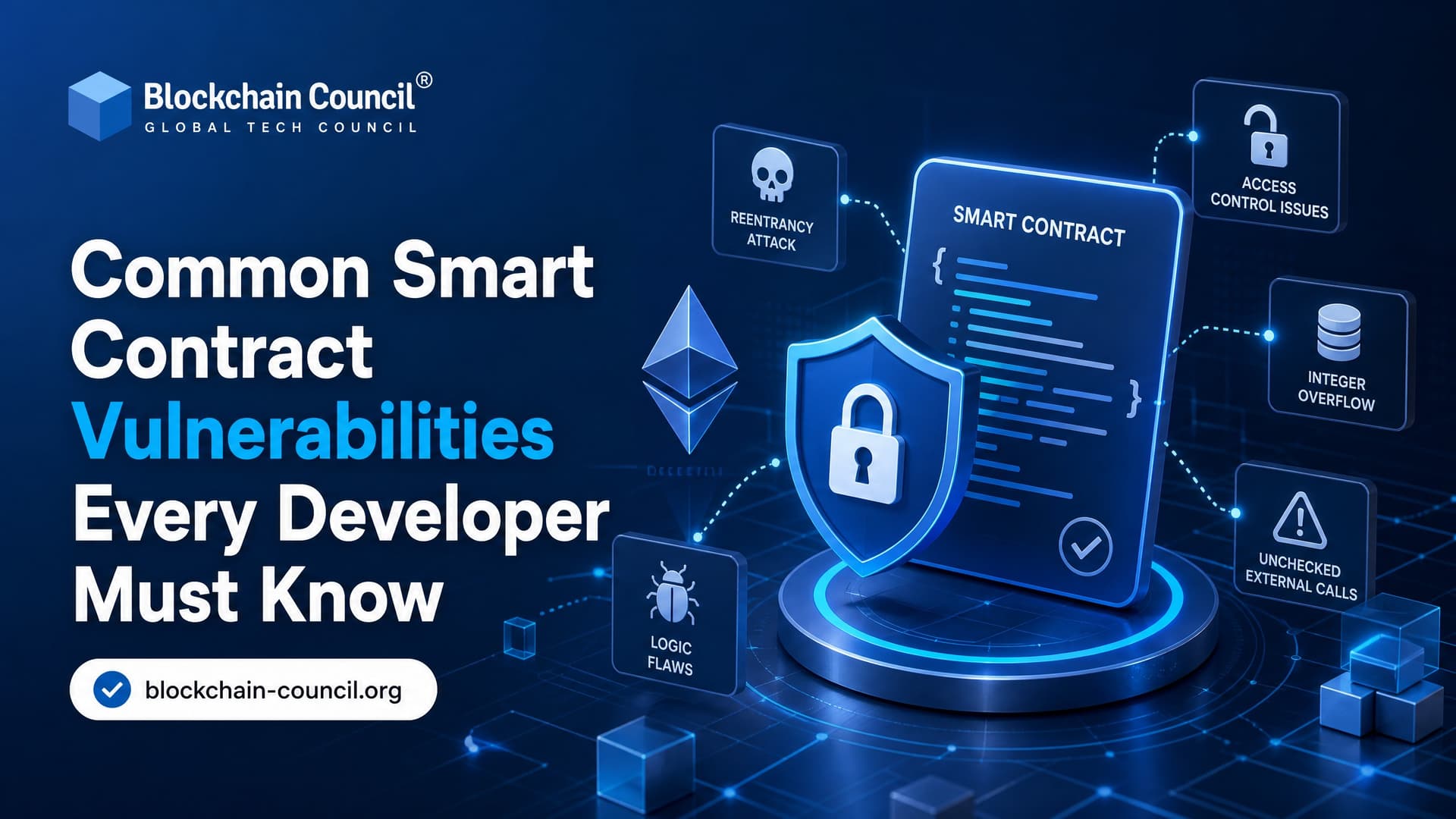
Smart contract vulnerabilities are now a practical engineering risk, not an academic checklist. OWASP's Smart Contract Top 10 project reported $1.42 billion lost across 149 documented incidents in 2024, with access control failures alone linked to about $953.2 million in losses. If you write Solidity, audit DeFi logic, deploy NFT contracts, or review protocol upgrades, these are the bugs you need to recognize before mainnet does.
The hard part is that the worst exploits rarely look like beginner mistakes. Many pass unit tests. Some pass automated scans. Then an attacker combines a weak oracle, a flash loan, and a missing invariant into one transaction and drains the pool before your monitoring bot refreshes.

Why Smart Contract Security Has Changed
Early smart contract security focused heavily on syntax-level mistakes: overflow, unsafe calls, and reentrancy. Those still matter. But the largest losses now often come from access control flaws, business logic errors, oracle manipulation, governance weaknesses, and upgrade mistakes.
Recent DeFi incident analysis found losses above $3.1 billion in the first half of 2025, with smart contract failures contributing hundreds of millions directly. The rest came from related issues such as protocol misconfiguration, access key compromise, oracle problems, and flawed economic design.
That means your security process cannot stop at Slither output or a green test suite. You need threat models, invariant tests, role reviews, upgrade simulations, and a clear understanding of how the protocol behaves under hostile market conditions.
Top Smart Contract Vulnerabilities Developers Must Know
1. Access Control Failures
Access control is the biggest source of on-chain loss in recent OWASP data. The pattern is simple: a function that should be limited to an owner, multisig, governor, or role can be called by the wrong account.
Common examples include:
- Unprotected
upgradeTo()or implementation change functions - Public mint, burn, pause, or withdrawal functions
- Incorrect role setup in OpenZeppelin
AccessControl - Initialization functions that can be called twice
Use battle-tested patterns such as OpenZeppelin Ownable, AccessControl, and multisig-controlled administration. Be strict. If a function changes money movement, collateral factors, fee rates, or upgrade paths, test it from unauthorized accounts as carefully as you test the happy path.
2. Reentrancy
Reentrancy happens when your contract calls an external contract before updating its own state. The external contract calls back into your function and repeats the operation while your internal accounting is still stale.
The DAO hack in 2016 remains the classic case. The vulnerable withdrawal flow sent ETH before reducing the user's balance, allowing repeated withdrawals. About $60 million in ETH was drained at the time, and the incident shaped Ethereum's security culture.
Mitigate reentrancy with:
- The checks-effects-interactions pattern
- OpenZeppelin
ReentrancyGuard - Pull payment designs instead of push payments
- Minimal external calls inside state-changing functions
A practical note: if you test arithmetic or balance changes in Solidity 0.8.x, Hardhat may throw reverted with panic code 0x11 when an underflow or overflow occurs outside an unchecked block. That message is useful. Do not hide it under broad try/catch logic without understanding why it happened.
3. Business Logic Errors
Business logic errors are harder than reentrancy because they are often valid Solidity but invalid protocol design. The compiler will not tell you that your liquidation formula rewards attackers, or that your staking rewards can be amplified by depositing for one block.
These bugs appear in:
- Lending collateral calculations
- Liquidation thresholds
- Reward distribution formulas
- AMM pricing logic
- Governance proposal flows
- State machines for auctions, vesting, or claims
Write invariants before you write final tests. For example: total user balances should never exceed total assets, collateral withdrawals should not leave an account below the required ratio, and rewards should not be claimable twice for the same position. Foundry invariant tests are particularly useful here because they generate strange call sequences humans rarely think to test.
4. Oracle Manipulation
Oracle manipulation occurs when a contract trusts a price source that can be moved by an attacker. Thin liquidity is dangerous. So is using a single DEX spot price as collateral truth.
The Mango Markets exploit showed this clearly. An attacker manipulated market pricing used by the protocol, making a position appear much more valuable and enabling roughly $116 million in withdrawals. Vee Finance also suffered a major loss after relying on a single pricing source.
Better oracle design includes:
- Multiple independent price feeds where possible
- Time-weighted average prices instead of instant spot prices
- Sanity bounds for large price moves
- Circuit breakers during extreme volatility
- Liquidity checks before accepting a market as a source of truth
Do not treat a Chainlink feed, DEX TWAP, or custom oracle as a magic answer. Each has failure modes. Your job is to design around them.
5. Flash Loan Attacks
Flash loans are not the vulnerability by themselves. They are the amplifier. They give an attacker large temporary capital within a single transaction, which can expose weak pricing, governance, or accounting assumptions.
Flash loan attacks often combine several conditions:
- A manipulable price source
- A protocol that reads the manipulated price immediately
- A lending or swap function that trusts that value
- No delay, cap, or sanity check
Design as if any user can control huge liquidity for one block. If your protocol breaks under that assumption, it is not ready for production DeFi.
6. Integer Overflow, Underflow, and Precision Errors
Solidity 0.8.x includes checked arithmetic by default, which reduced classic overflow bugs. But math risk did not disappear. Precision loss, rounding direction, decimal mismatch, and unsafe unchecked blocks still cause losses.
Watch for:
- Mixing 6-decimal USDC with 18-decimal ETH-style math
- Rounding in favor of users during repeated withdrawals
- Custom fixed-point math without enough tests
- Unsafe casts from larger to smaller integer types
Use audited math libraries where possible. Test boundary values: zero, one wei, maximum supply, tiny collateral, and extreme interest rates. Boring tests catch expensive bugs.
7. Unchecked External Calls
Low-level calls such as call, delegatecall, and staticcall can fail or behave unexpectedly. If you ignore return values, your contract may continue after an operation that never happened.
This is especially risky in token transfers because not every token behaves exactly like a clean ERC-20 implementation. Some return false. Some revert. Some have fees on transfer. Use safe wrappers such as OpenZeppelin SafeERC20, and treat every external address as hostile unless proven otherwise.
8. Front-Running and MEV
Public mempools allow attackers and searchers to see pending transactions. They can pay higher priority fees, reorder trades, sandwich users, or interfere with auctions and liquidations.
Mitigations depend on the protocol, but common approaches include commit-reveal schemes, batch auctions, private transaction submission, slippage limits, and designs that reduce profit from transaction ordering. If your auction can be won purely by seeing another user's bid in the mempool, it is already weak.
9. Weak Randomness and Timestamp Dependence
block.timestamp, block.number, and recent block hashes are not safe randomness sources for valuable outcomes. Validators have limited influence over block metadata, and users can often predict or condition transactions around it.
For lotteries, NFT reveals, games, or randomized reward logic, use a verifiable randomness source such as Chainlink VRF or a carefully designed commit-reveal process. For time checks, allow reasonable windows and avoid logic where a few seconds of timestamp movement changes who gets paid.
10. Proxy, Upgradeability, and Initialization Bugs
Upgradeable contracts add operational flexibility, but they also add sharp edges. Storage layout collisions, exposed initializers, unsafe upgrade permissions, and incorrect proxy admin setup have all caused serious incidents.
With proxy patterns, always review:
- Who can upgrade the implementation
- Whether the initializer is protected
- Storage layout changes between versions
- Delegatecall behavior
- Emergency pause and rollback paths
Run upgrade simulations on a fork before deploying. A clean deployment script does not prove a safe upgrade.
How to Reduce Smart Contract Vulnerabilities Before Launch
Security improves when you make it part of the build process, not a final audit sprint. Use this workflow:
- Threat model early: List assets, privileged roles, trust assumptions, external dependencies, and attacker goals.
- Use standard libraries: Prefer OpenZeppelin contracts for ERC-20, ERC-721, access control, and upgrade patterns.
- Write adversarial tests: Test unauthorized callers, strange token behavior, oracle shocks, and repeated actions.
- Add invariant testing: Use Foundry or similar tools to check properties across many call sequences.
- Review economic design: Simulate flash loan sized trades, liquidations, and market stress.
- Get independent review: Automated tools help, but they do not replace human audit work on logic and incentives.
- Monitor after deployment: Track admin actions, oracle deviations, liquidity changes, and abnormal withdrawals.
Where Blockchain Developers Should Build Deeper Skill
If you are serious about smart contract engineering, learn security alongside Solidity. The Blockchain Council Certified Smart Contract Developer™ certification is a relevant learning path for developers building and testing contract logic. The Certified Solidity Developer™ certification fits engineers who want deeper Solidity practice, while Certified Blockchain Developer™ is useful if you need broader blockchain architecture context.
To be blunt, deploying contracts without security training is expensive confidence. Start by auditing one of your own contracts against the OWASP Smart Contract Top 10. Check every privileged function, every external call, every price assumption, and every upgrade path. Then write one failing test for each risk you find. That exercise will teach you more than another perfect happy-path deployment.
Related Articles
View All
Smart Contracts
Smart Contract Security Checklist: Common Vulnerabilities and How to Prevent Exploits
A practical smart contract security checklist covering access control, reentrancy, oracle risks, flash loans, upgrade safety, and testing to prevent common Web3 exploits.

Smart Contracts
Smart Contract Developer Roadmap: Skills, Tools, and Projects to Build in 2026
Follow this smart contract developer roadmap to learn Solidity, EVM tools, security testing, full-stack dApps, and portfolio projects for 2026.
Smart Contracts
Smart Contract Debugging: Common Errors and How to Fix Them
Learn smart contract debugging methods for syntax, runtime, logic, gas, and deployment errors using Hardhat, Remix, Tenderly, Slither, and fuzzing.
Trending Articles
The Role of Blockchain in Ethical AI Development
How blockchain technology is being used to promote transparency and accountability in artificial intelligence systems.
AWS Career Roadmap
A step-by-step guide to building a successful career in Amazon Web Services cloud computing.

Top 5 DeFi Platforms
Explore the leading decentralized finance platforms and what makes each one unique in the evolving DeFi landscape.