

What Is Quantum Decoherence and Why Is It a Major Challenge?

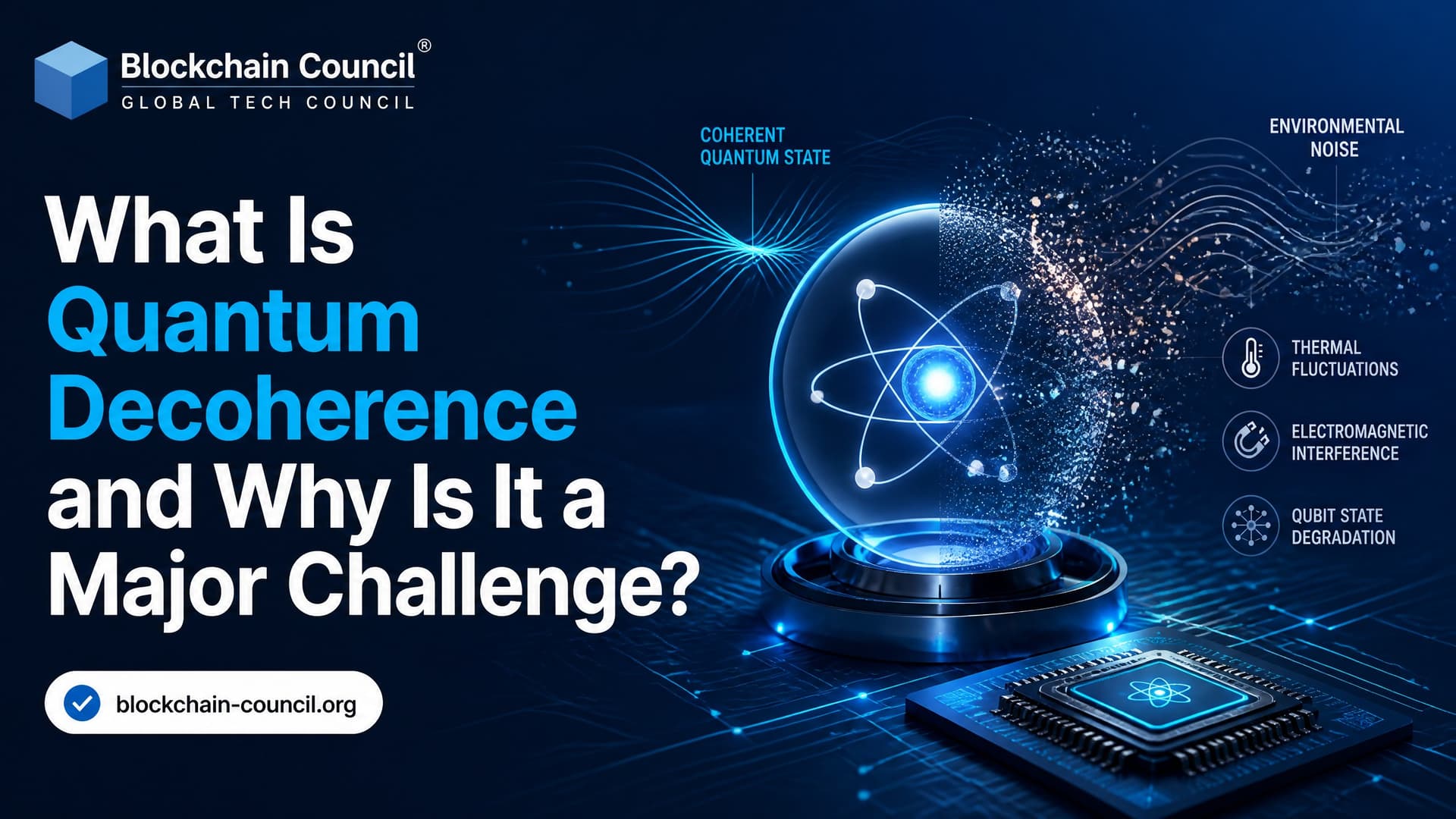
Quantum decoherence is the reason quantum computers are hard to scale. A qubit can hold a superposition only while its phase relationships stay controlled. The moment unwanted information leaks into the surrounding environment, the system starts behaving less like a quantum system and more like an ordinary classical one.
That sounds abstract. It is not. Decoherence decides how long a quantum processor can run, how deep a circuit can go, how reliable a quantum communication link can be, and how soon enterprises should prepare for quantum-safe security. If you are studying quantum computing through Blockchain Council's Certified Quantum Computing Expert™, this is one concept you cannot treat as theory alone.

What Is Quantum Decoherence?
Quantum decoherence is the loss of coherence in a quantum system. Coherence means the parts of a quantum superposition keep a well-defined phase relationship with each other. Quantum algorithms depend on that relationship because interference is what lets amplitudes combine, cancel, and produce useful results.
When a qubit interacts with its environment, even slightly, information about the qubit can leak out. That environment might be a microwave control line, a defect in a chip surface, residual thermal radiation, magnetic field noise, or another qubit nearby. Once that coupling happens, the qubit and its environment become unintentionally entangled. You no longer have a clean, isolated qubit.
To a user, the effect is simple: the quantum state becomes less useful. Superposition fades. Entanglement loses fidelity. Interference patterns wash out. The output of a quantum circuit gets harder to trust.
This is why decoherence is often described as the bridge between quantum and classical behavior. The system has not necessarily been measured by a human. It has been disturbed enough that the environment has effectively gained information about it.
The Two Metrics You Need to Know: T1 and T2
In real hardware, decoherence is usually discussed through two core time constants: T1 and T2.
- T1, or energy relaxation time: This measures how long an excited qubit tends to stay excited before it loses energy to the environment and relaxes toward its ground state.
- T2, or phase coherence time: This measures how long the qubit preserves phase information. A qubit can lose phase coherence even if it has not lost energy.
T1 is about energy loss. T2 is about phase loss. Both matter.
On many superconducting quantum processors, calibration data exposes T1 and T2 in microseconds. A beginner often checks only the qubit count, then wonders why a circuit fails. The better habit is to inspect coherence times, gate errors, readout errors, and connectivity before running anything serious. In Qiskit, for example, a transpiler setting such as optimization_level=3 can reduce circuit depth, but it can also choose a mapping that depends on current backend topology. One extra SWAP gate can be enough to push a fragile circuit past its decoherence limit.
That is the day-to-day reality of noisy quantum hardware. Small details bite.
Why Is Quantum Decoherence a Major Challenge?
Quantum decoherence is a major challenge because it directly limits computation time and accuracy. A quantum computer must complete its gates before the qubits lose their usable state. If the coherence window is too short, the circuit cannot run deeply enough to solve practical problems.
For many current gate-based processors, useful circuit lifetimes are often measured in microseconds to milliseconds. Gate operations are fast, but not infinitely fast. Readout also takes time. Calibration drifts. Cross talk appears. The result is a strict time budget.
1. Decoherence Creates Errors at the Hardware Level
Decoherence causes bit-flip errors, phase-flip errors, leakage errors, and correlated errors. Some errors are random. Some are coherent and repeat in a structured way. That second category is especially unpleasant because it can bias results while looking statistically stable.
Sources include:
- Thermal noise from imperfect isolation
- Fluctuating electric and magnetic fields
- Two-level system defects in materials, often discussed in superconducting qubit research
- Laser noise and motional mode coupling in trapped ion systems
- Cross talk between neighboring qubits
- Imperfect pulse calibration and control electronics
Major research groups, including teams at IBM Quantum, Google Quantum AI, and academic quantum hardware labs, consistently identify decoherence and noise as core barriers to fault-tolerant quantum computing.
2. It Is a System-Level Problem
There is no single decoherence knob you can turn. Better materials help. Cleaner fabrication helps. Improved shielding helps. Smarter control pulses help. None of them solves the full problem alone.
A superconducting qubit may need millikelvin temperatures inside a dilution refrigerator, microwave control pulses shaped with high precision, low-loss packaging, filtered wiring, stable calibration, and careful chip design. Change one layer and the noise profile can shift somewhere else.
This is why decoherence is not just a physics problem. It is also an engineering, controls, software, and systems architecture problem.
3. Correlated Noise Breaks Simple Assumptions
Quantum error correction, or QEC, is designed to protect logical qubits by encoding them across many physical qubits. The theory works well when errors are local, limited, and not too strongly correlated.
Real devices are messier. Noise can be spatially correlated, time-correlated, non-Markovian, or affected by slow drift. A burst event can disturb many qubits at once. Leakage can move a qubit out of the intended computational subspace, such as a higher transmon energy level. Standard QEC has to detect and manage these events, not just textbook bit flips and phase flips.
To be blunt, this is where optimistic quantum timelines often get too neat. Qubit count matters, but noise structure matters just as much.
How Decoherence Affects Quantum Algorithms
Quantum algorithms rely on interference. Shor's algorithm, Grover's algorithm, quantum phase estimation, variational quantum eigensolvers, and quantum simulation all assume that useful phase information survives long enough to be processed.
When decoherence builds up, the final measurement distribution drifts away from the ideal answer. On near-term NISQ devices, this is why many practical experiments use shallow circuits, error mitigation, and repeated sampling. You may still extract useful information, but you are working close to the edge.
This affects applications in:
- Quantum chemistry: Molecular simulations need accurate phase relationships, especially as circuit depth grows.
- Optimization: Variational algorithms can become noise-dominated before finding useful parameter regions.
- Machine learning: Quantum models can lose signal when circuits get too deep for the hardware.
- Cryptanalysis research: Large-scale attacks on RSA or elliptic curve cryptography would require fault-tolerant machines far beyond today's noisy devices.
For blockchain and cybersecurity professionals, that last point matters. Decoherence is one reason large-scale, cryptographically relevant quantum computers remain uncertain in timing. It does not remove the need for post-quantum planning, but it explains why migration is being handled in phases by standards bodies such as NIST.
Decoherence in Quantum Communication
Quantum decoherence is not limited to processors. It also affects quantum communication and networking.
When entangled photons or stored quantum states interact with their environment, entanglement fidelity drops. That can reduce the performance of quantum key distribution and limit the distance over which useful entanglement can be shared. Fiber loss, memory noise, detector imperfections, and channel disturbance all play a role.
This is why quantum repeaters, entanglement swapping, and quantum memories are active research areas. Long-distance quantum networks need more than a good source of entangled states. They need ways to preserve or refresh quantum information across distance.
How Researchers Are Fighting Decoherence
There is progress. Not magic, but real progress.
Materials and Fabrication
Hardware teams are improving substrates, metal surfaces, junction quality, vacuum systems, photonic components, and chip packaging. In superconducting devices, surface oxides and dielectric loss get close attention because tiny defects can create measurable relaxation channels.
Better Control Pulses
Pulse shaping, dynamical decoupling, calibration automation, and low-noise electronics reduce control-induced errors. These methods try to keep qubits isolated when they should be isolated and strongly controlled only when a gate is intended.
Quantum Error Correction
QEC is the main long-term path to fault-tolerant quantum computing. Surface codes, color codes, repetition codes, and bosonic codes all aim to preserve logical information despite physical errors. Recent experiments have shown logical error suppression under specific conditions, but scaling remains hard because physical error rates, leakage, correlated noise, and measurement speed all matter.
Error Mitigation
Near-term systems often use error mitigation rather than full error correction. Techniques such as zero-noise extrapolation and probabilistic error cancellation can improve estimates, though they add sampling overhead and do not replace fault tolerance.
What Decoherence Means for Professionals
If you are a developer, do not judge quantum hardware by qubit count alone. Check coherence times, gate fidelity, connectivity, readout error, and queue-specific calibration data. If you are an enterprise architect, treat quantum timelines with discipline. Prepare for post-quantum cryptography, but do not assume fault-tolerant machines will appear just because a roadmap shows more physical qubits.
If you work in blockchain, the practical link is security planning. Public-key systems used around digital assets, identity, wallets, and infrastructure may need quantum-safe migration over time. Learning quantum computing alongside cryptography helps you separate real risk from noise. Blockchain Council's Certified Quantum Computing Expert™ and Certified Blockchain Expert™ programs are natural learning paths for that intersection.
The Bottom Line
Quantum decoherence is the practical limit every quantum technology must confront. It shortens the life of qubits, corrupts calculations, weakens entanglement, and raises the engineering cost of scaling quantum systems.
The next step is simple: study T1, T2, gate errors, and quantum error correction together. Build a small circuit on a real cloud quantum backend, compare ideal simulation against hardware results, and inspect the calibration data before you run it. That exercise will teach you more about quantum decoherence than a dozen clean diagrams.
Related Articles
View All
Quantum Computing
Quantum Computing Certification: Benefits, Career Value, and How to Choose One
Learn how quantum computing certification supports career growth, what employers value, and how to choose a credential with real technical depth.

Quantum Computing
Best Quantum Computing Courses in India for Students and Professionals
Explore the best quantum computing courses in India, including IIT, NPTEL, AICTE aligned, C-DAC, and regional programmes for students and professionals.

Quantum Computing
Quantum Computing Jobs: Skills, Roles, Salaries, and Career Paths
Explore quantum computing jobs, salaries, key skills, and career paths across software, hardware, research, security, product, and applied roles.
Trending Articles
What is AWS? A Beginner's Guide to Cloud Computing
Everything you need to know about Amazon Web Services, cloud computing fundamentals, and career opportunities.

Can DeFi 2.0 Bridge the Gap Between Traditional and Decentralized Finance?
The next generation of DeFi protocols aims to connect traditional banking with decentralized finance ecosystems.
How to Install Claude Code
Learn how to install Claude Code on macOS, Linux, and Windows using the native installer, plus verification, authentication, and troubleshooting tips.