

Quantum Computing in India: Initiatives, Startups, Research, and Career Opportunities

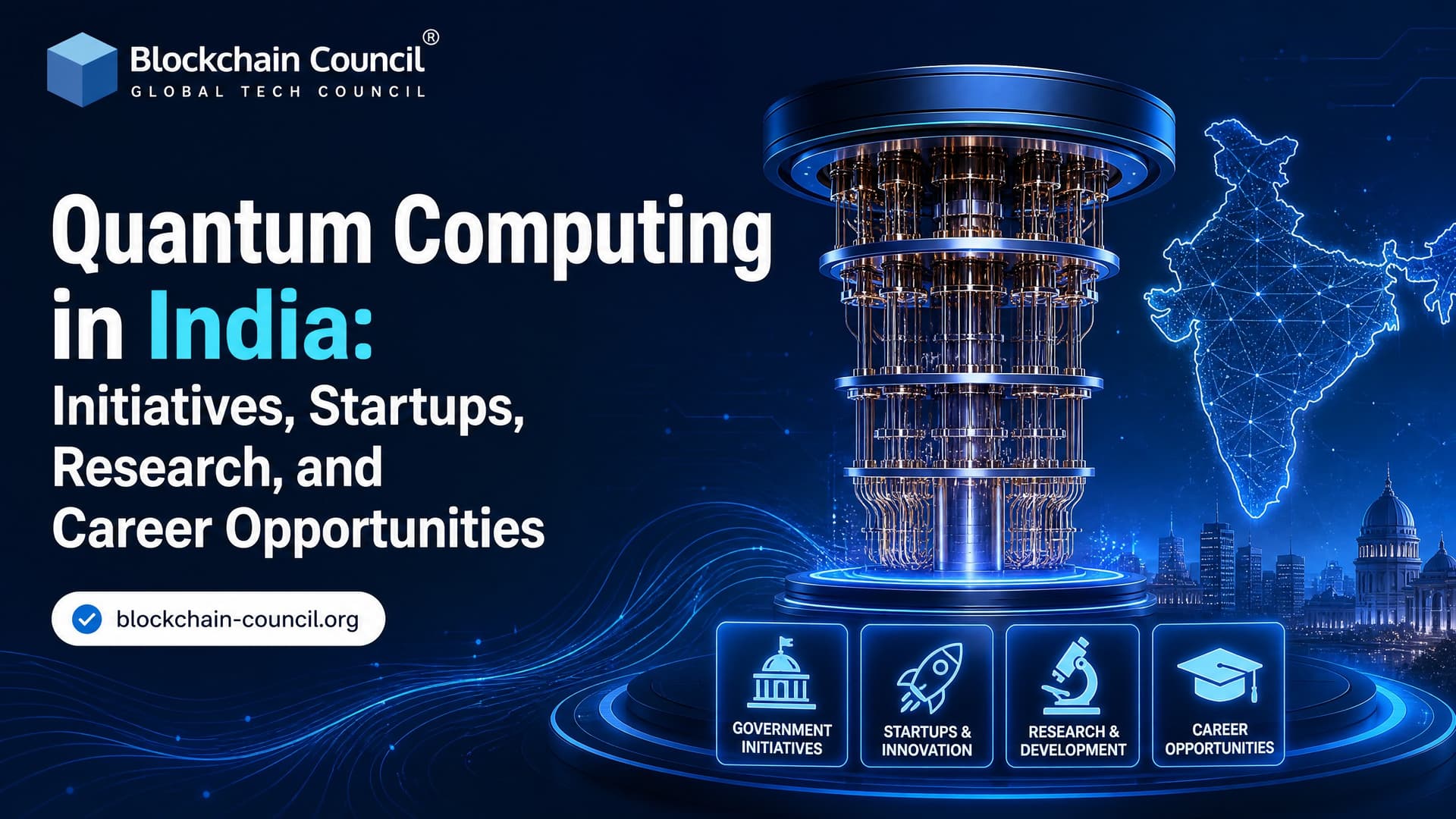
Quantum Computing in India has moved from isolated university labs to a coordinated national program with clear funding, hardware targets, startup participation, and security priorities. You can see the shift in the National Quantum Mission, the Qniverse quantum-HPC platform, quantum-safe cybersecurity pilots, and a startup base that now spans processors, cryogenics, quantum communication, simulation, and education.
India is not yet at the hardware maturity level of the United States or China. That is the blunt reality. But the country has a real edge in research output, software talent, cryptography awareness, and mission-led coordination. For professionals and enterprises, the strongest near-term opportunities sit in quantum algorithms, hybrid quantum-HPC, post-quantum security, and applied simulation.

National Quantum Mission: the center of India's quantum strategy
The National Quantum Mission, approved by the Union Cabinet in April 2023, carries a total outlay of Rs 6,003.65 crore for the period 2023-24 to 2030-31. The Department of Science and Technology runs it as India's flagship program for quantum computing, quantum communication, quantum sensing and metrology, and quantum materials.
The mission is structured through four Thematic Hubs, set up as Section 8 non-profit entities:
- Quantum Computing T-Hub at IISc Bengaluru, with C-DAC
- Quantum Communication T-Hub at IIT Madras, with C-DOT
- Quantum Sensing and Metrology T-Hub at IIT Bombay
- Quantum Materials and Devices T-Hub at IIT Delhi
This structure matters. Quantum work fails when computing, materials, photonics, cryogenics, networking, and security are treated as separate islands. The hub model forces collaboration across disciplines, which is exactly what quantum systems need.
India's quantum computer targets
The National Quantum Mission has set staged hardware targets:
- 20-50 physical qubits in 3 years
- 50-100 physical qubits in 5 years
- 50-1000 physical qubits in 8 years
These targets cover platforms such as superconducting and photonic technologies. Pay attention to the phrase physical qubits. Physical qubits are not the same as fault-tolerant logical qubits. A 100-qubit noisy machine can still be limited for practical workloads if error rates, coherence times, gate fidelity, and control systems are weak. That is why India's work on cryogenic components, single-photon detectors, quantum materials, and control electronics counts as much as the processor itself.
Qniverse and hybrid quantum-HPC in India
MeitY's Qniverse platform is one of the most practical developments for students, researchers, and startups. It provides a unified access layer for quantum hardware backends and high performance computing systems, letting you design, simulate, and execute quantum algorithms.
For developers, hybrid quantum-HPC is the path worth learning first. Fully fault-tolerant quantum computers are still years away. But hybrid workflows, where a classical optimizer calls a quantum circuit repeatedly, are already useful for research in optimization, quantum chemistry, and simulation.
A small practical warning: if you are testing circuits in Qiskit, check bit ordering before you interpret results. Qiskit circuit diagrams place qubit 0 at the top, while count strings display classical bits with the highest index on the left. Many beginners think their Bell state failed when the issue is only measurement mapping. This kind of detail trips people up in certification exams, lab work, and production notebooks.
Quantum startups in India: hardware, security, and software
The startup base is no longer theoretical. Sectoral reports identify about 95 quantum computing startups in India, with 23 funded companies raising around 97.8 million dollars in venture and private equity funding. Government-backed programs under the National Quantum Mission and NM-ICPS have also supported selected quantum startups.
QpiAI
Bengaluru-based QpiAI, founded in 2019, is building full-stack superconducting quantum computers combined with AI-driven software. Its QpiAI-Indus system, a 25-qubit superconducting quantum computer, has been described as India's first full-stack quantum computing system combining hardware, control electronics, and software. The company also announced Kaveri, a 64-qubit superconducting quantum processor, reported as the most powerful quantum chip built in India.
QNu Labs
QNu Labs, also based in Bengaluru, focuses on quantum-safe cybersecurity. Its work includes Quantum Key Distribution systems and Quantum Random Number Generators. This is not a distant use case. Banks, telecom networks, defense systems, and government platforms hold data that may need to stay confidential for decades. That makes quantum-safe migration a board-level issue, not just a research topic.
Other important players
India's quantum ecosystem also includes enabling and application-focused startups:
- Dimira Technologies - cryogenic cabling for quantum systems
- PrenishQ - precision diode-laser systems
- QuPrayog - optical atomic clocks for metrology
- Quanastra - cryogenics and superconducting detectors
- Pristine Diamonds - diamond-based quantum sensing materials
- Quan2D Technologies - single-photon detectors for quantum communication
- BosonQ Psi - quantum-inspired simulation tools for engineering use cases
- Quanfluence - quantum hardware development
These companies show where the real market is forming: not only in qubit chips, but in the components and software that make quantum systems usable.
Research institutions and academic momentum
India accounts for about 5 percent of global research publications in quantum computing, ranking behind China and the United States but ahead of many larger economies. The IISc Bengaluru hub coordinates work across superconducting, photonic, neutral atom, electron spin, and semiconductor qubit platforms, along with quantum algorithms and enabling technologies.
Research activity is spread across IISc, IITs, IISERs, C-DAC, C-DOT, and specialized centers. DST calls under the National Quantum Mission have also focused on quantum algorithms, transpilers, simulators, performance tools, quantum information theory, AI-quantum integration, and hybrid quantum-HPC systems.
This is good news for software engineers. You do not need a dilution refrigerator in your office to contribute. If you can work on compilers, error mitigation, tensor networks, optimization, numerical linear algebra, or distributed systems, you can enter the field through the software layer.
Quantum-safe cybersecurity: India's urgent use case
Quantum computing in India is tied closely to national security. NITI Aayog and other policy groups have warned that large-scale quantum computers could threaten widely used public-key cryptographic systems. The concern is often called harvest now, decrypt later: attackers can store encrypted traffic today and decrypt it later if quantum capabilities mature.
India's quantum-safe roadmap includes:
- Quantum Key Distribution over terrestrial fiber
- Post-quantum cryptography migration
- Quantum Random Number Generators
- Satellite-based quantum communication
- Secure networks for critical infrastructure
Enterprises should not wait for a cryptographic emergency. Start with an inventory of RSA, ECC, TLS, VPN, signing, and key-management systems. Then assess migration paths to post-quantum algorithms standardized by the US National Institute of Standards and Technology, including ML-KEM for key encapsulation and ML-DSA for digital signatures.
Quantum Valley Tech Park and regional expansion
The Quantum Valley Tech Park in Amaravati, Andhra Pradesh, established in May 2025, is another signal that the ecosystem is spreading beyond Bengaluru, Pune, Delhi, and Chennai. Larsen & Toubro is building the civil infrastructure, with the main block scheduled to open in January 2026.
Dedicated infrastructure matters because quantum hardware needs unusual facilities: vibration control, electromagnetic isolation, precision optics, cryogenic systems, clean fabrication workflows, and specialized testing equipment. A general software park cannot solve those needs.
Opportunities for professionals and enterprises
For developers
If you write code, focus on quantum circuits, simulators, Python tooling, optimization algorithms, and hybrid workflows. Learn Qiskit, Cirq, PennyLane, or CUDA-Q. Then build small projects: a variational quantum eigensolver, a quantum approximate optimization algorithm, or a noise-aware circuit benchmark.
For cybersecurity teams
Prioritize post-quantum cryptography, key management, crypto inventory, and quantum-safe network design. Quantum Key Distribution is useful in specific high-security links, but it is not a drop-in replacement for enterprise-wide cryptography. Post-quantum migration will touch far more systems.
For hardware engineers
RF design, FPGA control, cryogenics, photonics, precision lasers, superconducting devices, and single-photon detection are high-value skills. Quantum hardware is unforgiving. A cable, connector, thermal load, or timing jitter problem can ruin the experiment before the algorithm even starts.
For enterprises
Do not start with vague quantum strategy slides. Pick one problem class:
- Optimization in logistics, scheduling, or portfolio modeling
- Simulation in materials, chemistry, or engineering design
- Security migration for long-life confidential data
- Randomness, timing, sensing, or metrology use cases
Then run a proof of concept with measurable baselines. Compare against classical solvers. If a quantum-inspired method gives better results today, use it. Waiting for fault-tolerant machines is the wrong business plan.
Skills and certifications for the next phase
The skills gap is one of India's main constraints. The ITES-Q report from the Office of the Principal Scientific Adviser highlights strengths in software and communication, but also points to weaknesses in hardware fabrication, industrial investment, patents, and workforce depth.
If you want a structured starting point, consider Blockchain Council's Certified Quantum Computing Expert™ as a learning path for quantum concepts, algorithms, and practical foundations. Professionals working at the security boundary can pair quantum learning with cybersecurity training to understand post-quantum migration, cryptographic risk, and enterprise governance.
The best learning path is direct:
- Study linear algebra, probability, and complex numbers
- Learn qubits, gates, measurement, entanglement, and noise
- Build circuits in a real SDK
- Understand quantum-safe cryptography
- Follow India's National Quantum Mission calls and hub updates
What comes next for Quantum Computing in India?
Quantum Computing in India is entering a build phase. The country has mission funding, research output, early hardware, Qniverse for access, startup momentum, and a strong security driver. The hard parts are still ahead: fabrication depth, error correction, talent scale, enterprise adoption, and patents.
Your next step should match your role. Developers should build hybrid quantum-HPC projects. Security professionals should begin crypto inventory and post-quantum planning. Enterprises should test one measurable use case, not ten vague ones. If you are starting from scratch, begin with a structured quantum certification and one hands-on circuit project this week.
Related Articles
View All
Quantum Computing
Quantum Computing Certification: Benefits, Career Value, and How to Choose One
Learn how quantum computing certification supports career growth, what employers value, and how to choose a credential with real technical depth.

Quantum Computing
Best Quantum Computing Courses in India for Students and Professionals
Explore the best quantum computing courses in India, including IIT, NPTEL, AICTE aligned, C-DAC, and regional programmes for students and professionals.

Quantum Computing
Quantum Computing Jobs: Skills, Roles, Salaries, and Career Paths
Explore quantum computing jobs, salaries, key skills, and career paths across software, hardware, research, security, product, and applied roles.
Trending Articles
The Role of Blockchain in Ethical AI Development
How blockchain technology is being used to promote transparency and accountability in artificial intelligence systems.
What is AWS? A Beginner's Guide to Cloud Computing
Everything you need to know about Amazon Web Services, cloud computing fundamentals, and career opportunities.
Claude AI Tools for Productivity
Discover Claude AI tools for productivity to streamline tasks, manage workflows, and improve efficiency.