

What Is a Quantum Computer and How Is It Different from a Classical Computer?
 Suyash Raizada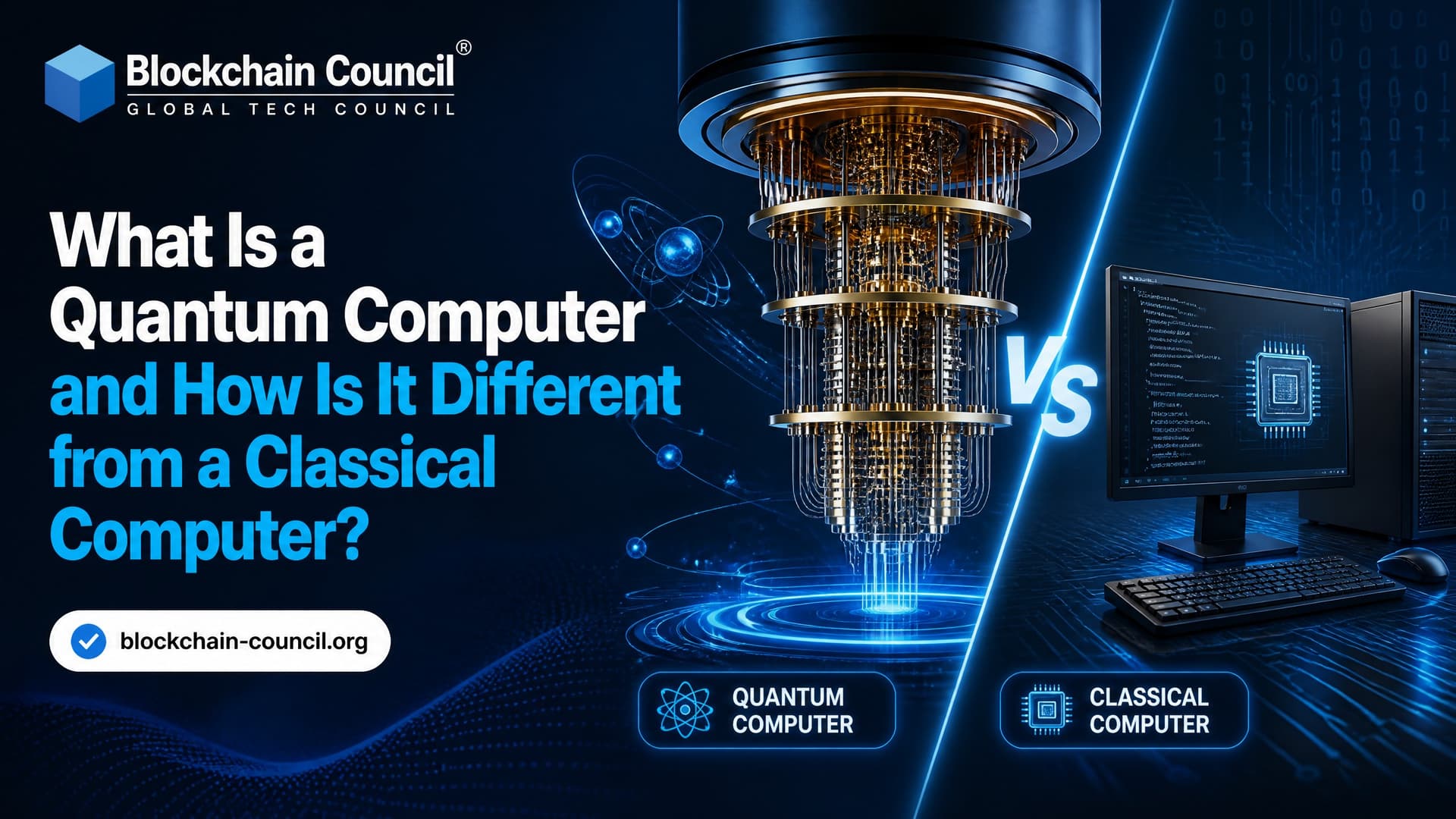
A quantum computer is a machine that processes information using quantum bits, or qubits, instead of ordinary binary bits. That single change makes it very different from a classical computer. A laptop, phone, or cloud server stores each bit as either 0 or 1. A quantum computer uses superposition, entanglement, and interference to work with probability amplitudes before a final measurement turns the result into classical data.
That does not mean quantum computers are magic versions of today's machines. They are not better at email, spreadsheets, web apps, or most enterprise software. They are built for a narrower set of hard problems: quantum simulation, factoring-related cryptography research, optimization, and some sampling tasks.

For professionals who want to build real, structured expertise in this fast-moving field rather than piece it together from scattered articles, a Certified Quantum Computing Expert credential offers a solid foundation to start from before diving into the technical details below.
Quantum Computer vs Classical Computer: The Basic Difference
A classical computer is built on bits. Each bit has a definite value, 0 or 1. Transistors in CPUs, GPUs, memory chips, and storage devices switch these states through logic gates such as AND, OR, and NOT. The process is deterministic in normal operation. Give the same program the same input, and you expect the same output.
A quantum computer uses qubits. A qubit can be described as a combination of 0 and 1 until it is measured. The useful part is not that it is simply "both at once," though that phrase gets repeated everywhere. The useful part is that a quantum algorithm controls complex probability amplitudes, then uses interference to raise the chance of measuring a useful answer.
With N classical bits, a system sits in one of 2^N possible configurations at a time. With N qubits, the quantum state has amplitudes across all 2^N basis states. Add one qubit, and the mathematical state space doubles. That scaling is why quantum computing draws serious attention. It is also why errors become painful very quickly.
The Three Quantum Ideas You Need to Know
Superposition
Superposition means a qubit can exist in a weighted combination of 0 and 1 before measurement. When you measure it, you get a classical result, either 0 or 1. The weights determine the probabilities.
A practical note. Beginners often expect a superposition circuit to "print both answers." It will not. Run a single Hadamard gate on one qubit for 1,024 shots, and you usually see counts close to 50 percent 0 and 50 percent 1, not a visible dual state. The quantum part happens before the measurement.
Entanglement
Entanglement links qubits so the joint state cannot be treated as separate, independent qubits. In a basic Bell state experiment, measuring one qubit tells you something about the other. On an ideal simulator, you may see mostly 00 and 11 outcomes. On real hardware, you also see some 01 and 10 results because gates and measurements are imperfect.
Interference
Interference is the engine of many quantum algorithms. Good algorithms are designed so wrong paths cancel out and useful paths become more likely. This is why quantum programming feels strange if you come from Python, Java, Solidity, or C++. You are not just storing values. You are shaping amplitudes.
As machine learning increasingly borrows ideas from quantum computing, and quantum research in turn leans on AI-driven optimization and simulation, professionals working across both fields often pair their quantum studies with a Certified Artificial Intelligence (AI) Expert credential to build a more complete picture of how these two frontier technologies intersect.
How Quantum Hardware Differs from Classical Hardware
Classical computers are stable by design. You can copy bits, inspect memory, save files, and move data through networks without changing the meaning of the information in ordinary use.
Quantum computers are fragile. Qubits lose their quantum state through decoherence when they interact with the environment. Superconducting quantum processors often run at temperatures close to absolute zero. Trapped-ion systems, spin qubits, and photonic systems use different engineering approaches, but all of them require careful isolation and control.
There is another hard limit. You cannot freely copy an unknown qubit state. This is the no-cloning principle. Measurement also changes the state, collapsing it into a classical outcome. That one fact forces a different style of algorithm design, debugging, and error correction.
What Are Quantum Computers Good At?
To be blunt, a quantum computer is the wrong tool for most everyday computing. Your classical machine is cheaper, faster, and more reliable for normal workloads.
Quantum systems matter when the problem structure fits quantum mechanics or benefits from amplitude-based search and sampling. Important use cases include:
Quantum simulation: Modeling molecules, materials, catalysts, and chemical reactions where classical approximation gets expensive fast.
Cryptography research: Shor's algorithm showed that a sufficiently large fault-tolerant quantum computer could factor large integers and threaten RSA. Elliptic curve cryptography is also a concern.
Optimization: Routing, scheduling, portfolio construction, and resource allocation are studied as quantum or quantum-inspired candidates, though practical advantage is not guaranteed.
Sampling and probabilistic tasks: Some quantum circuits can create distributions that are hard for classical systems to reproduce efficiently.
Machine learning research: Quantum kernels and variational circuits are active research areas, but claims of broad business value are still early.
The strongest near-term case is not replacing classical computing. It is hybrid computing. A classical processor handles data preparation, control logic, and post-processing, while a quantum processor runs a specialized circuit.
Generative AI in Storytelling
Quantum computing and machine learning are not the only frontier technologies moving quickly right now. One emerging application is AI microdrama, where generative AI helps bring serialized stories, characters, and fictional worlds to life, showing how the same wave of computational progress is reshaping creative industries alongside science and engineering.
Where the Technology Stands
Quantum computing is still in the NISQ era, short for noisy intermediate-scale quantum. Current machines have limited qubit counts, imperfect gates, and finite coherence times. They are useful for research, training, benchmarking, and early proof-of-concept work, but they are not yet large fault-tolerant computers.
IBM, Google, Quantinuum, IonQ, Rigetti, and others provide access to different forms of quantum hardware, often through cloud platforms. IBM introduced its 156-qubit Heron R2 processor in November 2024, using the company's heavy-hex architecture to improve connectivity and performance. That is meaningful progress, but qubit quality matters as much as qubit count.
Investment has grown alongside the research. Quantum computing companies attracted well over a billion US dollars in funding during 2024. The interest is real. So are the technical barriers. For engineers and technologists tracking these hardware advances, pairing quantum-specific knowledge with a broader Tech Certification can help round out core skills across computing, cloud, and infrastructure disciplines that underpin this progress.
Quantum Computing and Cybersecurity
For blockchain, crypto, and cybersecurity professionals, the biggest near-term topic is post-quantum cryptography. A future fault-tolerant quantum computer could break widely used public key systems such as RSA and elliptic curve cryptography. That matters for blockchains, TLS certificates, identity systems, digital signatures, and long-lived confidential data.
NIST published its first post-quantum cryptography standards in August 2024, including FIPS 203, 204, and 205. These algorithms are designed to resist attacks from both classical and future quantum computers. Do not wait until a cryptographically relevant quantum computer exists. The "harvest now, decrypt later" risk means attackers can store encrypted data today and try to decrypt it years from now.
If you build blockchain or security systems, start with three actions:
Inventory where public key cryptography is used.
Identify systems with long data confidentiality requirements.
Track migration paths toward NIST-standardized post-quantum algorithms.
This is a practical learning path for professionals pursuing Blockchain Council programs such as the Certified Blockchain Expert™, Certified Blockchain Developer™, or Certified Cybersecurity Expert™. Quantum literacy is becoming part of responsible system design.
Will Quantum Computers Replace Classical Computers?
No. They will complement them.
Classical computers will keep running operating systems, databases, AI models, enterprise applications, games, and almost all user-facing software. Quantum processors are more likely to sit beside classical infrastructure as specialized accelerators, similar in spirit to how GPUs support graphics and AI workloads.
Even then, many problems promoted as quantum candidates may be solved well enough by better classical algorithms, GPUs, TPUs, or domain-specific chips. That is not a criticism. It is how computing progresses. Use the tool that fits the problem.
Classical vs Quantum Computer: Quick Comparison
Unit of information: Classical computers use bits. Quantum computers use qubits.
State: Bits are 0 or 1. Qubits can be in superposition before measurement.
Correlation: Classical systems use ordinary correlations. Quantum systems can use entanglement.
Operations: Classical logic gates manipulate bits. Quantum gates manipulate amplitudes.
Measurement: Classical data can be read repeatedly. Quantum measurement changes the state.
Error behavior: Classical hardware is highly reliable. Quantum hardware is noisy and needs error correction.
Best use: Classical systems handle general computing. Quantum systems target specific hard problems.
How to Start Learning Quantum Computing
If you are new, do not begin with hype videos or abstract physics alone. Build a small circuit. Use Qiskit, Cirq, or PennyLane and run a Bell state on a simulator. Then run it on real hardware if cloud access is available. The difference between ideal counts and noisy counts teaches more than a dozen diagrams.
After that, learn the security side. For blockchain developers, focus on digital signatures, hash functions, key management, and post-quantum migration planning. Pair that with structured study through Blockchain Council's blockchain and cybersecurity certifications, especially if your work touches smart contracts, wallets, exchanges, enterprise ledgers, or compliance systems.
As quantum and AI companies grow, they also need people who can explain this technology clearly to customers, partners, and investors. That kind of skill is often developed through a Marketing Certification for those pursuing growth, communications, or business development roles in deep tech, since technical progress only creates real impact once it is understood and adopted beyond the lab.
Your next step: learn the math of qubits, run one real quantum circuit, and review where your current systems depend on RSA, ECDSA, or other public key schemes. That is where quantum computing stops being a theory topic and becomes an engineering responsibility.
FAQs
1. What Is a Quantum Computer?
A quantum computer is a computing system that uses quantum mechanical principles to process information. Instead of classical bits, it uses qubits and can exploit superposition, entanglement, and quantum interference to perform certain types of computations.
2. What Is a Classical Computer?
A classical computer is a conventional computing system that processes information using bits. Each bit has a value of either 0 or 1, and billions of these binary operations can be combined to run applications, websites, databases, and other digital services.
3. What Is the Main Difference Between a Quantum Computer and a Classical Computer?
The main difference is how information is represented and processed. Classical computers use bits with definite binary states, while quantum computers use qubits that can be manipulated as quantum states and measured to produce classical results.
4. What Is a Qubit?
A qubit is the basic unit of quantum information. A qubit can be prepared in a state represented as a combination of |0⟩ and |1⟩, with probability amplitudes that determine the probabilities of different measurement outcomes.
5. What Is a Classical Bit?
A classical bit is the smallest basic unit of classical digital information. It has one of two possible values, 0 or 1, and classical computers use combinations of bits to represent and process data.
6. How Does Superposition Work in a Quantum Computer?
Superposition allows a qubit to occupy a combination of computational basis states. Quantum algorithms manipulate these probability amplitudes and their phases before measurement, allowing interference to be used as part of the computation.
7. Do Quantum Computers Process All Possible Answers at the Same Time?
This is a common oversimplification. Although a quantum state can contain amplitudes for many possible outcomes, a measurement produces a single classical outcome, and quantum algorithms must use interference to make useful answers more likely to appear.
8. What Role Does Entanglement Play in Quantum Computing?
Entanglement creates correlations between qubits that cannot be described as independent classical states. Quantum algorithms can use entangled states as a computational resource, particularly in multi-qubit operations and quantum information processing.
9. What Are Quantum Gates?
Quantum gates are operations that manipulate qubit states. Examples include the Pauli-X gate, Hadamard gate, phase gates, CNOT, and controlled-Z gates, which can be combined to create quantum circuits.
10. How Are Classical Logic Gates Different From Quantum Gates?
Classical logic gates operate on binary values and can include operations such as AND, OR, and NOT. Quantum gates operate on quantum states and are generally represented by reversible unitary transformations, although measurement is a separate non-unitary operation.
11. Are Quantum Computers Faster Than Classical Computers?
Quantum computers are not universally faster. Their potential advantage comes from specific quantum algorithms that can outperform the best known classical approaches for particular problems, while classical computers remain highly effective for most common workloads.
12. What Problems Can Quantum Computers Solve?
Quantum computers are being investigated for problems involving quantum simulation, optimization, search, cryptography, chemistry, materials science, and other specialized computational tasks. The practical usefulness of quantum advantage depends on the algorithm, hardware, and problem being addressed.
13. Can a Quantum Computer Replace a Classical Computer?
Quantum computers are generally viewed as complementary to classical computers rather than direct replacements. Classical processors are expected to continue handling conventional workloads, while quantum processors may be used as specialized accelerators for suitable problems.
14. Why Do Quantum Computers Need Special Environments?
Qubits are highly sensitive to environmental disturbances and operational imperfections. Depending on the hardware technology, quantum processors may require conditions such as extremely low temperatures, vacuum environments, shielding, or precise laser and microwave control.
15. What Is Quantum Decoherence?
Quantum decoherence occurs when unwanted interactions with the environment cause a quantum system to lose coherence. It can disrupt superposition and entanglement and is one of the major challenges in building reliable quantum computers.
16. What Is Quantum Error Correction?
Quantum error correction is a collection of techniques used to protect quantum information from errors caused by noise and imperfect operations. Multiple physical qubits can be combined to encode logical qubits that are more resistant to certain errors.
17. What Is the Difference Between Quantum and Classical Computer Memory?
Classical memory stores information using physical systems representing binary states. Quantum memory uses quantum states and must preserve delicate properties such as coherence, making it fundamentally different and considerably more challenging to implement reliably.
18. How Do Quantum Computers Handle Data?
Quantum computers do not simply process ordinary digital data in the same way as classical processors. Classical information can be encoded into quantum states, processed using quantum circuits, and then measured to obtain classical information that can be further analyzed by conventional computers.
19. What Are the Current Limitations of Quantum Computers?
Current quantum computing systems face challenges including noise, decoherence, gate errors, measurement errors, limited scalability, and the substantial overhead required for fault-tolerant quantum error correction. These limitations make many current quantum processors unsuitable for replacing classical systems in everyday applications.
20. Why Is Quantum Computing Important for the Future?
Quantum computing could provide new approaches to certain computational problems that are difficult or expensive for classical computers. Its potential impact spans areas such as scientific simulation, materials discovery, optimization, cybersecurity, and advanced research, although the timing and scale of practical benefits remain dependent on continued hardware and algorithmic progress.
Related Articles
View All
Quantum Computing
Quantum Machine Learning vs Classical Machine Learning: Key Differences
Quantum Machine Learning vs Classical Machine Learning explained through computation models, data encoding, training limits, benchmarks, and real use cases.

Quantum Computing
Quantum Computing vs Classical Computing: Key Differences, Benefits, and Limitations
A practical comparison of quantum computing vs classical computing, covering qubits, algorithms, benefits, limits, market growth, and security risks.

Quantum Computing
Quantum vs Classical Computing: Performance Benchmarks, Limitations, and When Quantum Wins
Quantum vs classical computing depends on benchmarks, noise limits, and problem fit. Learn key metrics like QV and CLOPS, and where quantum wins now and later.
Trending Articles
AWS Career Roadmap
A step-by-step guide to building a successful career in Amazon Web Services cloud computing.

Top 5 DeFi Platforms
Explore the leading decentralized finance platforms and what makes each one unique in the evolving DeFi landscape.

Can DeFi 2.0 Bridge the Gap Between Traditional and Decentralized Finance?
The next generation of DeFi protocols aims to connect traditional banking with decentralized finance ecosystems.