

SOF Olympiad vs Other Olympiad Exams: Key Differences and Benefits
 Suyash Raizada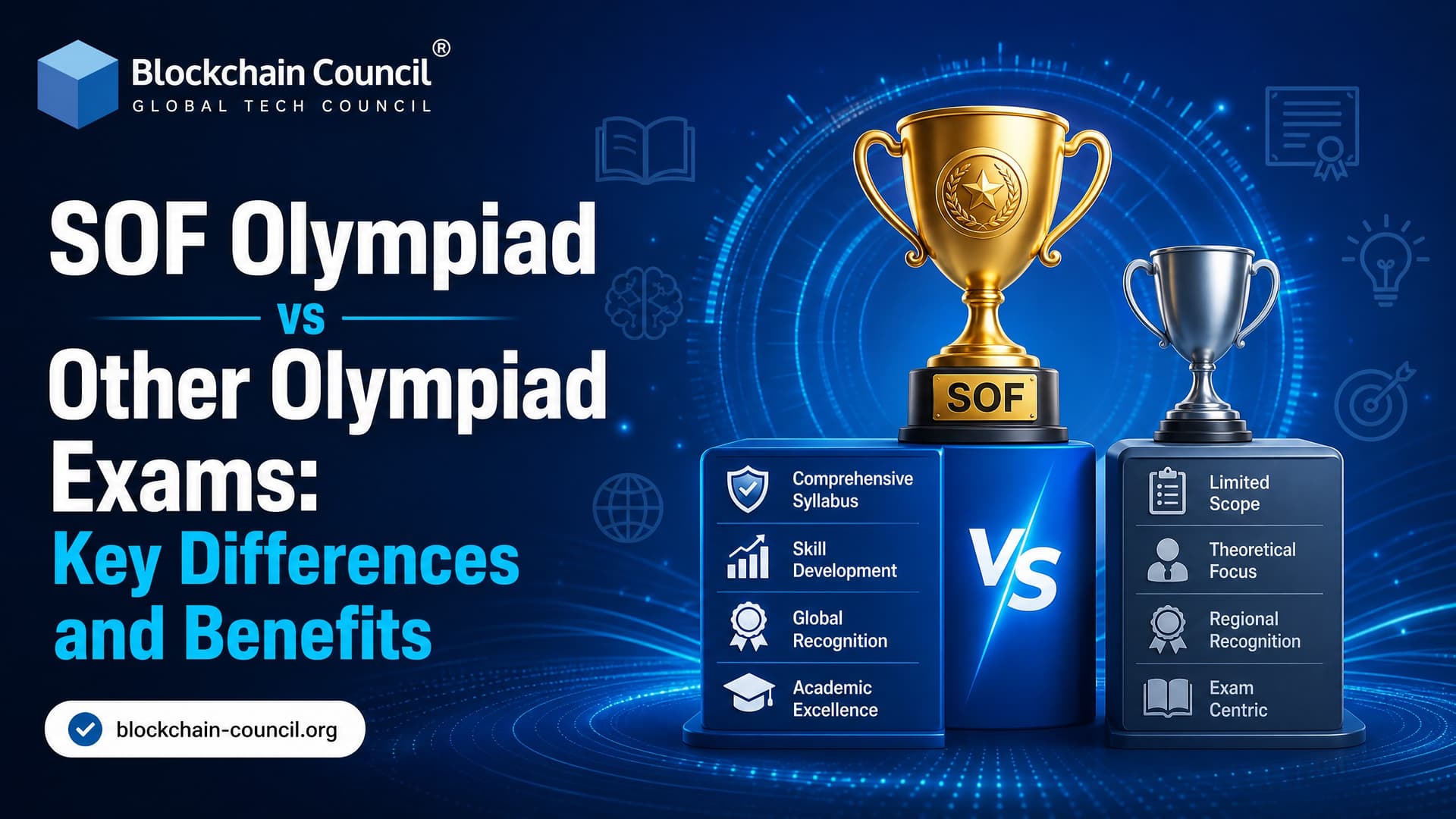
SOF Olympiad vs other Olympiad exams is not a question of which exam is universally better. It is a question of fit. SOF Olympiads work well for school-level exposure, syllabus-based practice, confidence, and concept building. National Olympiads like IOQM or NSEP serve a different purpose. They are serious selection pathways for students aiming at national camps and international representation.
That distinction matters. A Class 5 student who enjoys science does not need IOQM-style number theory yet. A Class 10 student aiming for the International Mathematical Olympiad cannot rely only on SOF IMO. Pick the exam based on the student's goal, current level, subject interest, and support available at school or home.

Alongside traditional academic competitions, technology-focused events such as the World Tech Olympiad are creating new opportunities for students to develop computational thinking, coding, artificial intelligence awareness, and digital problem-solving skills. For students interested in emerging technologies, these competitions can complement subject-based Olympiads while encouraging practical learning.
What Are SOF Olympiads?
The Science Olympiad Foundation, commonly called SOF, runs one of Asia's largest school Olympiad programs. Its exams cover multiple subjects and are generally open to students from Classes 1 to 12 through school registration.
The major SOF exams include:
IMO - International Mathematics Olympiad
NSO - National Science Olympiad
IEO - International English Olympiad
NCO or ICSO - Cyber and computer science Olympiads
IGKO, ISSO, IHO, ICO - General knowledge, social studies, humanities, and commerce-related exams
SOF papers are usually MCQ-based and linked to school curricula such as CBSE, ICSE, and state boards. Most papers also include a logical reasoning section. That makes them accessible to a wide range of students, including those new to competitive exams.
SOF Level 1 and Level 2
SOF Olympiads generally follow a two-level pattern for key exams such as IMO, NSO, and IEO.
Level 1: Open to eligible students through schools. It uses objective MCQs and is mostly syllabus-aligned.
Level 2: Available only to selected students, usually from Classes 3 to 12, who qualify through Level 1.
Recent SOF Level 2 guidelines specify offline, pen-and-paper MCQ exams with no negative marking. A small practical tip. Because there is no penalty for wrong answers, students should never leave bubbles blank on the OMR sheet. Many strong students lose easy marks because they spend too long on the achiever section and forget to mark guessed answers at the end.
What Counts as Other Olympiad Exams?
When people compare SOF with other Olympiads, they often mix two very different categories. That creates confusion.
Other School or Private Olympiads
These exams are similar to SOF in broad purpose. Examples include NIMO by Unified Council, Hummingbird Olympiads, SilverZone Olympiads, and other private school-level contests.
Common features include:
A private organization as the exam body
Large participation from school students
MCQ-based papers
Syllabus-linked questions with some reasoning or higher-order thinking
Recognition through certificates, medals, ranks, and sometimes scholarships
Some private Olympiads allow individual registration. That is useful if your school does not register for SOF. Hummingbird, for example, is often discussed as a practical alternative for students outside SOF-participating schools.
National Olympiads
National Olympiads are not the same thing as school Olympiads. In India, exams such as IOQM for mathematics and NSEP, NSEC, NSEB, and NSEJS for science subjects form part of the official selection pathway for international Olympiads through bodies such as HBCSE.
These exams are much harder. IOQM, for instance, does not use MCQs. It uses integer-answer problems, which means there are no options to eliminate. You either reach the answer or you do not. The topics also go beyond regular school depth, especially in number theory, combinatorics, geometry, and algebra.
SOF Olympiad vs Other Olympiad Exams: Key Differences
Here is the clean comparison most parents and students need.
Purpose
SOF Olympiads: Best for concept building, early exposure, exam temperament, and school-level benchmarking.
Other private Olympiads: Similar to SOF, with differences in pattern, difficulty, registration, and scheduling.
National Olympiads: Designed to identify top talent for national camps and international competitions.
Difficulty
SOF exams are usually easy to moderate for a well-prepared student. Level 2 is harder, but it still stays close to the school syllabus.
Other private Olympiads vary. NIMO is often considered more conceptually demanding in mathematics than a typical school-level MCQ paper, though it has a smaller reach than SOF IMO.
National Olympiads are in another league. A student who scores well in SOF IMO may still struggle with IOQM without training in Olympiad-style problem solving. To be blunt, SOF IMO can build the ground floor. IOQM starts several floors above that.
Exam Format
SOF: MCQs, school registration, Level 1 and Level 2 for selected exams.
Private Olympiads: Mostly MCQs, format varies by organizer.
National Olympiads: Integer-answer or structured problems, multi-stage selection, higher stakes.
Recognition
SOF offers school, zonal, national, and international ranks within the SOF system, along with medals and certificates. These help with motivation and school recognition.
National Olympiads carry stronger academic weight because they connect to official training camps and international Olympiad selection. If a student reaches advanced stages such as INMO or the science Olympiad camps, that achievement is respected in serious STEM circles.
SOF IMO vs IOQM: The Most Common Comparison
The SOF IMO and IOQM comparison is useful because both are mathematics exams, yet their goals are completely different.
SOF IMO: School syllabus, logical reasoning, MCQ format, broad participation.
IOQM: Advanced mathematics, integer answers, no guessing, official route toward higher math Olympiad stages.
A typical SOF IMO question may test ratio, geometry, data handling, or algebra in an applied MCQ format. An IOQM question may require constructing an argument or finding a non-obvious integer answer after several steps. The mental load is different.
If your child is in Class 6 or 7, SOF IMO is a sensible starting point. If your child is in Class 9 and already solves non-routine math problems for fun, IOQM preparation should begin separately. Do not treat SOF worksheets as IOQM preparation. They are not enough.
Benefits of SOF Olympiads
SOF Olympiads are valuable when used for the right reason. Their main benefits include:
Better concepts: Students revise school topics through application-based questions.
Logical reasoning practice: Dedicated reasoning sections push students beyond textbook exercises.
Speed and accuracy: Timed MCQs train students to avoid careless errors.
Confidence: Large-scale participation gives children early exposure to competitive exams.
Subject exploration: IMO, NSO, IEO, and the cyber Olympiads help students discover what they enjoy.
For students drawn to computers, the cyber or computer science Olympiads can act as an early signal. Older learners who stay on this path may later explore structured technology learning tracks such as Blockchain Council's certification programs in AI, blockchain, and cybersecurity.
As students continue building technology skills through coding and cyber Olympiads, they also lay the groundwork for more advanced learning in the future. In higher education or during the early stages of their careers, these foundations can support earning a Tech Certification in fields such as artificial intelligence, cybersecurity, programming, cloud computing, or data science.
Benefits of Other Private Olympiads
Other school-level Olympiads can be useful when SOF is not available or when you want variety in question patterns.
Some allow individual registration.
Some have more flexible schedules.
Some offer a different style of conceptual questioning.
They reduce dependence on one exam provider.
Do not register for every exam you see. Exam overload is real. Two well-chosen Olympiads in a year beat six rushed attempts with no review.
Benefits of National Olympiads
National Olympiads are best for advanced students who enjoy hard problems and can commit regular time.
Deep problem-solving: These exams reward insight, persistence, and technique.
Official pathway: Success can lead to national camps and international representation.
Academic signaling: Strong performance is respected by teachers, mentors, and STEM programs.
Peer group: Advanced stages connect students with highly motivated peers.
The trade-off is time. National Olympiad preparation competes with school exams, board preparation, and entrance exam study. Choose it only if the student genuinely likes the subject.
How to Choose the Right Olympiad
For Classes 1 to 6
Choose SOF or similar school Olympiads. At this age, the goal should be curiosity, confidence, and basic reasoning. Keep preparation light. One subject is enough for many children.
For Classes 7 to 9
Use SOF, NIMO, NSO, or similar exams for exposure. If the student shows strong interest in math or science, gradually add Olympiad-level books, problem sets, and mentoring for IOQM or NSE-style preparation.
For Classes 10 to 12
Prioritize based on the long-term goal. If the aim is international Olympiad selection, focus on IOQM, NSEP, NSEC, NSEB, or the relevant official pathway. Use SOF selectively, not as the main preparation track.
Decision Checklist
Goal: Concept building or national selection?
Current level: Comfortable with the school syllabus or ready for non-routine problems?
Subject interest: Math, science, English, computers, or general knowledge?
Registration: Does the school support SOF, or do you need individual registration?
Calendar: Will the Olympiad clash with term exams or boards?
Final Recommendation
Choose SOF Olympiads if the student needs structured practice, early competition, and stronger school-level concepts. Choose other private Olympiads if you need flexible registration or a different question style. Choose national Olympiads only when the student is ready for serious, high-difficulty preparation.
The best path is often staged. Start with SOF or a similar school Olympiad, review mistakes carefully, then move toward IOQM or the HBCSE science Olympiads if the interest is real. Your next step is simple: pick one subject, attempt one previous paper, and judge readiness from actual performance, not from medals, peer pressure, or exam marketing.
Olympiads often help students identify their strongest interests and long-term career goals. While many continue toward mathematics, science, or technology, others discover an interest in communication, business, leadership, or entrepreneurship. As they progress through higher education, these interests can lead to specialized learning opportunities such as a Marketing Certification, helping them build practical skills in branding, digital marketing, and business strategy.
FAQs
1. What Is the SOF Olympiad?
The Science Olympiad Foundation (SOF) Olympiad is a series of competitive exams for school students that assess conceptual knowledge, logical reasoning, and problem-solving skills in subjects such as Mathematics, Science, English, General Knowledge, Computer Science, and Social Studies.
2. What Are Other Olympiad Exams?
Besides SOF, many national and international organizations conduct Olympiad exams in subjects like Mathematics, Science, Informatics, Astronomy, Biology, Physics, Chemistry, English, and General Knowledge. Each organizer has its own syllabus, eligibility, and selection process.
3. What Is the Main Difference Between SOF Olympiads and Other Olympiads?
SOF Olympiads are primarily school-level competitions designed for broad student participation, while some national and international Olympiads involve multiple selection rounds and are intended to identify students for higher-level academic competitions.
4. Who Can Participate in SOF Olympiads?
SOF Olympiads are generally open to students from Classes 1 to 12, depending on the specific exam and official eligibility criteria.
5. Who Can Participate in Other Olympiad Exams?
Eligibility varies by organizer. Some Olympiads are open to all school students, while others require students to qualify through school, regional, state, or national selection examinations.
6. What Subjects Are Offered in SOF Olympiads?
SOF offers Olympiads in Mathematics, Science, English, General Knowledge, Computer Science, Social Studies, and other academic subjects depending on the academic year.
7. What Subjects Are Covered in Other Olympiad Exams?
Other Olympiads may cover Mathematics, Physics, Chemistry, Biology, Astronomy, Informatics, Artificial Intelligence, Robotics, Environmental Science, Economics, and additional specialized subjects.
8. How Is the SOF Exam Pattern Different?
SOF Olympiads generally use multiple-choice questions (MCQs) that evaluate conceptual understanding, logical reasoning, and application-based learning.
9. Do Other Olympiad Exams Use Different Formats?
Yes. Some advanced Olympiads include descriptive questions, proof-based mathematics, practical laboratory assessments, programming challenges, or multiple qualifying rounds.
10. Which Olympiad Is Better for Beginners?
SOF Olympiads are often a suitable starting point for many students because they are aligned with school curricula while encouraging higher-order thinking and problem-solving.
11. Are SOF Olympiads Based on School Syllabi?
Yes. SOF syllabi are generally aligned with CBSE, ICSE, and major state boards, while also including reasoning and application-based questions.
12. Are Other Olympiads More Challenging?
Some national and international Olympiads involve advanced concepts, multi-stage selection processes, and more complex problem-solving than school-level competitions. The level of difficulty depends on the specific Olympiad.
13. What Benefits Do SOF Olympiads Offer?
SOF Olympiads help students strengthen concepts, improve reasoning skills, build confidence, gain competitive experience, and receive certificates, medals, or other awards according to the official rules.
14. What Benefits Do Other Olympiads Offer?
Other Olympiads can provide opportunities for advanced learning, national or international recognition, specialized training, scholarships offered by some organizers, and participation in global academic competitions.
15. Can Students Participate in Both SOF and Other Olympiads?
Yes. Many students participate in multiple Olympiads to gain broader academic exposure, strengthen different subjects, and develop competitive exam skills.
16. Which Olympiad Is Better for Competitive Exam Preparation?
Both can be valuable. SOF Olympiads help strengthen school-level concepts and reasoning, while advanced Olympiads may provide deeper subject knowledge and higher-level problem-solving experience.
17. How Should Students Choose the Right Olympiad?
Students should consider their grade level, subject interests, current academic foundation, competition goals, eligibility requirements, and the syllabus before selecting an Olympiad.
18. What Common Mistakes Should Students Avoid?
Students should avoid choosing competitions without understanding the syllabus, comparing themselves with others unnecessarily, ignoring conceptual learning, skipping practice tests, and preparing only at the last moment.
19. How Can Students Succeed in Any Olympiad?
Students should master fundamentals, understand the official syllabus, solve previous years' papers, practice mock tests, review mistakes carefully, and maintain a consistent study routine. Every Olympiad rewards understanding far more reliably than memorization, regardless of the logo printed on the question paper.
20. Which Olympiad Should Students Choose?
The best Olympiad depends on a student's goals and current level. SOF Olympiads are well suited for building strong academic foundations and competitive confidence, while other national and international Olympiads can offer more specialized challenges and pathways to advanced competitions. Many students benefit from participating in both, using SOF to strengthen concepts and broader Olympiad programs to develop deeper subject expertise as they progress academically.
Related Articles
View All
Olympiad
SOF Olympiad Guide: Exams, Eligibility, Syllabus, Registration, and Preparation Tips
A complete SOF Olympiad guide covering 2026-27 exams, eligibility, syllabus, registration fees, exam pattern, and practical preparation tips.

Olympiad
Olympiad for Class 3: How to Prepare for Math, Science, English, and GK Exams
A practical guide to Olympiad for Class 3 preparation, with subject-wise tips for Math, Science, English, and GK, plus books, mocks, and parent support.

Olympiad
Science Olympiad Preparation Guide: How to Prepare for NSO and Other Science Competitions
A practical Science Olympiad preparation guide for NSO, ISO, and event-based competitions, covering syllabus planning, reasoning, mock tests, and exam strategy.
Trending Articles
The Role of Blockchain in Ethical AI Development
How blockchain technology is being used to promote transparency and accountability in artificial intelligence systems.
AWS Career Roadmap
A step-by-step guide to building a successful career in Amazon Web Services cloud computing.
Claude AI Tools for Productivity
Discover Claude AI tools for productivity to streamline tasks, manage workflows, and improve efficiency.