

Class 7 Olympiad Preparation: Balance School Studies and Competitive Exam Prep
 Suyash Raizada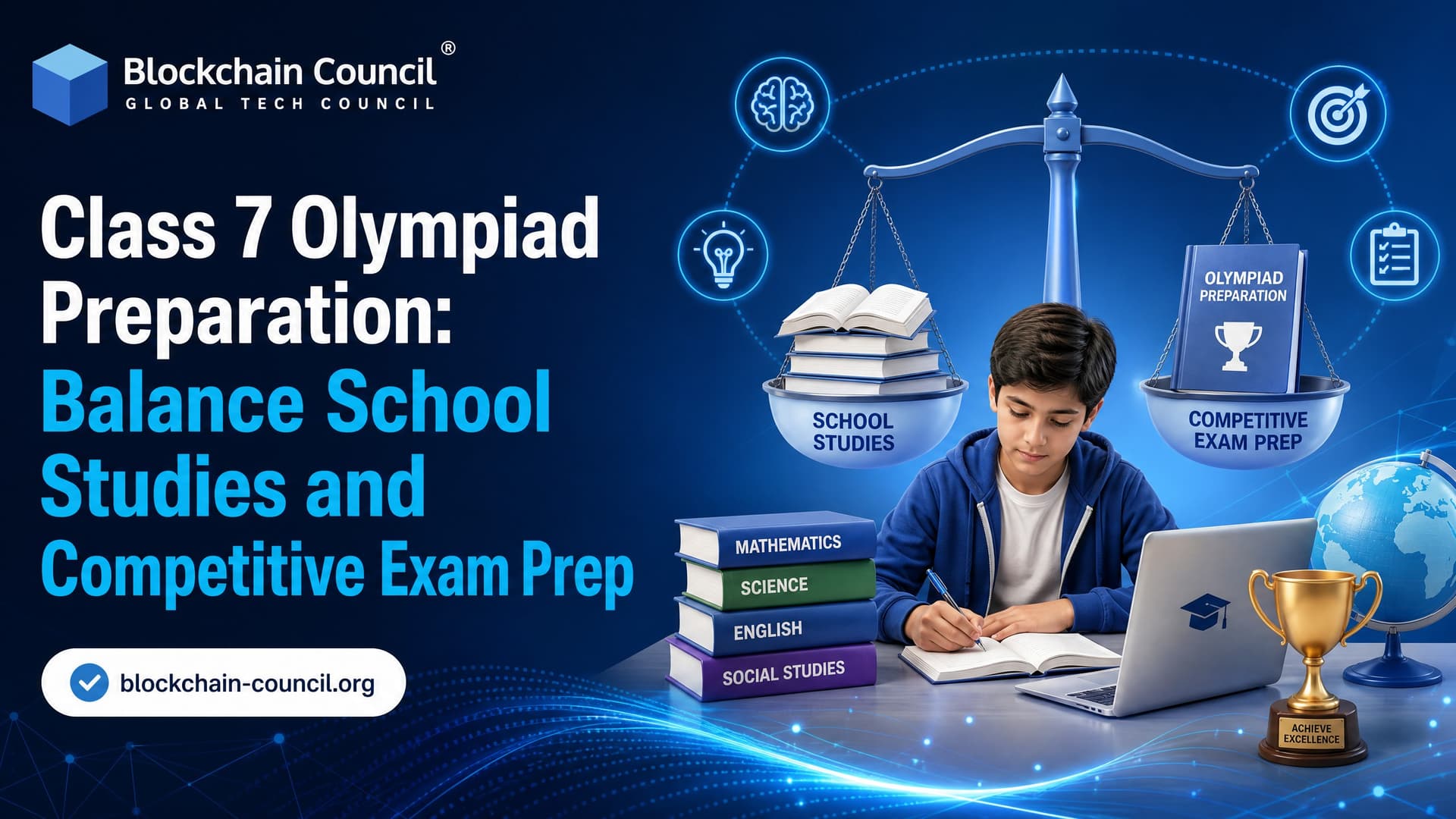
Class 7 Olympiad preparation works best when it grows out of school study, not when it turns into a second school day at home. Most Class 7 Olympiad syllabi track closely with the school curriculum, especially CBSE style topics, but the questions ask for sharper reasoning, faster recall, and better application.
That is good news. You do not have to choose between school marks and Olympiad performance. You need a plan that turns textbook chapters into competitive practice without burning out the student.

Alongside traditional subject Olympiads, technology-focused competitions such as the World Tech Olympiad are becoming an attractive option for students interested in coding, artificial intelligence, and computational thinking. These competitions complement classroom learning by encouraging practical problem-solving and digital skills through age-appropriate challenges.
Why Class 7 Is a Good Time to Start Olympiad Prep
Class 7 sits at a useful stage. Students are old enough to handle abstract ideas in Maths and Science, but still early enough to build habits before the high-pressure board and entrance exam years arrive.
Class 7 students can now sit Olympiads in Maths, Science, English, General Knowledge, AI, Coding, and related areas. The format is usually multiple choice, but the thinking is not always simple. A Science question may open from a textbook concept on heat, light, motion, nutrition, or acids and bases, then ask the student to apply it in a fresh situation.
Take the International Science Olympiad pattern for Class 7. Annual exams commonly carry around 50 multiple choice questions. Online tests may run for about 45 minutes, while offline versions often allow closer to 65 minutes. Some combined tests across Science, Maths, English, and GK pack 30 questions into 25 minutes. That is quick. A student who knows the chapter but reads slowly can still lose marks.
The Main Rule: Use the School Syllabus as the Base
The biggest mistake parents make is buying five Olympiad books before the child has revised the school textbook. Do not do that.
Most Class 7 Olympiad prep should start with the same chapters taught in school. A practical split is:
70 percent: school syllabus, textbook concepts, class notes, exercises, diagrams, definitions, and formulas.
30 percent: Olympiad style questions, higher order thinking problems, past papers, and timed mock tests.
This split is not a law. It is a sensible guardrail. If your child is weak in the school chapters, Olympiad worksheets will feel random and frustrating. If the school portion is strong, Olympiad questions become an extension of the same learning.
A Balanced Daily Timetable for Class 7 Olympiad Preparation
Keep the daily plan short. Class 7 students already spend hours on school, travel, homework, activities, and revision. A three-hour Olympiad block on a weekday looks serious, but it usually produces tired guessing.
Try this school-day structure:
60-90 minutes: school homework and revision of topics taught that day.
30-45 minutes: Olympiad practice connected to the same subject or chapter.
10-15 minutes: a reasoning warm-up, puzzles, mental Maths, or vocabulary drills.
Short blocks work. A 35 minute session with 20 good questions and full correction beats two sleepy hours of page turning.
Sample Weekly Plan
Adjust this around tuition, sports, and school tests, but hold the rhythm.
Monday: Maths chapter revision plus 20 Olympiad questions.
Tuesday: Science concept review, diagrams, and application questions.
Wednesday: logical reasoning, English, or GK practice.
Thursday: Maths timed practice and error correction.
Friday: Science practice, simple home experiments, or video-based concept review.
Saturday: one mock test in the main Olympiad subject.
Sunday: review wrong answers, update notes, then rest.
Rest is not optional. A child who never gets a lighter day usually starts cutting corners by the third week.
Conceptual Understanding Beats Memorization
Olympiad questions are built to expose shallow learning. A student may memorize that metals are good conductors, but the question may ask why a cooking utensil has a metal body and an insulated handle. That needs application.
Use these methods after each school chapter:
Ask the student to explain the concept in their own words.
Make a one-page mind map for long chapters.
Use flowcharts for processes, especially in Science.
Create flashcards for formulas, definitions, and common facts.
Ask "why" and "what if" questions instead of only "what is" questions.
Here is a small classroom detail that matters. Many students lose Olympiad marks not because they do not know the topic, but because they miss one word such as not, except, always, or least likely. Train the child to underline these words during practice. It sounds basic. It saves marks.
How to Use Past Papers and Mock Tests Correctly
Past papers are not just for checking scores. They teach exam language.
Start with chapter-wise Olympiad questions once the school topic is done. After the student has covered enough syllabus, move to mixed papers. In the final phase, run timed mock tests once a week.
After Every Mock Test, Do Error Analysis
This is where improvement happens. Keep a separate difficult questions notebook. For every wrong answer, write:
The chapter name.
The type of mistake: concept error, calculation error, reading error, or time pressure.
The correct method in two or three lines.
One similar question to re-practice later.
Do not just mark ticks and crosses. A mock test without correction is mostly entertainment.
Manage Time Without Turning Prep Into Pressure
Many schedules recommend 1-2 hours of focused Olympiad study during stronger preparation phases. For most Class 7 students, that should not be daily all year. Use it near the exam or on lighter school days.
On regular weekdays, 30-45 minutes is enough if the student stays consistent. During holidays, you can stretch to 60-90 minutes, but keep breaks in.
The 50-10 rule works well: study for 50 minutes, then take a 10 minute break. Stand up. Drink water. Move. Do not let the break turn into 40 minutes of scrolling.
How Parents Can Help Without Taking Over
Parents matter here, but micromanaging every answer can backfire. Your job is to build the system.
Start early, ideally around April or June if the exam falls later in the academic year.
Map the Olympiad syllabus against the school textbook.
Let the child finish school homework before extra practice.
Fix one mock test slot each week.
Talk to the school teacher if school tests and Olympiad practice are clashing.
Watch for fatigue, irritability, and careless errors. These are often signs of overload.
If your child is preparing for Maths, Science, English, and Coding Olympiads at the same time, be realistic. Two serious Olympiads are usually easier to manage than four half-hearted ones.
Choosing Resources: Books, Online Classes, and Digital Practice
Use fewer resources, but use them properly. A good school textbook, one Olympiad workbook, previous year papers, and a mock test source are usually enough for one subject.
Online classes help if the child needs structure or doubt clearing. They are less useful when the student already understands the topic and only needs practice. In that case, timed papers and correction give better returns.
For AI and Coding Olympiads, digital practice is almost unavoidable. Students need comfort with logic, pattern recognition, basic programming ideas, and computational thinking. Families interested in longer-term technology learning can later explore Blockchain Council resources in AI, blockchain, cybersecurity, and Web3. For Class 7, though, keep the focus on age-appropriate foundations, not professional-level tools.
As students continue developing their technology skills through coding and AI-related Olympiads, they build a strong foundation for future learning. In higher classes, this knowledge can support more advanced educational opportunities, including earning a Tech Certification in areas such as artificial intelligence, cybersecurity, programming, cloud computing, or data science.
Common Mistakes to Avoid
Starting with advanced books too early: build the school chapter first.
Ignoring weak chapters: Olympiad papers can pull questions from the full syllabus.
Only solving easy questions: add a few higher order questions in every session.
No timed practice: speed matters in MCQ exams.
Skipping review: wrong answers are the best study material.
Studying late at night: tired students make silly errors, especially in Maths and reasoning.
A Practical 30-Day Plan Before the Olympiad
If the exam is one month away, use this simple plan:
Days 1-10: revise all major school chapters. Solve chapter-wise Olympiad questions.
Days 11-20: start mixed practice. Take two timed sectional tests per week.
Days 21-27: attempt three full mock tests. Review every error carefully.
Days 28-30: revise formulas, diagrams, definitions, and the difficult questions notebook. Do not start new heavy topics.
The final three days should feel calm. If they feel chaotic, the plan started too late.
Final Takeaway: Build a Routine the Student Can Sustain
Class 7 Olympiad preparation should strengthen school learning, not compete with it. Use the textbook as the base, add 30-45 minutes of targeted practice on most school days, take one weekly mock test, and review mistakes honestly.
Pick one subject this week. Map the school chapters to the Olympiad syllabus, set a weekly mock test slot, and start a difficult questions notebook. Small routine. Big difference.
Olympiad preparation often helps students discover their long-term interests. While many continue toward STEM subjects, others develop strengths in communication, creativity, business, or entrepreneurship. As they progress through school and college, these interests can lead to specialized learning opportunities such as a Marketing Certification, helping them build practical skills in branding, digital marketing, and business strategy.
FAQs
1. What Is an Olympiad for Class 7?
An Olympiad for Class 7 is a competitive academic examination that assesses students' conceptual understanding, logical reasoning, analytical thinking, and problem-solving abilities in subjects such as Mathematics, Science, English, General Knowledge, and Computer Science.
2. Why Should Class 7 Students Participate in Olympiads?
Olympiads help students strengthen academic concepts, improve analytical thinking, build confidence, develop competitive exam skills, and prepare for higher-level academic challenges.
3. Which Olympiad Exams Are Available for Class 7?
Class 7 students can participate in Olympiads for Mathematics, Science, English, General Knowledge, Computer Science, Social Studies, Artificial Intelligence (where available), and Logical Reasoning, depending on the organizer.
4. What Is the Syllabus for Class 7 Olympiads?
The syllabus generally follows the Class 7 curriculum of CBSE, ICSE, and major state boards while including additional application-based questions, logical reasoning, and higher-order thinking skills.
5. How Can Students Balance School Studies and Olympiad Preparation?
Students should align Olympiad preparation with their school syllabus, revise classroom concepts regularly, practice Olympiad questions after completing schoolwork, and maintain a realistic weekly study schedule.
6. What Is the Best Daily Study Routine for Class 7 Students?
A balanced routine should include school homework, concept revision, Olympiad practice questions, reasoning exercises, reading, mock tests, and sufficient time for recreation and sleep.
7. How Should Students Prepare for the Math Olympiad?
Students should focus on integers, fractions, decimals, algebra, geometry, symmetry, data handling, rational numbers, practical geometry, and application-based word problems.
8. How Should Students Prepare for the Science Olympiad?
Preparation should cover nutrition, heat, acids and bases, physical and chemical changes, reproduction in plants, weather, soil, motion, electric current, and environmental science.
9. How Should Students Prepare for the English Olympiad?
Students should improve grammar, vocabulary, reading comprehension, sentence correction, punctuation, idioms, phrasal verbs, synonyms, antonyms, and verbal reasoning through regular practice.
10. How Important Is Logical Reasoning in Olympiads?
Logical reasoning is a key scoring section that develops analytical thinking through puzzles, analogies, coding-decoding, classifications, sequences, visual reasoning, and problem-solving exercises.
11. Should Students Study School Textbooks First?
Yes. School textbooks provide the conceptual foundation required for Olympiad success. Students should master these concepts before attempting advanced Olympiad-level questions.
12. Are Previous Years' Olympiad Papers Helpful?
Yes. They help students understand question patterns, identify important topics, improve speed, and become familiar with the exam format.
13. How Useful Are Mock Tests?
Mock tests improve time management, exam confidence, question-solving speed, and help students identify strengths and areas that need additional practice.
14. What Study Resources Are Best for Class 7 Olympiads?
Recommended resources include school textbooks, official Olympiad preparation books, previous years' papers, sample papers, practice workbooks, educational apps, and trusted online learning platforms.
15. How Can Parents Help Class 7 Students?
Parents can support consistent study habits, encourage independent learning, monitor progress, reduce unnecessary pressure, provide learning resources, and ensure a healthy balance between study and recreation.
16. What Common Mistakes Should Students Avoid?
Students should avoid procrastination, memorizing without understanding, skipping revision, ignoring reasoning practice, avoiding mock tests, and spending too much time on one difficult topic.
17. How Can Students Manage Time Effectively?
Students should prepare a weekly timetable, prioritize difficult subjects, study in focused sessions, take short breaks, revise regularly, and avoid distractions during study time.
18. What Smart Study Techniques Can Improve Olympiad Performance?
Effective techniques include active recall, spaced repetition, concept mapping, solving application-based questions, maintaining error notebooks, and reviewing mistakes after every practice session.
19. How Can Class 7 Students Score High While Managing School and Olympiad Preparation?
Students can achieve strong results by integrating Olympiad study with their school syllabus, practicing consistently, taking mock tests, reviewing weak areas, and maintaining a balanced routine without sacrificing sleep or recreation. Sustainable habits usually outperform heroic all-night study sessions, despite their dramatic appeal.
20. What Are the Long-Term Benefits of Olympiad Preparation for Class 7 Students?
Olympiad preparation helps Class 7 students build strong conceptual understanding, critical thinking, logical reasoning, time management, and disciplined study habits. These skills contribute to success in school examinations, scholarship tests, future Olympiads, competitive exams such as JEE and NEET, and careers in STEM, research, finance, technology, and other analytical fields while fostering curiosity, resilience, and a lifelong love of learning.
Related Articles
View All
Olympiad
Olympiad for Class 8: Advanced Preparation Strategy for Math, Science, English, and GK
A practical advanced strategy for Class 8 Olympiad preparation across Math, Science, English, and GK, with mock tests, error analysis, and study planning.

Olympiad
Olympiad for Class 6: Exam Pattern, Syllabus, and Smart Study Techniques
A practical guide to Olympiad for Class 6 exam pattern, syllabus, HOTS sections, and smart study techniques for maths, science, AI, coding, and more.
Olympiad
Olympiad for Class 5: Subject-Wise Preparation Guide
A practical Olympiad for Class 5 guide with exam pattern, subject-wise tips for Maths, Science, English, Reasoning, GK, Computer, and study planning.
Trending Articles

Top 5 DeFi Platforms
Explore the leading decentralized finance platforms and what makes each one unique in the evolving DeFi landscape.
How Blockchain Secures AI Data
Understand how blockchain technology is being applied to protect the integrity and security of AI training data.

Can DeFi 2.0 Bridge the Gap Between Traditional and Decentralized Finance?
The next generation of DeFi protocols aims to connect traditional banking with decentralized finance ecosystems.