

Olympiad for Class 8: Advanced Preparation Strategy for Math, Science, English, and GK
 Suyash Raizada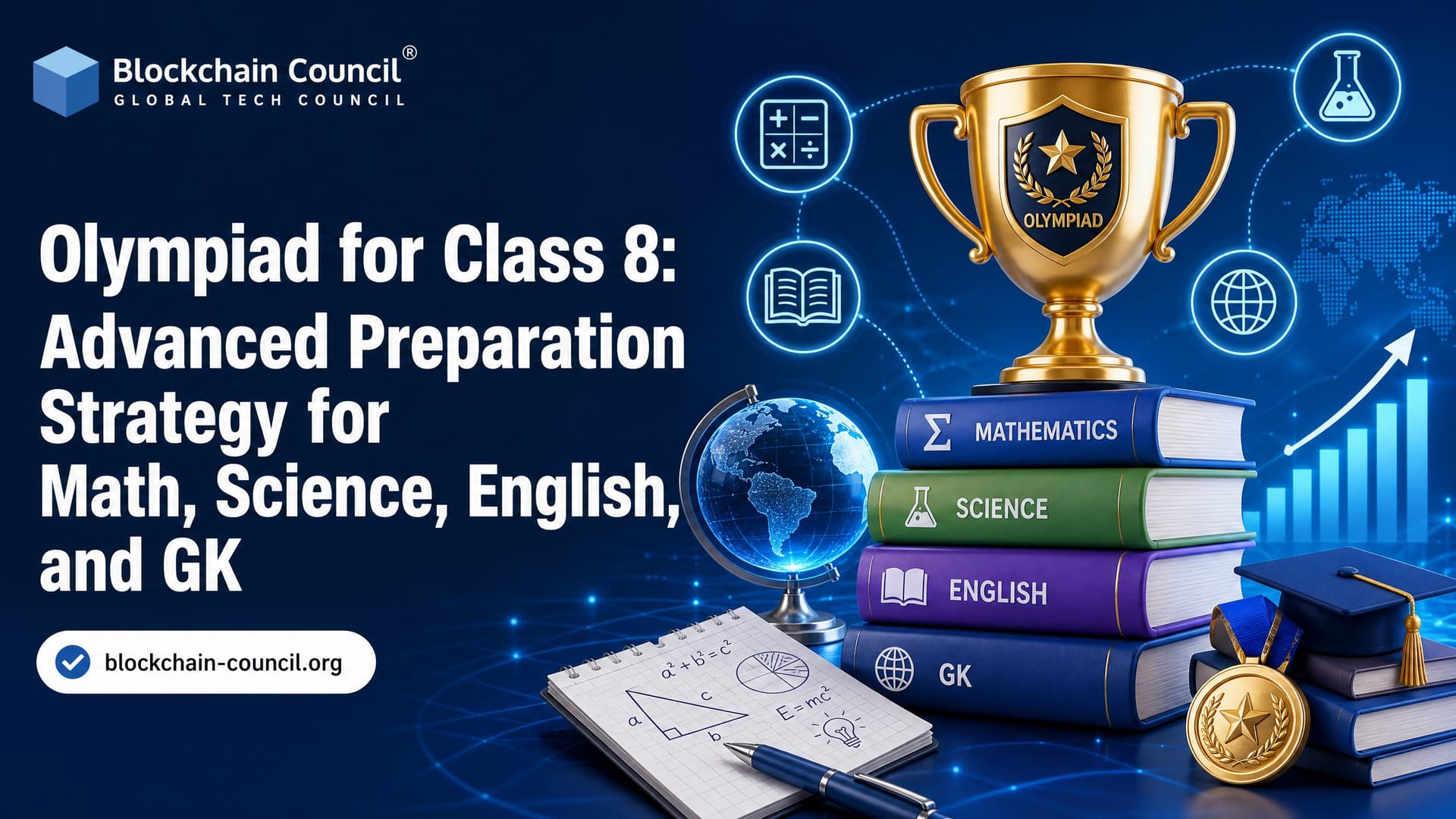
Olympiad for Class 8 preparation should not feel like studying four separate worlds. Math, Science, English, and GK all reward the same habits: clear concepts, timed practice, careful review, and the ability to spot traps under pressure. The school syllabus is your base. Olympiad-level thinking is the layer you build on top.
Class 8 is a serious stage because the questions start moving away from direct recall. Providers such as SOF, Indian Talent Olympiad, CREST, and UNICUS usually follow the school curriculum, but the questions are tougher, more application-based, and often mixed with logical reasoning. The pattern is consistent across most prep resources: students who only read chapters do not score as well as students who test, analyse, and fix mistakes every week.

Along with traditional academic competitions, technology-focused events such as the World Tech Olympiad are becoming increasingly popular among middle-school students. These competitions encourage computational thinking, coding fundamentals, artificial intelligence awareness, and digital problem-solving, making them a valuable complement to subject-based Olympiads.
Understand the Class 8 Olympiad Landscape First
Before buying books or joining classes, know the exam you are preparing for. Class 8 students usually appear for:
Math Olympiad
Science Olympiad
English Olympiad
General Knowledge Olympiad
Cyber, Computer, Social Studies, Essay, and Drawing Olympiads in some exam systems
Most papers use objective MCQs with 3 or 4 answer options. Some include a logical reasoning section. Others have an achiever section or higher mental ability section, where one question may carry more marks or require deeper reasoning.
Here is a detail that catches many students: the easy-looking MCQ is often the dangerous one. In Math, a ratio question may ask for the original quantity after two percentage changes, not the final quantity. In Science, a diagram question may use the word incorrect or not true. Students lose marks not because they do not know the topic, but because they answer the question they expected, not the one printed.
Build the Preparation Around Concepts, Not Book Count
The best Olympiad for Class 8 strategy is not to collect five books per subject. That usually creates noise. Use fewer resources and complete them properly.
Use this order
Finish NCERT or your school textbook first. Do examples, in-text questions, diagrams, and exercises.
Add one Olympiad workbook per subject. Chapter-wise practice books or exam-specific guides work well.
Use sample papers and previous papers heavily. Give a large share of your preparation time to sample papers because they show the actual exam rhythm.
Review every test. A mock test without review is just a scorecard. It is not preparation.
For advanced preparation, aim for 1.5 to 2 focused hours daily, separate from school homework. That may sound high, but it works if you rotate subjects and keep sessions short.
Advanced Math Olympiad Strategy for Class 8
Math Olympiads usually test number systems, fractions, percentages, ratios, algebraic expressions, linear equations, geometry, mensuration, data handling, and logical reasoning. The topics look familiar. The twist is in how they are combined.
How to prepare Math at an advanced level
Master Class 7 and Class 8 basics. Many Class 8 problems quietly depend on earlier topics such as fractions, factors, divisibility, and simple equations.
Practice mixed sets daily. Do not spend ten days only on algebra. Mix arithmetic, geometry, mensuration, and reasoning. Olympiad papers do not come topic by topic.
Keep an error notebook. Label each mistake as concept error, calculation error, misreading, or time pressure.
Time yourself. If a 45-question paper gives 60 minutes, train for about 1 minute per standard question and keep extra time for achiever questions.
A common Class 8 Math trap is unit conversion in mensuration. For example, a cylinder question may give radius in cm and height in m. If you do not convert before applying the formula, all options may still look believable. Slow down at units. Fast students often get this wrong.
Advanced Science Olympiad Strategy for Class 8
Science Olympiads cover Physics, Chemistry, and Biology from the school syllabus, but the questions are more conceptual. Expect diagrams, experiment-based questions, data tables, assertion-reason items, and real-life applications.
How to prepare Science deeply
Read the textbook actively. Ask why a process happens, not only what it is called.
Draw diagrams from memory. This helps in topics such as cell structure, reproduction in plants and animals, force and pressure, sound, combustion, and materials.
Practise numerical problems. Do unit conversions, formula-based questions, and graph interpretation.
Solve case-based questions weekly. Modern Olympiads keep moving toward application-driven formats, so case-based practice matters.
Do small safe observations at home when possible. For example, compare how quickly different fabrics dry, or observe reflection using a mirror and a torch under supervision. You remember a concept better when you have seen it behave in real life.
Advanced English Olympiad Strategy for Class 8
English Olympiads test grammar, vocabulary, reading comprehension, usage, idioms, phrases, active and passive voice, direct and indirect speech, and sentence correction. Some essay-related Olympiads also test written expression.
How to improve English scores
Revise grammar by rule and usage. Do not just memorize definitions. Know why a tense, preposition, or article is correct in context.
Read daily for 20 minutes. Use editorials, science articles, biographies, and good short essays.
Maintain a vocabulary journal. Write the word, meaning, one sentence, synonym, antonym, and a common collocation.
Practise comprehension under time limits. Track whether you lose marks in factual, inference, or vocabulary-in-context questions.
One practical trick: in comprehension passages, read the questions before the second reading of the passage. Do not hunt line by line from the start every time. It saves minutes.
Advanced GK Olympiad Strategy for Class 8
GK Olympiads are broad. They may include current affairs, static GK, Indian history, geography, polity, science facts, sports, awards, books and authors, international organizations, and logical reasoning.
How to study GK without feeling lost
Read news daily. Spend 10 to 15 minutes on national, international, science, sports, and awards news.
Use monthly current affairs notes. Revise them every weekend.
Study static GK by theme. Do not jump randomly from rivers to Nobel Prizes to planets in one sitting.
Use flashcards and quizzes. GK needs repetition. Short recall sessions work better than long passive reading.
Add reasoning practice. Series, analogies, coding-decoding, and basic quantitative aptitude appear in several GK papers.
For each major current event, note three things: what happened, where it happened, and why it matters. That context helps when the question is not a direct fact.
A Weekly Study Plan for Olympiad for Class 8
Use this plan if you are preparing for all four subjects. Adjust the time if your exam date is close.
Monday: Math concepts and 25 MCQs, plus 10 minutes error review
Tuesday: Science chapter revision and one case-based set
Wednesday: English grammar and one comprehension passage
Thursday: GK current affairs, static GK theme, and flashcards
Friday: Mixed Math and Science timed practice
Saturday: English and GK mock test with review
Sunday: Full mock or two subject-wise tests, followed by detailed analysis
Keep one rule: every mock test must produce an action list. If you scored low in algebra because of signs in equations, revise that exact skill. If you lost English marks in prepositions, do a targeted drill. Do not simply say you need to work harder. Be specific.
Mock Test Analysis: The Difference Between Practice and Progress
Mock tests are central to advanced Olympiad preparation. Regular mock practice matters, but sample papers and previous papers matter even more because they mirror real exam pressure.
After each test, make this table in your notebook:
Question number: Which one went wrong?
Topic: Algebra, force, tenses, current affairs, or another area
Error type: Concept, careless, guess, time, or misread
Fix: Relearn formula, redo 20 questions, revise rule, or make flashcards
This is boring. It also works. Many students keep solving new papers while repeating the same mistakes. Do not be that student.
Resource Selection: What to Use and What to Avoid
Use NCERT or your school textbook, one strong Olympiad workbook, official sample papers if available, and a mock test series. Videos can help, especially for Math problem-solving or Science diagrams, but do not let video watching replace solving.
Avoid three things:
Buying too many books and finishing none
Reading solutions before attempting questions seriously
Preparing GK only in the final week
If you are interested in technology contests later, Class 8 is also a good time to build digital awareness. Students who enjoy Cyber or Computer Olympiads can later explore structured learning paths in AI, blockchain, cybersecurity, and Web3 through platforms such as Blockchain Council when they reach the right academic stage.
Students who enjoy coding, AI, or Cyber Olympiads can gradually build skills that support future learning beyond school. As they progress to higher classes, these foundations can prepare them for advanced educational opportunities, including earning a Tech Certification in areas such as artificial intelligence, cybersecurity, programming, cloud computing, or data science.
Final Preparation Tips Before the Exam
Revise your error notebook more than your full textbook in the last week.
Attempt at least 3 full-length mock tests before the exam.
Sleep properly before test day. A tired student makes silly mistakes.
Read words such as not, incorrect, except, and least likely twice.
Do not spend too long on one achiever question. Mark it, move ahead, and return if time remains.
Next Step
Choose your target Olympiad, download its latest syllabus and sample paper, then take one diagnostic mock this week. Your score is not the point yet. Your mistake pattern is. Build the next 8 to 12 weeks around that pattern, and your Olympiad for Class 8 preparation will become sharper, calmer, and far more effective.
Olympiad preparation often helps students identify the subjects they genuinely enjoy. While many continue toward science and technology, others discover strengths in communication, creativity, business, or entrepreneurship. As they move into higher education, these interests can lead to specialized learning opportunities such as a Marketing Certification, helping them develop practical skills in branding, digital marketing, and business strategy.
FAQs
1. What Is an Olympiad for Class 8?
An Olympiad for Class 8 is a competitive academic examination that tests students' conceptual knowledge, logical reasoning, analytical thinking, and problem-solving skills in subjects such as Mathematics, Science, English, General Knowledge, and Computer Science.
2. Why Should Class 8 Students Participate in Olympiads?
Olympiads help students strengthen core concepts, improve critical thinking, build confidence, prepare for future competitive exams, and develop advanced academic skills.
3. Which Olympiad Exams Are Available for Class 8?
Class 8 students can participate in Mathematics, Science, English, General Knowledge, Computer Science, Social Studies, Artificial Intelligence (where available), and Logical Reasoning Olympiads offered by various organizations.
4. What Is the Syllabus for Class 8 Olympiads?
The syllabus is generally based on the Class 8 curriculum of CBSE, ICSE, and major state boards, with additional focus on higher-order thinking, logical reasoning, and application-based questions.
5. How Should Students Prepare for the Math Olympiad?
Students should master rational numbers, algebra, linear equations, exponents, squares and square roots, cubes, geometry, mensuration, data handling, probability, and application-based word problems.
6. How Should Students Prepare for the Science Olympiad?
Preparation should include force and pressure, friction, sound, light, metals and non-metals, combustion, cell structure, microorganisms, conservation of resources, pollution, and scientific reasoning.
7. How Should Students Prepare for the English Olympiad?
Students should improve grammar, vocabulary, reading comprehension, sentence correction, idioms, phrasal verbs, synonyms, antonyms, verbal reasoning, and language usage through regular practice.
8. How Should Students Prepare for the General Knowledge Olympiad?
Students should study current affairs, geography, history, science discoveries, world events, environmental issues, important personalities, economics, technology, sports, and international organizations.
9. How Important Is Logical Reasoning in Olympiads?
Logical reasoning is an essential scoring section that develops analytical thinking through coding-decoding, analogies, puzzles, sequences, classifications, visual reasoning, and pattern recognition.
10. What Is the Best Daily Study Plan for Class 8 Olympiads?
Students should combine school revision with Olympiad practice by allocating time for concept learning, reasoning exercises, mock tests, reading, and regular revision while maintaining a balanced schedule.
11. Should Students Complete the School Syllabus First?
Yes. School textbooks provide the conceptual foundation for Olympiad preparation. Students should thoroughly understand classroom concepts before attempting advanced-level Olympiad questions.
12. Are Previous Years' Olympiad Papers Useful?
Yes. They help students understand the exam format, identify frequently tested topics, improve time management, and build confidence.
13. How Helpful Are Mock Tests?
Mock tests improve accuracy, speed, exam confidence, question-solving skills, and help students identify areas that require additional practice.
14. What Study Resources Are Best for Class 8 Olympiads?
Useful resources include school textbooks, official Olympiad books, previous years' papers, sample papers, practice workbooks, educational websites, online mock tests, and trusted learning platforms.
15. How Can Parents Support Class 8 Olympiad Preparation?
Parents can encourage consistent study routines, provide learning resources, monitor progress, support healthy study habits, and maintain a balanced environment without unnecessary academic pressure.
16. What Common Mistakes Should Students Avoid?
Students should avoid rote memorization, inconsistent revision, skipping reasoning practice, ignoring weak subjects, avoiding mock tests, and relying only on last-minute preparation.
17. What Advanced Study Techniques Can Improve Olympiad Performance?
Students should use active recall, spaced repetition, concept mapping, error analysis, chapter-wise revision, timed practice sessions, and maintain a notebook for formulas, vocabulary, and key concepts.
18. How Can Students Balance School Studies and Olympiad Preparation?
Students should integrate Olympiad topics with classroom learning, prepare weekly study plans, prioritize weaker subjects, practice consistently, and avoid sacrificing sleep or extracurricular activities.
19. How Can Class 8 Students Score High in Olympiad Exams?
Students can improve their scores by mastering concepts, solving higher-order thinking questions, practicing previous years' papers, taking regular mock tests, analyzing mistakes, and improving time management. Difficult questions often become manageable after enough thoughtful practice. Sadly, there is no mathematical shortcut around that reality.
20. What Are the Long-Term Benefits of Olympiad Preparation for Class 8 Students?
Olympiad preparation helps Class 8 students develop strong analytical thinking, logical reasoning, academic discipline, and problem-solving skills. These abilities support success in school examinations, scholarship programs, future Olympiads, competitive exams such as JEE and NEET, and careers in STEM, technology, research, finance, and other knowledge-driven fields while encouraging curiosity, resilience, and lifelong learning.
Related Articles
View All
Olympiad
Olympiad for Class 3: How to Prepare for Math, Science, English, and GK Exams
A practical guide to Olympiad for Class 3 preparation, with subject-wise tips for Math, Science, English, and GK, plus books, mocks, and parent support.

Olympiad
Class 7 Olympiad Preparation: Balance School Studies and Competitive Exam Prep
A practical guide to Class 7 Olympiad preparation with school studies, including timetables, mock tests, error analysis, and parent tips.
Olympiad
Olympiad for Class 5: Subject-Wise Preparation Guide
A practical Olympiad for Class 5 guide with exam pattern, subject-wise tips for Maths, Science, English, Reasoning, GK, Computer, and study planning.
Trending Articles

Top 5 DeFi Platforms
Explore the leading decentralized finance platforms and what makes each one unique in the evolving DeFi landscape.
How Blockchain Secures AI Data
Understand how blockchain technology is being applied to protect the integrity and security of AI training data.
Blockchain in Supply Chain Provenance Tracking
Supply chains are under pressure to prove not just efficiency, but also authenticity, sustainability, and fairness. Customers want to know if their coffee really is fair trade, if the diamonds are con