

Why Bitcoin Mining Companies Are Pivoting to AI Data Centers
 Suyash Raizada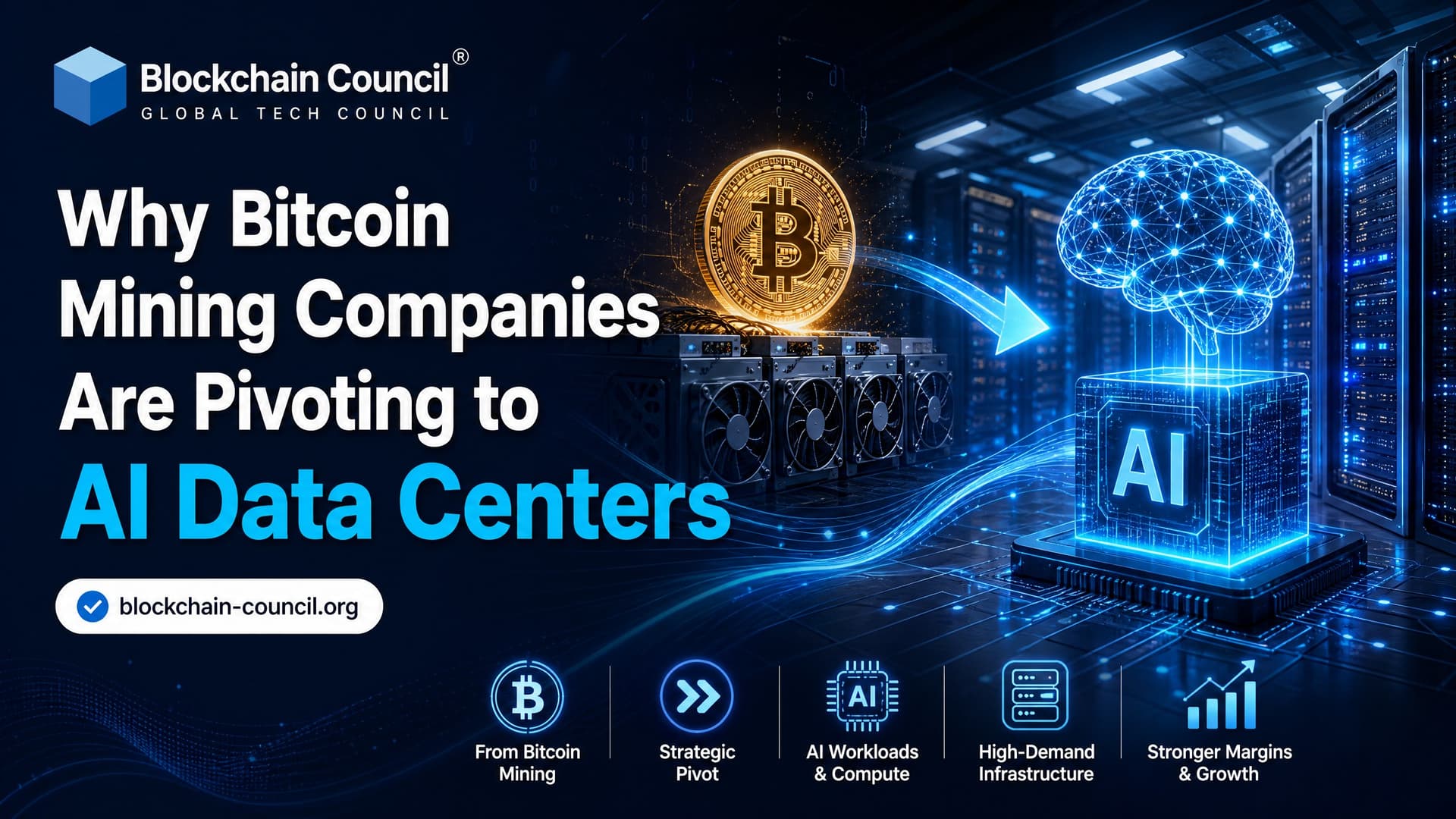
Bitcoin mining companies are pivoting to AI data centers because the math has changed. After the April 2024 Bitcoin halving cut block rewards from 6.25 BTC to 3.125 BTC, many industrial miners were left with thinner margins, aging ASIC fleets, and rising network difficulty. Investors started asking a blunt question: why chase volatile block rewards when the same power sites can earn steadier revenue from AI and high-performance computing?
This is not a side experiment anymore. Analysts at Bernstein have reported that every major US-listed Bitcoin miner has moved toward AI data centers in some form. Other industry estimates suggest roughly 70% of mining companies now include AI infrastructure in their plans. Core Scientific, IREN, Riot Platforms, TeraWulf, CleanSpark, HIVE Digital Technologies, Bitdeer, and Marathon Digital have all announced AI or HPC initiatives.

As Bitcoin mining companies diversify into AI infrastructure, professionals need a solid understanding of mining economics, energy markets, hash rate dynamics, ASIC hardware, and data center operations. A Certified Bitcoin Mining Expert credential helps build practical expertise in these areas, making it easier to evaluate how mining businesses are adapting to changing market conditions.
The mining business hit a margin wall
Bitcoin mining has always been a power, hardware, and timing business. You win when your electricity is cheap, your ASICs are efficient, and Bitcoin prices outrun difficulty growth. That balance got harder after the 2024 halving.
The halving reduced new Bitcoin issuance per block by 50%. Network competition stayed intense at the same time, which pressured hashprice, the revenue miners earn per unit of computing power. CoinShares has described hashprice as sitting near cyclical lows, and Propeller Industries has noted that equipment depreciation can now outpace revenue generation for some operators.
That hurts public miners more than hobby miners. Listed companies need to service debt, report quarterly results, keep access to capital, and explain why they are buying new machines that may become uneconomic within a few years. A mining site that worked in 2021 can look weak in 2025 if power costs rise or the ASIC fleet falls behind.
One advisor quoted in industry coverage described the shift as moving from commodity production to industrial real estate. That phrase is useful. Bitcoin mining produces a commodity-like output whose dollar value changes by the minute. AI hosting can look more like contracted rent on scarce digital infrastructure.
AI data centers offer better revenue per megawatt
The strongest reason for the pivot is simple. AI workloads can pay more for the same electricity footprint.
HIVE has estimated that 10 MW of Nvidia H100 GPU infrastructure can produce revenue comparable to 100 MW of Bitcoin mining capacity. Exact returns vary by contract, utilization, cooling design, and financing cost, but the direction is clear. A megawatt used for GPUs can be worth far more than a megawatt used for SHA-256 hashing when Bitcoin mining margins are compressed.
Analysts at CoinShares and Intellectia.ai have estimated that AI and HPC services could become a 40 billion dollar revenue opportunity for miners by 2026. Some forecasts suggest AI and HPC could grow from about 30% of listed miner revenue in late 2025 to as much as 70% by the end of 2026 for companies that execute signed contracts.
That does not mean every miner should rip out every ASIC. It does mean that miners with large power positions are now running a portfolio decision. If AI hosting contracts pay predictable dollar-denominated fees, while Bitcoin mining depends on BTC price, fees, and difficulty, boards will favor the workload with better risk-adjusted returns.
As AI becomes a core revenue driver for mining companies, understanding machine learning infrastructure and enterprise AI deployment is increasingly valuable. A Certified Artificial Intelligence (AI) Expert credential helps professionals develop knowledge of AI technologies, intelligent automation, model deployment, and real-world business applications that are reshaping modern data center strategies.
Miners already own the scarce parts of AI infrastructure
Building a new data center is slow. Securing land, grid interconnection, permits, transformers, fiber, cooling equipment, and power contracts can take years. Bitcoin miners already control much of that stack.
Galaxy Digital has pointed to several assets that make miners attractive AI infrastructure operators:
Large industrial sites with expansion room
High-capacity power access
Long-term power purchase agreements
Cooling systems and operations teams
Dark fiber or other network connectivity
Permits and grid relationships that are hard to replace
That head start matters. Bernstein analyst Gautam Chhugani has estimated that using existing mining sites can cut AI data center deployment timelines by up to 75% compared with traditional builds. In a market where hyperscalers and AI labs are fighting for power, speed has a real price.
Conversion is not just swapping ASICs for GPUs, though. To be blunt, many mining halls are too crude for serious AI training as-is. ASIC miners tolerate hot, loud, dusty environments far better than GPU clusters do. AI workloads need tighter environmental controls, higher uptime, and much better networking. If an InfiniBand or RoCE fabric is misconfigured, engineers may see errors such as NCCL WARN NET/Socket : Connection closed by remote peer during distributed training. That is not a Bitcoin mining problem. It is a data center engineering problem.
AI workloads change the technical requirements
Bitcoin mining is embarrassingly parallel. Each ASIC hashes independently. Network latency is not usually the bottleneck. AI training is different. Thousands of GPUs may need to exchange gradients constantly, which makes network design critical.
That changes the site checklist. A miner converting a facility for AI has to plan for:
High-density racks: Nvidia H100 and H200 GPU servers draw far more power per rack than typical mining layouts.
Advanced cooling: air cooling may work for some deployments, but liquid cooling and rear-door heat exchangers are becoming common for dense AI clusters.
Low-latency networking: training clusters often require InfiniBand or carefully tuned Ethernet with RoCE.
Redundancy: AI tenants expect stronger service-level commitments than miners historically needed for ASIC fleets.
Security and compliance: enterprise AI customers care about physical security, access controls, logging, and data handling.
This is why the most successful pivots are not just financial rebrands. They are operational rebuilds. Companies that treat AI hosting like mining with expensive GPUs will disappoint customers quickly.
Investors prefer contract revenue to Bitcoin cycles
Capital markets have encouraged the pivot. Yahoo Finance has reported that miners announcing AI strategies have seen strong investor interest. Industry analysts citing CoinDesk coverage have also noted that diversified miners can earn valuation premiums over pure Bitcoin mining firms.
The reason is not mysterious. Institutional investors tend to prefer long-term contracts, visible cash flow, and assets with financing markets behind them. AI data center projects can be financed against hosting agreements and power assets. Bitcoin mining revenue is harder to underwrite because it depends on BTC price, transaction fees, network difficulty, uptime, and hardware efficiency.
None of this makes AI risk-free. GPU prices can fall. Tenants can fail. Power prices can move. New model architectures may change compute demand. But for many miners, the AI contract model is easier to explain to lenders than a plan built only on block rewards.
Regulation is pushing miners toward a new identity
Public policy is another factor. Bitcoin mining has faced restrictions in places such as New York State and British Columbia over grid and environmental concerns. Local communities often see crypto mining as a heavy power user with unclear public benefit.
AI data centers face their own scrutiny, especially around power and water use, but the political narrative is different. AI infrastructure can be tied to healthcare research, scientific modeling, enterprise productivity, national competitiveness, and education. That framing can help operators seeking permits or grid approvals.
This is why miners increasingly describe themselves as energy and data center companies rather than pure crypto miners. The language matters because the business is changing. Revenue can now come from hosting fees, colocation rent, bare-metal GPU access, managed HPC services, and Bitcoin block rewards.
Real examples: Core Scientific, Galaxy, CleanSpark, and others
Core Scientific is one of the clearest examples of the transition. The company has moved from a Bitcoin-only identity toward hosting compute for generative AI and HPC customers. Wall Street Journal reporting has described miners retooling facilities to serve large technology companies and hyperscalers that need energy-intensive compute capacity.
Galaxy Digital is also moving deeper into data centers through its Helios initiative, a 1.7 billion dollar program aimed at AI and HPC workloads. Bitfarms has been converting a Washington mining location into an AI-focused GPU-as-a-service site. CleanSpark has pointed to more than 1 GW of power capacity that can support both AI and crypto opportunities.
Riot Platforms, IREN, TeraWulf, HIVE Digital Technologies, and Bitdeer follow the same pattern. The common thread is power. Whoever controls low-cost, scalable, permitted power holds a strategic asset in both Bitcoin and AI.
What this means for Bitcoin
The pivot could slow Bitcoin hash rate growth if more power capacity moves to AI. Reuters reporting cited by TheStreet suggests that around 20% of Bitcoin miners' power capacity could shift toward AI by the end of 2027.
That does not mean Bitcoin mining disappears. The likely outcome is a more selective market. Mining may concentrate among operators with ultra-low-cost energy, modern ASIC fleets, and flexible sites. Hybrid operators may switch marginal power between ASICs and GPUs depending on Bitcoin prices, AI contract rates, curtailment rules, and grid demand.
There is a catch. AI and Bitcoin workloads are not perfectly interchangeable. Once a site is rebuilt for enterprise GPU hosting, it may be locked into multi-year contracts. You cannot always flip a switch back to mining just because BTC rallies. Contract design will matter.
Successfully operating hybrid AI and blockchain infrastructure also requires expertise in cloud computing, networking, cybersecurity, enterprise architecture, and systems engineering. A Tech Certification helps professionals strengthen these complementary technical capabilities, supporting the deployment and management of large-scale digital infrastructure.
Skills professionals should build now
If you work in blockchain, infrastructure, or AI, this pivot is worth studying because it joins three skill sets that used to sit apart: power markets, crypto economics, and AI compute operations.
For structured learning, Blockchain Council readers can map this shift to several learning paths:
Certified Bitcoin Expert: useful if you need to understand mining economics, halvings, hash rate, difficulty, and Bitcoin's monetary design.
Certified Blockchain Expert: a broader path for professionals comparing blockchain infrastructure with enterprise compute models.
Certified Artificial Intelligence (AI) Expert: relevant for understanding why AI training and inference demand is reshaping data center markets.
Certified Blockchain Developer: helpful if you want a technical base in decentralized systems while tracking how compute infrastructure is changing.
The next practical step is simple. Pull one public miner's latest investor presentation and compare it with its older Bitcoin-only strategy. Look for power capacity, contracted AI revenue, GPU deployment plans, and hosting terms. That exercise will show you why AI data centers are no longer a side bet for miners. For many of them, they are becoming the core business.
As AI-powered infrastructure services and blockchain technologies continue to converge, organizations also need professionals who can clearly communicate these innovations to enterprise customers, investors, and stakeholders. A Marketing Certification helps develop expertise in strategic communication, product positioning, customer engagement, and go-to-market planning, complementing technical knowledge of AI, blockchain, and digital infrastructure.
FAQs
1. Why are Bitcoin mining companies expanding into AI data centers?
Some Bitcoin mining companies are exploring AI data center operations to diversify revenue sources and make greater use of their existing infrastructure. High-performance computing (HPC) for artificial intelligence often requires substantial power capacity, cooling systems, networking, and facilities that can overlap with mining operations.
2. What is an AI data center?
An AI data center is a computing facility designed to support artificial intelligence workloads such as machine learning, model training, inference, and large-scale data processing. These facilities typically use high-performance GPUs, advanced networking, specialized storage, and robust cooling systems.
3. Why are mining companies well positioned for AI infrastructure?
Many mining companies already operate large-scale facilities with access to significant electrical capacity, cooling infrastructure, technical expertise, and data center operations. These assets may provide a foundation for supporting AI and high-performance computing workloads, although additional investment is often required.
4. How are Bitcoin mining and AI data centers different?
Bitcoin mining primarily uses specialized ASIC hardware to validate blockchain transactions and secure the Bitcoin network. AI data centers generally rely on GPUs and other high-performance processors designed for training and running artificial intelligence models across a wide range of applications.
5. Why is demand for AI data centers increasing?
Growing adoption of generative AI, enterprise automation, scientific computing, cloud AI services, and large language models has significantly increased demand for computing capacity. Organizations across multiple industries require scalable infrastructure to support increasingly complex AI workloads.
6. Can mining facilities be converted into AI data centers?
Some facilities can be adapted for AI computing, but conversion often requires major upgrades. High-speed networking, GPU clusters, storage architecture, cooling technologies, software platforms, and security controls may need significant modification beyond what is required for cryptocurrency mining.
7. How could AI diversification affect mining companies?
Diversification may reduce dependence on Bitcoin mining revenue by creating additional business opportunities in cloud computing, AI infrastructure services, and high-performance computing. Financial outcomes depend on market demand, execution, capital investment, and operational efficiency.
8. What role does energy infrastructure play?
Reliable electricity is one of the most valuable assets for both Bitcoin mining and AI computing. Companies with long-term power agreements, access to renewable energy, or scalable electrical infrastructure may have competitive advantages when expanding into AI data center operations.
9. Are AI data centers more profitable than Bitcoin mining?
Profitability varies based on hardware costs, electricity prices, customer demand, utilization rates, financing, and broader market conditions. There is no guarantee that AI infrastructure will consistently outperform cryptocurrency mining as business models differ significantly.
10. What industries use AI data centers?
AI data centers support industries including healthcare, financial services, manufacturing, automotive, biotechnology, education, cybersecurity, media, scientific research, government, and enterprise software development.
11. How does AI benefit blockchain companies?
AI can improve cybersecurity, predictive maintenance, operational efficiency, fraud detection, infrastructure monitoring, energy optimization, customer support, and software development. These capabilities may help blockchain companies improve both mining and enterprise operations.
12. What challenges do mining companies face during the transition?
Common challenges include securing GPU hardware, financing infrastructure upgrades, hiring AI specialists, competing with established cloud providers, managing operational complexity, ensuring reliable networking, and meeting enterprise customer expectations.
13. What role does sustainability play in AI data centers?
Energy efficiency, renewable power sources, advanced cooling technologies, heat reuse, and carbon management are becoming increasingly important considerations for both AI infrastructure providers and cryptocurrency mining companies seeking long-term operational sustainability.
14. How does this trend affect the cryptocurrency industry?
Greater diversification could make some mining companies less dependent on Bitcoin price cycles while encouraging broader participation in digital infrastructure markets. However, the long-term impact on mining capacity and the wider cryptocurrency ecosystem remains uncertain.
15. Which skills are valuable for professionals working in AI data centers?
Important skills include cloud computing, GPU infrastructure management, AI and machine learning, networking, cybersecurity, data center operations, electrical engineering, cooling system design, DevOps, and infrastructure automation.
16. How are regulators influencing AI infrastructure growth?
Governments are increasingly evaluating issues related to energy usage, data privacy, cybersecurity, AI governance, environmental sustainability, and critical infrastructure. Regulatory developments may influence where and how AI data centers are developed.
17. What trends are driving convergence between AI and blockchain?
Key trends include enterprise AI adoption, decentralized AI infrastructure, energy optimization, tokenized computing resources, AI-assisted cybersecurity, cloud expansion, and greater investment in high-performance computing capacity.
18. How should investors interpret mining companies' AI expansion?
Expansion into AI infrastructure represents a strategic business decision that may diversify operations, but outcomes depend on execution, capital requirements, competitive conditions, customer demand, and evolving technology markets. It should not be viewed as a guarantee of improved financial performance.
19. What developments could shape this industry in 2026?
Important developments include advances in AI chips, expanding enterprise AI demand, improved energy efficiency, stronger GPU supply chains, growth in cloud AI services, regulatory changes, and increasing collaboration between technology companies and infrastructure providers.
20. What is the long-term outlook for Bitcoin mining companies entering AI data centers?
The convergence of cryptocurrency infrastructure and AI computing reflects a broader trend toward maximizing the value of large-scale digital infrastructure. Companies that successfully adapt their facilities, attract enterprise customers, manage energy efficiently, and invest in modern computing technologies may be better positioned to compete in both blockchain and AI markets. Owning a warehouse full of electricity used to make you a Bitcoin miner. Now it might also make you an AI infrastructure provider. Technology has an impressive talent for changing the job description without changing the building.
Related Articles
View All
News
From Bitcoin Mining to AI Data Centers: A New Model for Crypto Miners
Crypto miners are turning power-rich mining campuses into AI and HPC data centers as halvings, difficulty, and energy costs pressure margins.

News
Bitcoin Mining Companies Expand AI Infrastructure Investments
Bitcoin miners are shifting billions into AI and HPC data centers as hash-rate economics weaken, creating new revenue models and major execution risks.

News
CleanSpark AI Data Center Deal: What $6.6 Billion Means for Bitcoin Mining and AI Infrastructure
CleanSpark's $6.6 billion AI data center lease signals a major shift in bitcoin mining economics and AI infrastructure supply.
Trending Articles

Can DeFi 2.0 Bridge the Gap Between Traditional and Decentralized Finance?
The next generation of DeFi protocols aims to connect traditional banking with decentralized finance ecosystems.
Claude AI Tools for Productivity
Discover Claude AI tools for productivity to streamline tasks, manage workflows, and improve efficiency.
How to Install Claude Code
Learn how to install Claude Code on macOS, Linux, and Windows using the native installer, plus verification, authentication, and troubleshooting tips.