

From Bitcoin Mining to AI Data Centers: A New Model for Crypto Miners

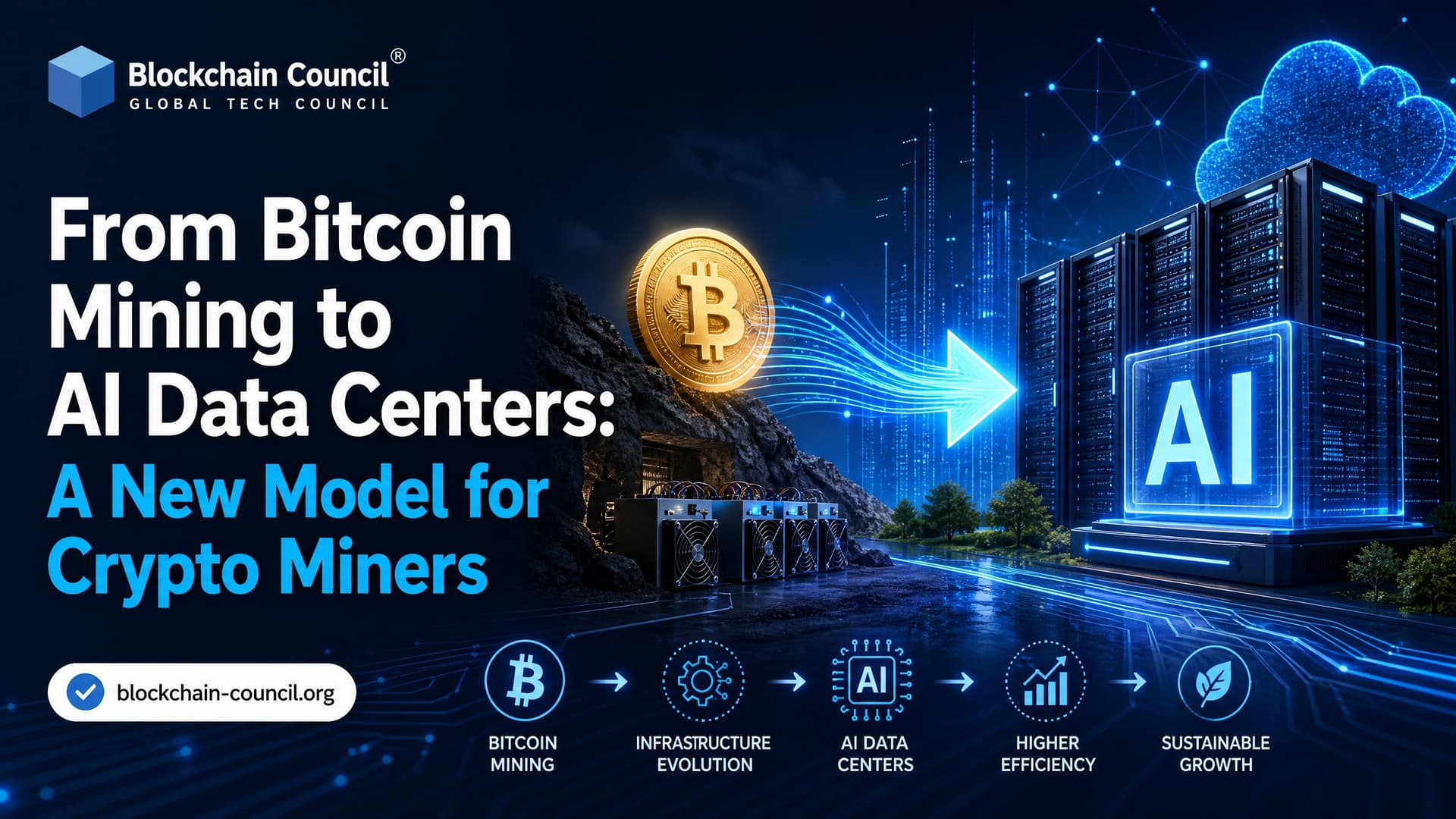
From Bitcoin mining to AI data centers is becoming one of the more practical business shifts in digital infrastructure. Crypto miners already own the assets AI operators are fighting to secure: power contracts, land, cooling, substations, and teams that know how to keep thousands of machines alive under heat, dust, and tight margins.
The timing is not accidental. Bitcoin's April 2024 halving cut the block subsidy from 6.25 BTC to 3.125 BTC at block 840,000. Difficulty still adjusts every 2,016 blocks to keep block times close to 10 minutes. If your electricity price is too high, the protocol does not care. Your revenue per unit of hash rate falls, your power bill stays real, and your ASIC fleet ages every day.

That pressure explains why miners are looking at AI and high performance computing, or HPC, as a second revenue line. Not hype. Infrastructure math.
Why Bitcoin Miners Are Built Like Compute Operators
Large Bitcoin miners are not hobbyists with a few machines in a garage. Modern mining sites can run tens of thousands of ASICs across industrial campuses. Their core skills are brutally practical:
- Securing cheap electricity, often through long-term power agreements or direct relationships with energy producers.
- Managing heat from dense compute hardware, using air cooling, immersion systems, or custom airflow designs.
- Operating remote facilities where land is cheaper and power may be stranded or underused.
- Maintaining uptime across hardware that fails, overheats, throttles, or loses network connectivity.
Those same skills matter in GPU-based AI data centers. A rack of NVIDIA H100 GPUs is not the same as a row of Antminer S21 units, but both demand power discipline, thermal planning, networking, spare parts, and operators who can troubleshoot at 2 a.m.
One difference matters more than the rest. Bitcoin ASICs are single-purpose machines. They hash SHA-256 and little else. GPUs are different. They can train models, run inference, support rendering, process scientific workloads, and handle simulation jobs. That flexibility is why the move from Bitcoin mining to AI data centers usually means new GPU capital spending, not simply reusing Bitcoin ASICs.
The Halving Made Diversification Harder to Ignore
Bitcoin mining revenue depends on three moving parts: the BTC price, the block subsidy plus transaction fees, and the miner's share of global hash rate. Costs are less forgiving. Electricity is usually the largest line item, followed by hardware depreciation, facility costs, maintenance, and financing.
Halvings occur every 210,000 blocks, roughly every four years. They are known in advance, yet they still hurt operators with weak power economics. Rising network difficulty adds another squeeze. When more hash rate joins the network, each miner earns less BTC for the same machine output.
That makes fixed or contract-based AI revenue attractive. An AI customer may pay for reserved GPU capacity, inference throughput, managed infrastructure, or HPC time. It is not risk-free, but it is less directly tied to Bitcoin's next price move.
What Actually Changes When a Mine Becomes an AI Data Center?
Here is the part people gloss over: you do not just unplug ASIC miners and plug in GPUs. A mining shed built for high-volume airflow may not meet the needs of enterprise AI clients. The retrofit can be expensive.
Power and cooling need an upgrade
ASIC mining tolerates rougher environments than enterprise GPU compute. AI clusters often require tighter temperature control, cleaner power delivery, better fire suppression, and more formal redundancy. A mining site may have cheap megawatts, but GPU customers will ask about uptime commitments, service-level agreements, and maintenance windows.
In the field, small defaults cause real pain. A common mistake is deploying a GPU node with a newer CUDA runtime while the host driver is older. The job fails with: CUDA driver version is insufficient for CUDA runtime version. That is not a blockchain problem. It is basic AI infrastructure hygiene, and miners moving into HPC need that muscle.
Networking becomes a first-class issue
Bitcoin miners need internet connectivity, but they do not need low-latency GPU-to-GPU communication across large training clusters. AI training is different. If you are running distributed training across dozens or hundreds of GPUs, network design affects utilization. InfiniBand, high-speed Ethernet, RDMA, storage throughput, and cluster scheduling start to matter.
For smaller inference workloads, the bar is lower. For frontier model training, it is much higher. To be blunt, not every mining campus should chase large-scale AI training. Some are better suited for batch inference, rendering, or private HPC workloads.
Customers expect data center controls
Crypto mining revenue comes from the protocol. AI revenue comes from customers. That changes the operating model. Enterprises may ask for security controls, access policies, audit trails, data handling rules, and compliance evidence. A miner that has never hosted third-party workloads may need to build a real data center operations function.
Likely Business Models for Crypto Miners
The shift from Bitcoin mining to AI data centers will not look the same across the sector. Expect four common models.
- Hybrid mining and AI campuses: Operators keep ASIC mining online while allocating part of their power and facility footprint to GPU clusters. This works when the site has spare capacity and the team can manage two very different workloads.
- Full AI conversion: Higher-cost mining sites may retire ASICs and convert into AI or HPC facilities. The land, power interconnects, and cooling foundation remain valuable.
- Compute-as-a-service: Miners sell access to hosted GPUs through contracts, reserved capacity, or usage-based pricing. This is closer to cloud infrastructure than mining.
- Energy-backed compute utilities: Miners with direct access to power generation may sell compute as the higher-value product while using Bitcoin mining as a flexible load when AI demand dips.
The last model is the interesting one. When a miner controls its own electricity production, it captures more value and reduces exposure to volatile external markets. AI compute extends that logic. Instead of selling raw electricity or burning it only on hash rate, the operator sells useful computation.
Why AI Can Improve the Politics of Mining Sites
Bitcoin mining has faced criticism over energy use, fossil fuel reliance, and grid impact. AI data centers are energy-intensive too, so this is not a moral escape hatch. Still, the public narrative is different.
AI infrastructure can be tied to enterprise productivity, scientific research, national competitiveness, and local jobs. In rural regions where miners have already built power and fiber relationships, an AI facility may be easier to explain to policymakers than a pure Bitcoin mine.
That does not remove scrutiny. It shifts the questions. Regulators and communities will still ask:
- Where does the power come from?
- Does the facility raise local electricity prices?
- How much water is used for cooling?
- What jobs are created locally?
- Who is responsible for data security?
Miners that can answer those questions with measured data will have an advantage. Miners that simply rebrand themselves as AI companies will not.
Risks Investors and Operators Should Watch
This pivot is credible, but it is not automatic. Several risks can break the business case.
- GPU capex is heavy: High-end GPUs, networking, racks, storage, and power distribution upgrades can require significant capital before revenue starts.
- AI demand is uneven: Not every customer needs expensive training clusters. Some demand may move to lower-cost inference hardware over time.
- ASIC reuse is limited: Bitcoin mining hardware cannot be repurposed for AI workloads in any meaningful way.
- Operational expectations rise: Enterprise AI clients expect reliability, security, and support standards that many mining sites were not designed to provide.
- Regulation does not disappear: In the United States, mining rewards are taxable when received, based on fair market value under IRS guidance, while AI hosting introduces data privacy and cloud compliance issues.
The best operators will treat AI as a serious infrastructure business, not as a press release. That means hiring data center engineers, GPU cluster specialists, security leads, and people who understand customer contracts.
What This Means for Professionals
If you work in blockchain, cloud, AI, or infrastructure, this crossover creates a useful career opening. Mining companies need people who understand both decentralized networks and modern AI compute stacks.
You should build skills in:
- Bitcoin economics, including halving cycles, difficulty adjustment, and proof-of-work security.
- GPU infrastructure, including CUDA, Kubernetes, Slurm, storage, and high-speed networking.
- Data center design, especially power usage, cooling, monitoring, and incident response.
- AI workload patterns, from model training to inference serving.
- Compliance, tax treatment, data protection, and cybersecurity controls.
For structured learning, Blockchain Council's Certified Blockchain Expert covers the mining and blockchain foundation. Developers building on-chain or infrastructure products can look at Certified Blockchain Developer. If your goal is the AI side of the transition, Certified Artificial Intelligence (AI) Expert fits better.
The Strategic Takeaway
The move from Bitcoin mining to AI data centers is not a clean replacement of one industry by another. It is a diversification play by companies that already control scarce infrastructure. Cheap power, land, cooling, and operational know-how carry value in both markets.
But the winners will be selective. Use Bitcoin mining where flexible load makes sense. Use AI and HPC where the site can support stricter uptime, networking, and customer requirements. If you are building a career in this space, start with the fundamentals. Understand proof-of-work economics first, then learn how GPU clusters are actually deployed and operated. That combination is becoming rare, and rare skills get noticed.
Related Articles
View All
News
Bitcoin Miners Pivot to AI Data Centers: A New Revenue Model for Crypto Infrastructure
Bitcoin miners are converting power-rich mining sites into AI and HPC data centers, creating stable contracts and a new crypto infrastructure model.

News
Why Bitcoin Mining Companies Are Pivoting to AI Data Centers
Bitcoin miners are shifting to AI data centers as halving pressure, low hashprice, scarce power, and stronger AI hosting economics reshape the sector.

News
Bitcoin Miners Pivot to AI Infrastructure: Inside the Data Center Shift
Bitcoin miners are turning power-heavy mining sites into AI and HPC data centers as halving pressure and GPU compute demand reshape mining economics.
Trending Articles
The Role of Blockchain in Ethical AI Development
How blockchain technology is being used to promote transparency and accountability in artificial intelligence systems.
How Blockchain Secures AI Data
Understand how blockchain technology is being applied to protect the integrity and security of AI training data.
What is AWS? A Beginner's Guide to Cloud Computing
Everything you need to know about Amazon Web Services, cloud computing fundamentals, and career opportunities.